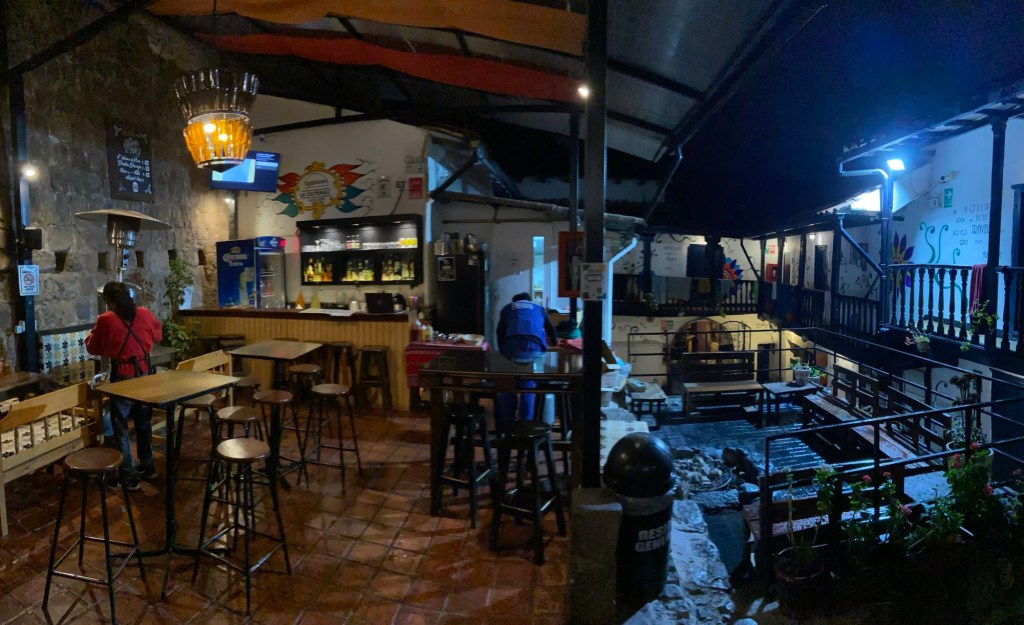
Author: Phil Matthews

  • Day 70

    I can confirm that the world is round! Having set off in a generally westerly direction and kept going (with a few detours on the way), I have now arrived back where I started.

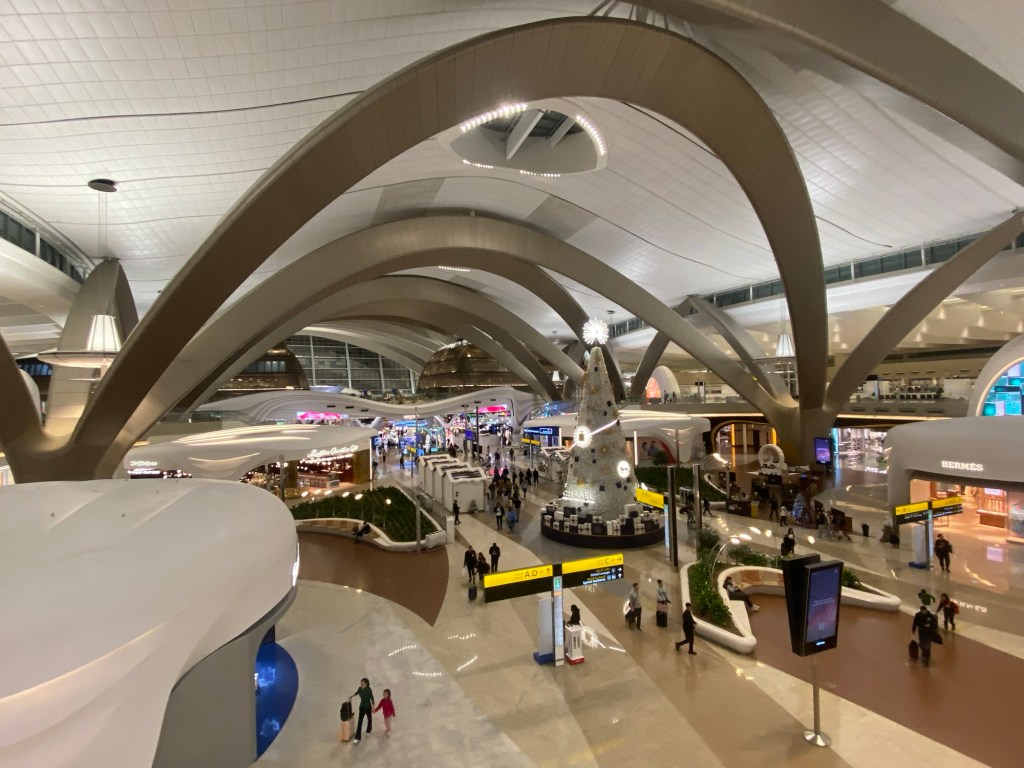
    Back to snow, and the last few days of Christmas festivities!
    Via Abu Dhabi airport, where I spent 3 hours between my 14 hour and 8 hour flights

    I can definitely recommend sticking to westward travel: the jet lag is much kinder when days and nights are lengthened rather than shortened.

    My route around the world!

    I took a bit of artistic license in naming this blog: I got actually got back home 68 days after leaving. It is now Day 70 though, and an opportunity to reflect on the whole experience. Or at least start reflecting: it has been such a whirlwind 10 weeks that I think it’s going to take rather longer than a day to process it all!

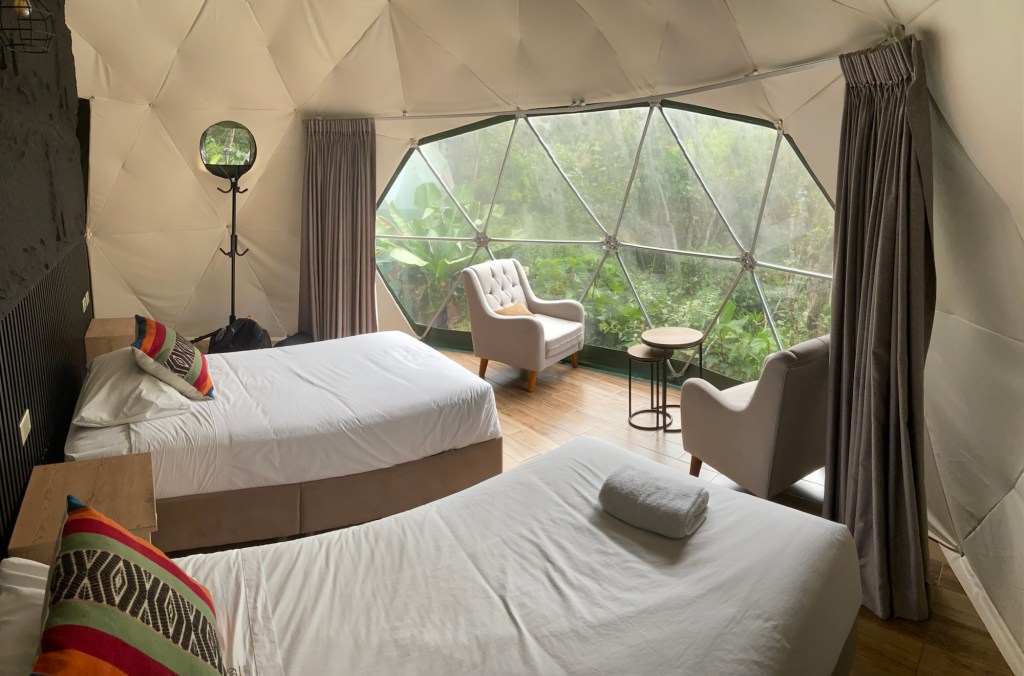
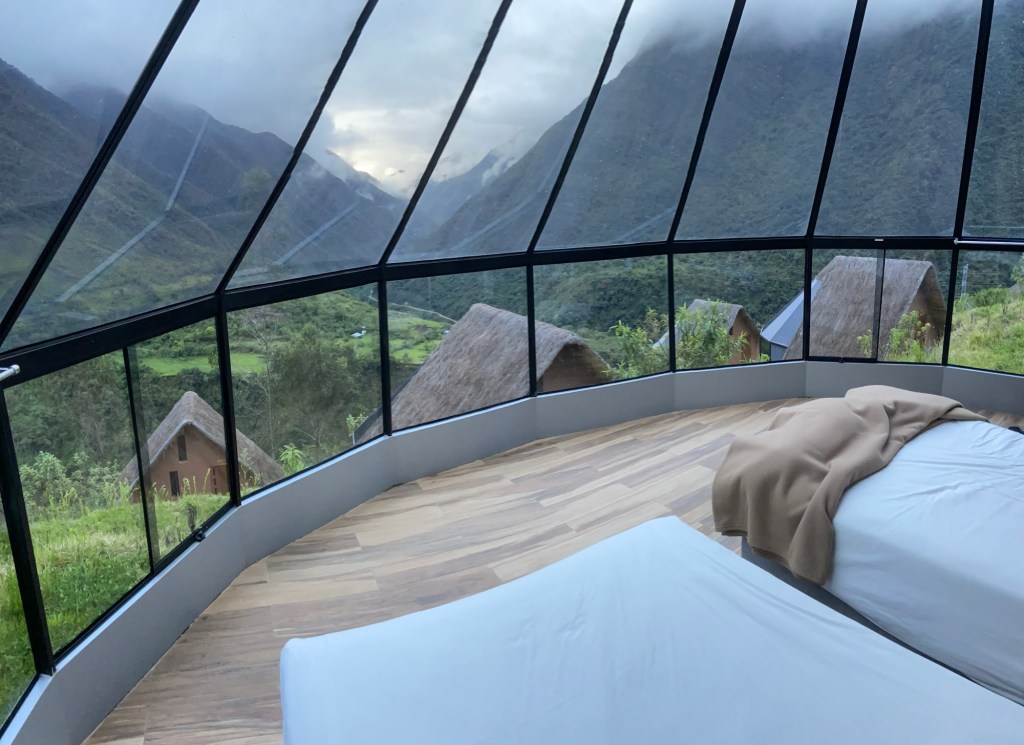
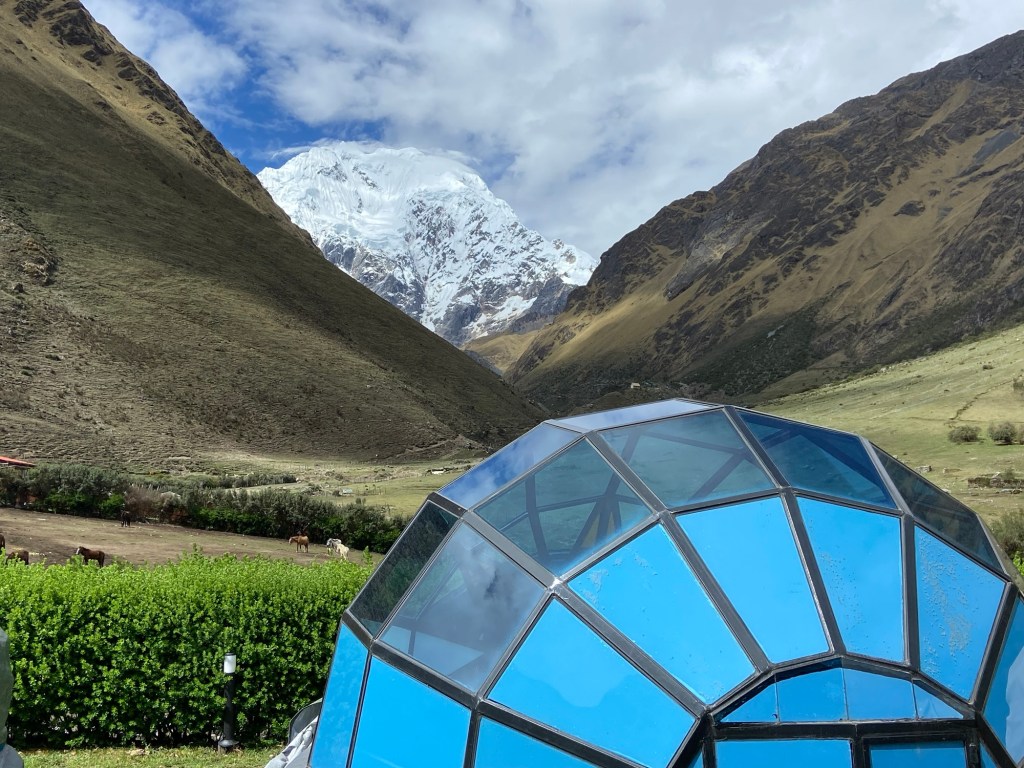
    A few numbers from the trip: I have set foot in 5 continents, 9 countries (officially entering 7), taken 20 flights, and slept in 23 different buildings (hotels, hostels, houses, apartments, mountain domes, jungle lodges and an island cabin) – and in 1 car!

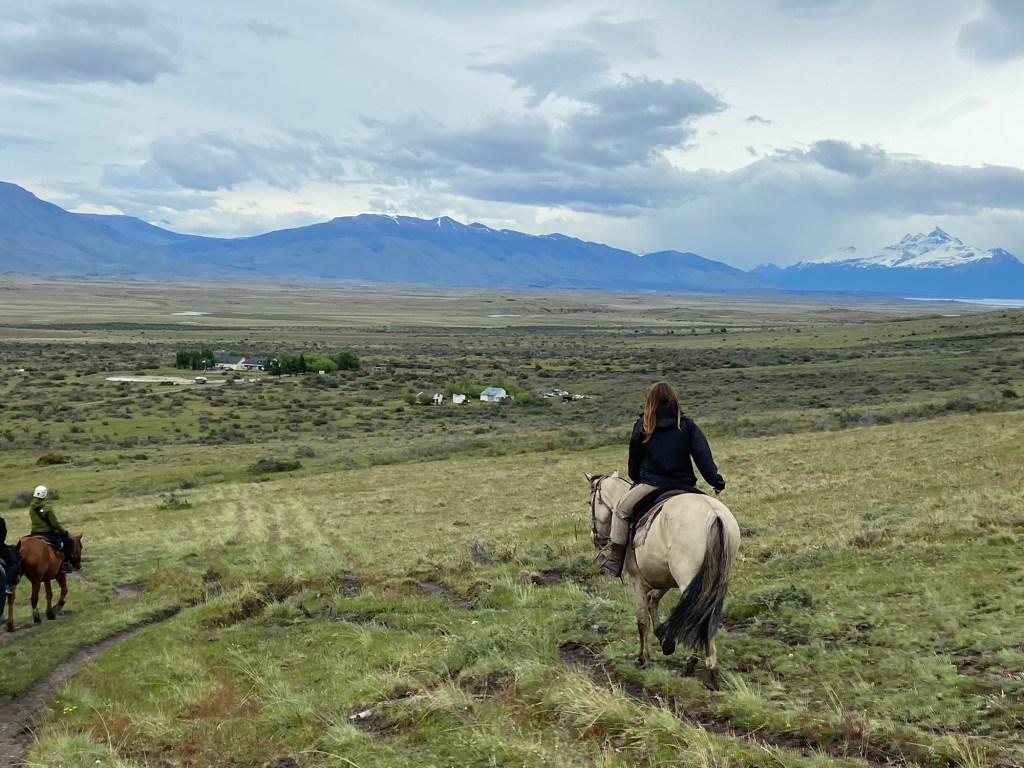
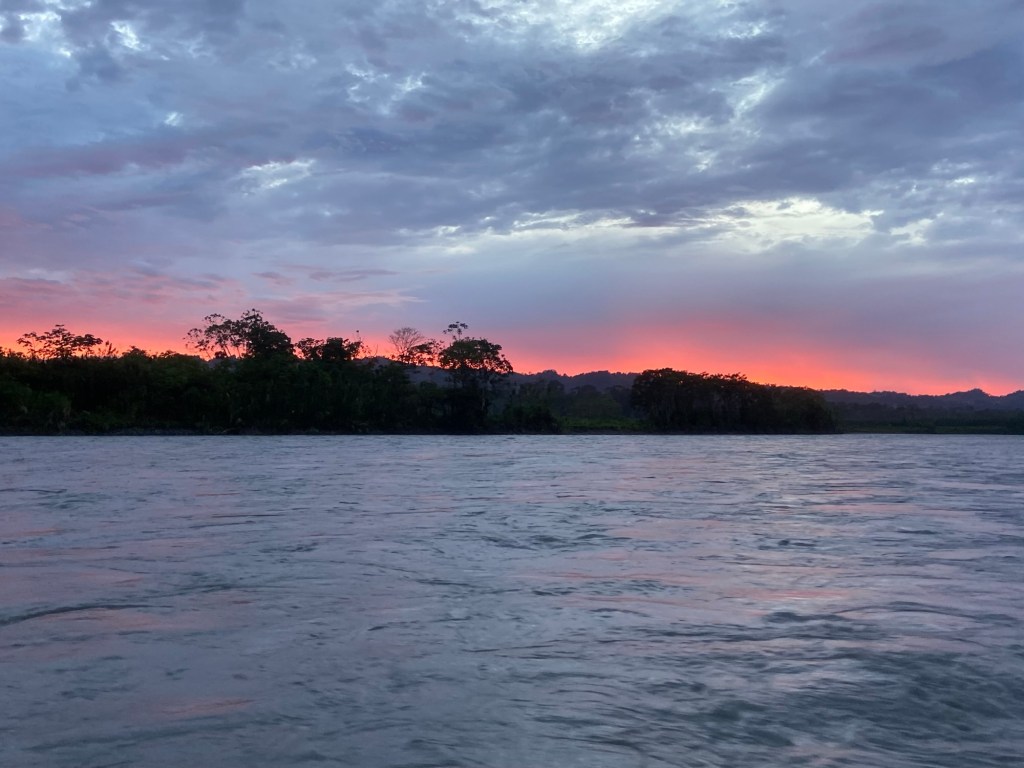
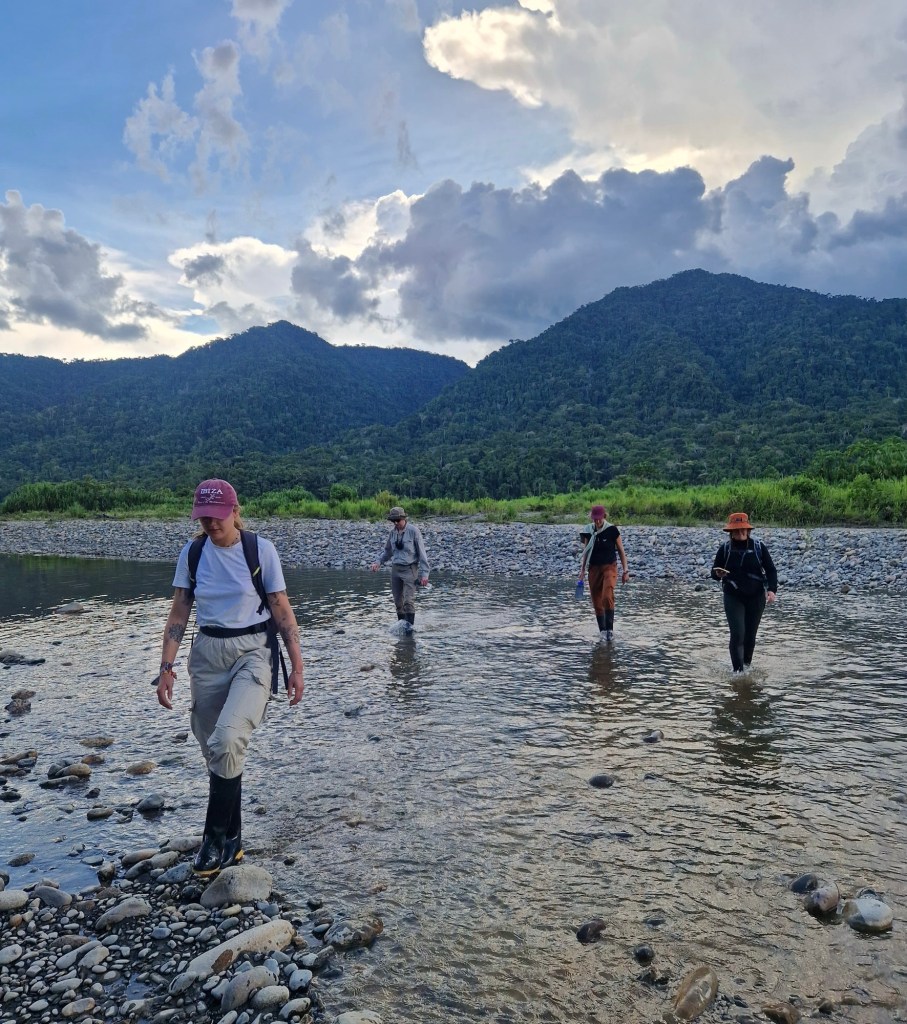
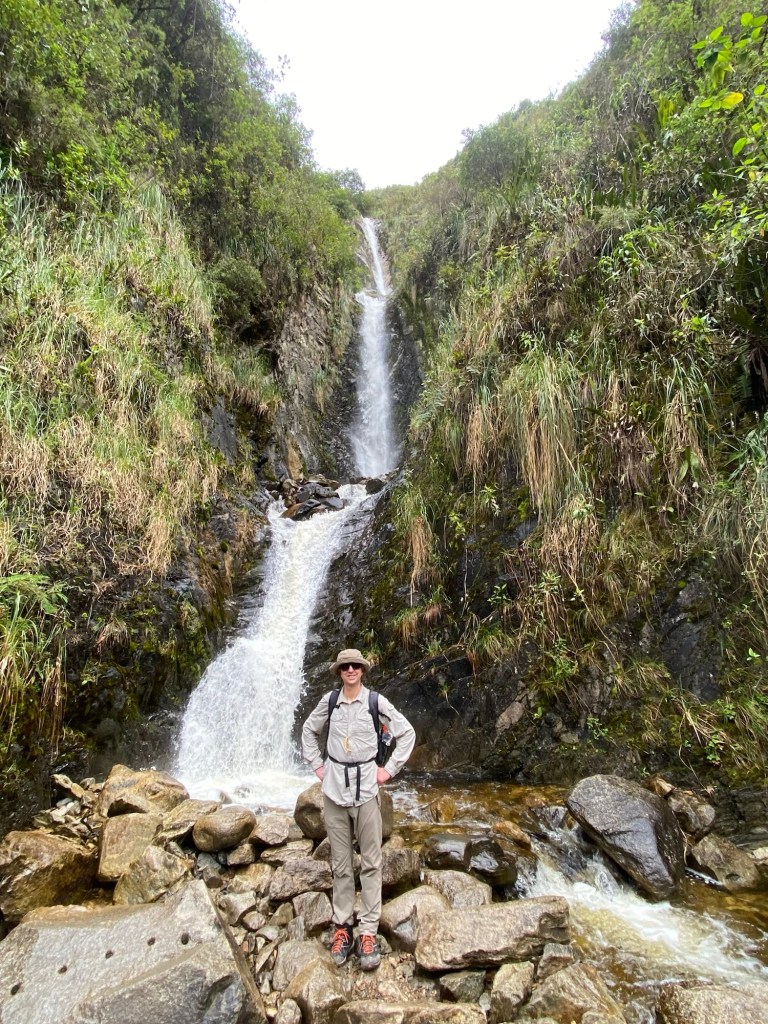
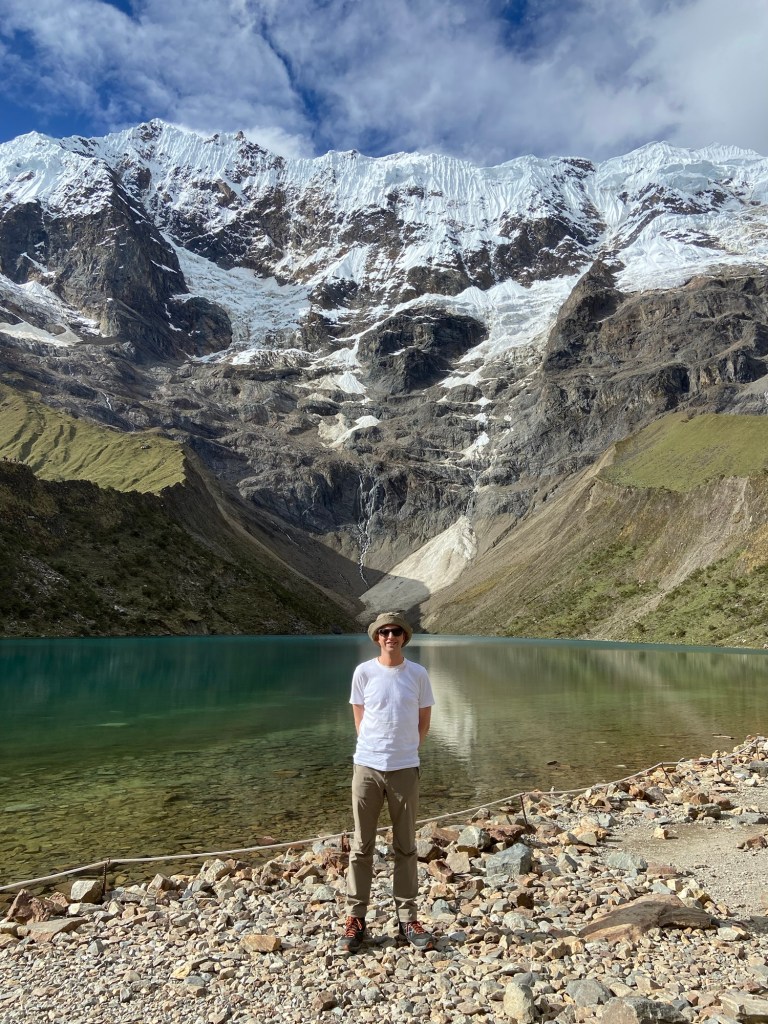
    I have seen a huge variety of landscapes: mountains in the Andes, cloud forest at Machu Picchu, tropical rainforest in the Manu National Park, the semi-arid steppe of Patagonia, a geo-thermal park in New Zealand, a coral island in the Great Barrier Reef, the sand island of K’gari, the basalt and limestone coastline of Victoria, a mangrove forest near Adelaide, the wine country of South Australia and even some scenery in the same state with a hint of the Outback!

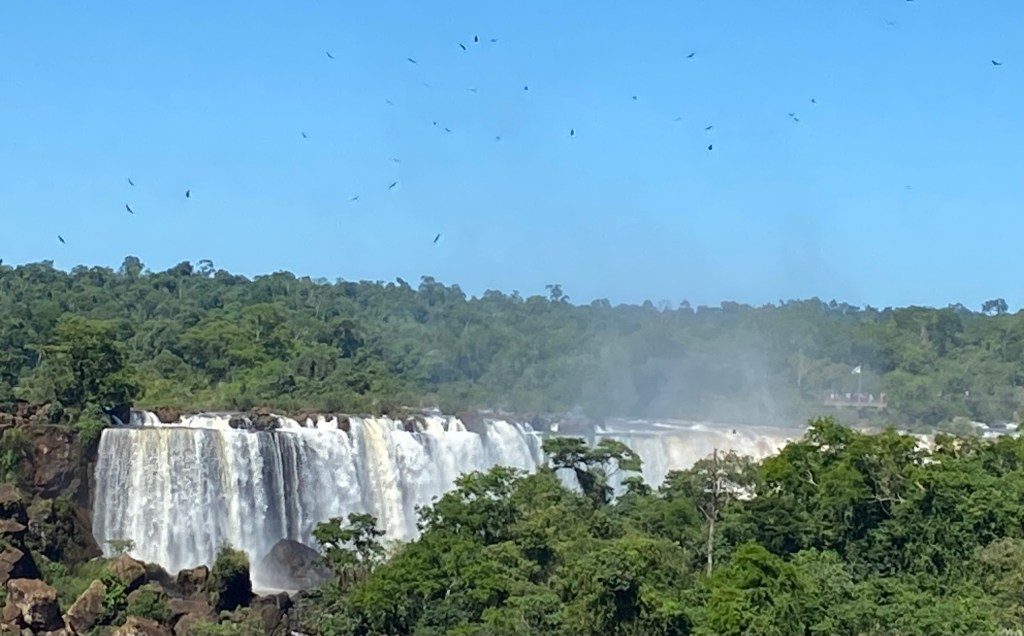
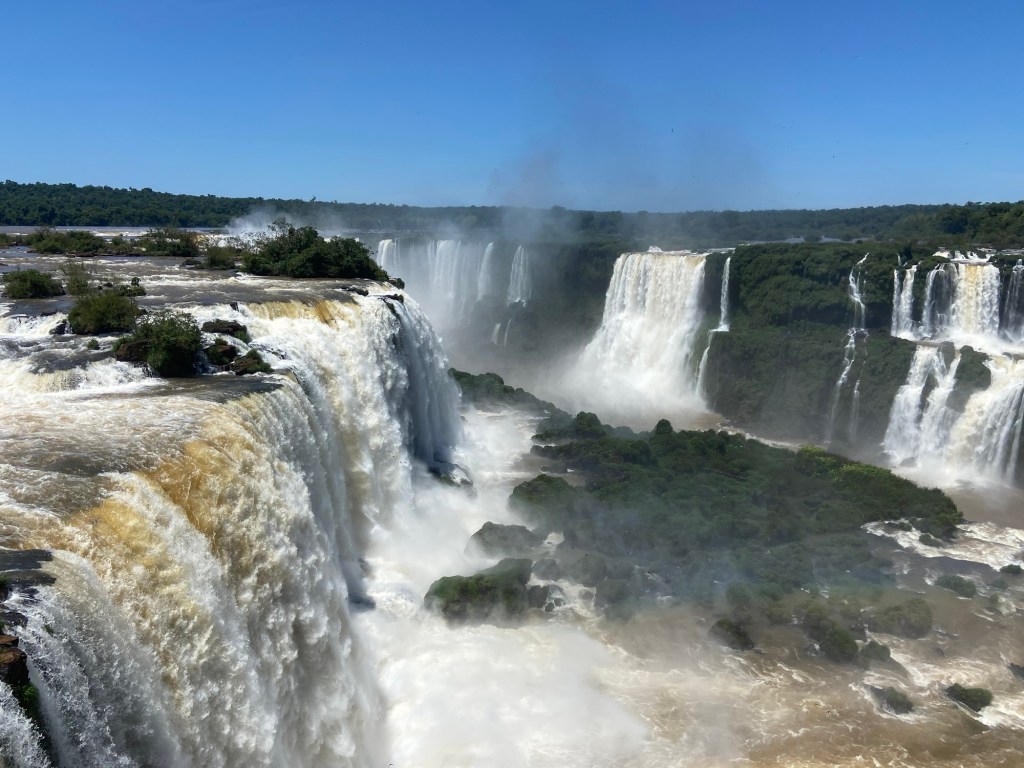
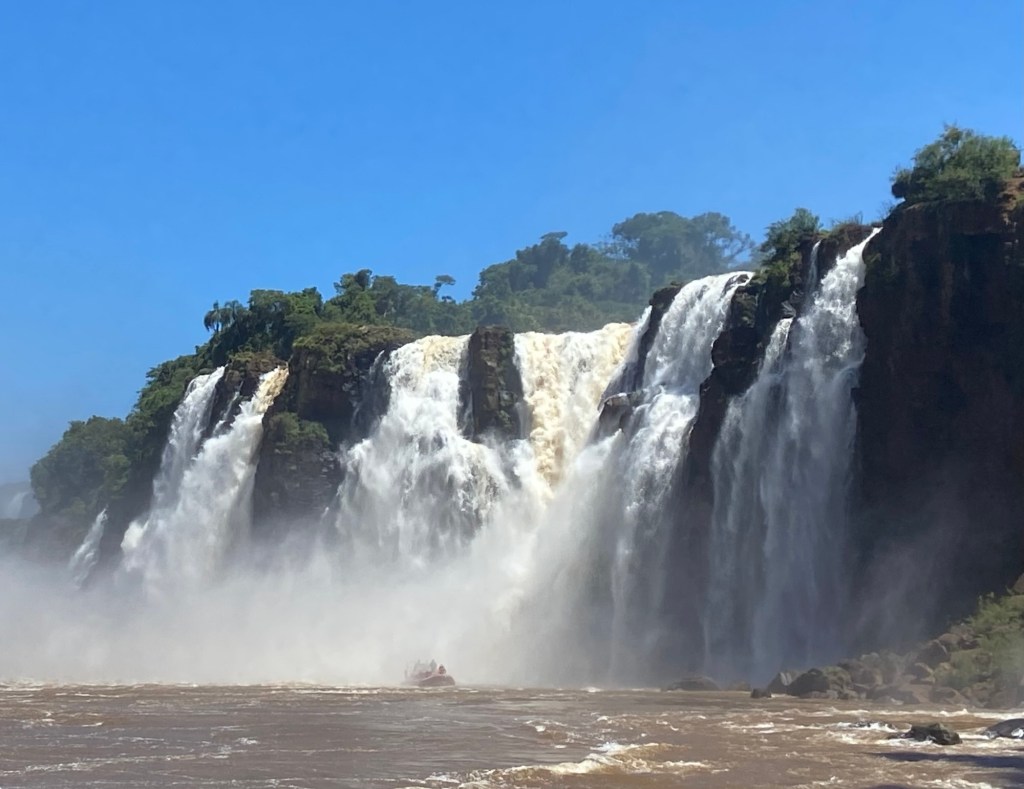
    There have been the phenomenal natural wonders of the Amazon, the Patagonian glaciers, Iguazu Falls and the Reef, and the human wonders of the Incan, Māori and Aboriginal civilisations.

    I have explored the great cities of Cusco, Buenos Aires, Auckland, Brisbane, Sydney, Canberra, Adelaide and Melbourne.

    I have shivered in near-freezing temperatures on an Andean pass and sweltered in 40 degree heat at the Adelaide Oval.

    I have travelled by plane, car, taxi, bus, colectivo, train, metro, tram, boat, raft, kayak, horse, mule and inflatable ring! And completed a 75km trek on foot.

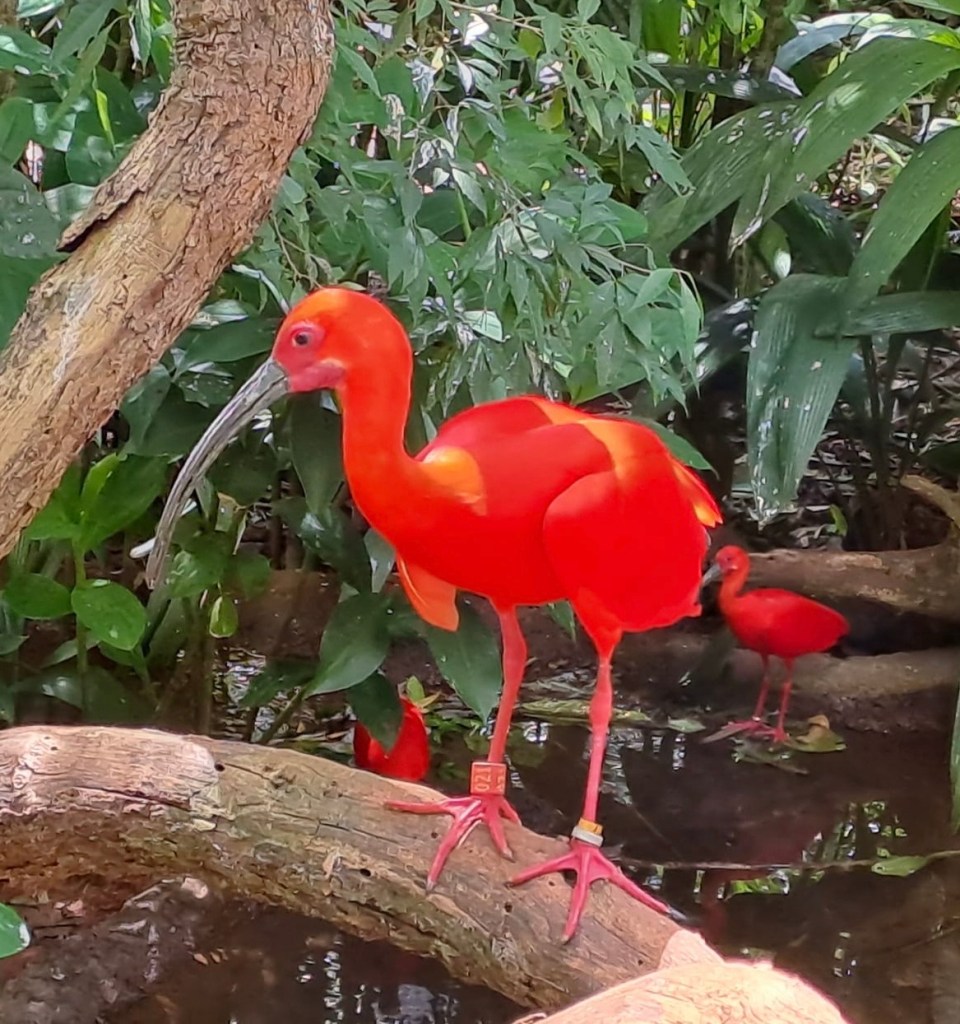
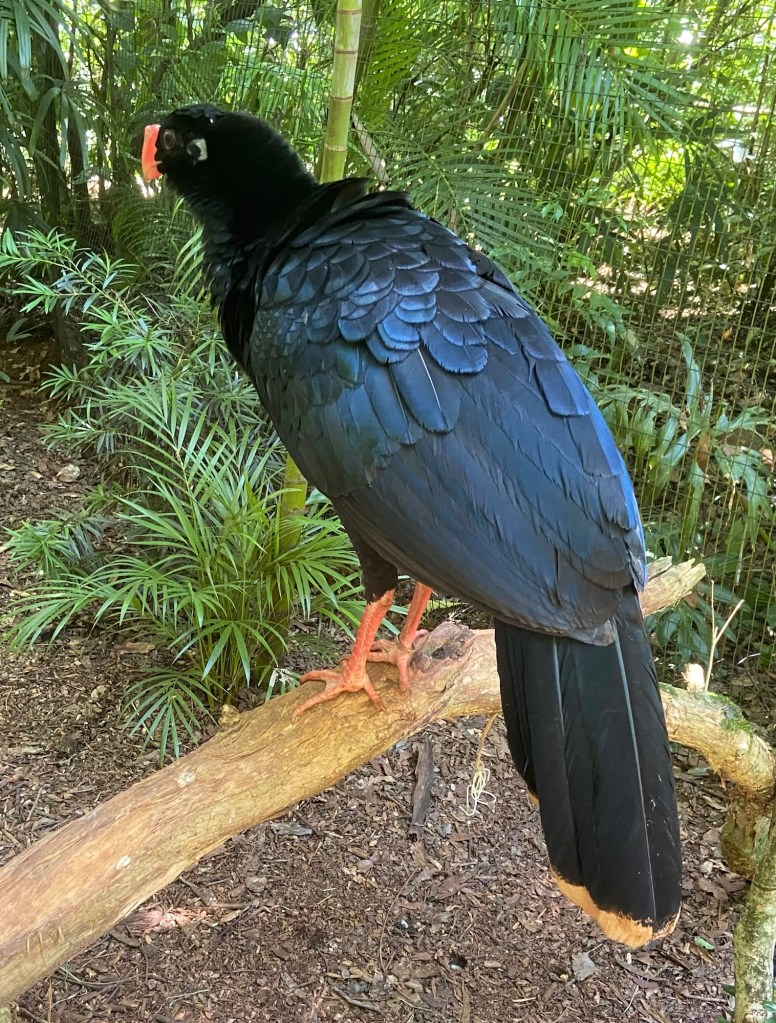
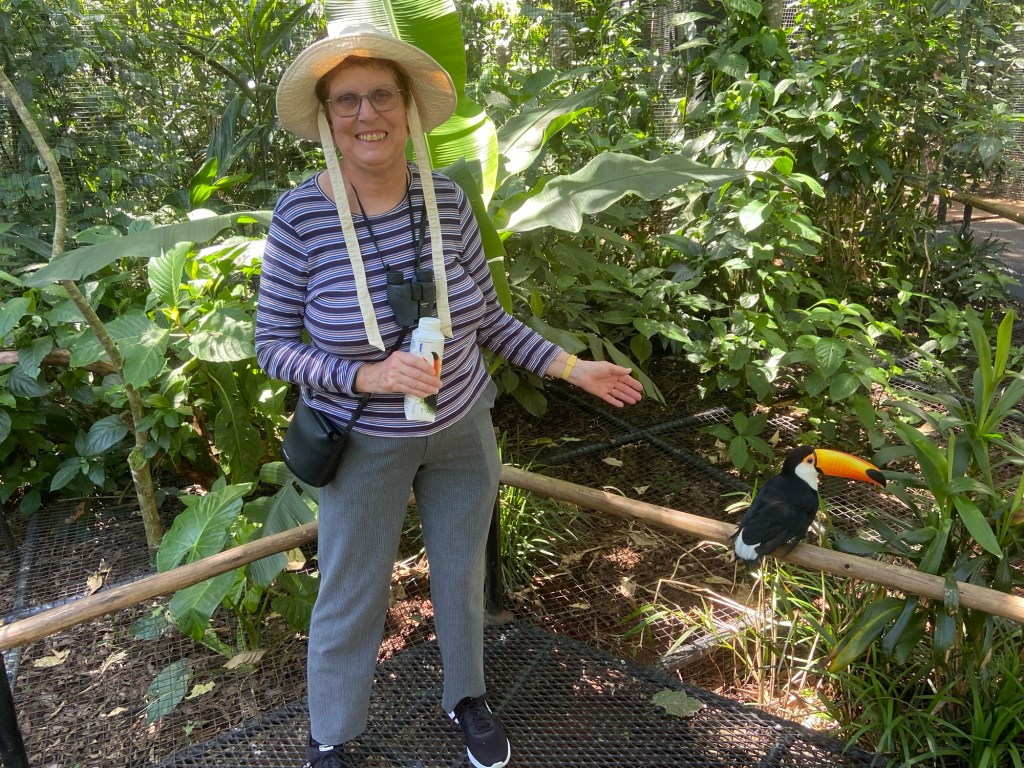
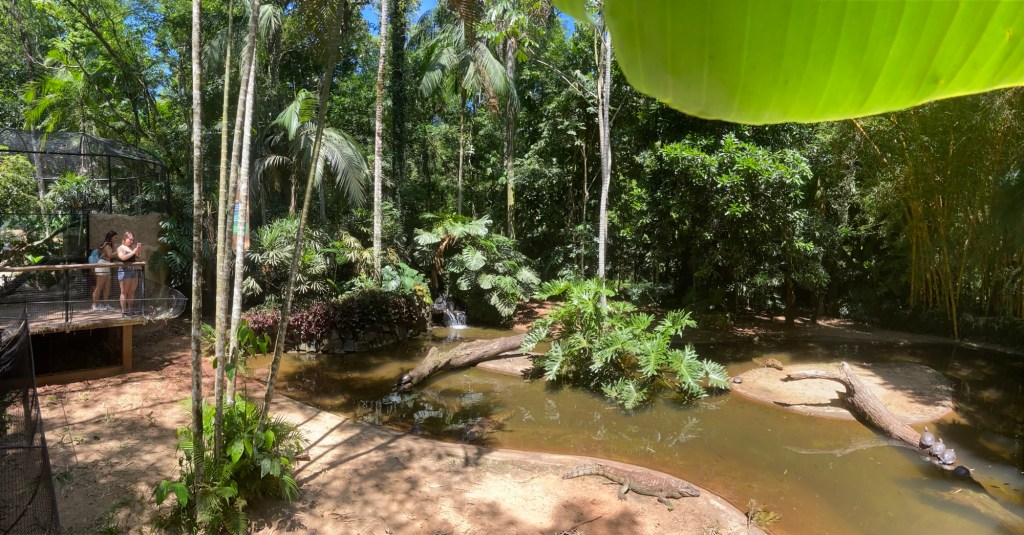
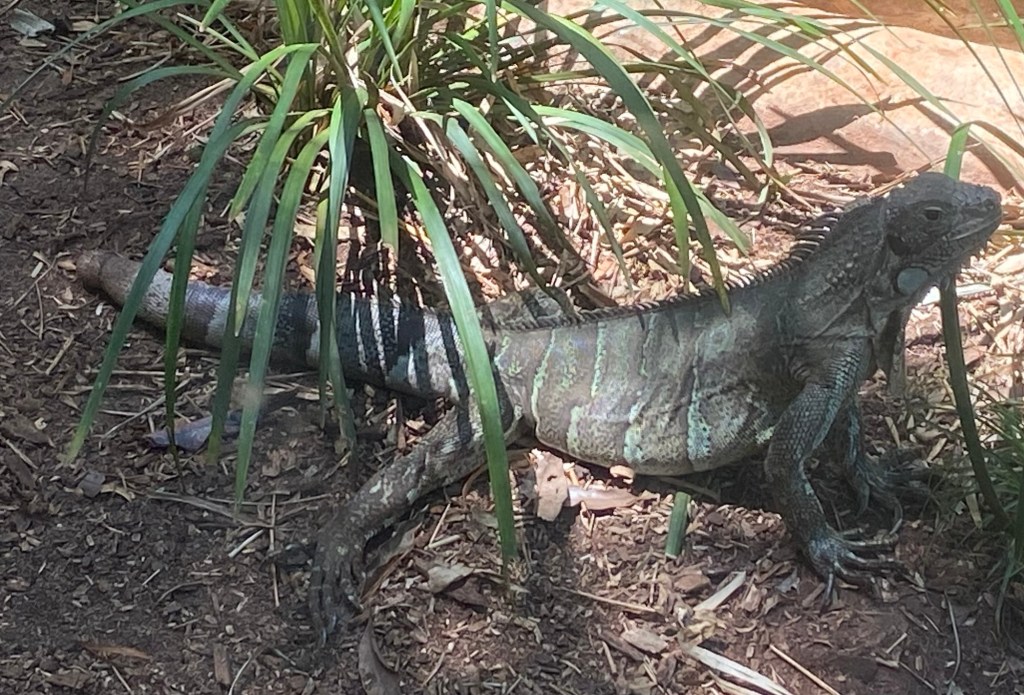
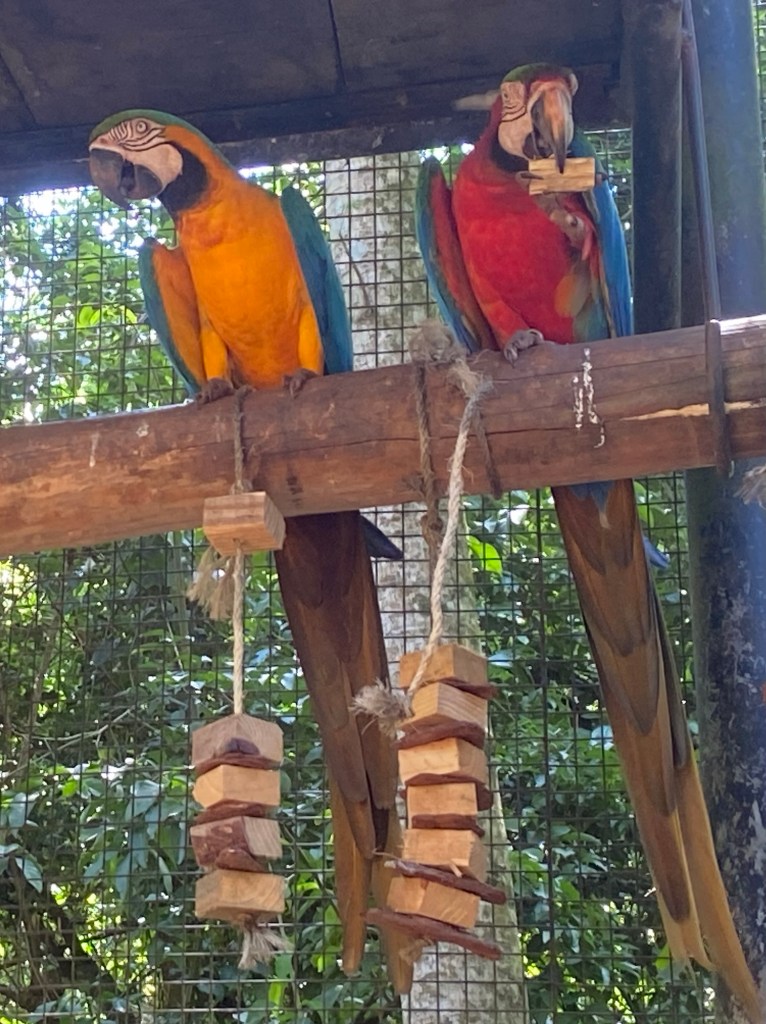
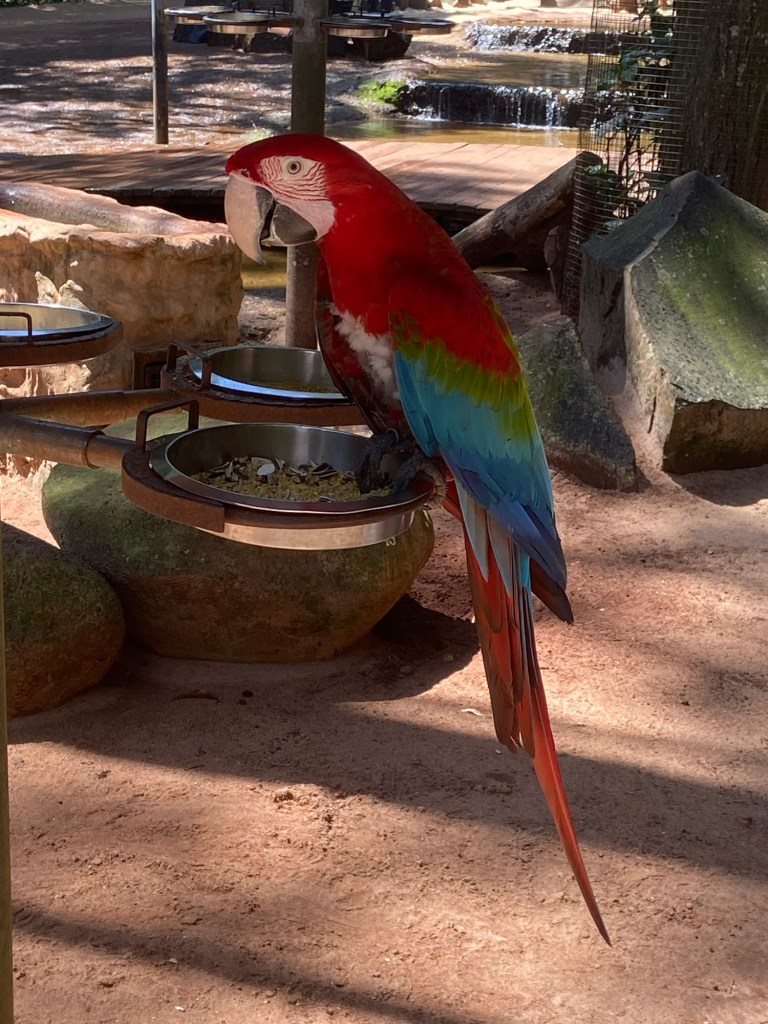
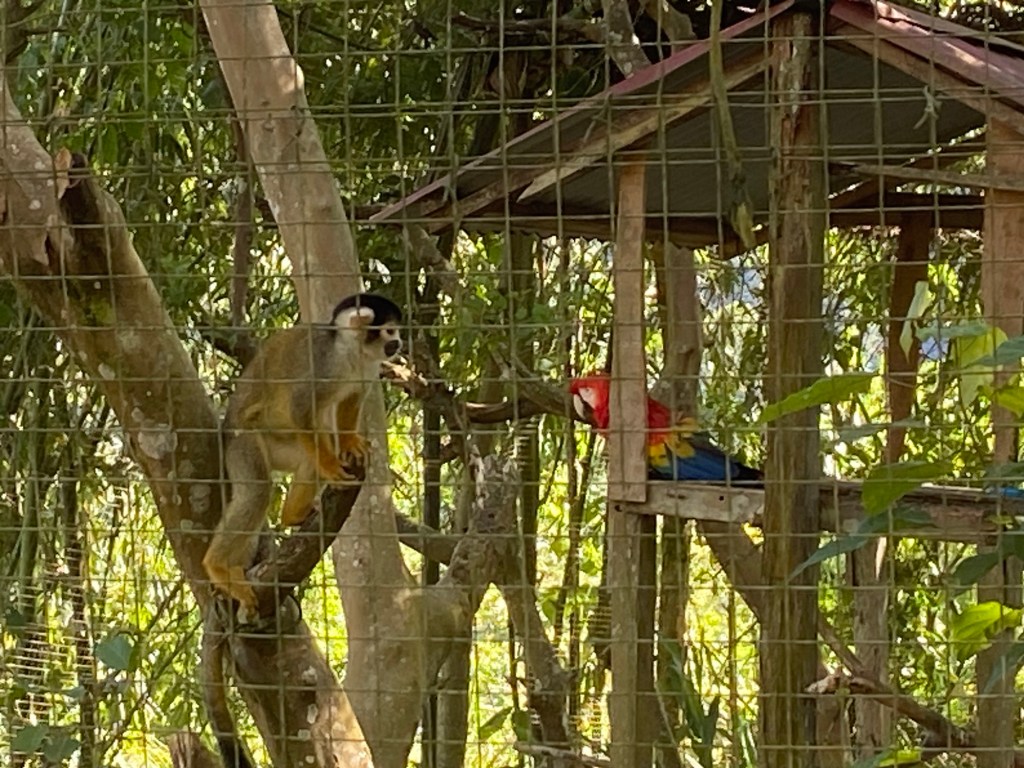
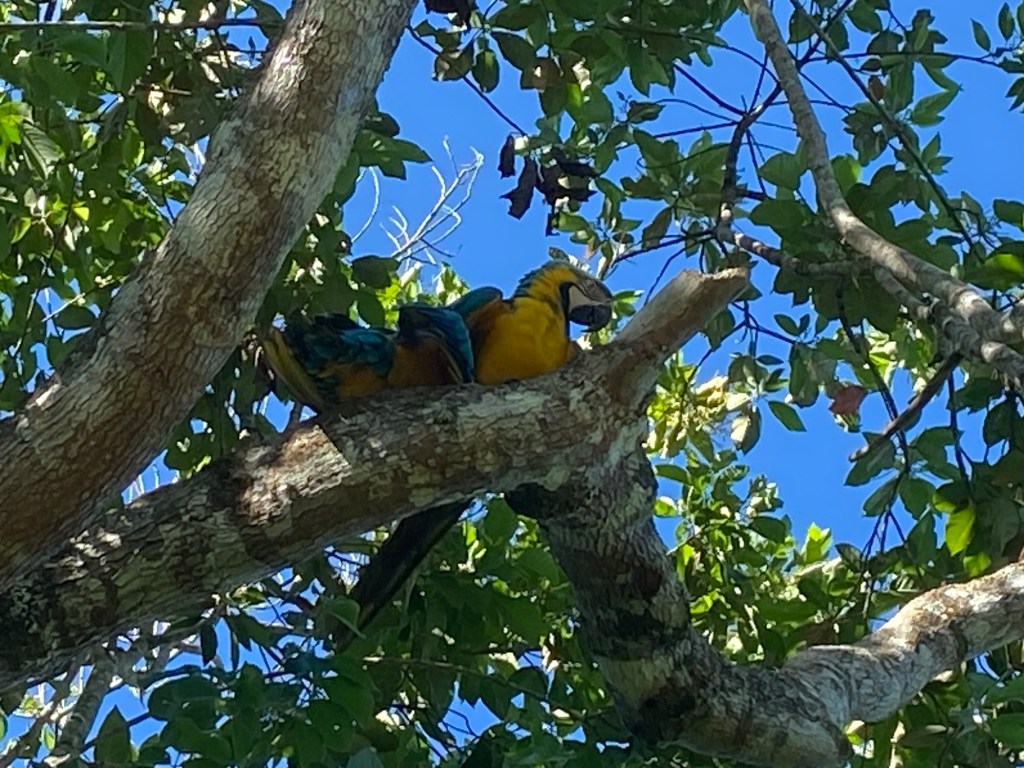
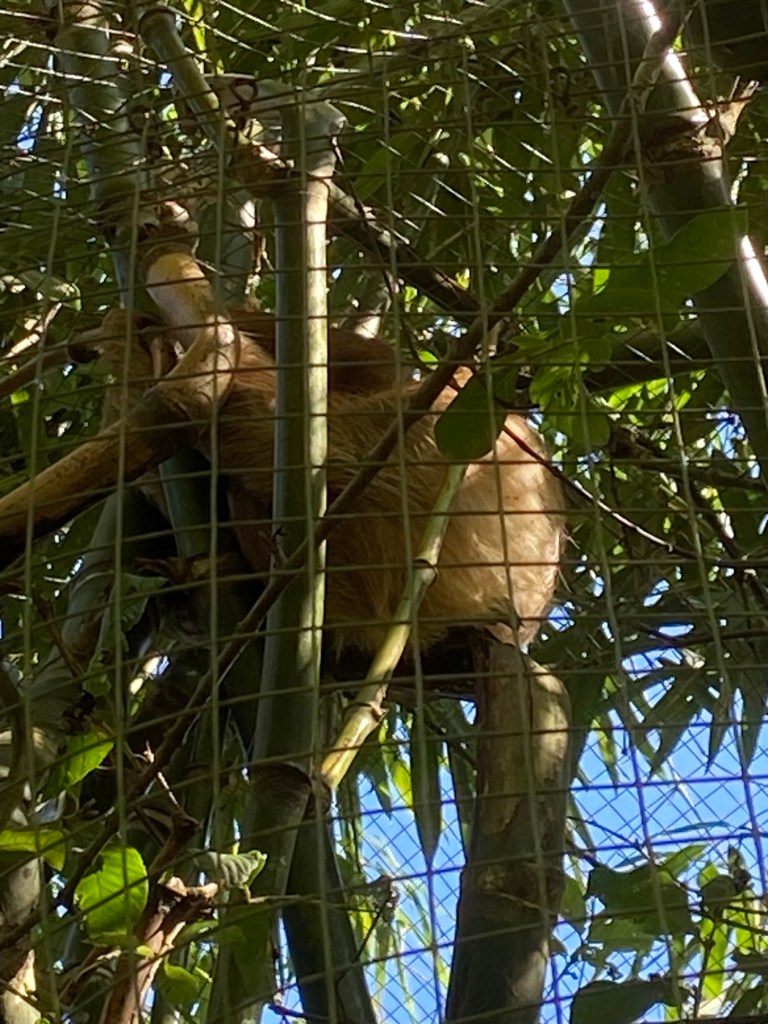
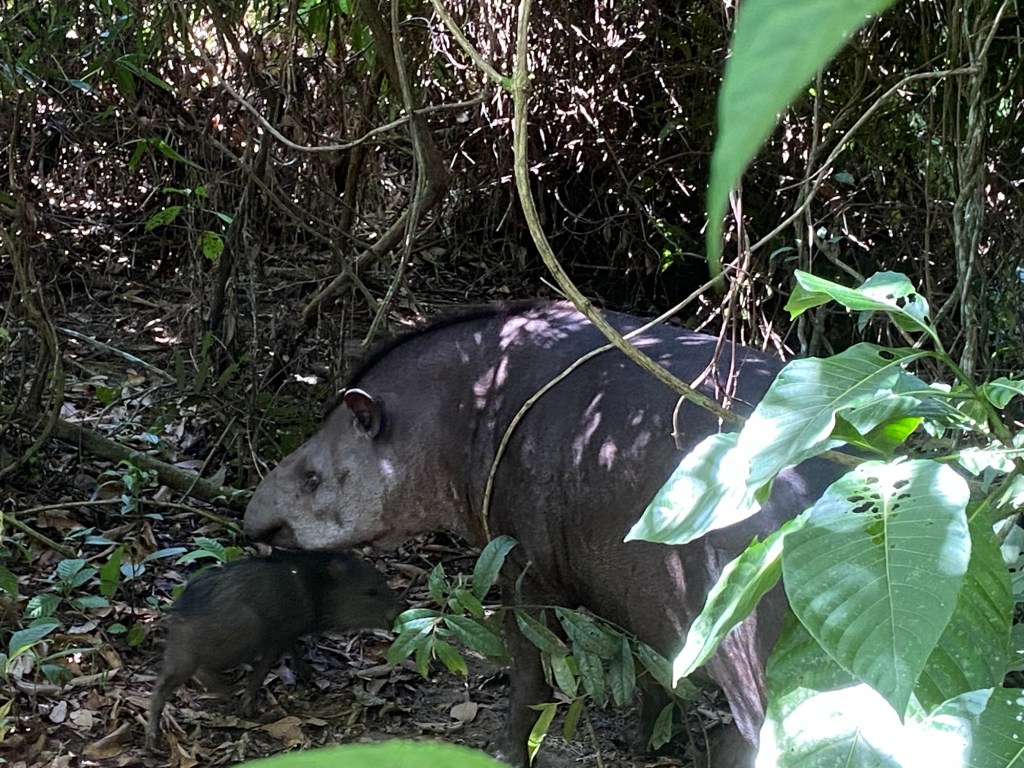
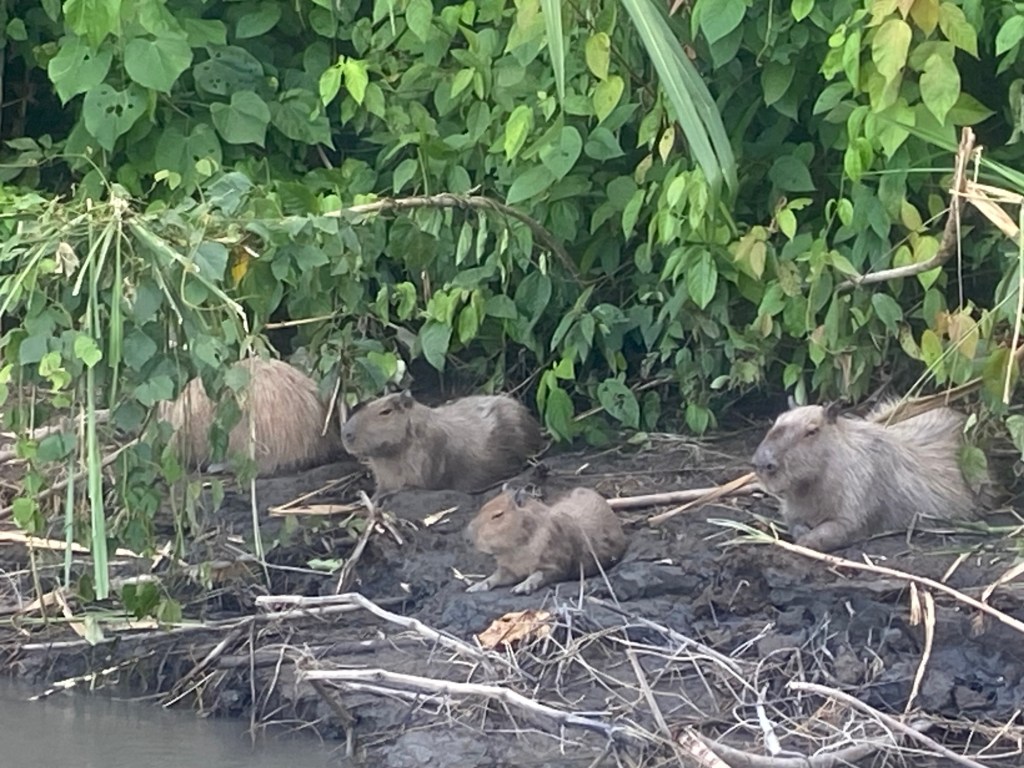
    The list of wildlife highlights is long (those with an asterisk were seen, although not in the wild). There have been the birds: hummingbirds, parrots, macaws, cock-of-the rock, oropendolas, condors, eagles, vultures, toucans*, ibises, a kiwi*, kookaburras, lorikeets, kingfishers and penguins. The sea-life: nesting turtles, a shark, a ray, crabs, coral and the kaleidoscope of fish that dwell in it. In rivers: capybaras, an alligator and caimans*. And on the land: butterflies (including the blue morpho), monkeys, cicadas, fireflies, bats, snakes, tarantulas, a tapir*, a sloth*, coatis, lizards, a lace monitor, glow worms, kangaroos, a dingo, koalas, wallabies and an echidna!

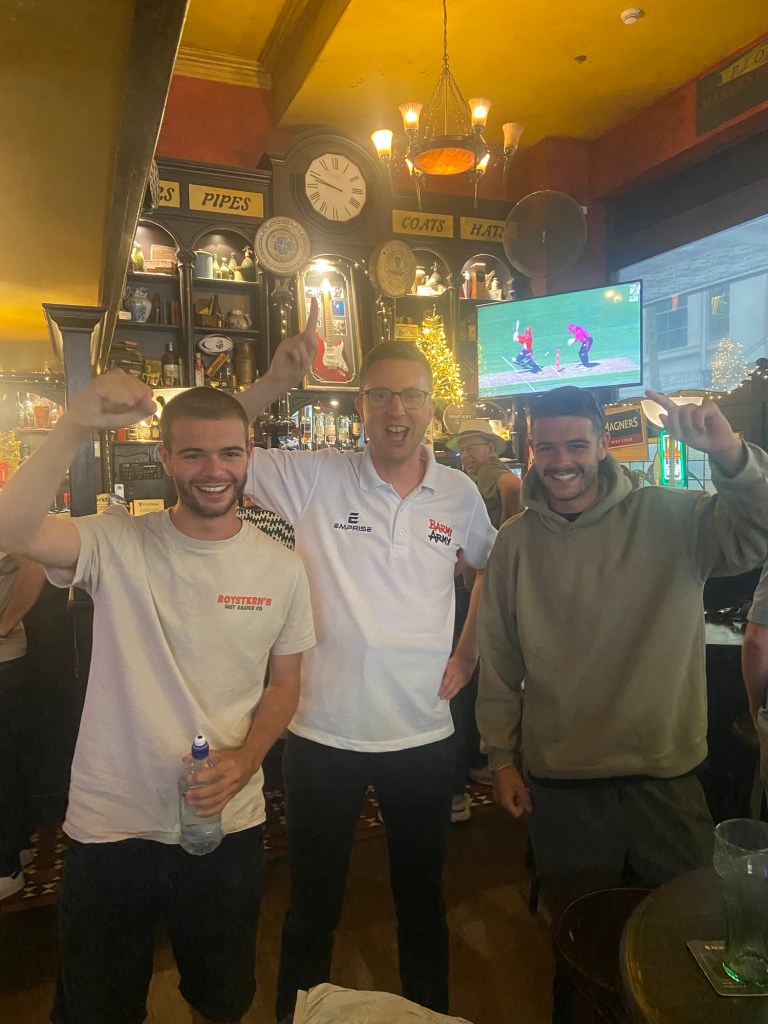
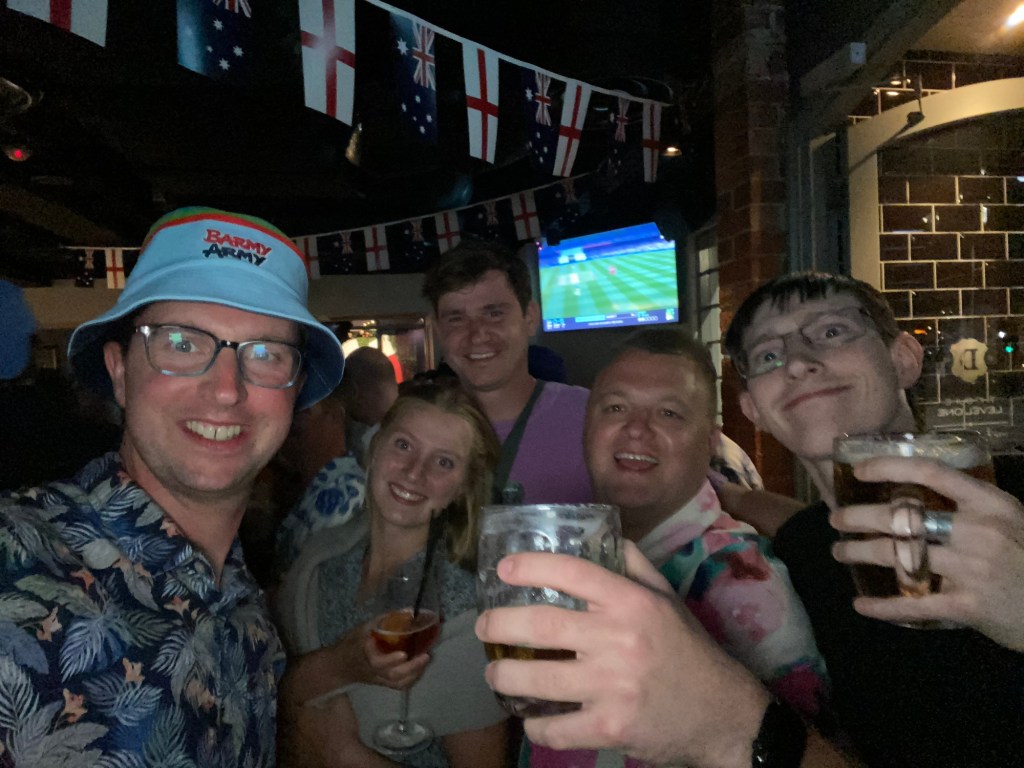
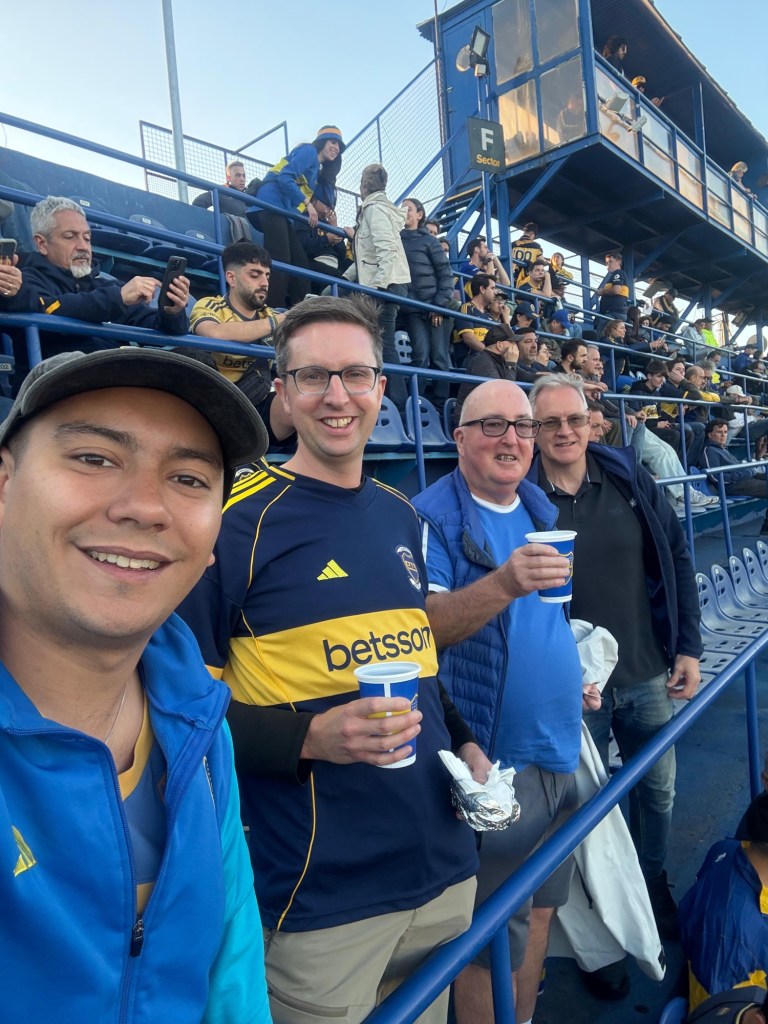
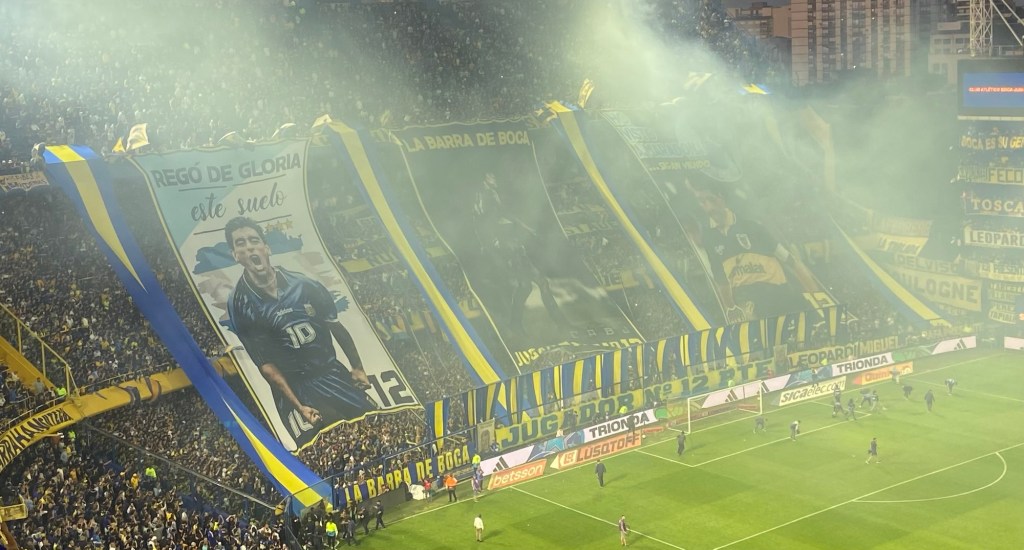
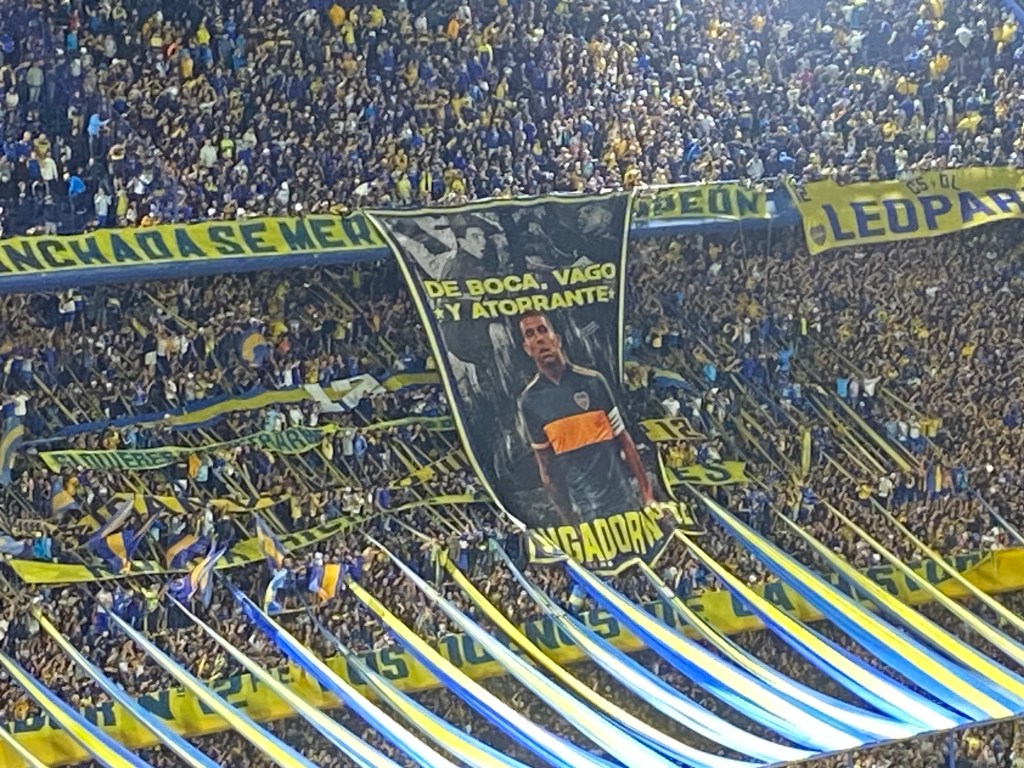
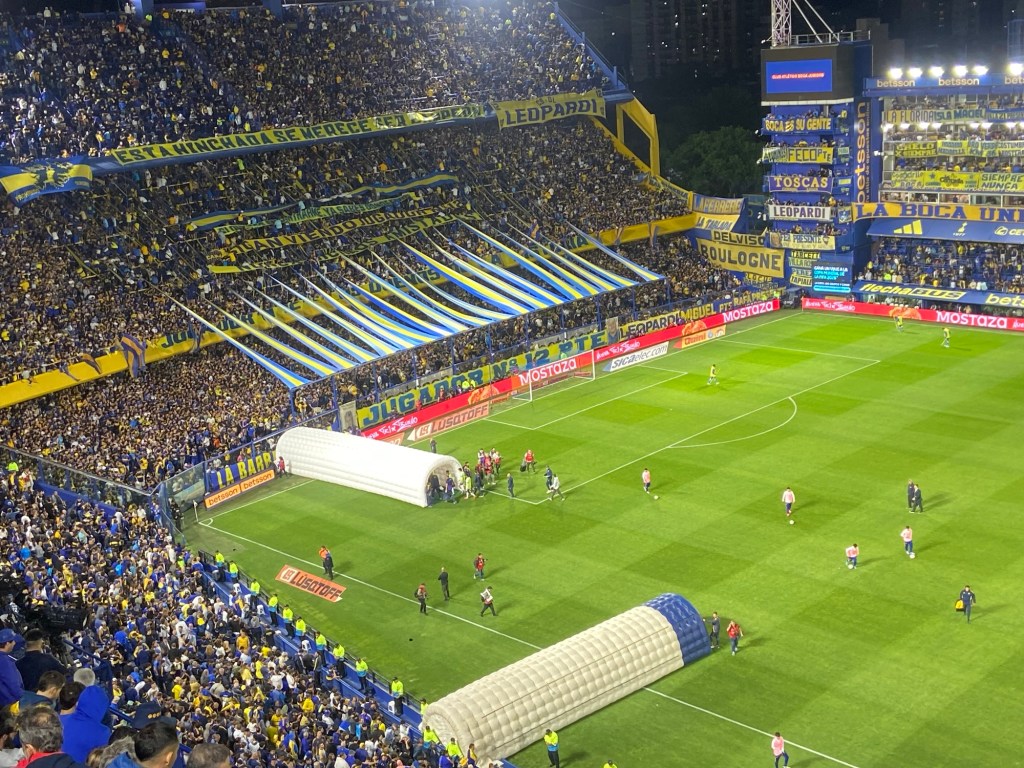
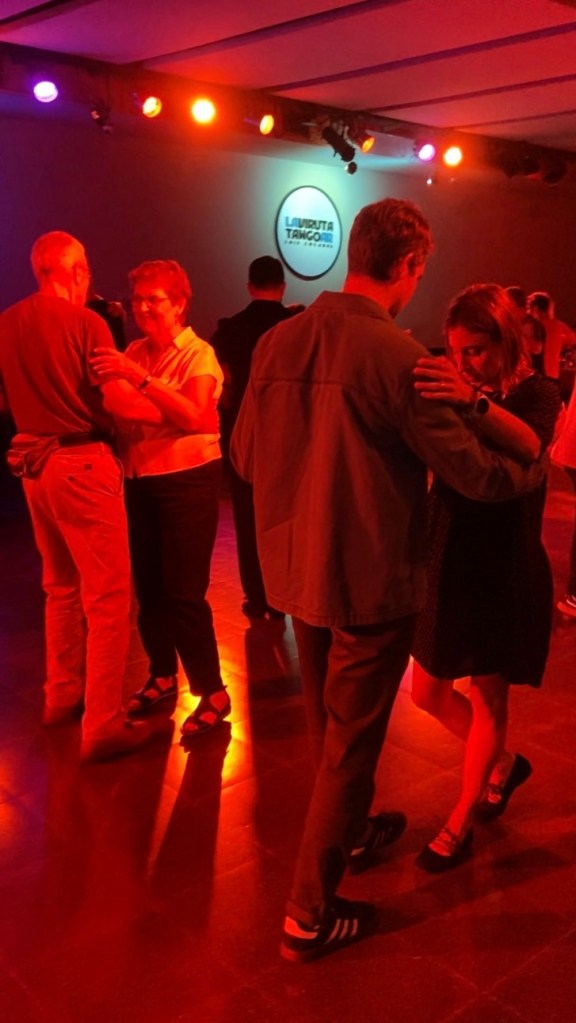
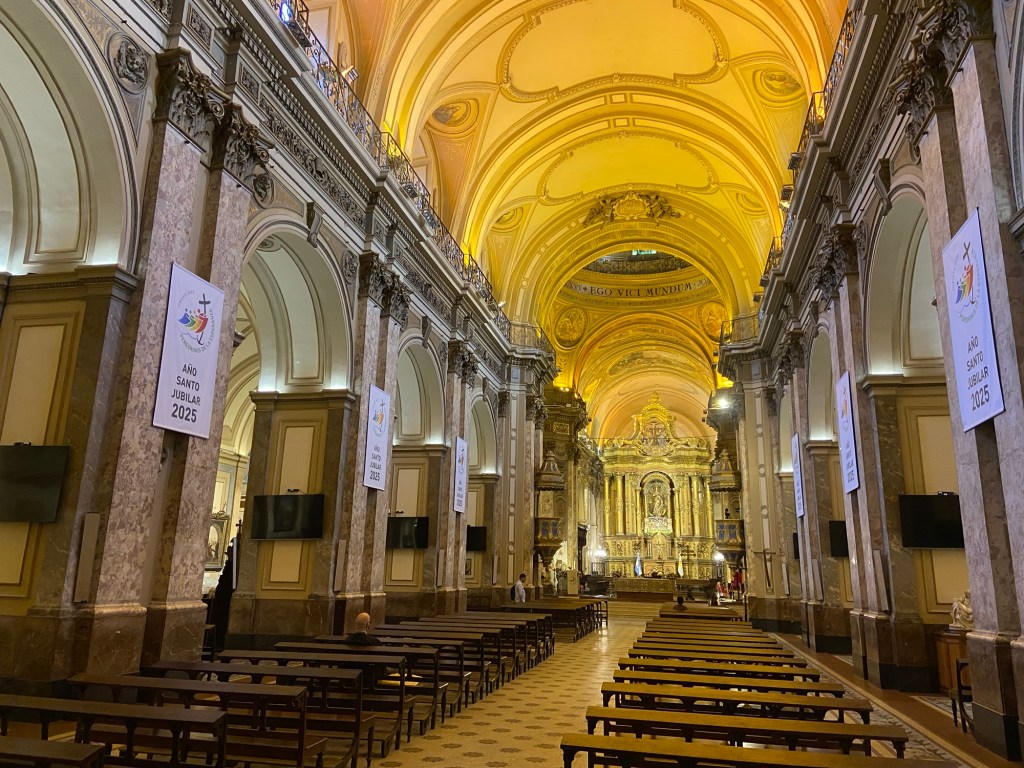
    I have hiked with quechuas, ridden with gauchos, snorkelled next to green turtles, scuba-dived, floated down a creek, swum in pools and the ocean, taken a boat into the spray of a waterfall, unearthed family archives, watched fireworks in a crowd of 1 million, danced the tango, shuffled to jazz, partied with the Barmy Army and sung along to Spanish hymns, English carols, cricketing chants, Boca anthems and the repertoire of live bands!
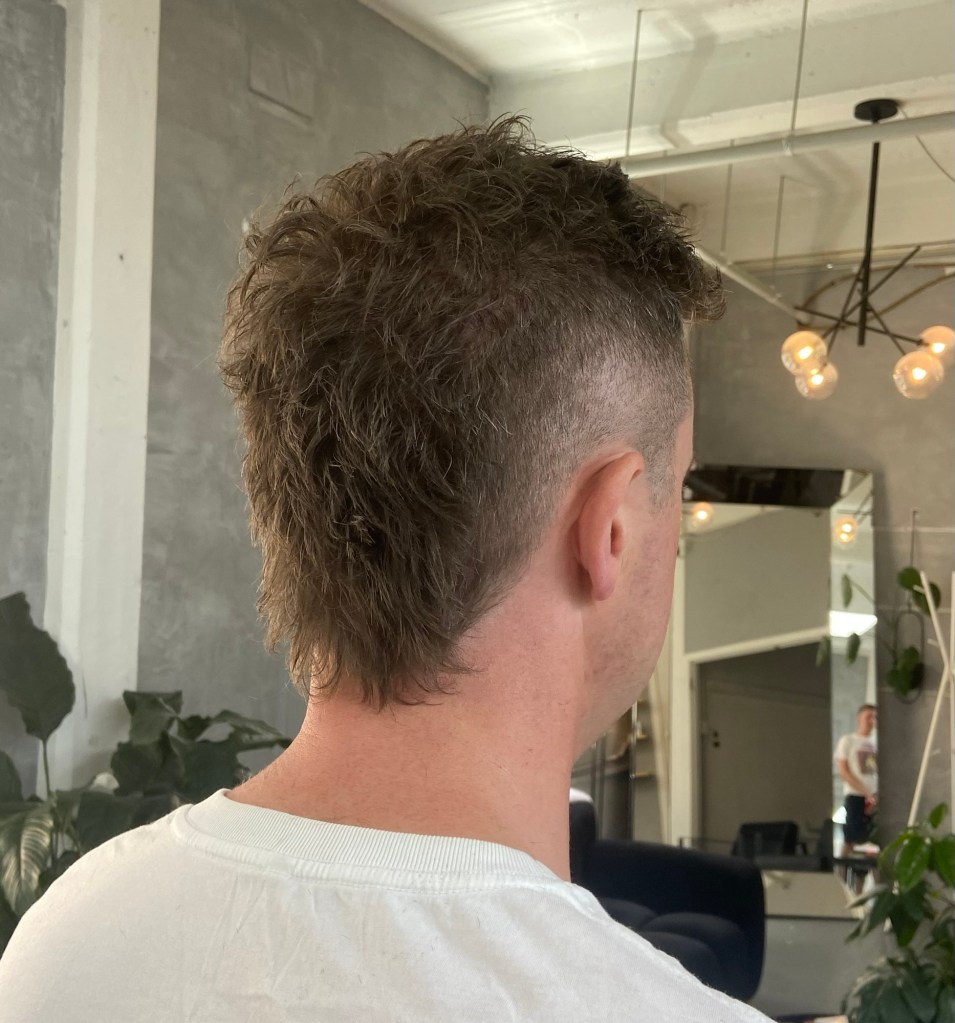
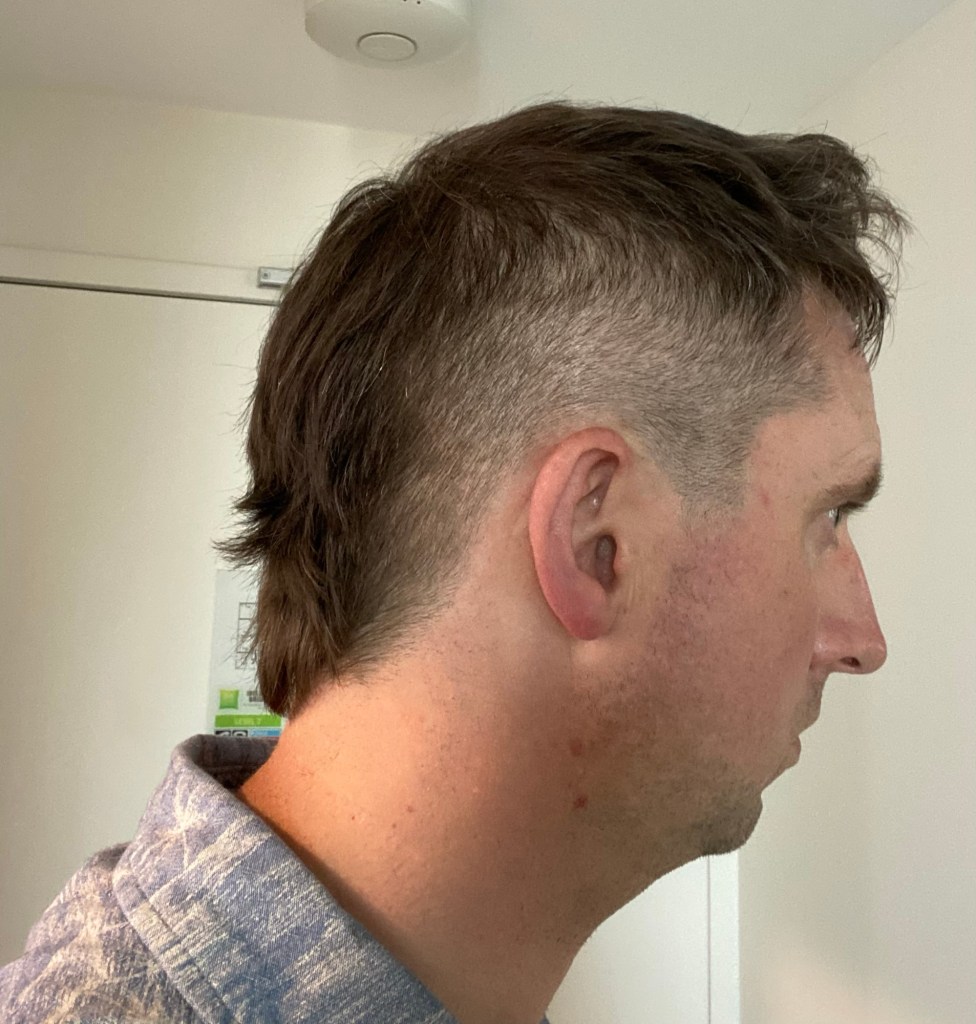
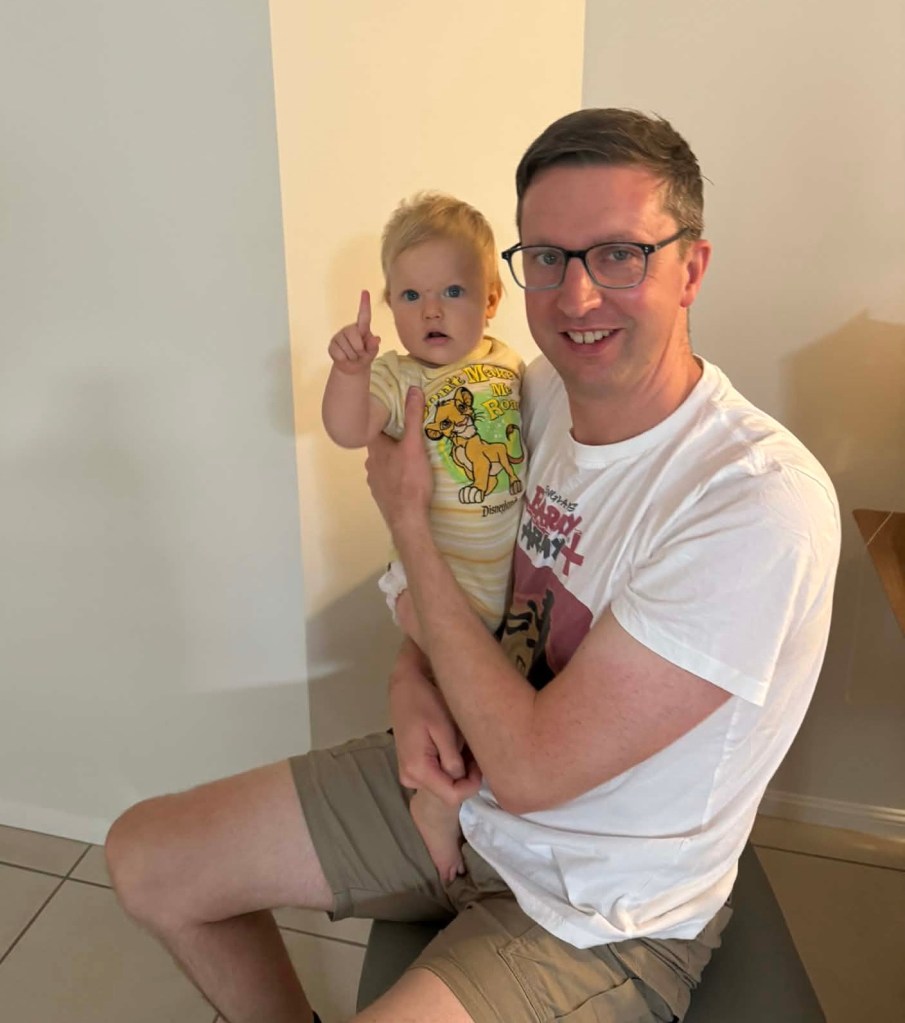
    Did I mention I also went native with my hair?

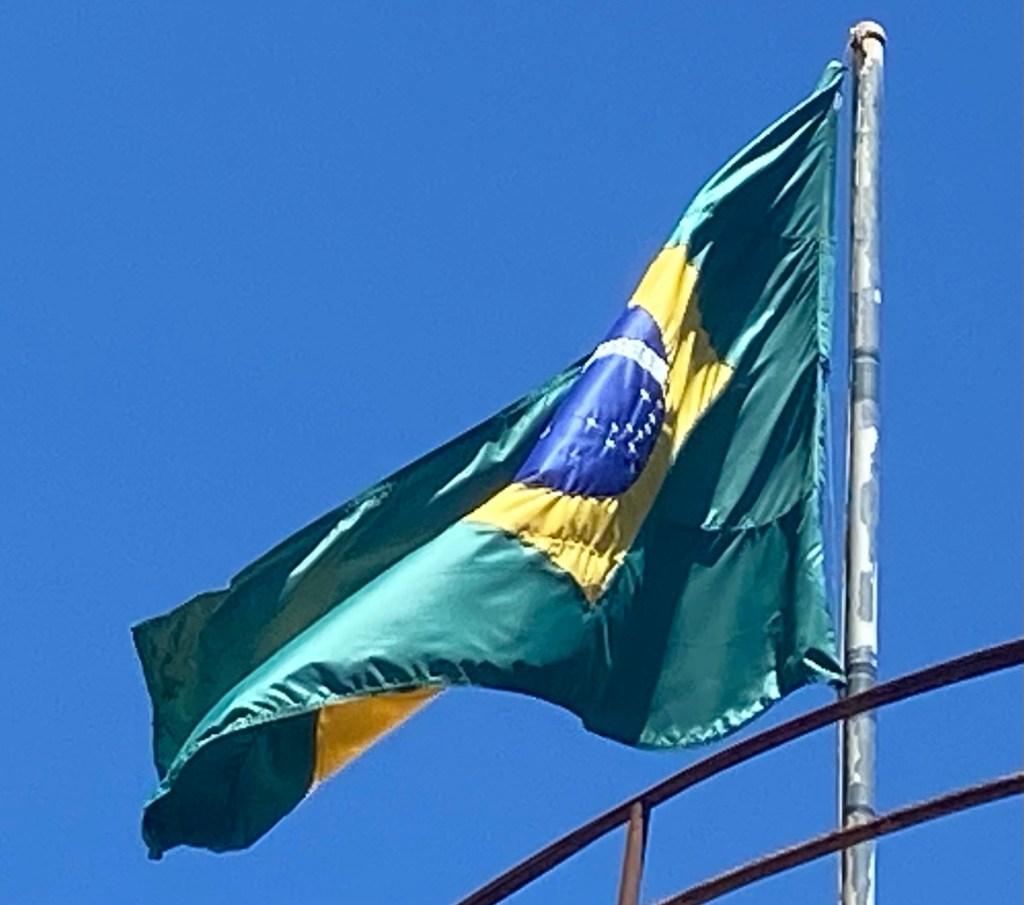
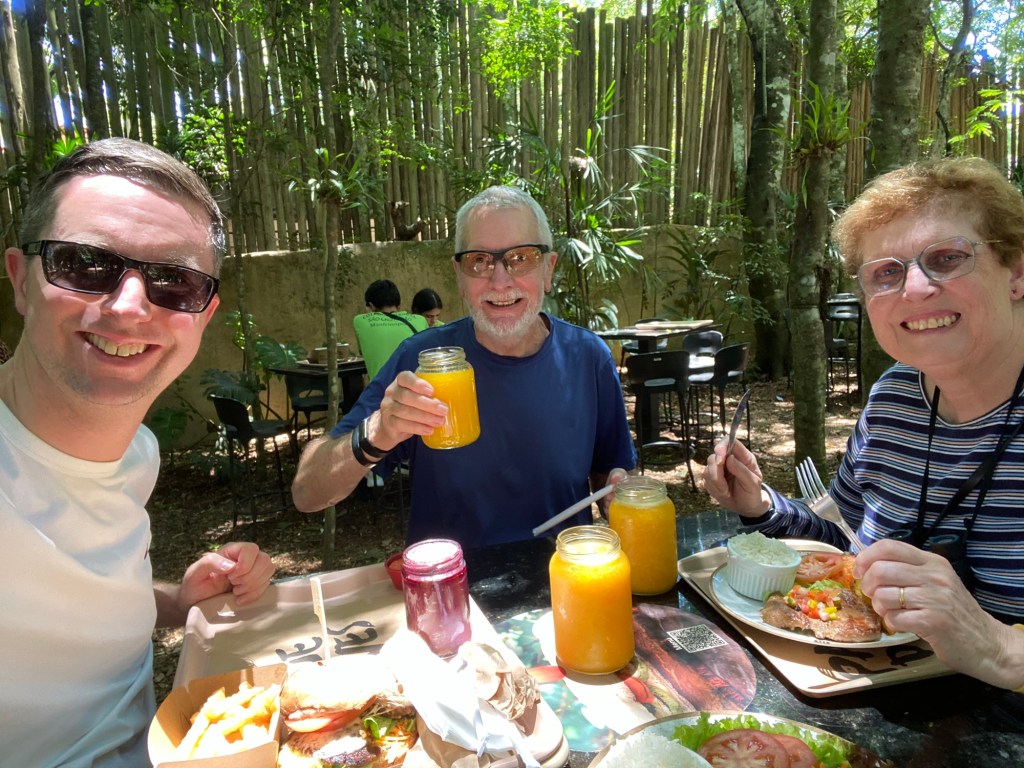
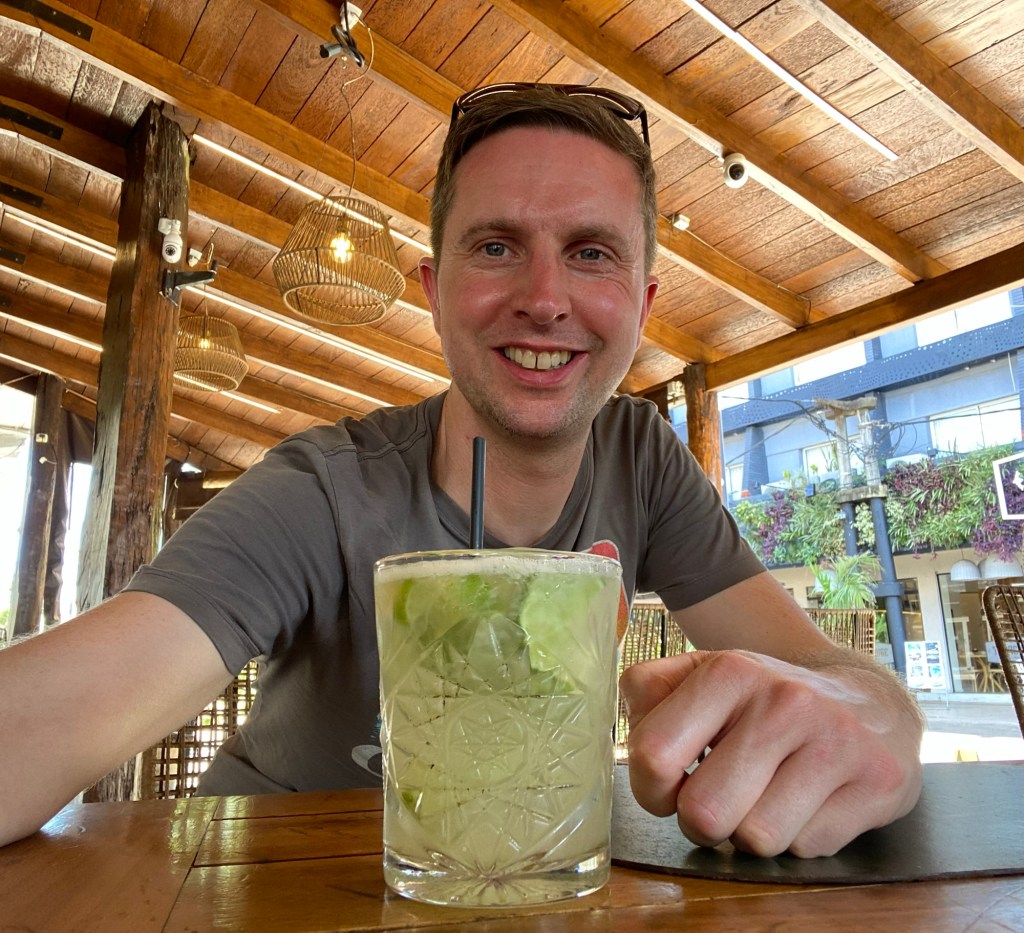
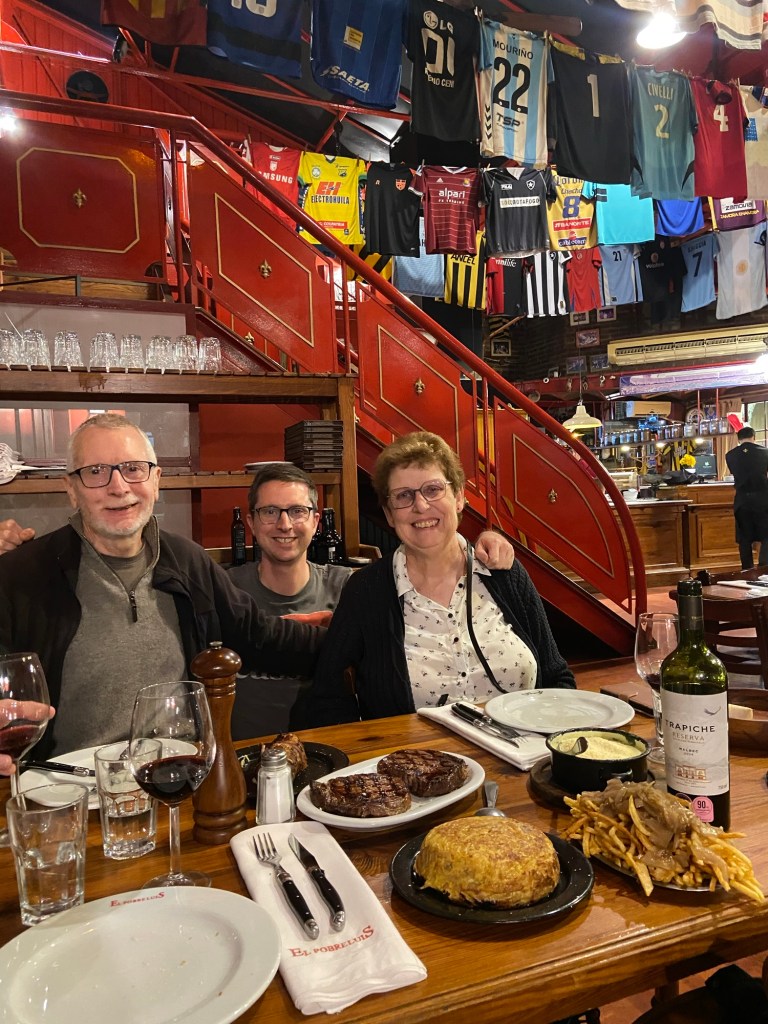
    I’ve dined on Peruvian guinea pig, Argentine steak, New Zealand lamb, Aussie BBQ meat and fresh fish from the river and the sea. I’ve drunk freshly-squeezed mango juice, freshly roasted coffee, Peruvian pisco, Argentinian Malbec, Brazilian açai and caipirinha, Barossa wines and a fair few different beers…

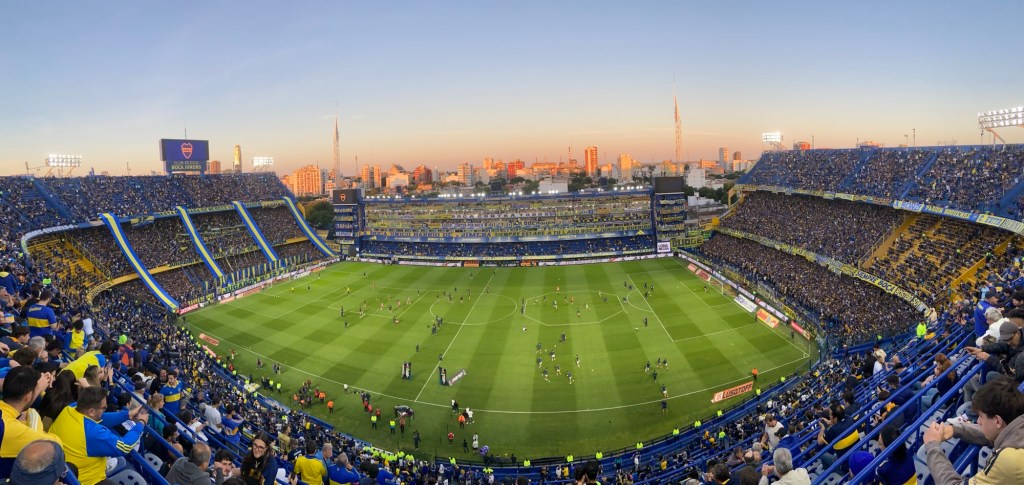
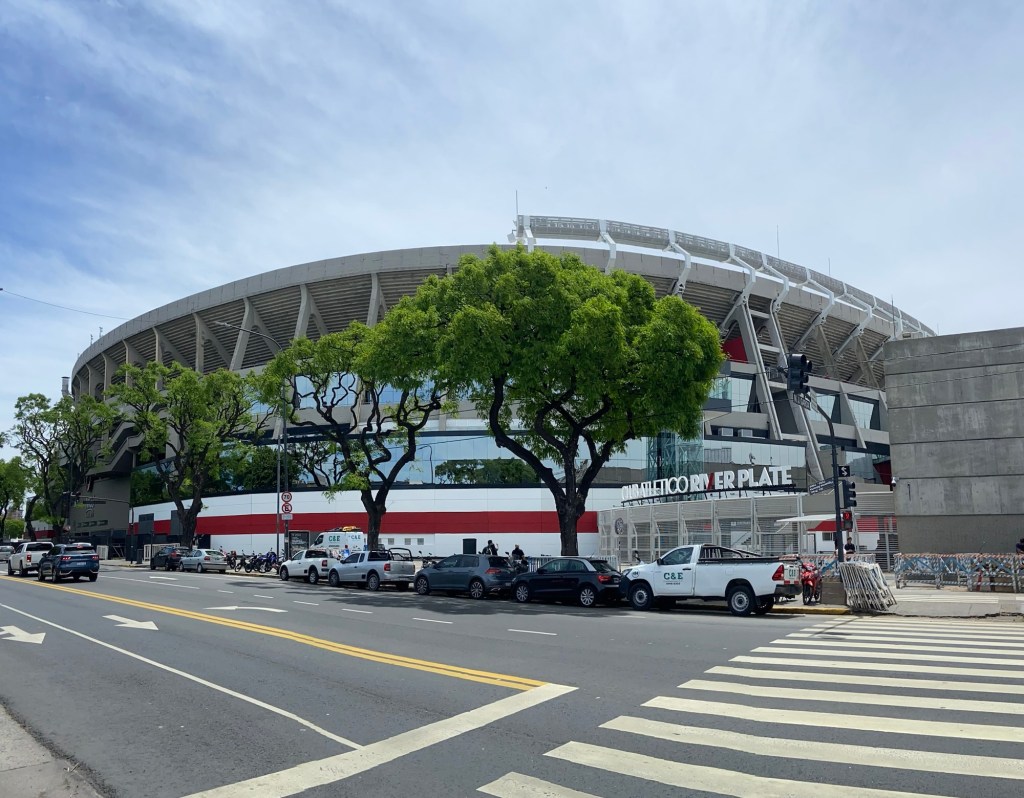
    I’ve worshiped in five different churches and visited five stadia, witnessing two of sport’s greatest rivalries in the Superclásico and the Ashes. I’ve met Ben Stokes, Joe Root, Steve Finn, and so many wonderful people in hostels, on tours, at sports venues and elsewhere – I hope I will stay in touch with many of them. And I’ve been blown away by the kindness of those who’ve hosted me and served me, both sides of the Pacific.

    I’ve been thrilled to reconnect with British and Argentinian family, our former Head of Cricket, a cricketing parent, former students, and my very dear Aussie friends from Paris (and to meet their families)!

    I have been richly blessed. And not just in these ways, but also with good health, great weather, smooth travels and no interruptions to my itinerary. I’m glad that I prepared thoroughly for the trip – the stress before my departure minimised that after – but I’ve also experienced so many unexpected kindnesses that it has become quite overwhelming.

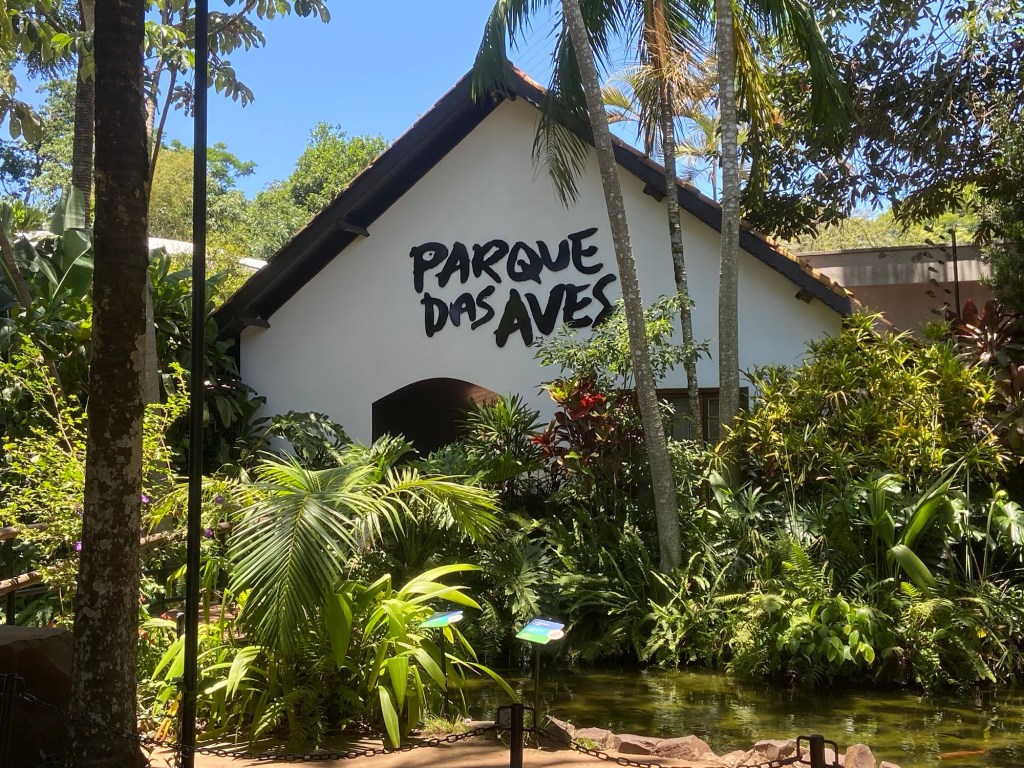
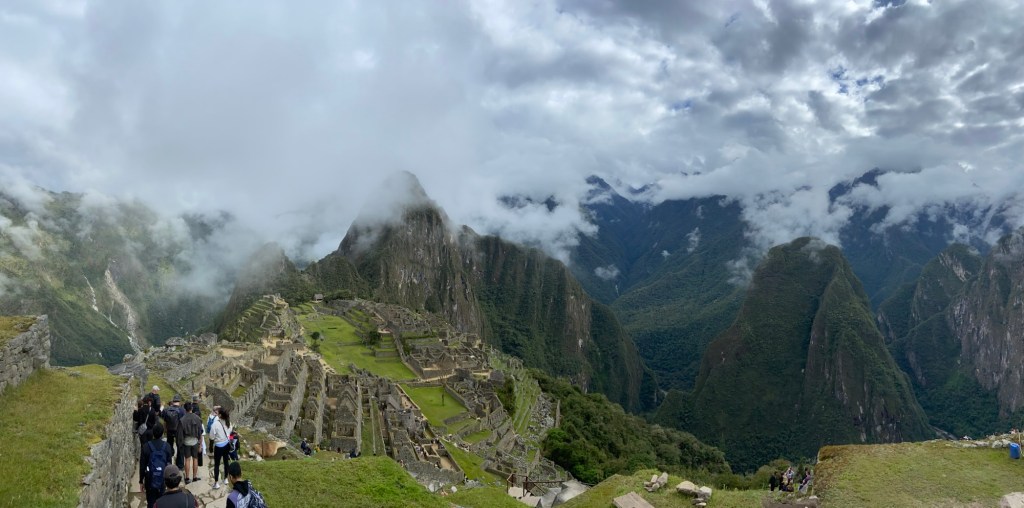
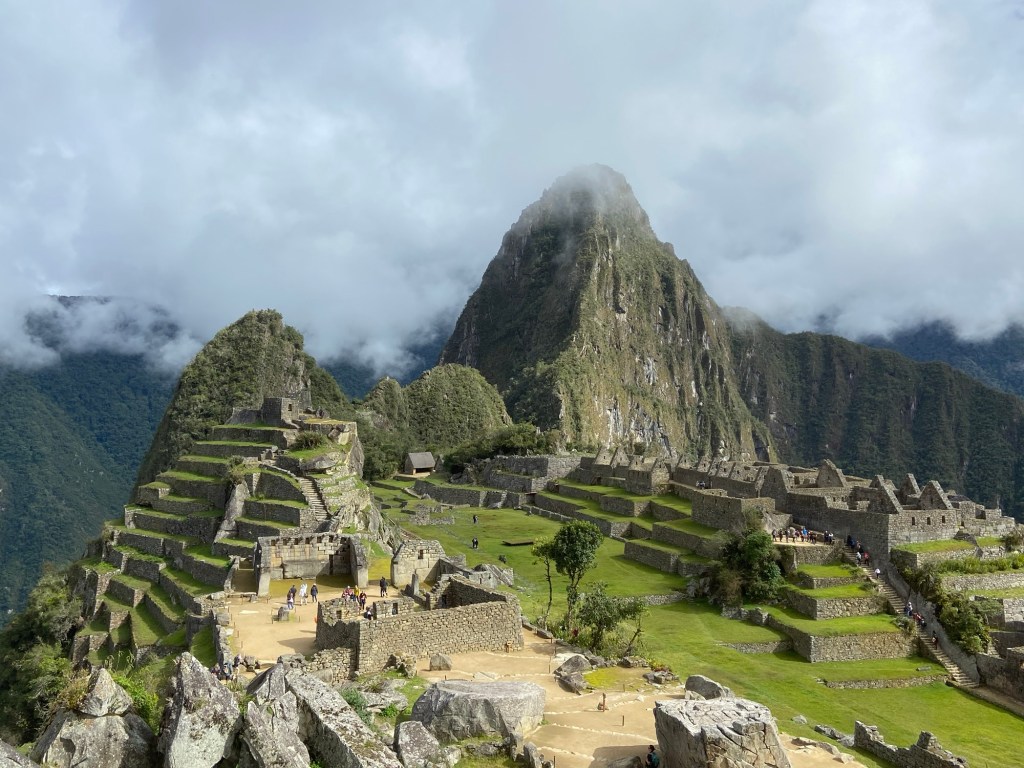
    There was the hire car that appeared just in time in Brisbane when my original booking fell through, the clouds that cleared at Machu Picchu shortly after our arrival, the doctor who rescued my dive course on Lady Elliot Island, the ticket I was gifted to see England’s day of triumph in Melbourne, the change to my Amazon tour that led to a safer and more authentic experience, the company I was able to find every time I most needed it, the rainy season that held off just long enough in both Peru and Queensland, and all the wildlife encounters that took place at the last possible opportunity (the baby alligator in the Amazon, the hummingbird at Parque das Aves, the reef shark at Lady Elliott Island, the echidna on Phillip Island and the koala joey on the Great Ocean Road)!

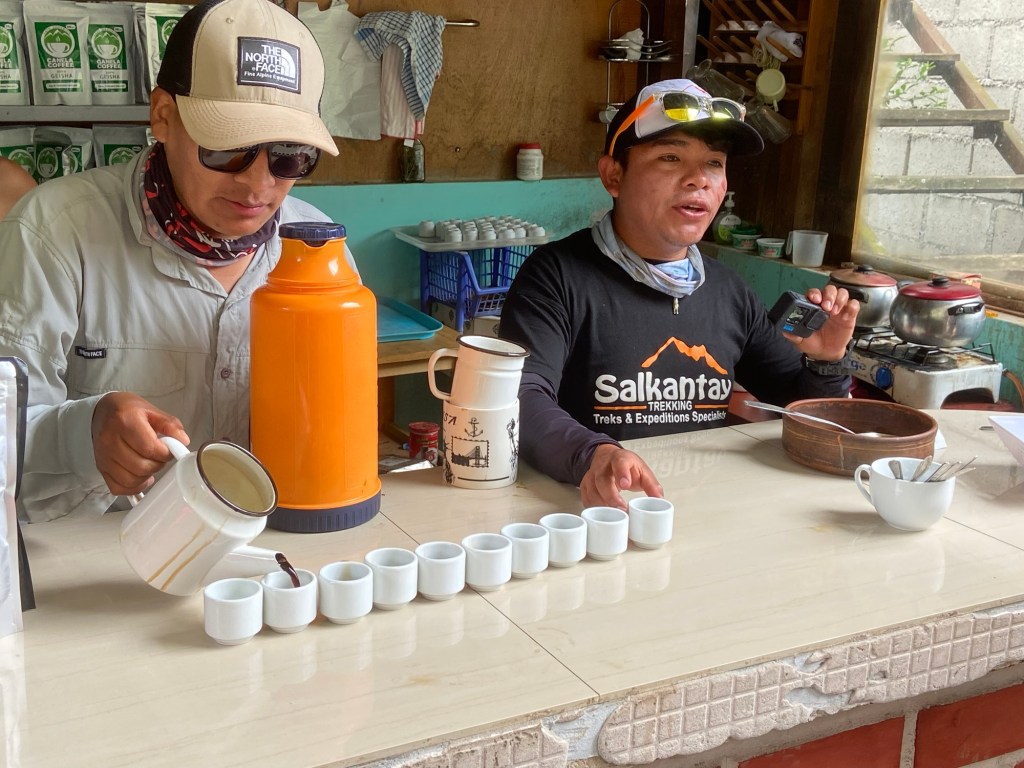
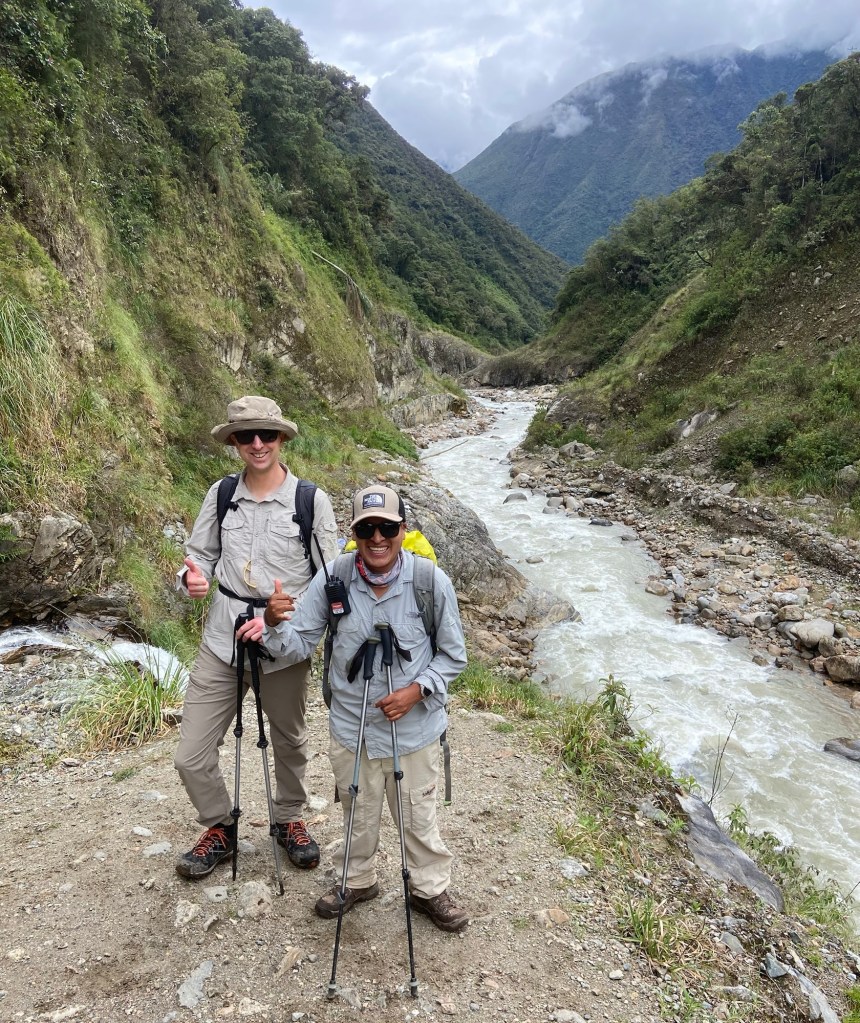
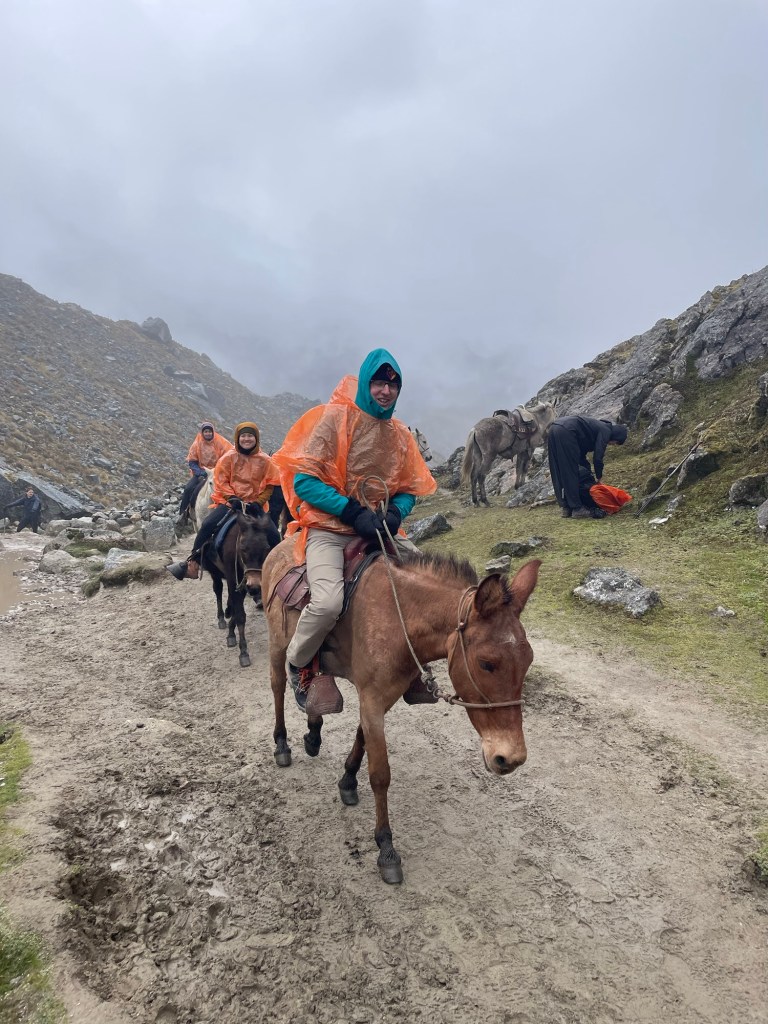
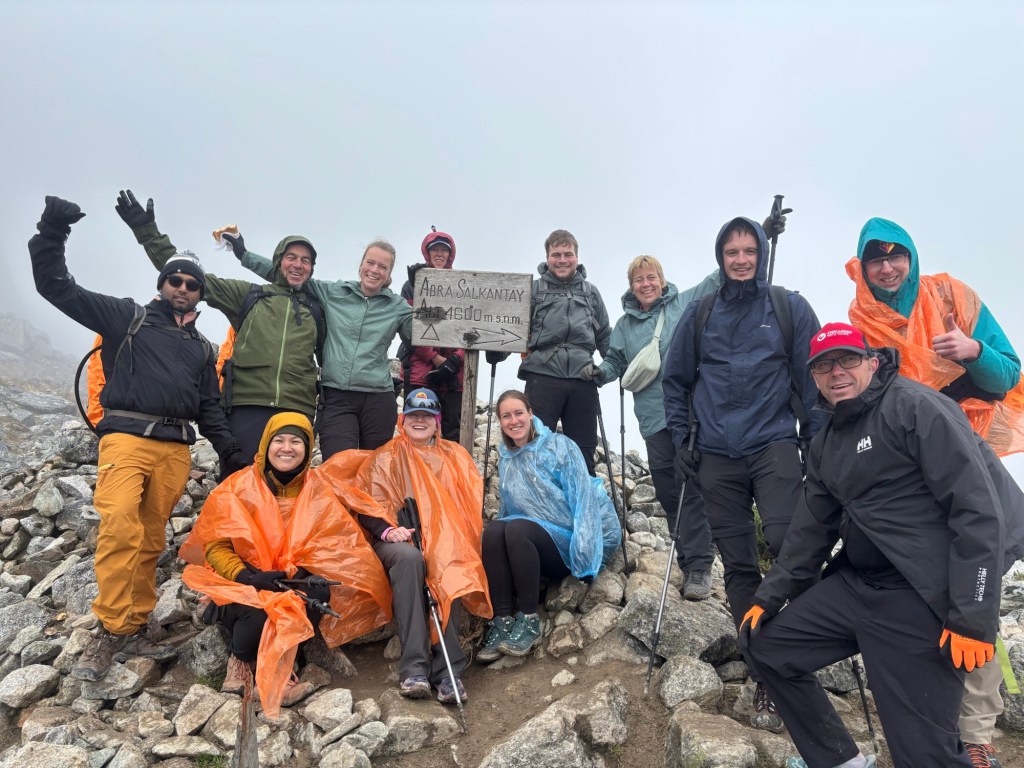
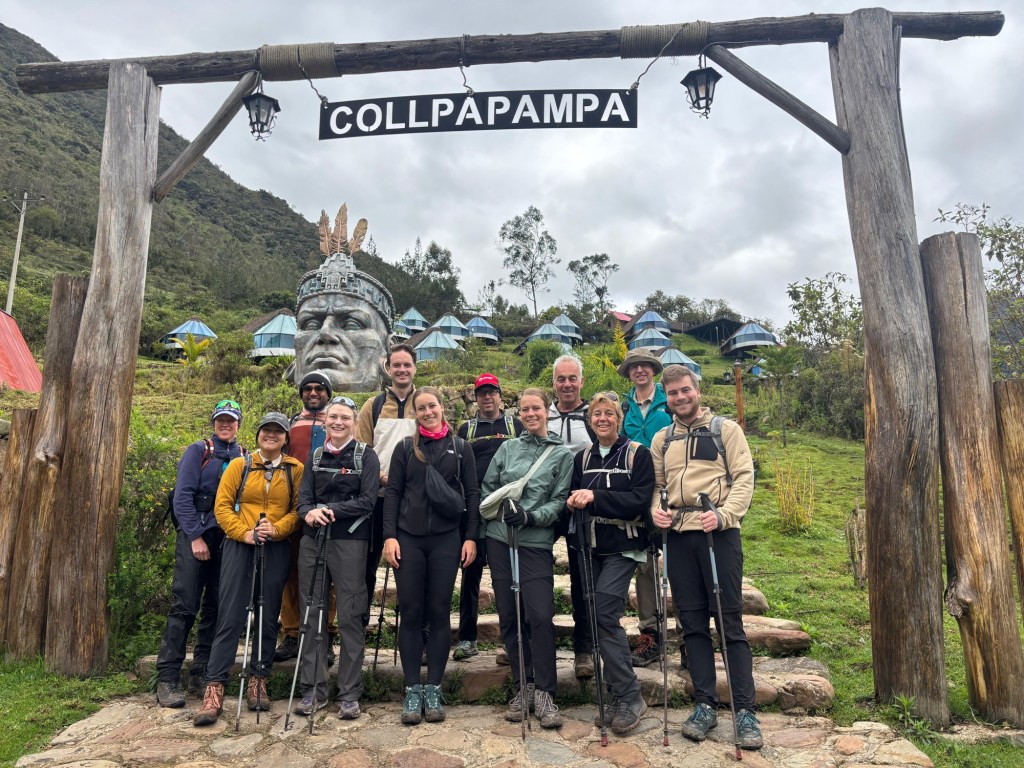
    I have felt protected throughout my trip – thank you to those who have prayed about this! I had quite a few anxieties at the beginning: about diet, illness, dangerous animals, loneliness and perhaps most acutely, about the cliff-side paths on the Salkantay Trek! It was good for me to confront my fears (I am grateful to our guide Puma with the latter – and to the mule that carried me when altitude sickness struck hard), and I thankfully became less anxious as the trip progressed.

    The one genuinely hairy moment was when I was struggling to stay awake while driving back to Brisbane after my K’gari tour. Thankfully I was kept safe and learned a lesson about not planning 250km road trips at the end of an exhausting day…

    The hope Claire shared that my trip contain moments of peace, wonder and connection has certainly been fulfilled. The uncertainty of travel has heightened my sense of dependence on God, and there have been many times I’ve found myself uttering words of thanks to Him after an involuntary “wow” has come to my lips from the latest awe-inspiring experience.

    At church over Christmas or in some of the moments I’ve spent in my own company, it’s been good to process and develop those thoughts. In a world where there can be such darkness – not even carefree Australia has been able to escape that – it’s done me the world of good to rediscover the light. Whether that’s in creation, in the love shown by those made in God’s image or, as we celebrate at Christmas, in “the true light, which gives light to everyone, (who) was coming into the world” (John 1:9).

    I’ve also learned a lot about myself and what I value during the trip. To the extent that I am currently a solo traveller in life as well as on my sabbatical, it has been good to realise I can connect with people so easily: it has proved much simpler than expected to make friends at nearly every turn on the trip. I’ve also rediscovered how to relax, how not to fret, how to appreciate a moment or how to embrace being alone (even if I retain a preference for company)!

    Seeing something different, having spent 17 years in the same place, has certainly helped me find some perspective. I’ve both seen the value of what I have and identified aspects of my travel mindset and lifestyle that I would like to incorporate more into my day-to-day.

    I’ve also seen something of the needs that exist around the world and feel compelled to keep looking for ways to do good in my (albeit limited) sphere of influence, rather than seeking to retreat just yet into a permanent sabbatical! I am very conscious of what a privilege travel is, and want to make sure I am using the benefit I have derived from it to serve others and not just myself…

    I am very grateful to those who’ve allowed me to have this experience of a lifetime, at a time that’s coincided with the South American Spring, the Australian Summer, the Ashes and our family celebrations in Argentina:

    To Ian, to the school and to those who’ve taken my classes, for finding a way to make my sabbatical possible.

    To my parents, for the money they’ve lent me when my own funds have been insufficient.

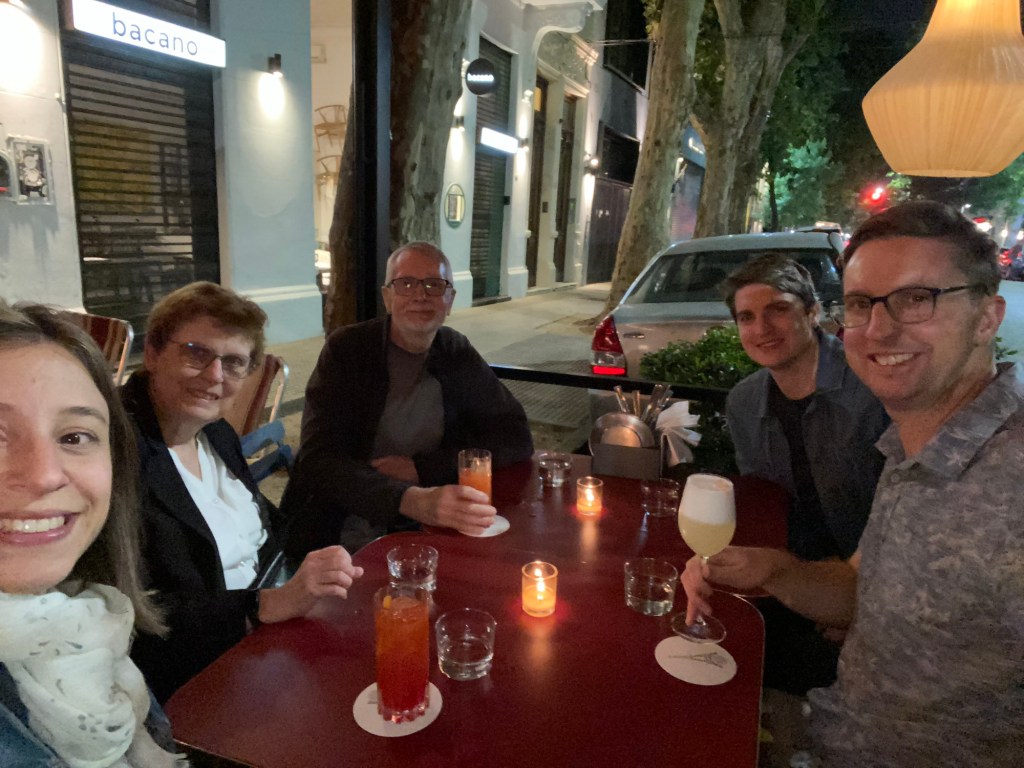
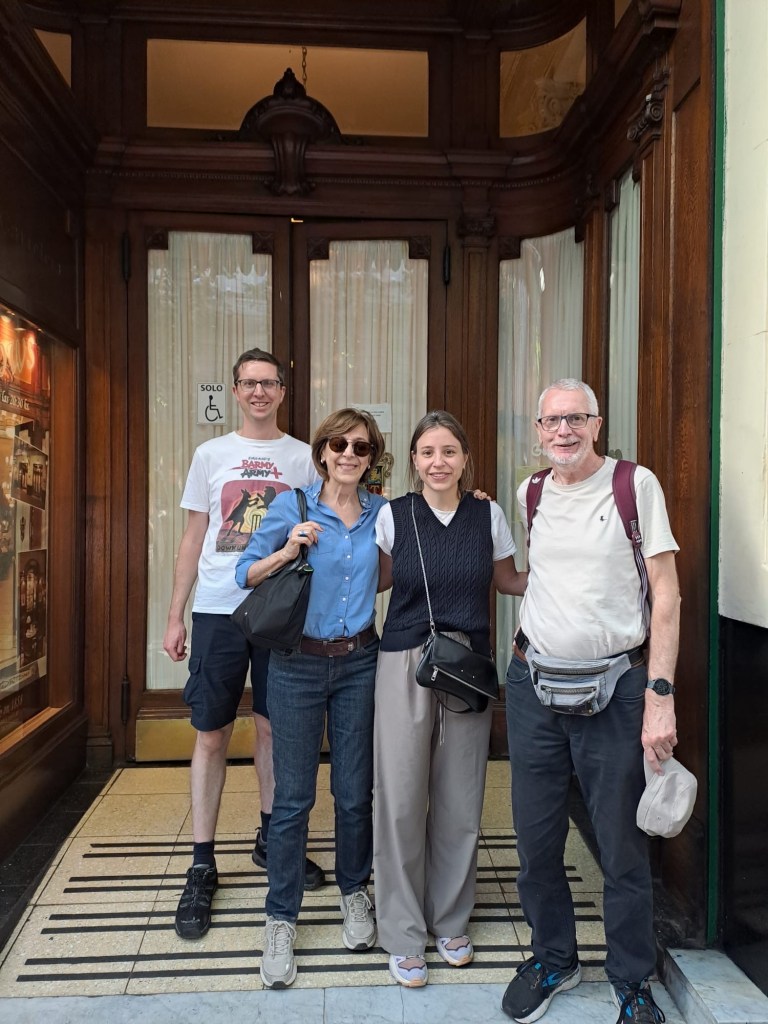
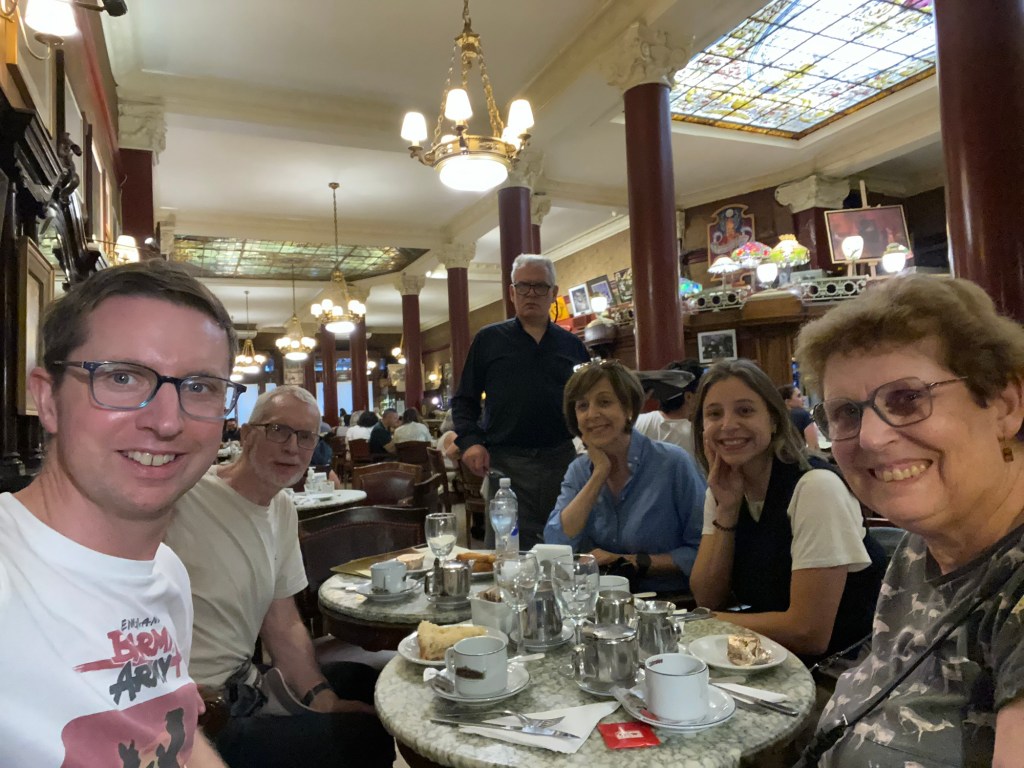
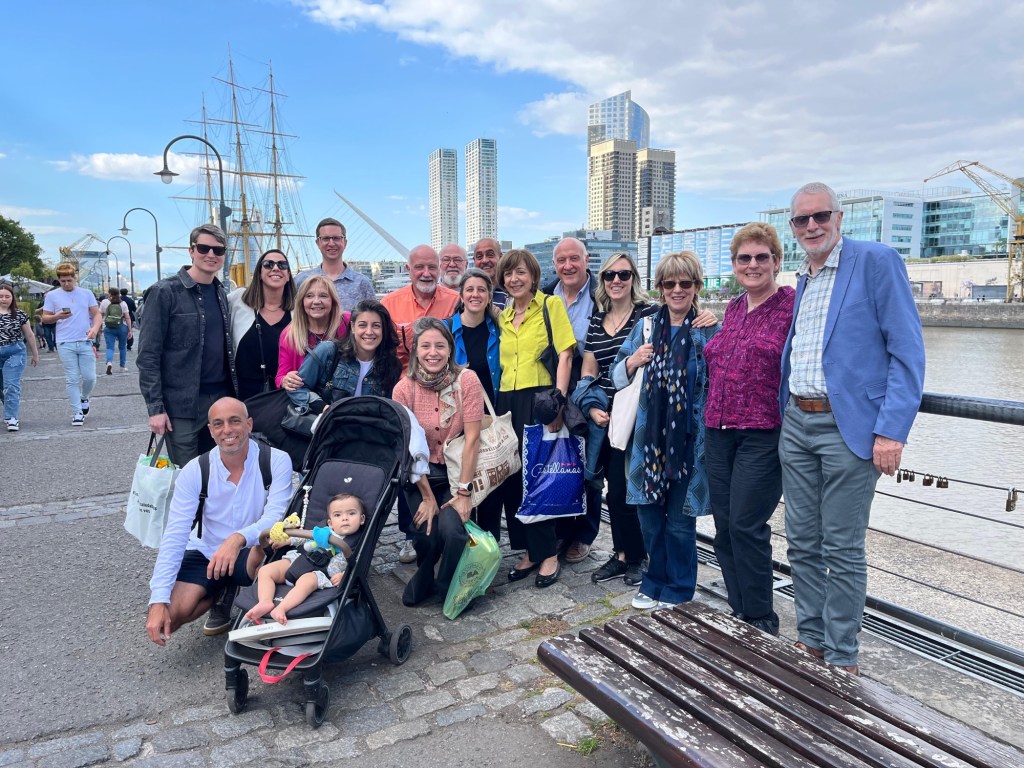
    To Jorge, Adriana, Caro and Estefi, for their extremely kind hospitality in Argentina. And to Josh, Annie, Zoe and Paul in Australia.

    To all who’ve supported me or shown an interest: it’s been such a joy to share the journey with you through this blog, knowing that you have become part of the adventure.

    And of course to God, the source of every good thing!

    I am sad that my 70 day saga is coming to an end and I have left a bit of my heart in each of the countries I’ve visited. Nonetheless, I have a sense of satisfaction and completeness about all that this uniquely significant experience for me has encompassed. And of course I’ve been looking to seeing everyone back home!

    I’m not sure I could have fulfilled more dreams in a 10 week period, or had a better time, or derived more benefit. It’s been an absolute, life-enhancing and life-changing, blast.

    Thank you for coming along on it with me.
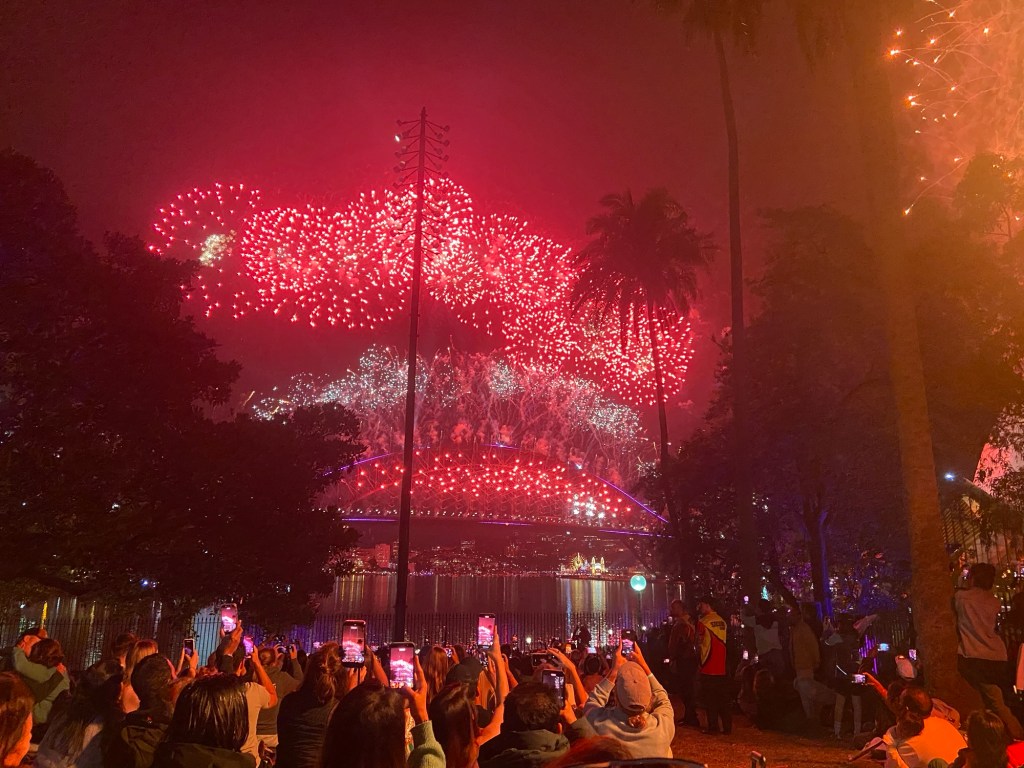
  • Happy New Year!

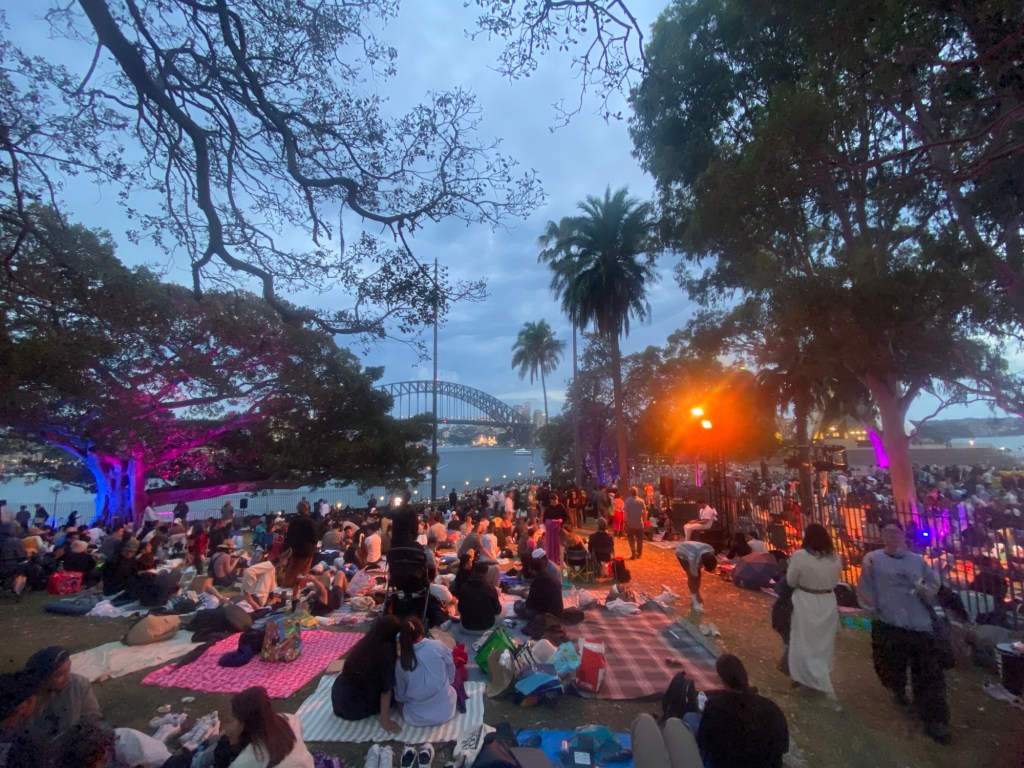
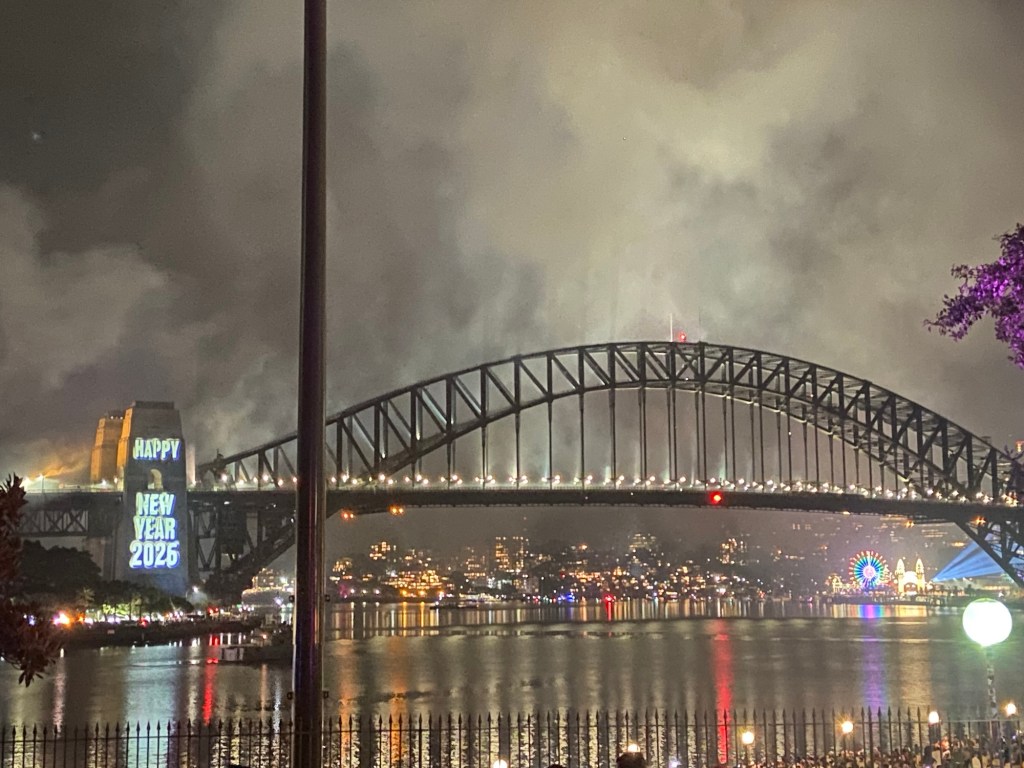
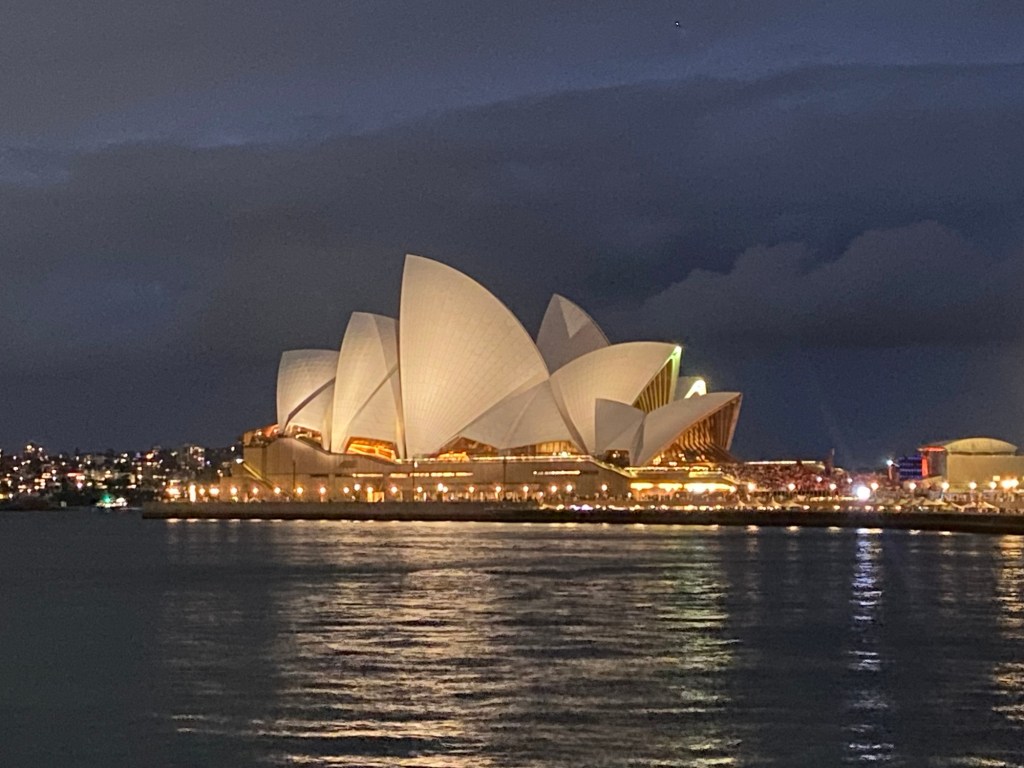
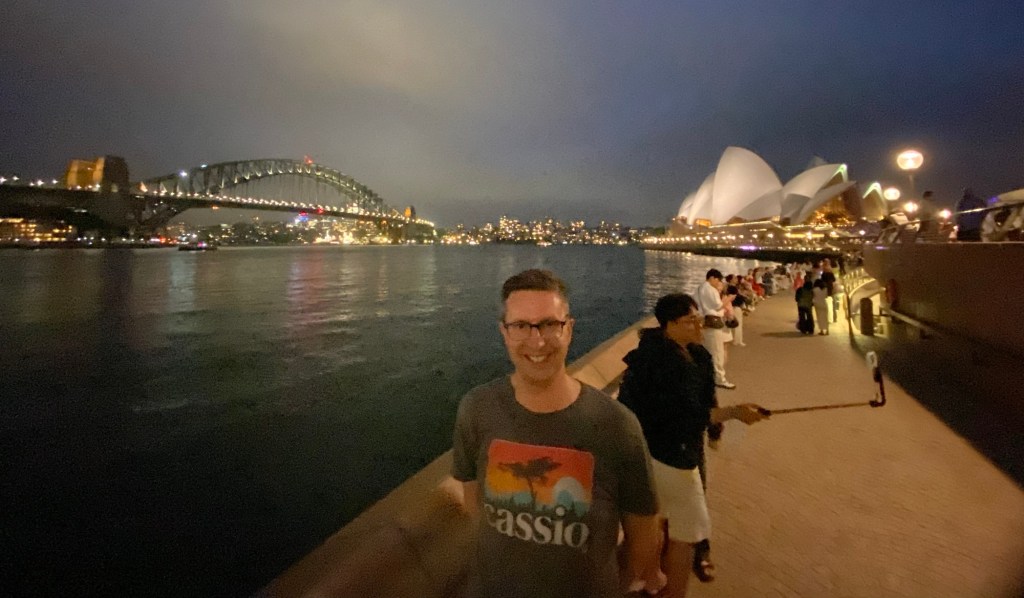
    The grand finale to my trip was the New Year fireworks display at Sydney Harbour. It required a whole day’s investment for ten minutes’ entertainment, but as soon as I’d decided to extend my stay here beyond Christmas, I’d figured it was one worth making!

    At 11am, I picked up my picnic (special mention to the cherries, which are in season and delicious at the moment!) from Coles, and headed to the botanic gardens. The whole event is brilliantly well organised, and a dedicated website gives the live status of all the vantage points. There were huge queues at the first location I tried, which seemed to be full anyway, but I was pleasantly surprised to find another section of the gardens still open and with free entry. Numbers at each site are limited to sensible levels, and the gates were shut about half an hour after my arrival.

    I was much nearer to the harbour bridge and opera house than I thought would be possible
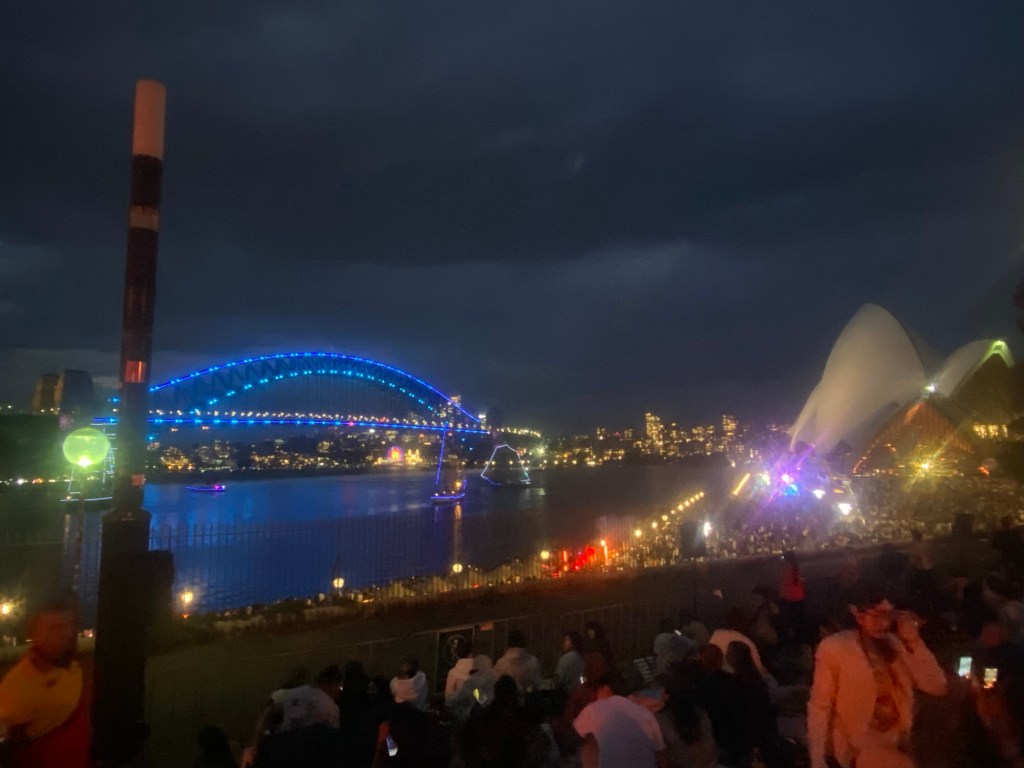
    Beneath us, another big crowd had gathered around Circular Quay

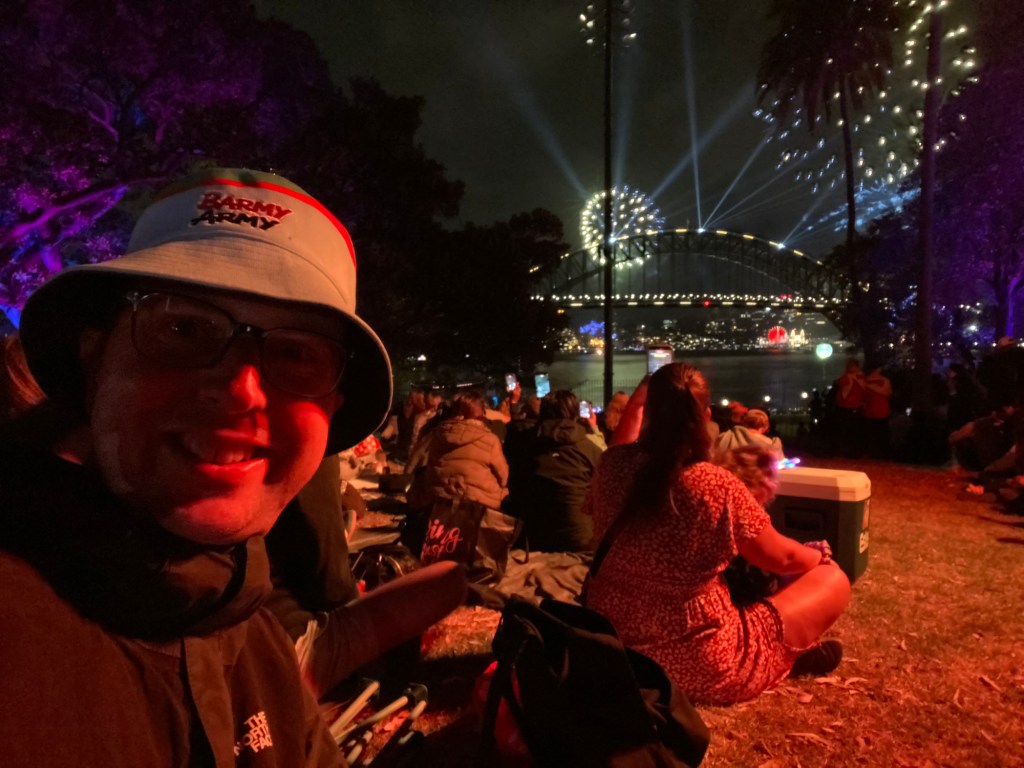
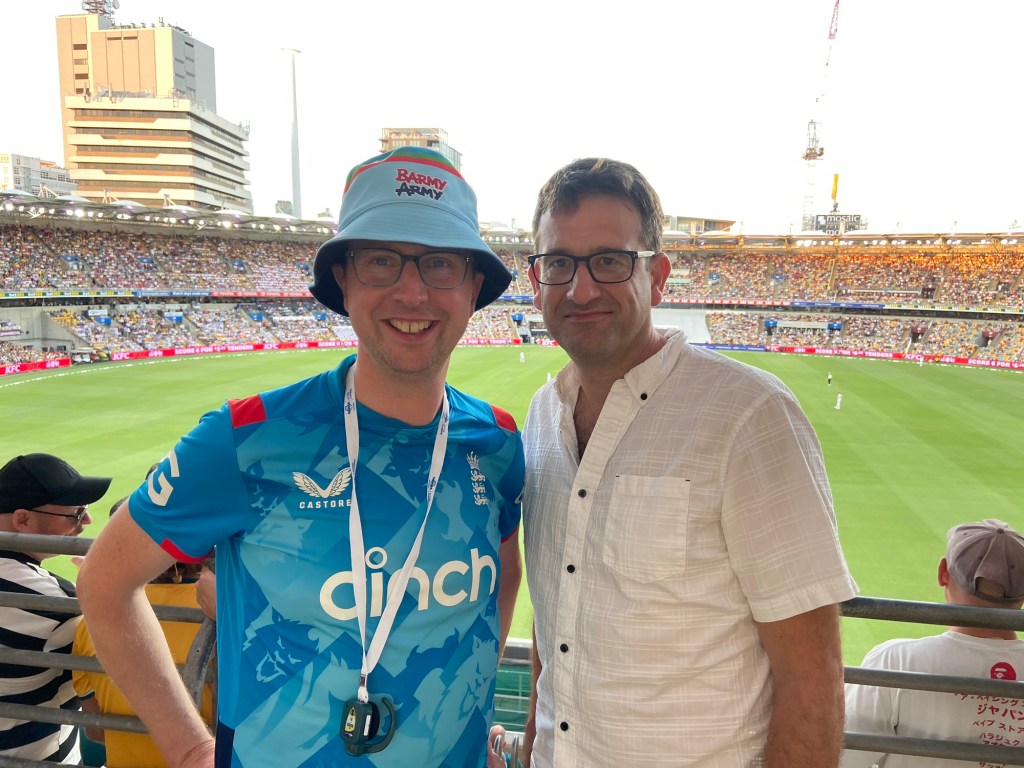
    The twelve hour wait certainly didn’t go quickly, but once a patch of grass had been claimed, it was possible to walk about, visit food stalls and mingle with people. I had a long chat with some Watford fans, and shorter ones with various other groups, which helped pass the time. I managed to fall over while leaning on a barrier, which proved to be a slightly embarrassing icebreaker with an American family, and my Barmy Hat attracted the attention of the stewards (especially those who’d witnessed my fall…)!

    There was a shorter, aboriginal-themed display at 9pm. Bats were also putting on their own display between the trees!

    At 11pm, the estimated one million people gathered around the harbour rose and fell silent to remember the victims of the Bondi attack: a powerful and poignant moment.

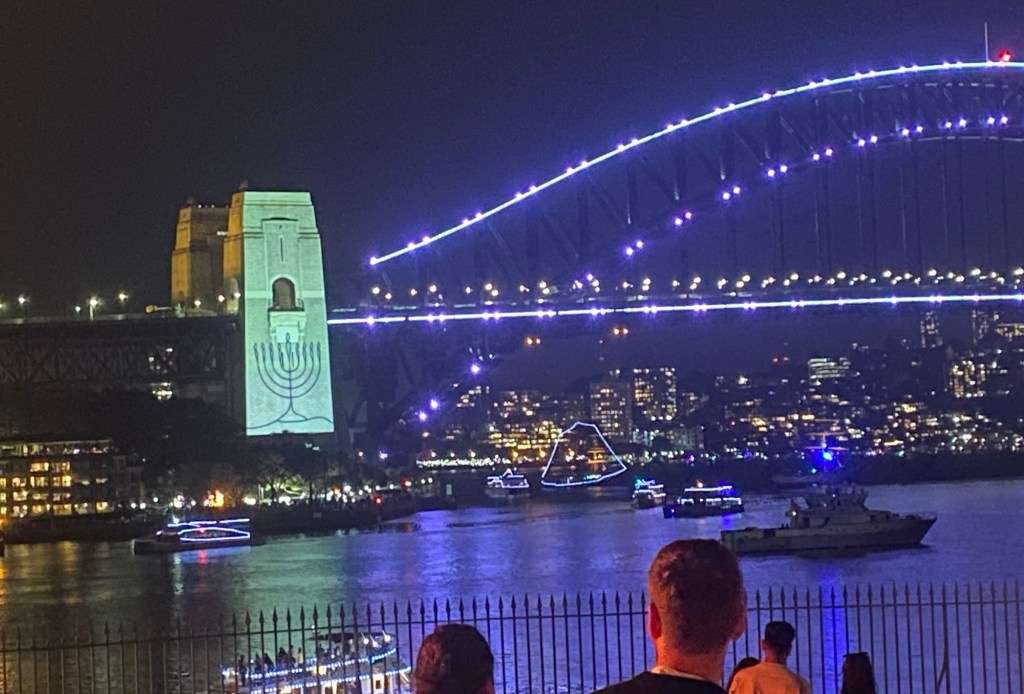
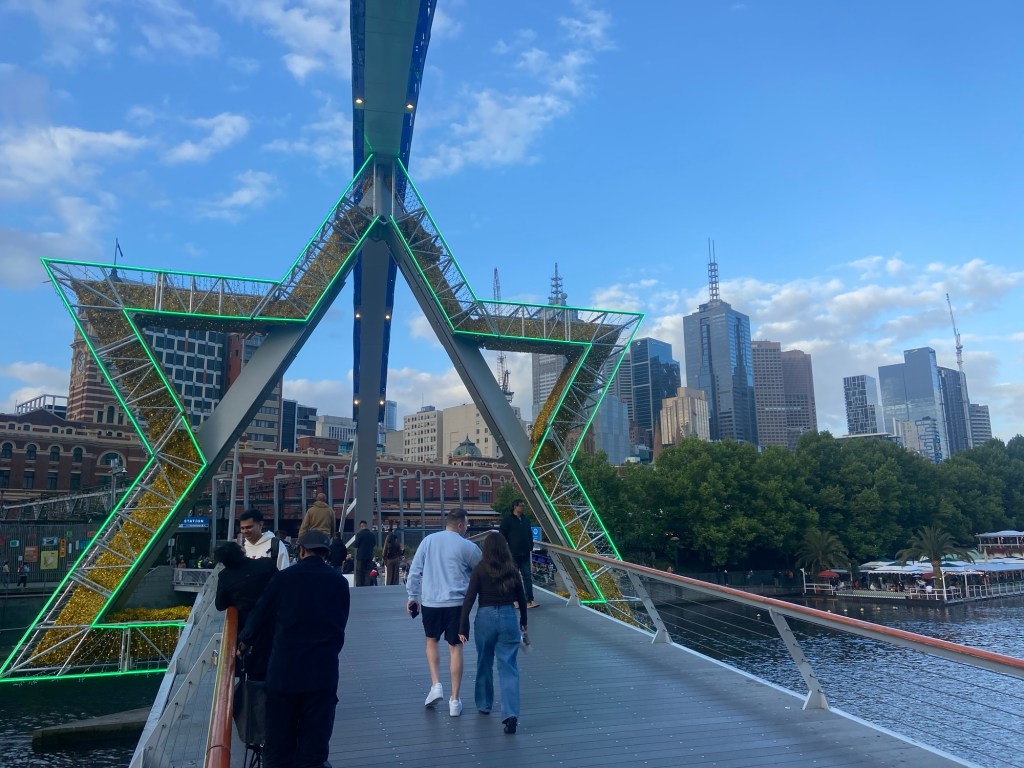
    A menorah appeared on the bridge during the silence. The tragedy at Bondi has dominated the news for much of my stay (replacing the social media ban for under 16s, which had been the main talking point after its introduction in early December)

    A fleet of colourfully lit boats also paraded around the harbour, in significantly greater numbers than I managed to capture in this photo:

    At midnight, the much anticipated display began. It was spectacular. Here are a few highlights:

    The finale!
    Happy New Year 2026!

    At the end of the display, I joined the masses leaving the harbour, and arranged a late checkout from my hostel, to make the most of the last bed I’ll see for 48 hours!

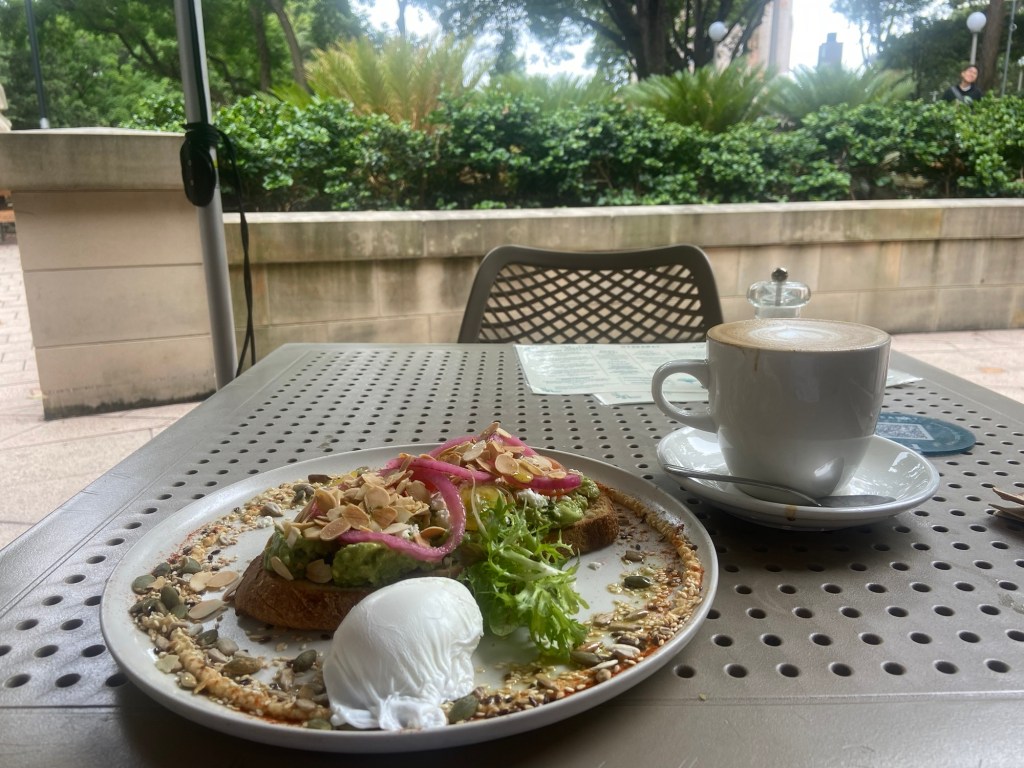
    I had a relaxed New Year’s Day in Sydney before heading to the airport: a final smashed avo brunch, a bit of souvenir-hunting and a catch-up with two of the Barmy Army members who’d sat next to me throughout the Brisbane Test.

    Reprising the Brydon Carse chant for a final time on the trip!

    I am now at Sydney Airport, awaiting my flight to Abu Dhabi, from where the next stop will be London!

    Here’s a final message from Australia, as I prepare to complete my circumnavigation of the globe…

  • The Great Ocean Road

    After a day exploring the coast to the east of Melbourne, for completeness sake I decided to join a tour heading west! It was another long day, but well worth it for the sights we saw.

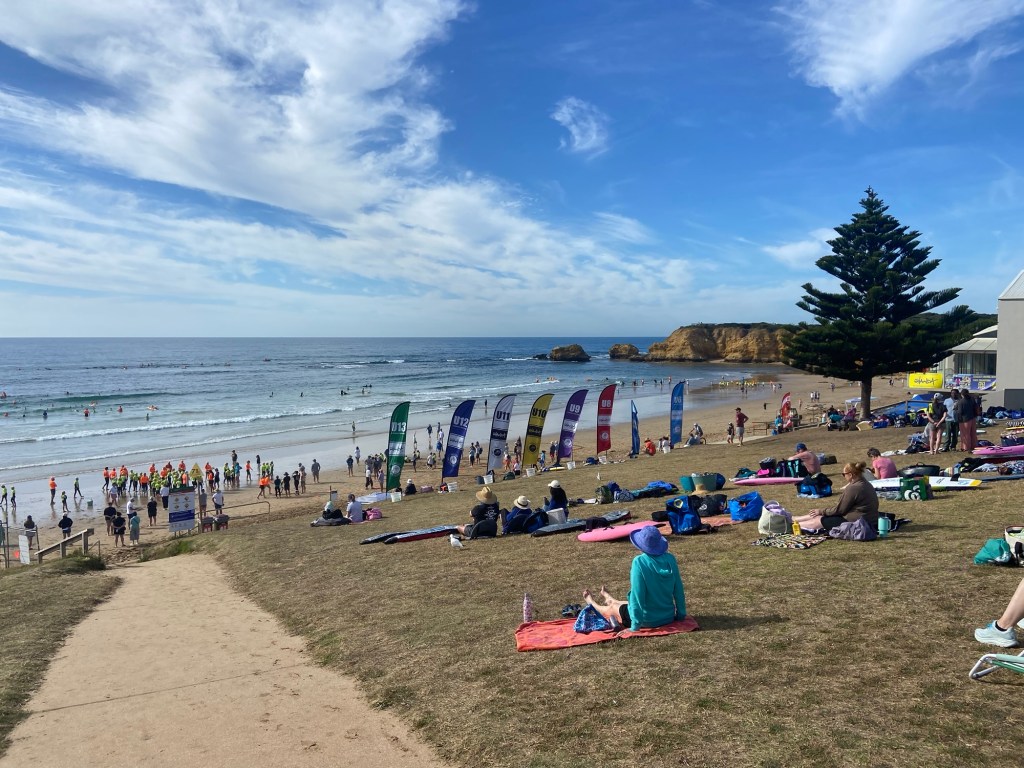
    Our first stop was at Torquay beach – somewhat different to its Devon namesake! At the heart of the Surf Coast, it is the birthplace of famous brands like Rip Curl and Quiksilver, which can’t be doing that badly given the number of people we saw in the water…

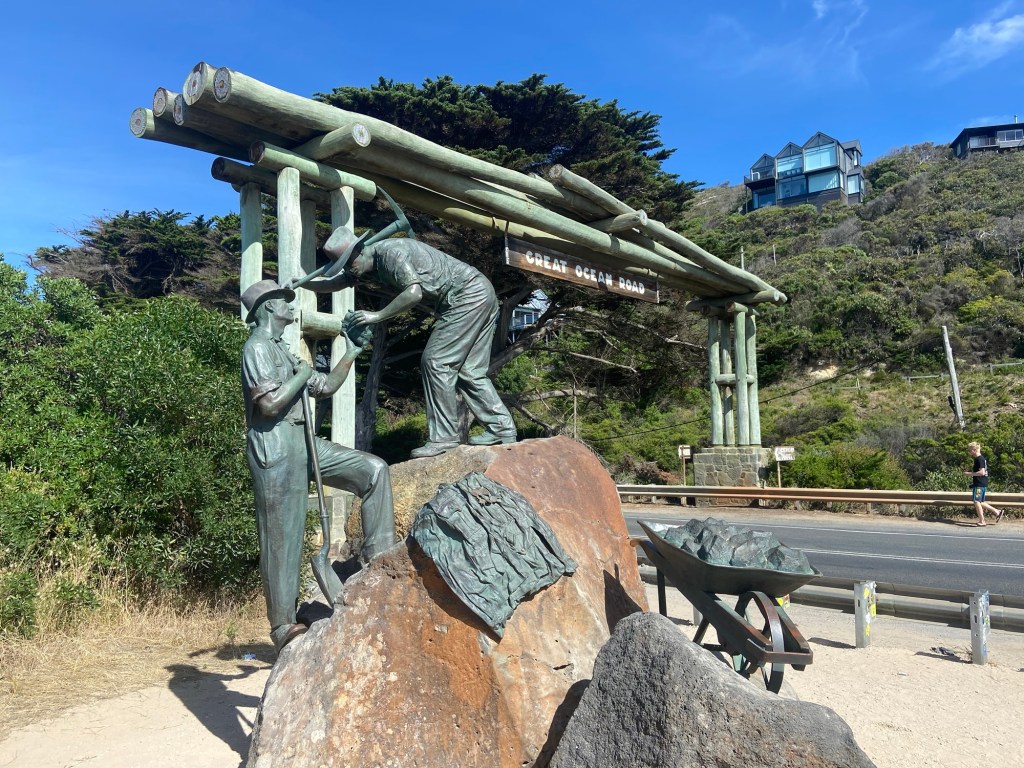
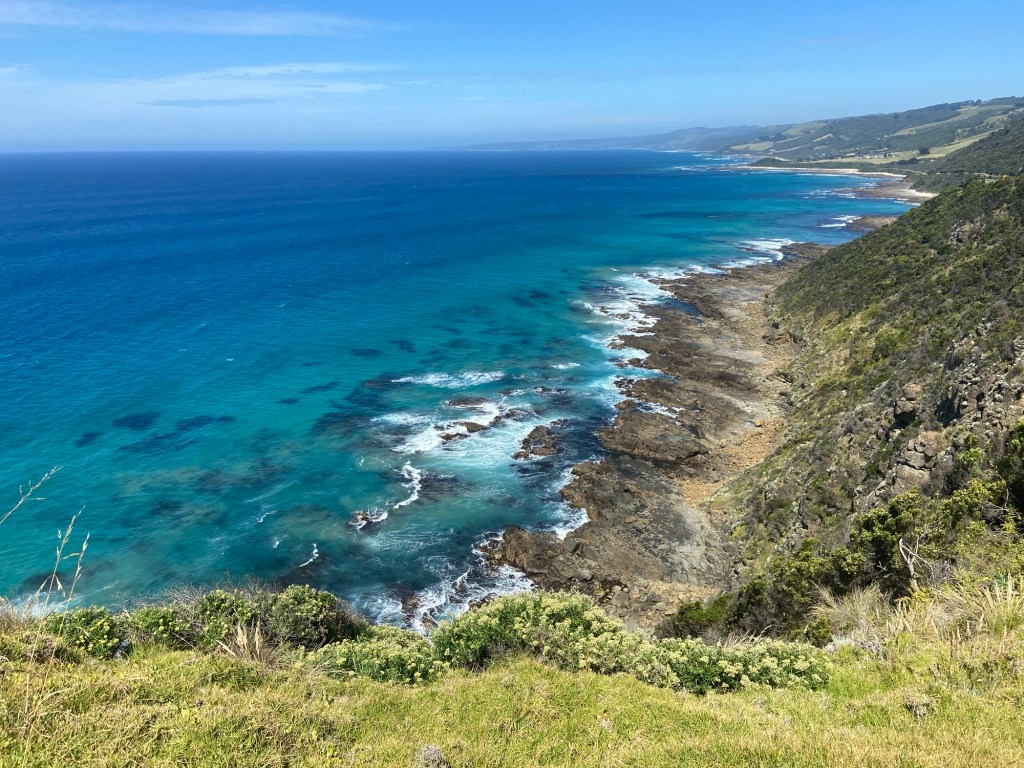
    We then picked up the Great Ocean Road. Largely built by returning Anzacs after the First World War, it is both an impressive feat of engineering and one of the world’s great scenic drives.

    We had lunch at Apollo Bay, which was teeming with holidaymakers: it now being the busy post-Christmas period. I left my phone charging on the bus by mistake, so didn’t get any pictures and had to be lent money for lunch! But my hour there was spent eating scallop rolls with Matt and Lottie, a couple from England with whom I quickly connected, and a stroll on the beach, on which I was heartened to see that cricket was the sport of choice!

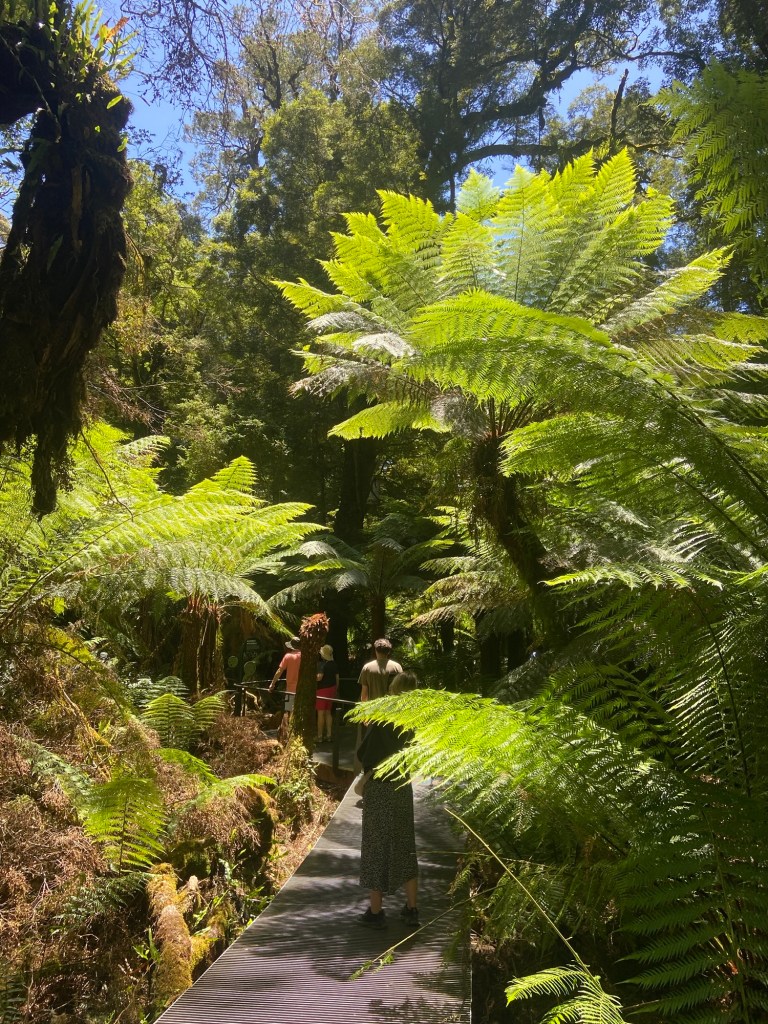
    Our next port of call was Mait’s Rest, a beautiful spot in the temperate rainforest where we went for a circular walk. With the warm air temperature and gentle sights, sounds and smells of the woodland, I found our time there very relaxing and a reminiscent of other rainforest experiences earlier in my trip.

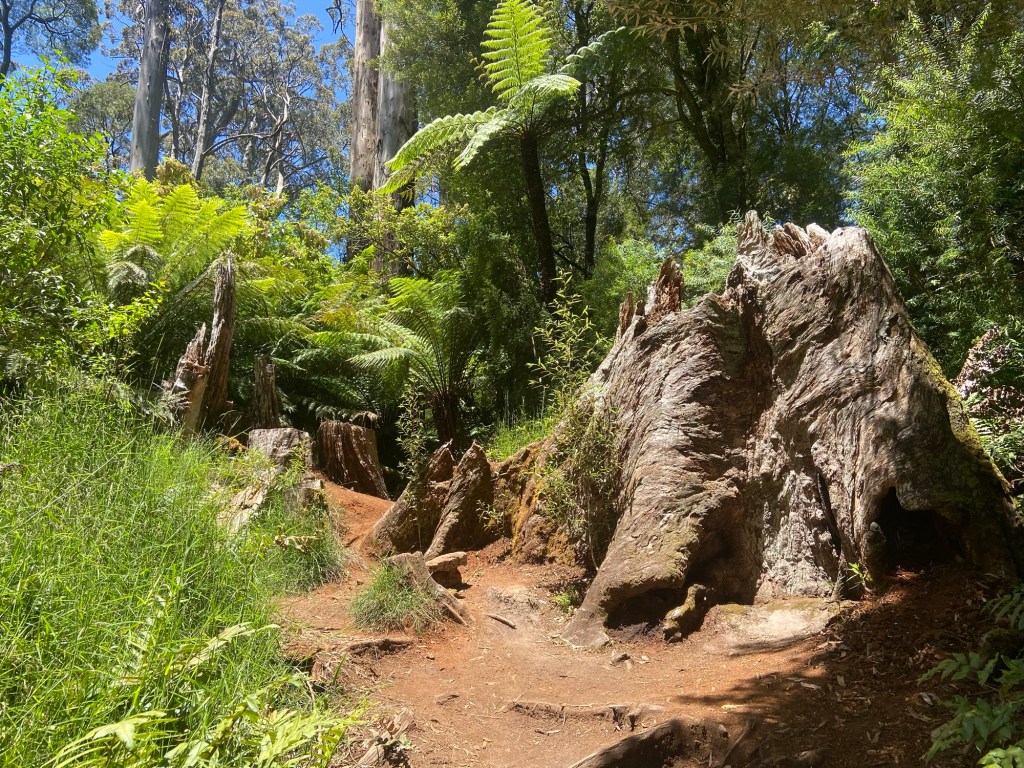
    One of the huge eucalyptus trees visible through the ferns

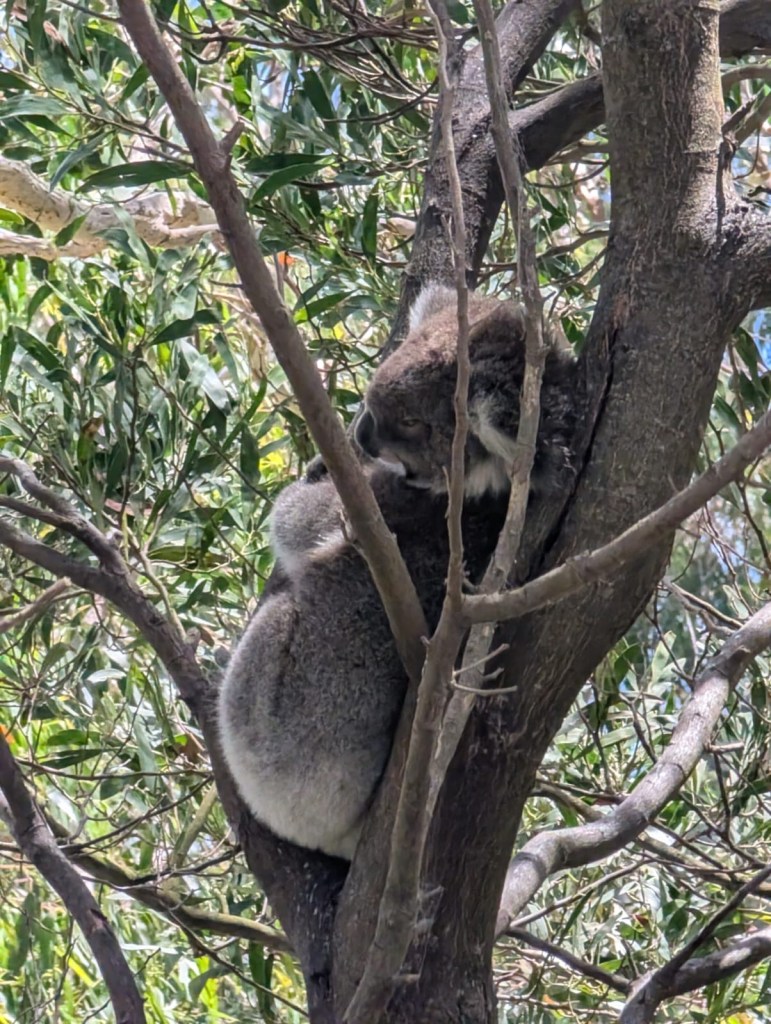
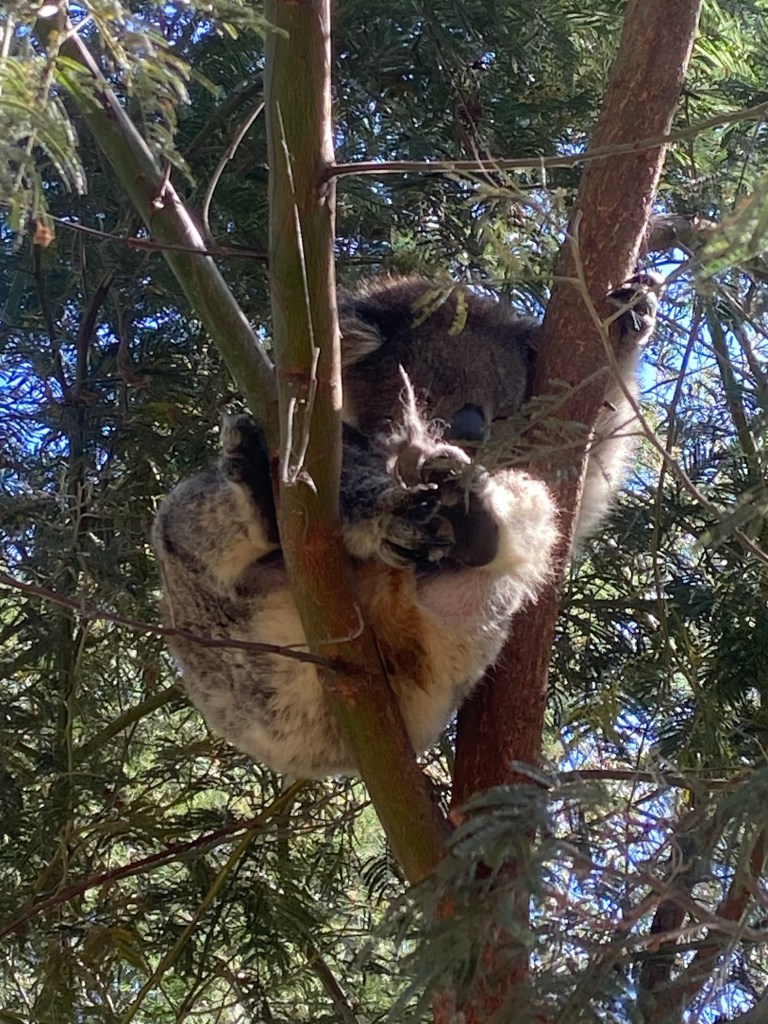
    We made a few extra stops for wildlife sightings, with wild kangaroos and koalas appearing by the side of the road.

    I only got pictures of the koalas!

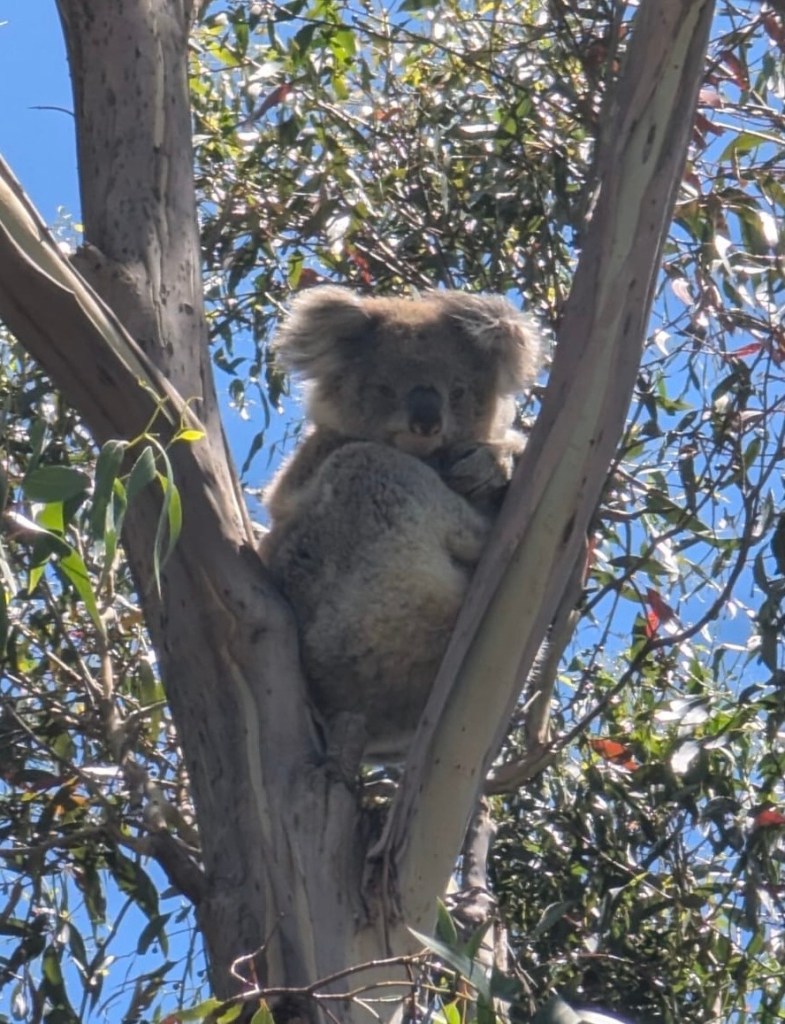
    As marsupials, both species keep their young, joeys, in pouches before gradually giving them more independence. Remarkably, koala joeys move from womb to pouch when only the size of a jelly bean! I had been on the look out for a (larger) joey throughout my stay, and finally found one during one of our roadside stops:

    The joey had been on its mother’s back before climbing up the branch towards the leaves

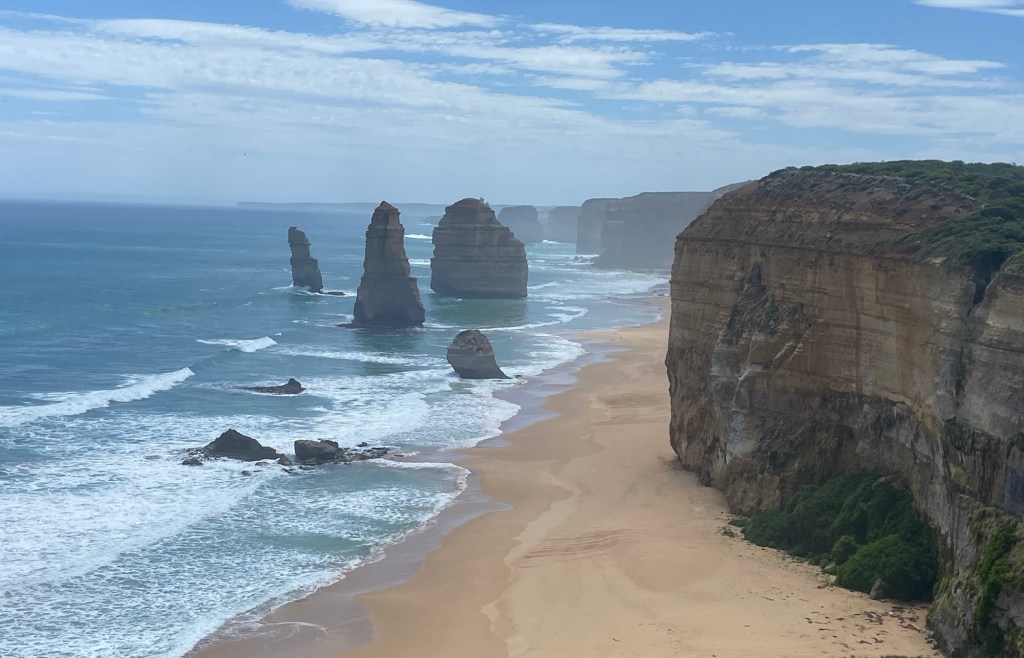
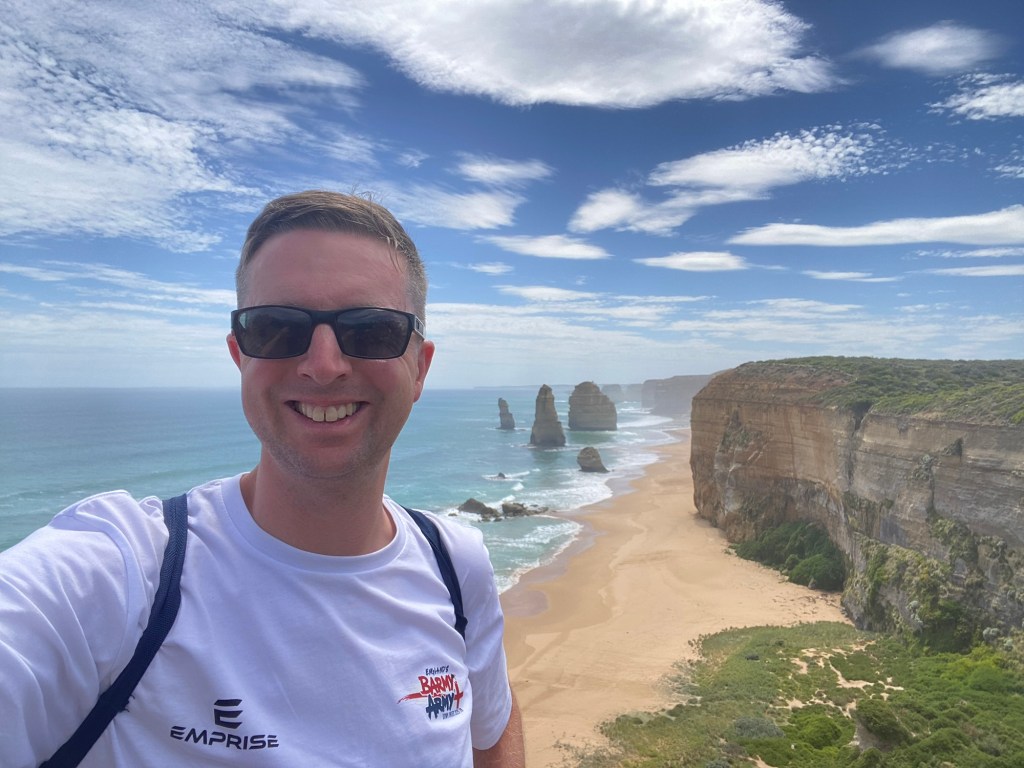
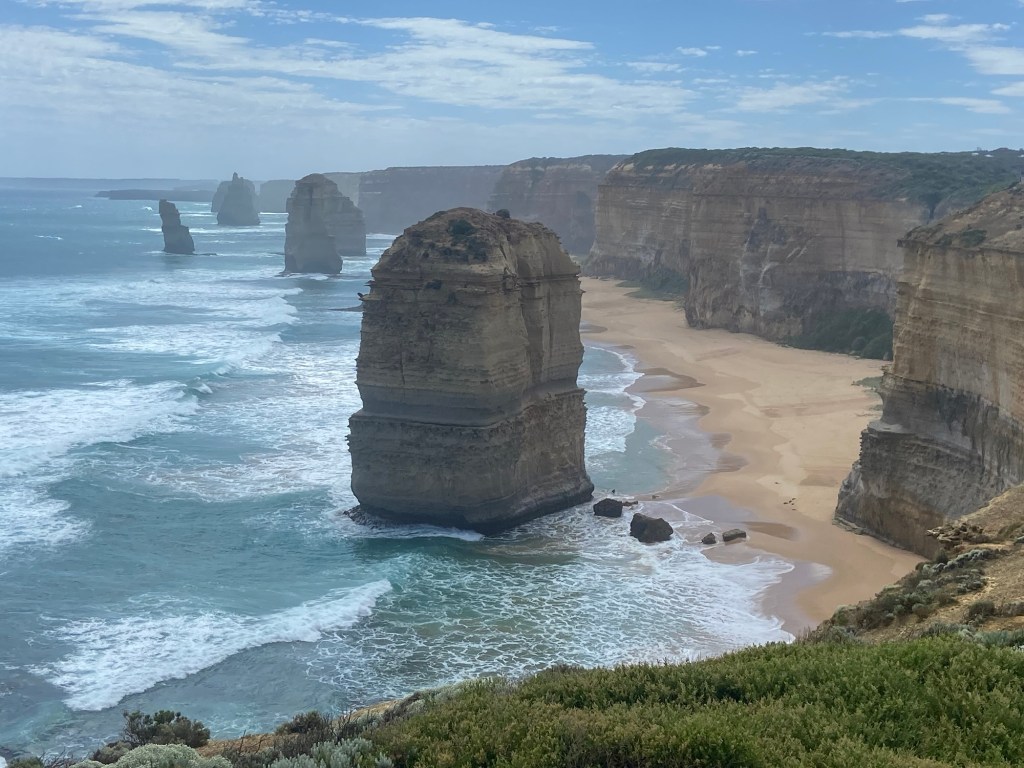
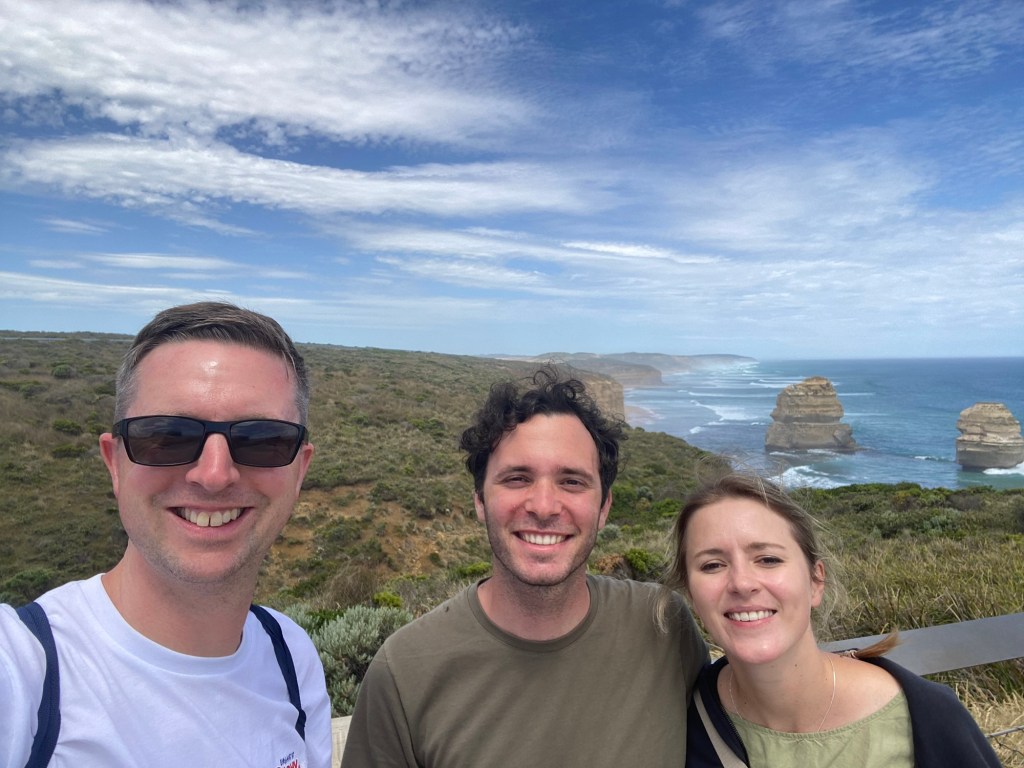
    The star attraction of the Great Ocean Road is The Twelve Apostles. This sequence of limestone stacks, of which there are actually seven (but the number changes as coastal erosion takes its course), stand imperious above the sand and sea. We didn’t have long to take in the scene at the viewpoint before needing to get back to the bus, but it had certainly lived up to the hype!

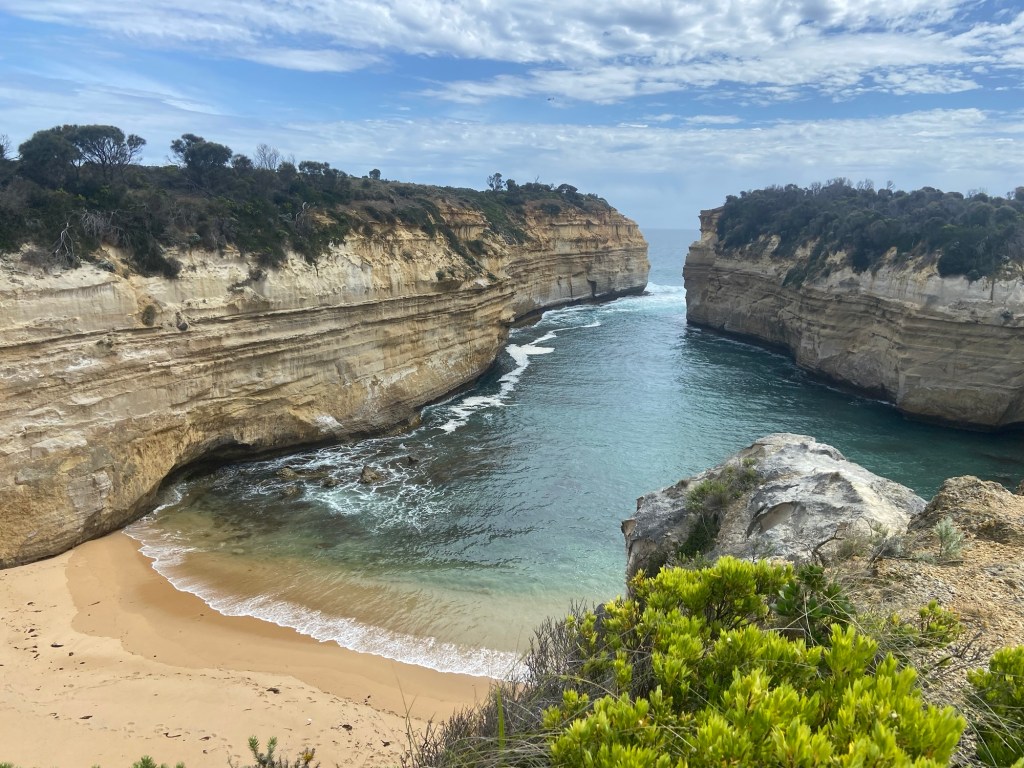
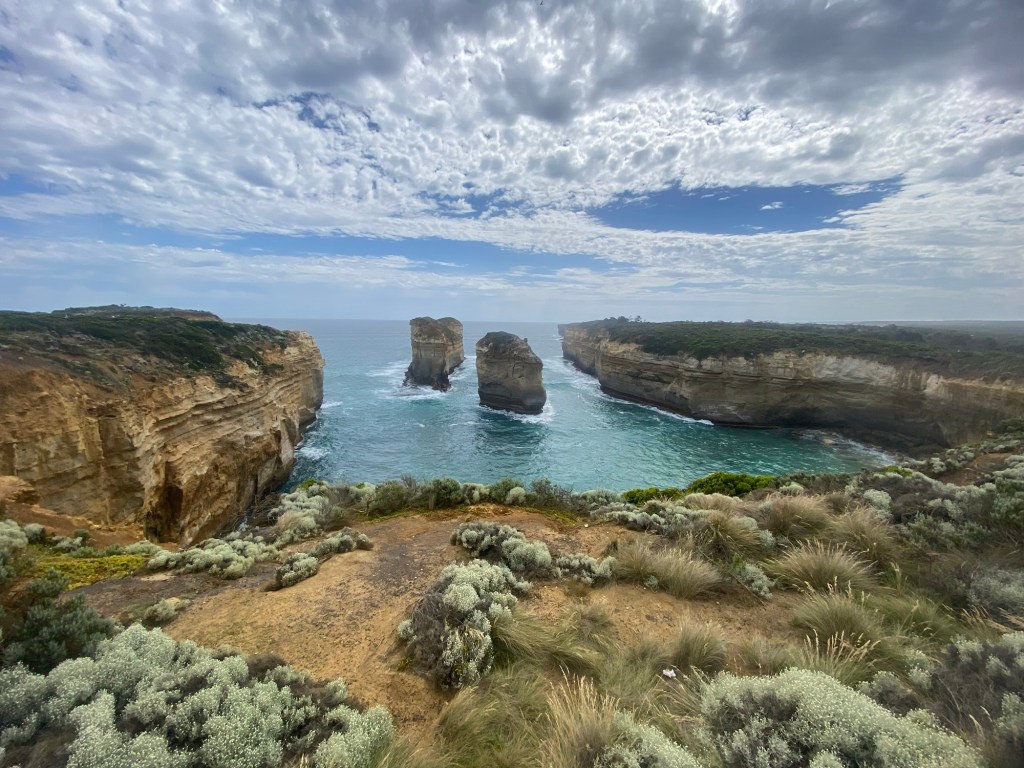
    Before returning to Melbourne, we paid a brief visit to Loch Ard Gorge on the notorious Shipwreck Coast. Here the Scottish clipper Loch Ard ran aground in 1878, with only two survivors – who took refuge from the storm in a cave next to the beach.

    Tom and Lottie were very entertaining company and back in Melbourne we extended the day by another five and a half hours over dinner and in a couple of Barmy Army pubs: most enjoyable!

    Meeting folk like these two has been an absolute highlight of travelling for me

    I left Melbourne with something of a heavy heart, as my week in Australia’s most populous city has been incredibly good fun. I’ve met so many great people, in the hostel and on trips, reconnected with others, seen some unforgettable sights and sport – and celebrated Christmas!

    And so to my last internal flight of the trip: a short hop back to Sydney for New Year. Australia’s transport system is so well connected that this is almost as simple as taking the train – or maybe I’ve just learned the routine after two months travelling… I’ve certainly enjoyed the experience of navigating my way around this country, as I did in South America.

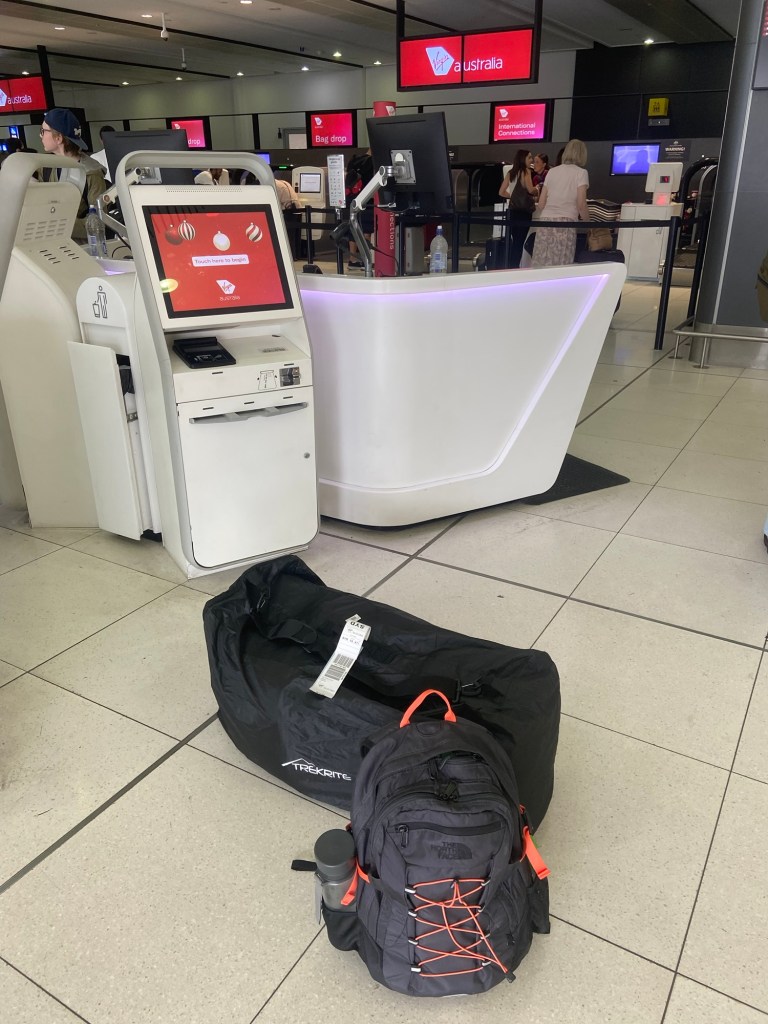
    Bags become faithful friends to backpackers, but I am particularly glad to have the large black one, as it accommodates my rucksack and all the additional detritus I can’t fit into it!

    I’m hoping the festivities at Sydney Harbour prove a fitting finale to my adventure.

  • Philip on Phillip Island

    130km from Melbourne, Phillip Island is a wildlife lover’s dream. On Sunday, after enjoying the complimentary breakfast at the hostel and going to church, I joined a tour there and thoroughly enjoyed ticking off some more of Australia’s animal A-listers!

    After braving the holiday traffic, our first port of call on the island was the Koala Conservation Reserve. Though not native to the island, these iconic animals have a healthy population there and throughout Victoria, unlike in other states, where the devastating forest fires of 2019 took a heavy toll on their numbers.

    The word koala comes from an aboriginal word meaning “no drink”, as their only water source, and indeed food source, is gum tree (eucalyptus) leaves. These only give them sufficient energy for activity a couple of hours a day, so they spend much of the time asleep and wedged snugly between gum tree branches.

    From the Reserve’s raised walkways, we saw several of these teddybear-like creatures, including this one chewing on gum leaves
    It is mating season, and this male was unusually animated as he tried to attract a nearby female!

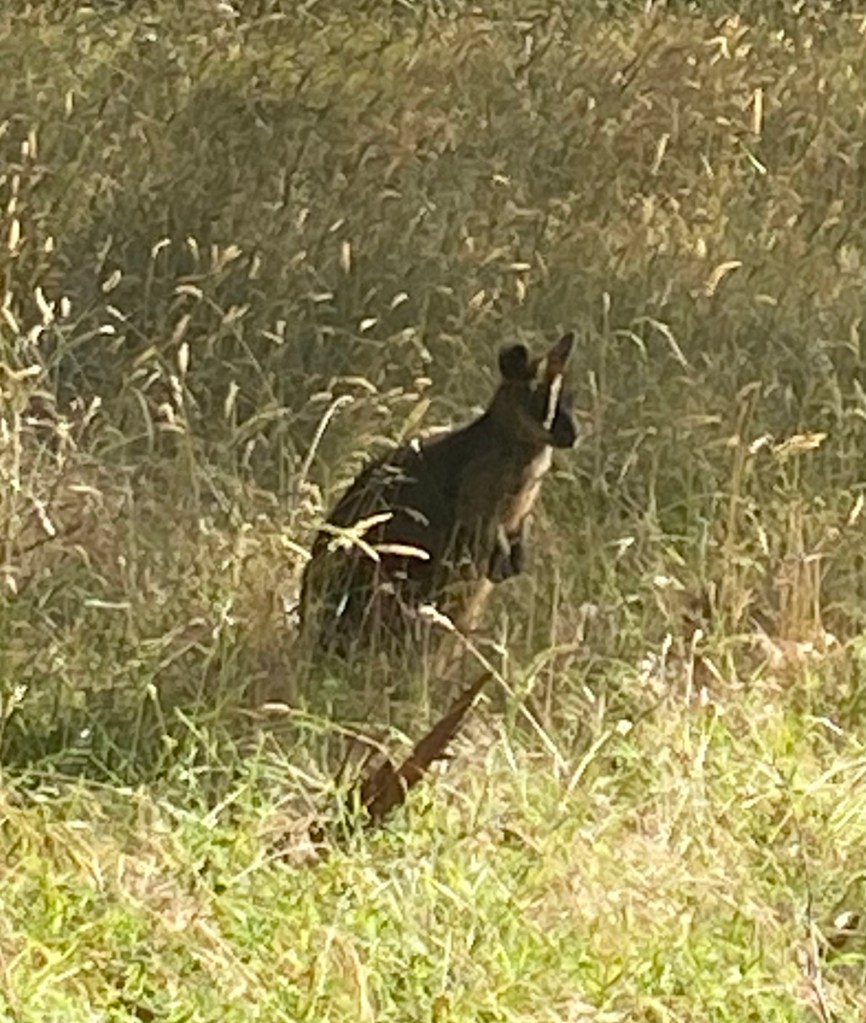
    Phillip Island also has a large population of another favourite marsupial, the wallaby. Smaller than kangaroos, they hop around much like their cousins and we saw several in the wild as we drove around the island.

    My closest encounter was this with this one in the Reserve though. Once again, just as I made my way to the exit!

    At the Reserve, we were also on the look-out for echidnas, but to no avail. Whilst driving we were treated to a roadside encounter with one though:

    These fascinating animals are only found in Australia and New Guinea, and alongside their nearest relative, the platypus, are the only egg-laying mammals (monotremes) in the world. They are covered by quills, but, despite appearances, are only distantly related to hedgehogs.

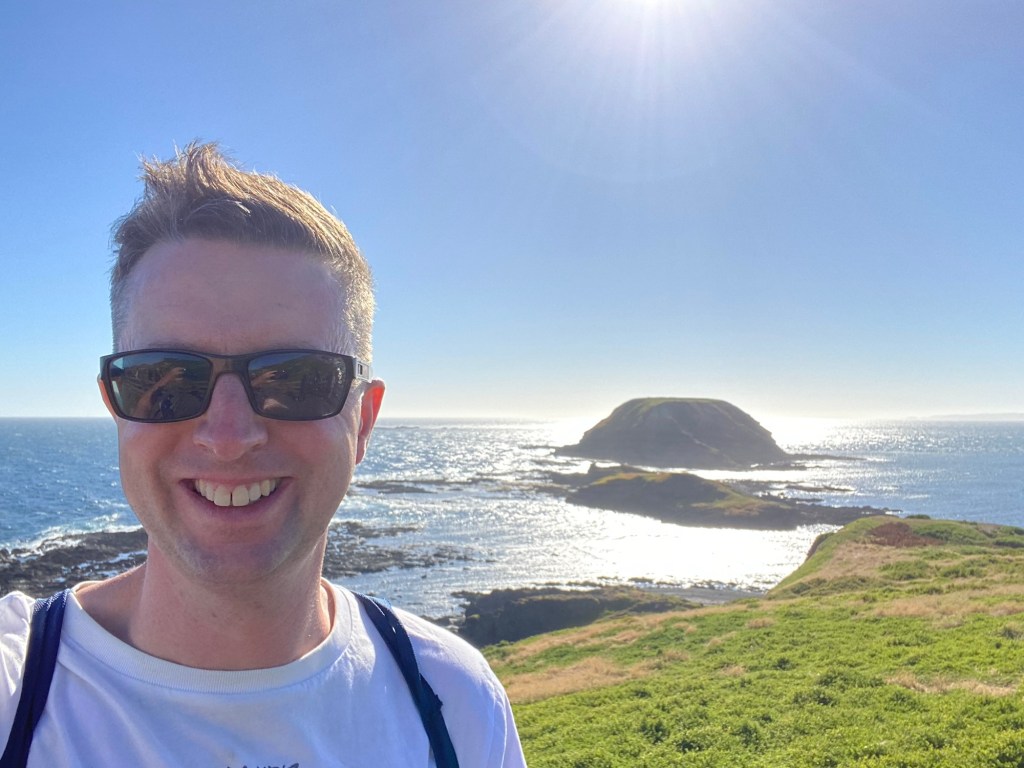
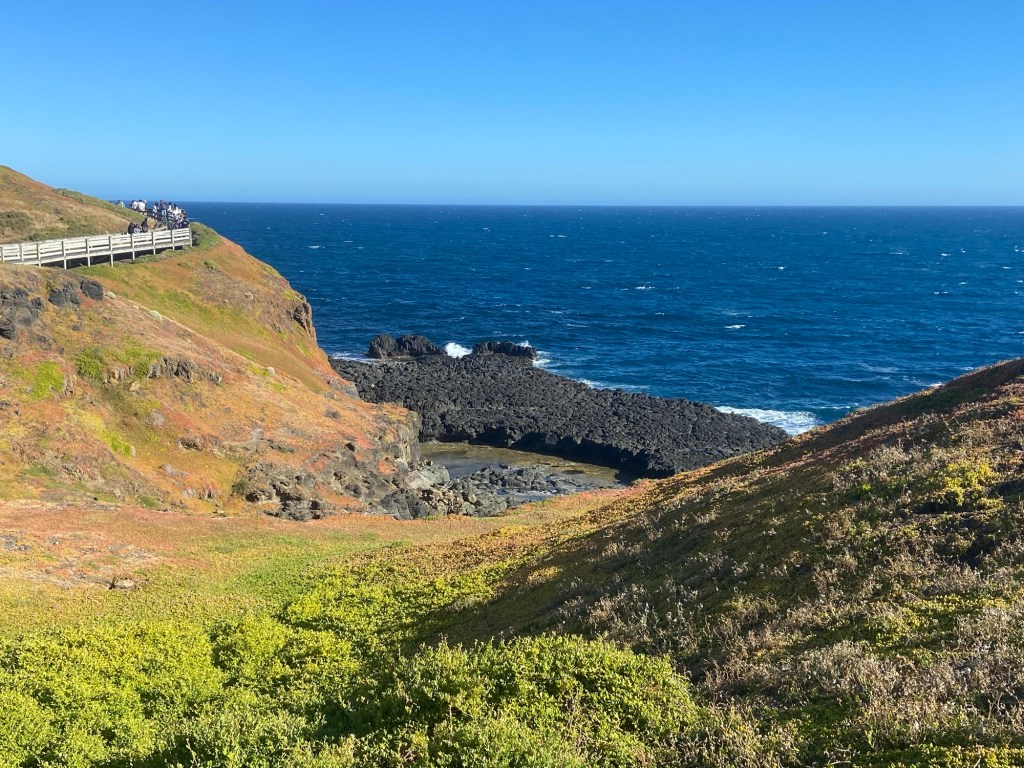
    From the Reserve, we headed to the peninsula at the furthest end of the island, which culminates in rocky outcrops known as The Nobbies. A boardwalk affords views of the stunning coastline, which looked particularly majestic in the evening sunshine.

    The Bass Strait, seen here, separates the Australian mainland from Tasmania
    These basalt pavements reminded me of the Giant’s Causeway

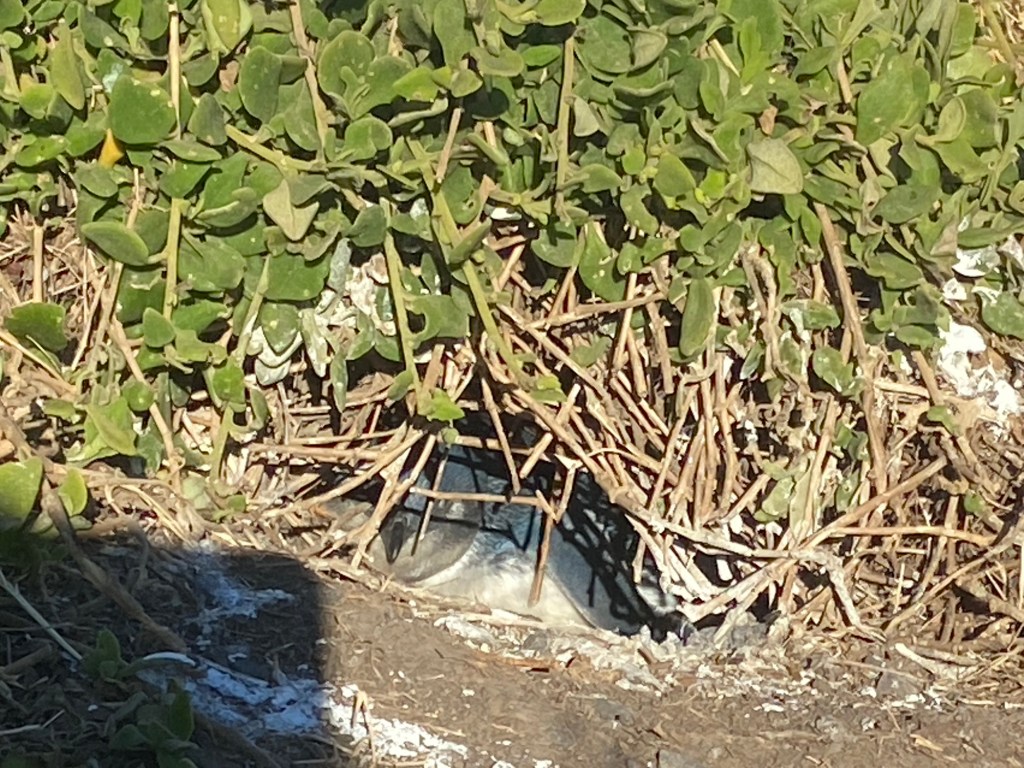
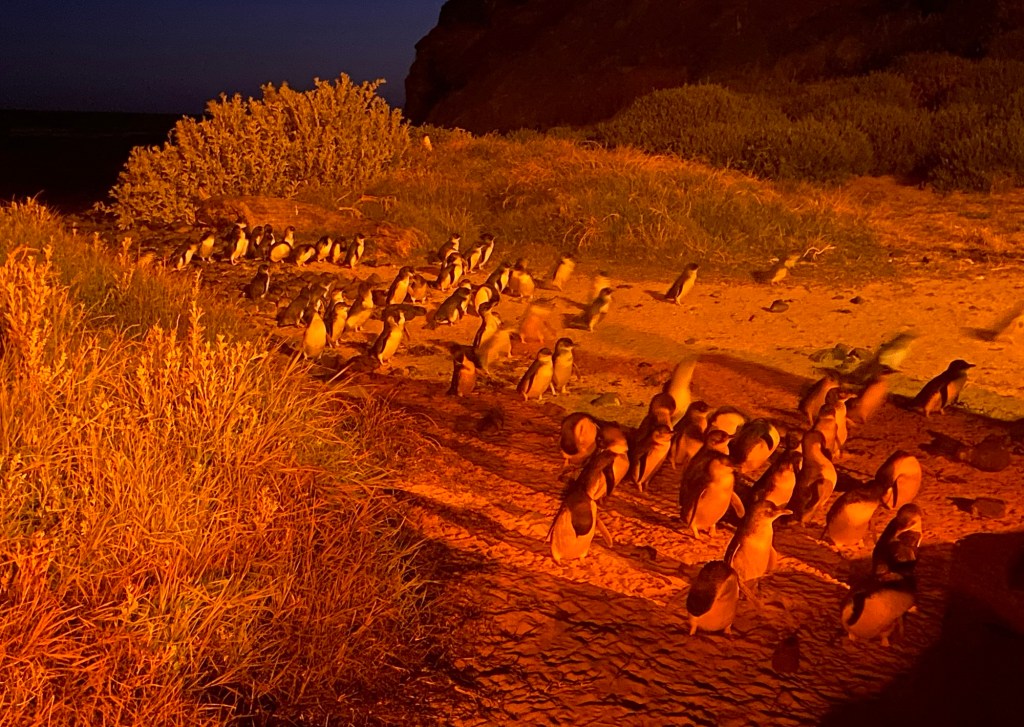
    Phillip Island’s best known resident is the Little Penguin, and the Nobbies Peninsula is home to many of their burrows. Having not seen any from the boardwalk, I wandered down the road a little way and was excited to stumble across this little fellow!

    Phillip Island’s most famous spectacle is the nightly Penguin Parade. Most evenings, just after dusk, a couple of thousand Little Penguins emerge from the waters at Summerland Bay, socialise and waddle chaotically to their burrows. It is a remarkable sight to behold, and ticketed seating has been installed to view it:

    We saw some sea eagles near this spot, but they evaded my camera lens!

    Waiting for the Parade at the visitor centre, with fish and chips and a glass of wine, felt a bit like the preamble to a West End show. When the performance finally began, the cast put on a stellar performance (quite literally, under a starlit sky).

    There is something very endearing about these flightless birds. Maybe that’s because it is easy to anthropomorphise them with their upright stance. Maybe it’s due to how clumsy they are as they stumble their way over the rocks. Maybe it’s the enthusiasm of the chicks as they approach every passing adult in the hope they’ve found a parent (parents are able to recognise their young but not vice versa)…

    Whatever the reason, I was transfixed by them and lost track of time, almost missing the bus (most unlike me…).

    Phillip Island is a real conservation success. Penguin numbers were plummeting with heavy development on the Nobbies Peninsula, but over several decades the whole area has been rewilded and the penguin colony is healthy again.

    As on other tours, another highlight of this one was meeting fellow group members. I was paired with the other solo traveller, a girl from Buenos Aires, on the bus, so we had plenty to discuss! And there was yet another WBGS alumnus, although not one I’d taught this time.

    We got back to Melbourne at midnight and I settled down for a short night ahead of my next tour, which was due to depart the next morning at 6:45am!

  • The Boxing Day Test

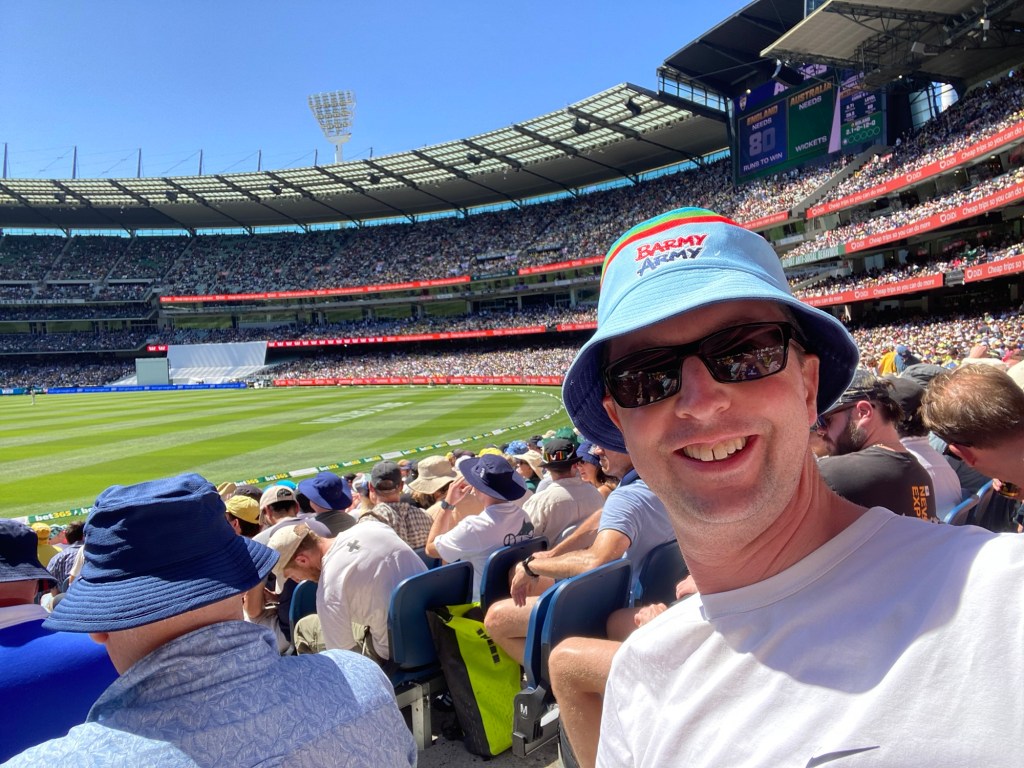
    In the early hours of the morning one Tuesday in June, I joined the queue to try and get tickets for Boxing Day at the MCG (Melbourne Cricket Ground), the showpiece day in Australian sport. Happily I was successful, and so I was able to be present for the thrilling and record-breaking 2025 edition of cricket’s big day.

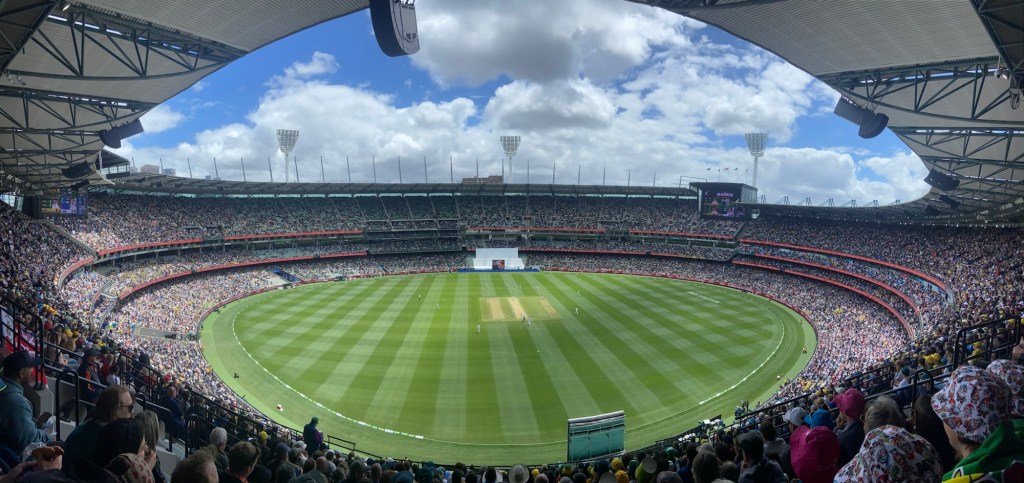
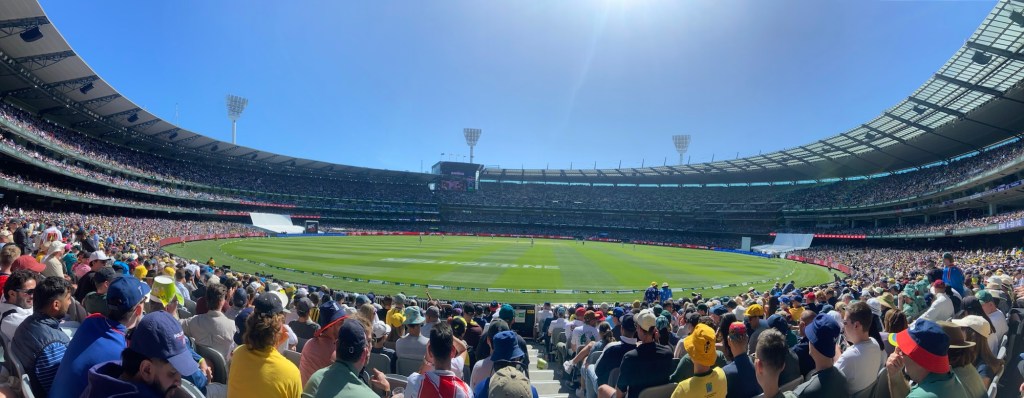
    Boosted by a huge influx of English fans, the attendance of 94,199 was a record for a cricket match at the “G”, the largest stadium in Australia. 20 wickets also fell in the day for the first time in an Ashes Test since 1950. The pitch has come under considerable criticism for this, but it did lead to a contest in which it felt something could happen with every ball!

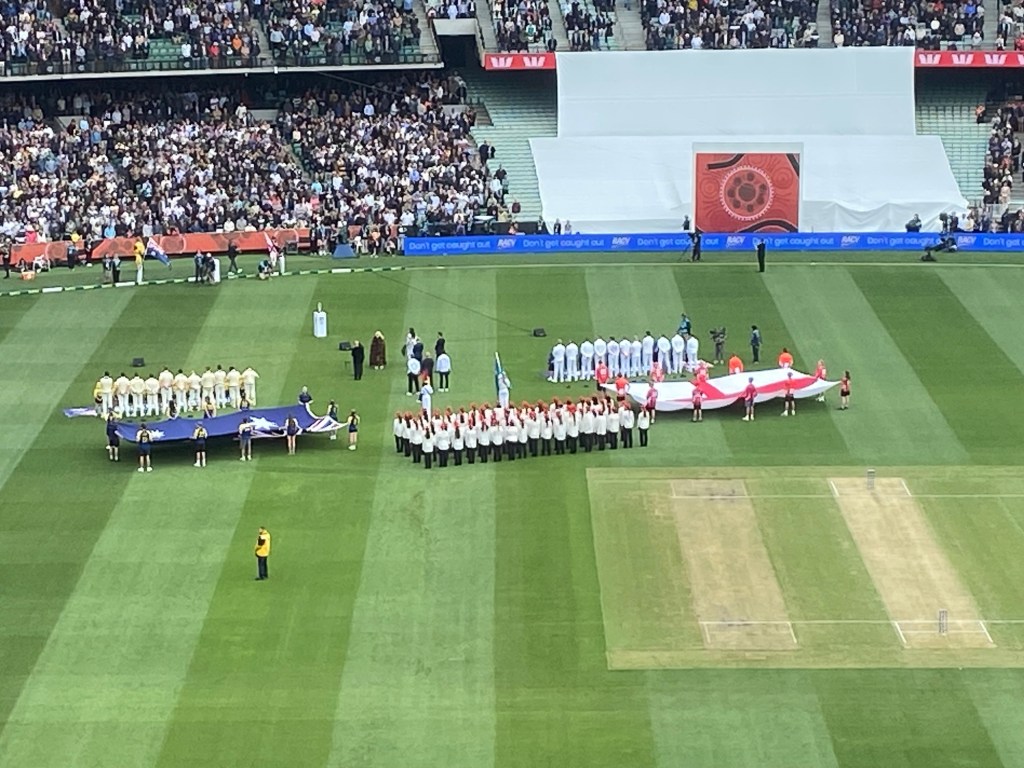
    The teams lining up for the traditional indigenous “welcome to country” ceremony, which took place to the strains of a didgeridoo, and the anthems

    Given how many had been in front of me in the ticket queue, I was pleasantly surprised by the view from my seat, almost behind (or here in front of) the bowler’s arm:

    I enjoyed watching the Australian wickets fall throughout the morning from this elevated vantage point, but after lunch I decided to join the swelling section of England fans on the concourse behind the Barmy Army. Here I met my former students again, and discovered various other WBGS groups were there, so it became a surreal afternoon of school reunions on the other side of the world from Watford.

    It was also considerably warmer when I later found a spare seat in the sun!

    The evening session made for less enjoyable viewing for England fans. Our batting looked chaotic and we fell 42 runs short of Australia’s (albeit meagre) total. The last English wicket fell at 5:49pm, meaning that after the 10 minute innings break, there was a minute left in the day’s play to start the first ever Third Innings to take place on Day 1 of the Boxing Day Test.

    Australia’s number 11 and hometown hero, Scott Boland, was brought in to open the batting and a frenzied over ensued, with Boland blocking the first 5 deliveries, before hitting the last ball of the day for four. The MCG erupted, and wry smiles decorated English faces…

    On the way back to the hostel, I decided tennis may be a less cruel mistress than cricket, so I took a detour via Melbourne Park, the home of the Australian Open. 2026’s first grand slam is only a fortnight away, so the venue was being spruced up, and I was surprised that it was quite so accessible!

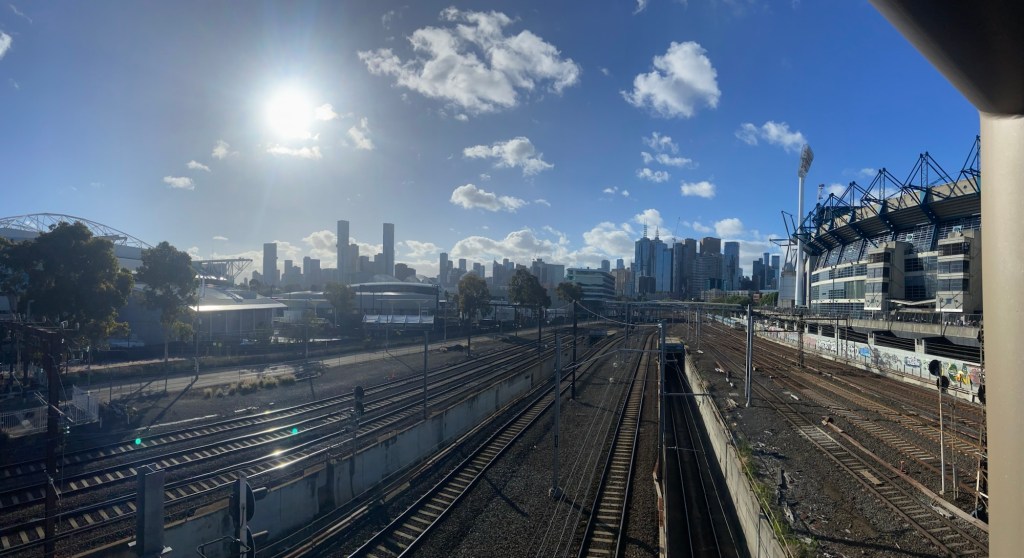
    Melbourne Park (on the left) is “the other side of the tracks” from the MCG. I’m not sure if anything can be read into that!
    The Rod Laver Arena is Melbourne Park’s Centre Court
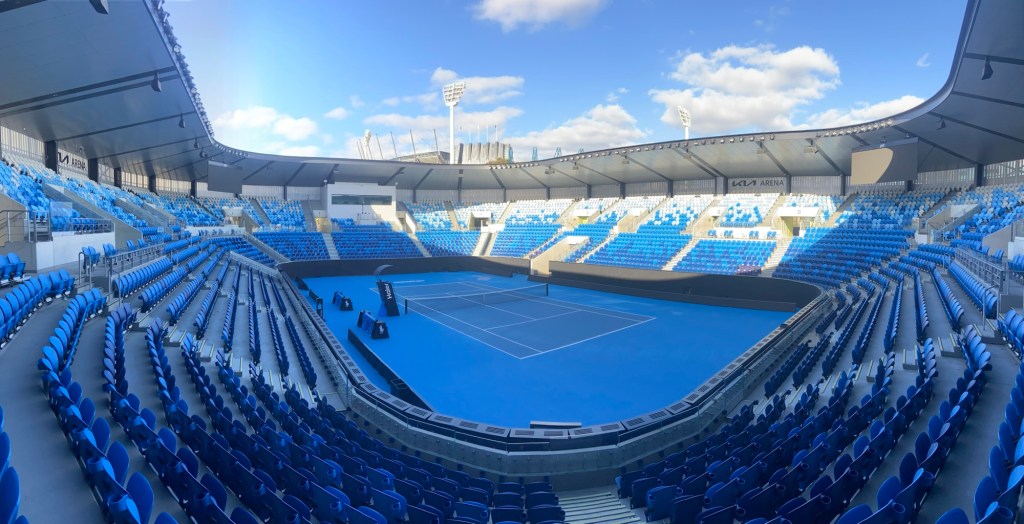
    The gates of the Kia Arena were open when I walked past, so I thought I’d have a peek inside!

    I hadn’t bought tickets for Day 2 of the Test Match and so had my happy reunion with Chantal instead. I kept half an eye on the cricket though and realised Australian wickets were tumbling in the Third Innings. With Chantal’s encouragement, I decided to take the train with her when she had to leave, but to disembark at the MCG. By now, it was Tea and England were batting. There was a stream of Aussie fans leaving early, fearing a rare defeat, and the first one I saw realised I was in pursuit of a ticket and generously offered his! I trotted to the ground, found another spare seat in the sun by the Barmy Army, and prepared to watch history (England hadn’t won a Test in Australia for a few days shy of 15 years).

    First though there was the tribute to Shane Warne at 3:50pm (350 being his Test cap number), which was planned to take place on each day of the Test Match. Fans of both teams tipped their caps in Warne’s trademark style, while the stadium echoed to the chant “there’s only one Shane Warne”:

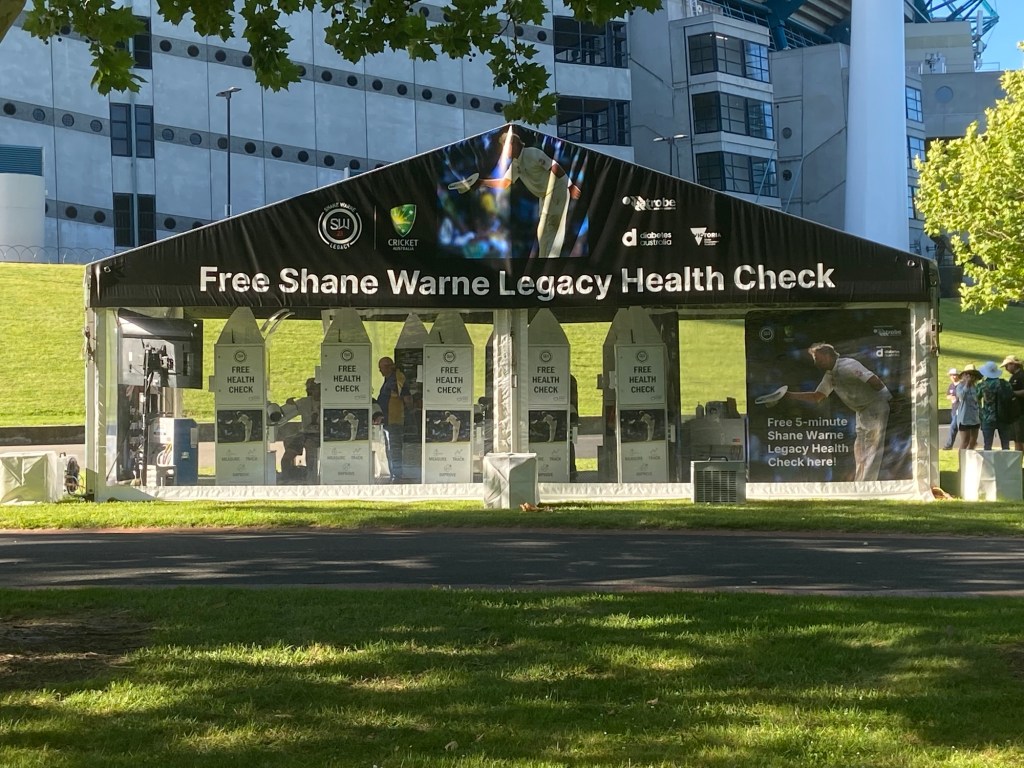
    Health checks were also been offered to fans in Warne’s memory, so I popped in for a quick MOT on the way out!

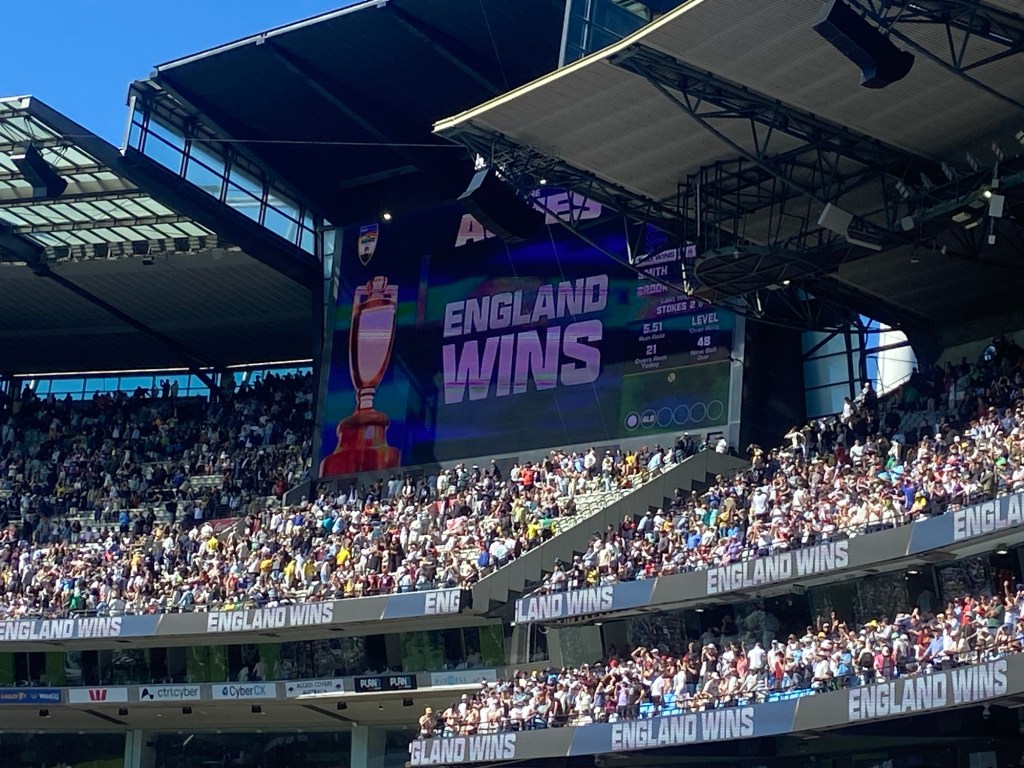
    England lost 4 more wickets after my arrival, but still had 4 to spare when they passed Australia’s total with leg-byes. Jubilant scenes ensued!

    The Barmy Army were still going strong a good 20 minutes after the moment of victory!

    I was having to pinch myself that I’d made it into the ground for this historic day. It also meant I’d attended every day of three Tests, despite having only bought a ticket to one day in Melbourne. My tickets for Brisbane and Adelaide were part of Barmy Army packages for all five days, so I’d also done pretty well to get four and five days of play respectively in these Tests, given the other two Tests had both ended within two days!

    The win clearly meant a huge amount to the players. Stokes and Root had never before won a Test in Australia and shared a now iconic exchange at the end. Root also walked to the middle by himself after his stadium interview, to blow a kiss to the Barmy Army, who had been singing his name throughout: a big gesture from a usually understated character! Root’s hundred in Brisbane and the victory in Melbourne bookended my eleven days of cricket and, in the absence of a series win, have been England’s best moments of the tour so far.

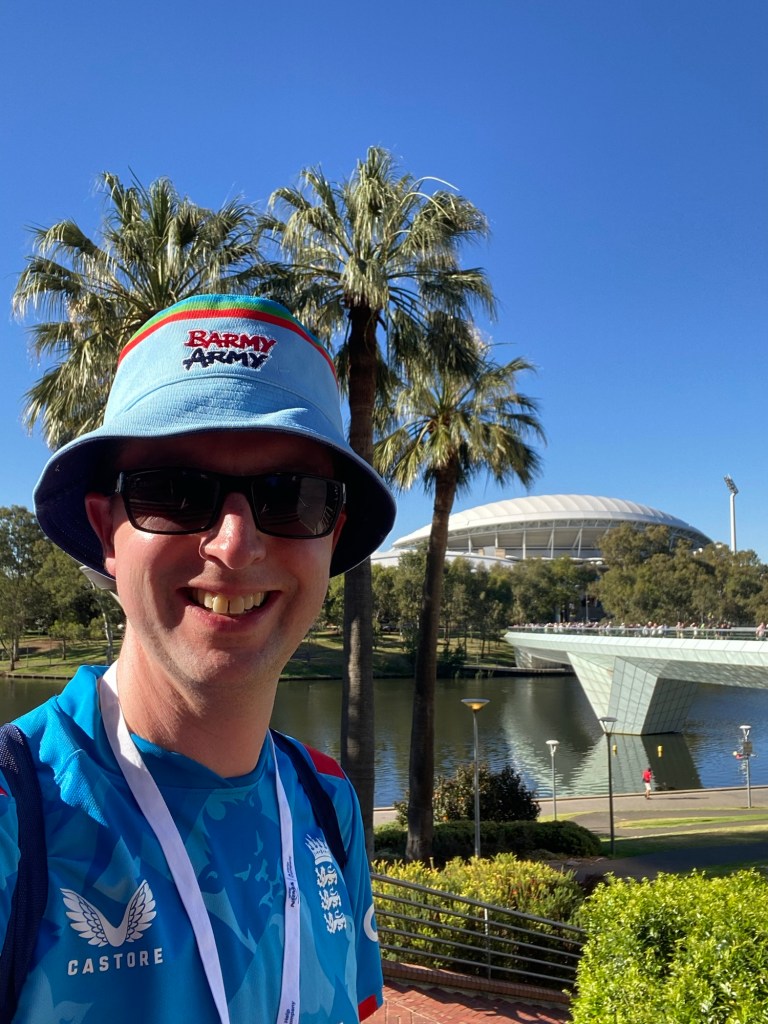
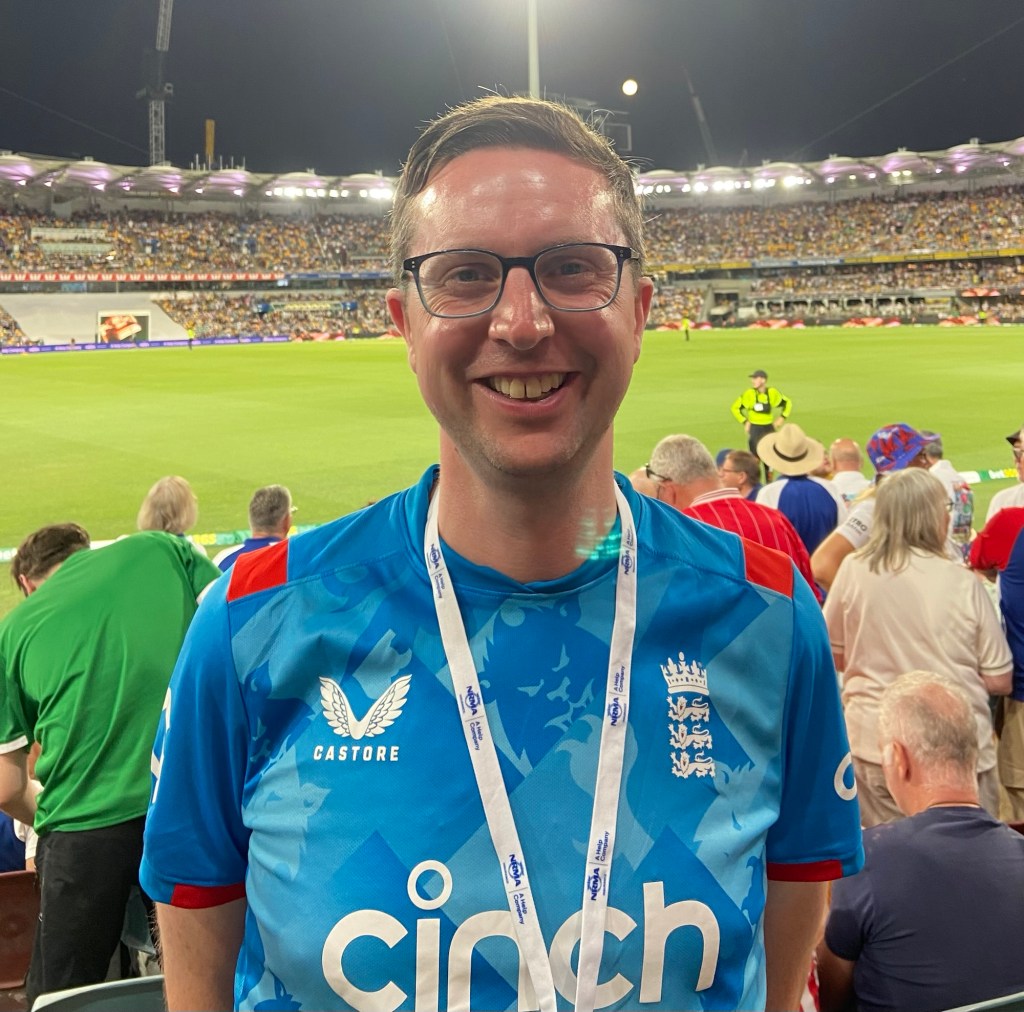
    It has been great fun travelling with the Barmy Army, and the passion and humour of the English fans seems to have really captured the imagination here. I’ve almost felt like a celebrity wearing my branded attire around the country, such has been the (usually!) friendly interest.

    This press release from the Lord Mayor of Melbourne captures both the intensity and the good feeling of the Ashes rivalry rather well

    True to the Lord Mayor’s warning, a group of us from the hostel decided we needed to head out to celebrate the day’s events. My only disappointment was that I left the Barmy Army bar a matter of minutes before Root and Stokes made a surprise appearance there themselves. But I’d met both in Brisbane, and it’s not as if I hadn’t had enough unexpected bonuses in the day. Or indeed throughout the previous 9 weeks…

  • A Melbourne Christmas

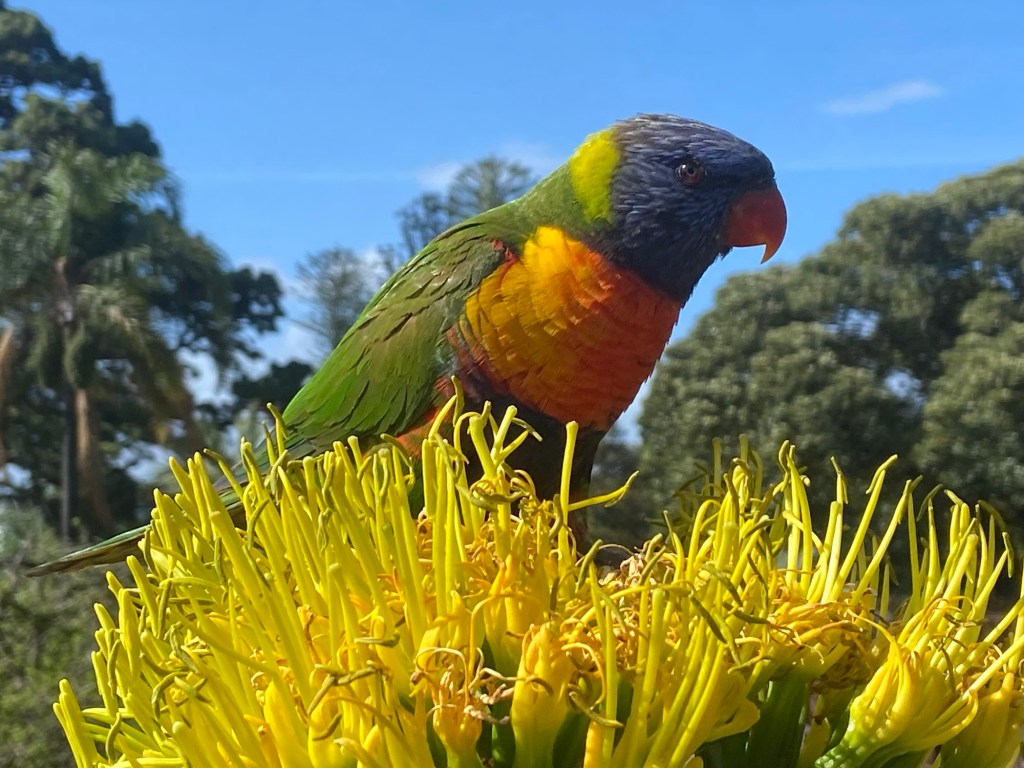
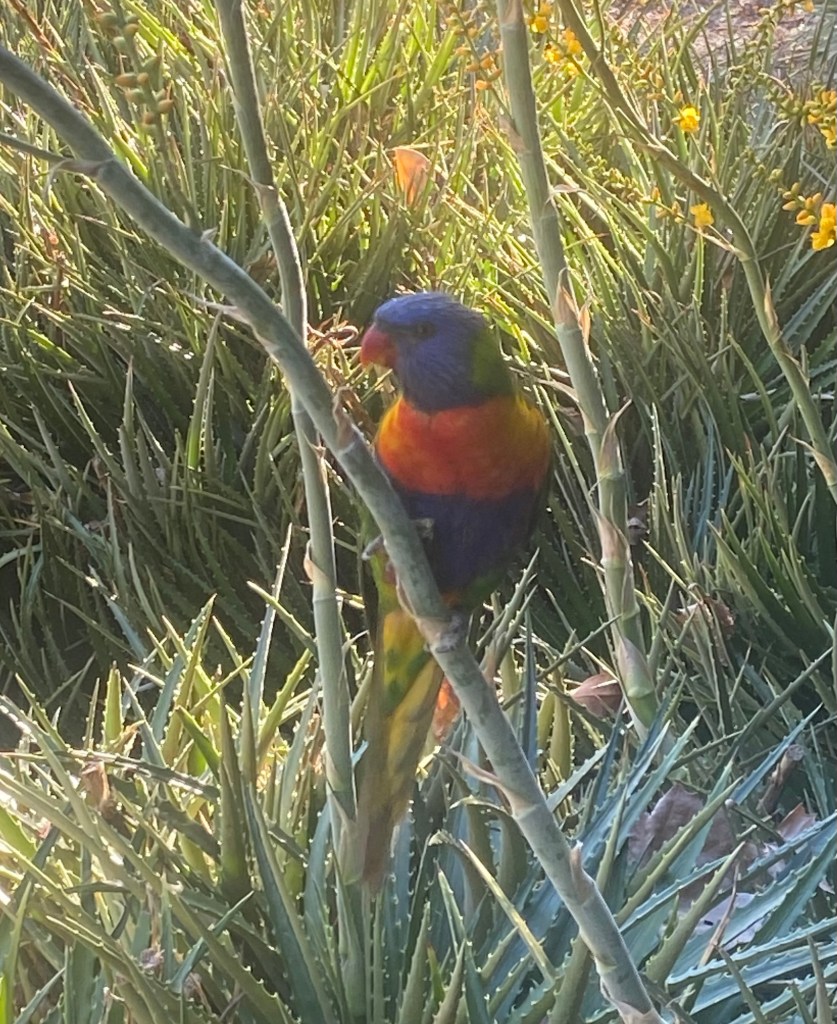
    A Rainbow Lorikeet in the Botanic Gardens on Christmas Day

    I must have spent more time thinking about Christmas Day than any other day on this trip. This is the first time I’ve spent it away from family, so I was keen to make sure that I’d be in company for as much of it as possible. I’m pleased to report that Melbourne came up trumps and my Christmas was as merry as it could be so far from home!

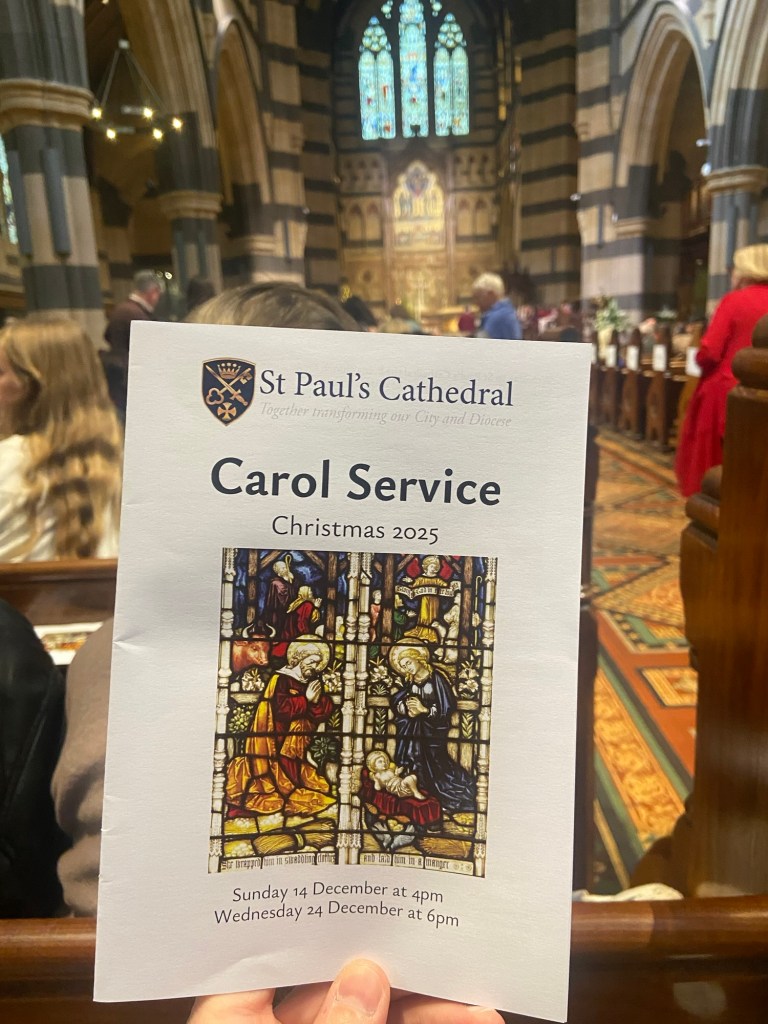
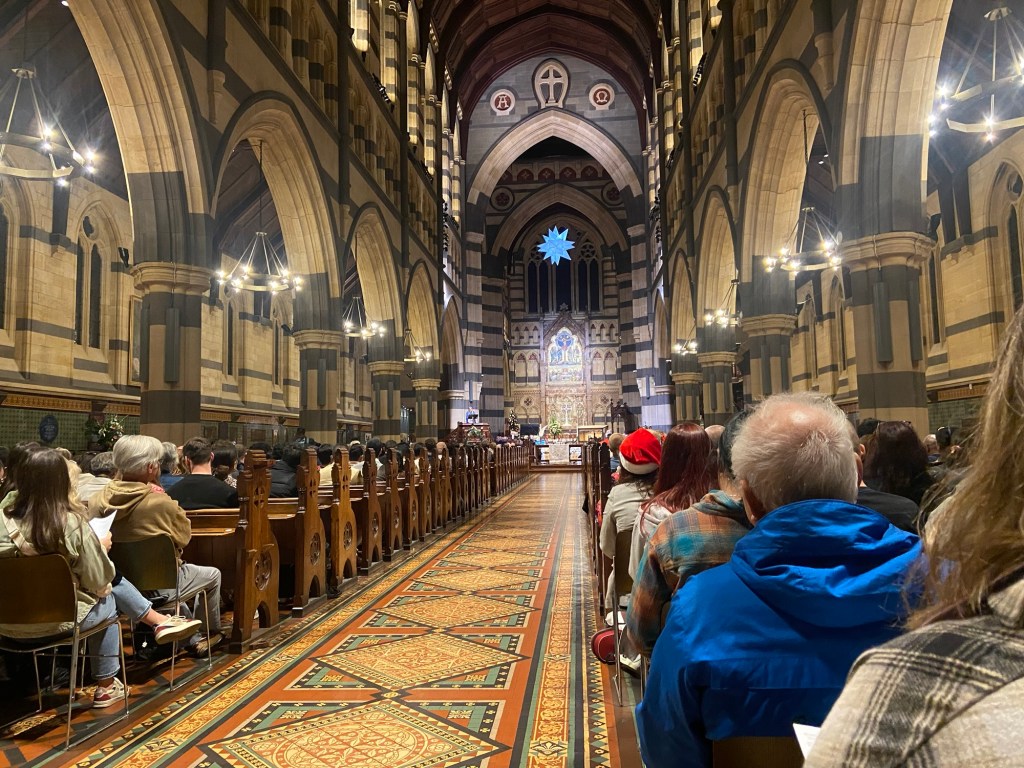
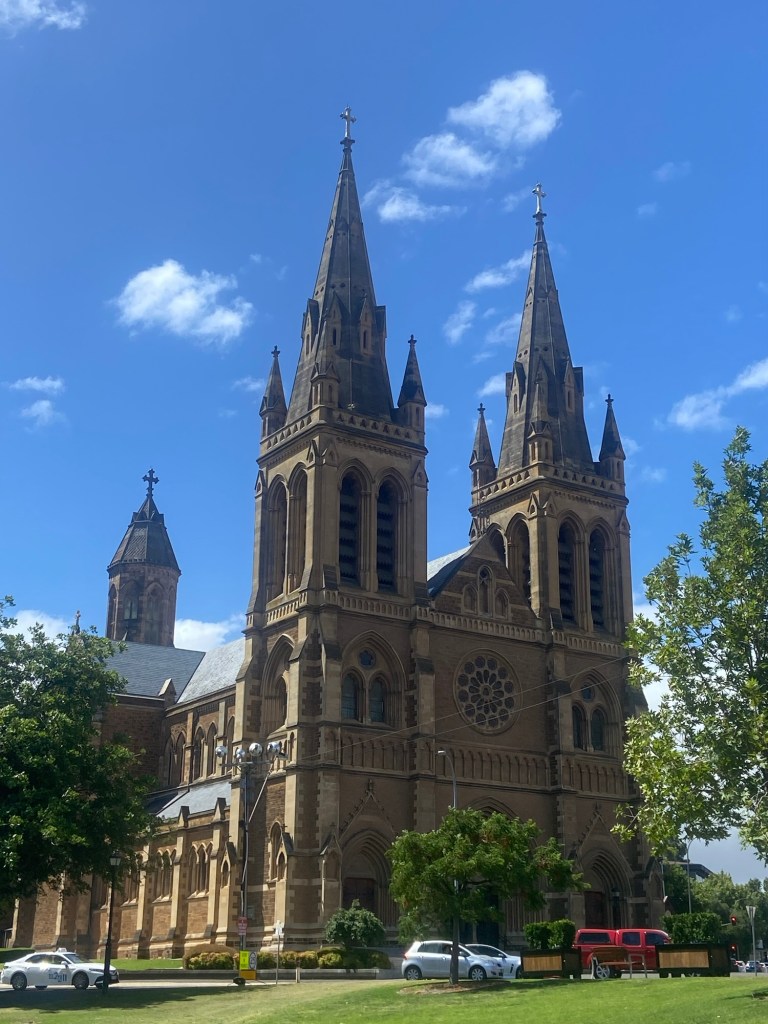
    The celebrations began for me on Christmas Eve at St Paul’s Anglican Cathedral. I attended the beautiful Service of Nine Lessons and Carols, modelled on that at King’s College Cambridge, but with a few interesting variations. Each reading was given in one of the many languages spoken in the city, and references to “winter’s snow” were replaced by ones to “summer’s sun”!

    My position in the centre of the nave meant I was surrounded by sound for the first carol (From the Father’s heart begotten). The choristers were next to me, with the lower voices completing the stereo effect from the side aisles.
    I pondered whether this version or the northern hemisphere one was more accurate!

    It was great to “come and adore Him” on the other side of the world and the preacher drew out many lessons from the Nativity story that were pertinent to the current national conversation in Australia. He was preaching again at Midnight Mass, for which I returned later. On Sunday the service was taken by a cricket fan who couldn’t resist a few digs at the Poms…

    The first communion of Christmas Day
    At the end of the service the choir broke out into a Gospel version of the Hallelujah Chorus. Unusual but joyous nonetheless – in keeping with the whole evening!

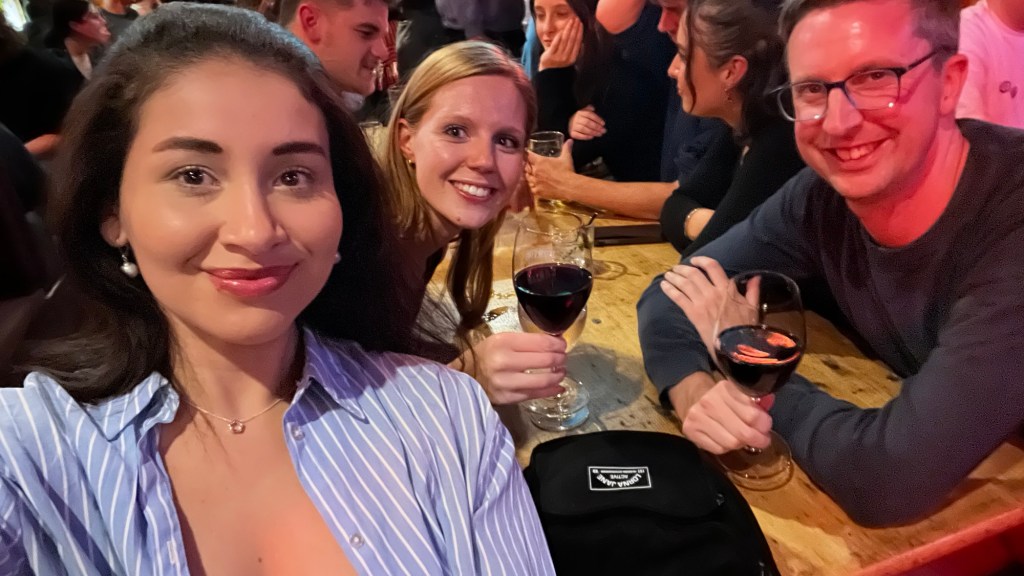
    In between the services, I headed down to the Yarra River for dinner and drinks with some of my former students, who’d let me know they were in Melbourne for the cricket.

    It was great to catch up with my first ever Core Maths cohort!

    On Christmas Day, I attended a community lunch at CrossCulture church. The people were friendly, and I was invited to a café (several were open in this multicultural city) by some of them afterwards. I also had a jolly good singsong with a chap who was playing carols on the piano!

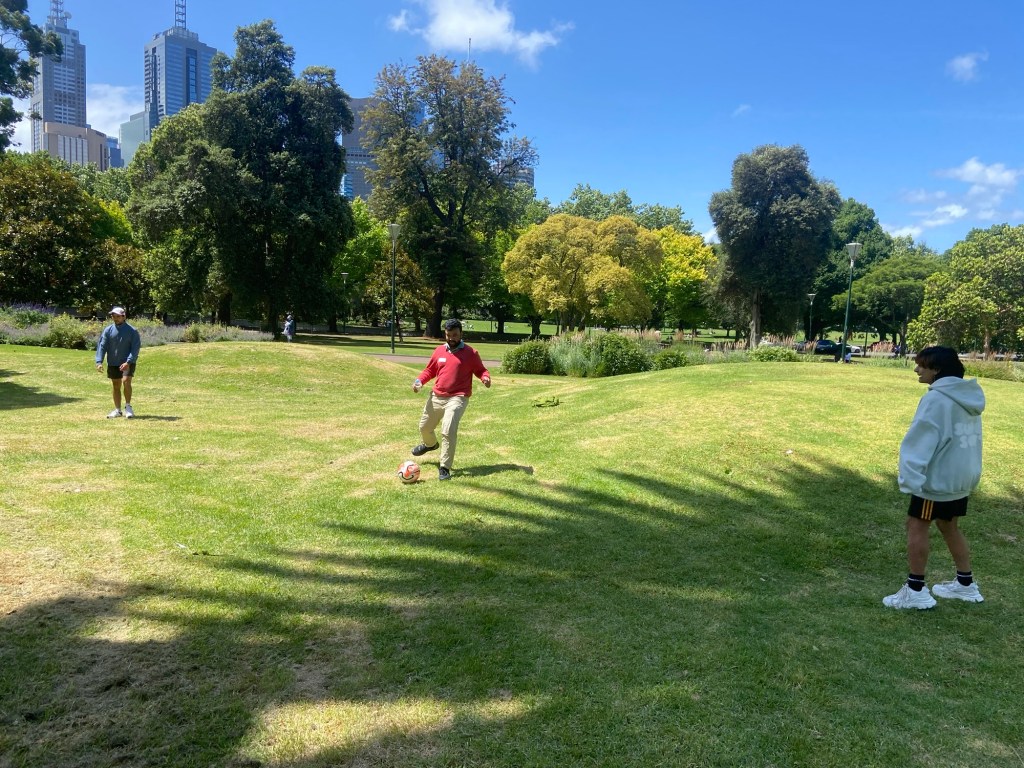
    From my extensive research to avoid being alone (!), I’d discovered that a local social club was holding a Christmas picnic in the Queen Victoria Gardens. I arrived for the end of it, kicked a ball about for a while, was given cake and found myself invited to various other events later in the day!

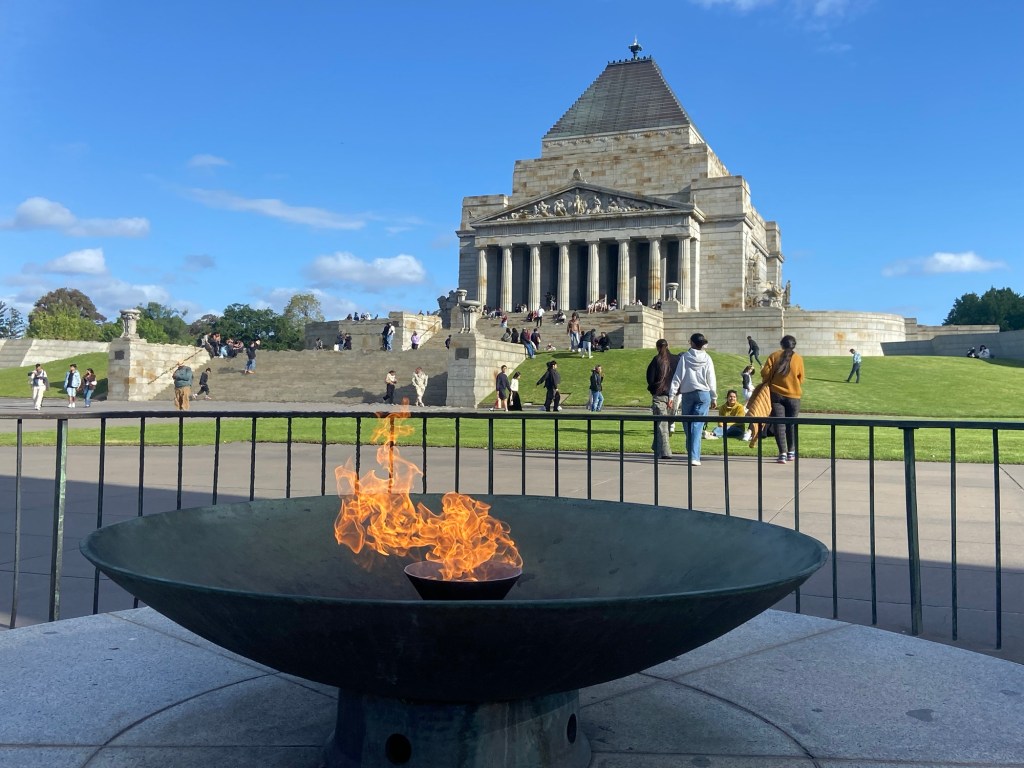
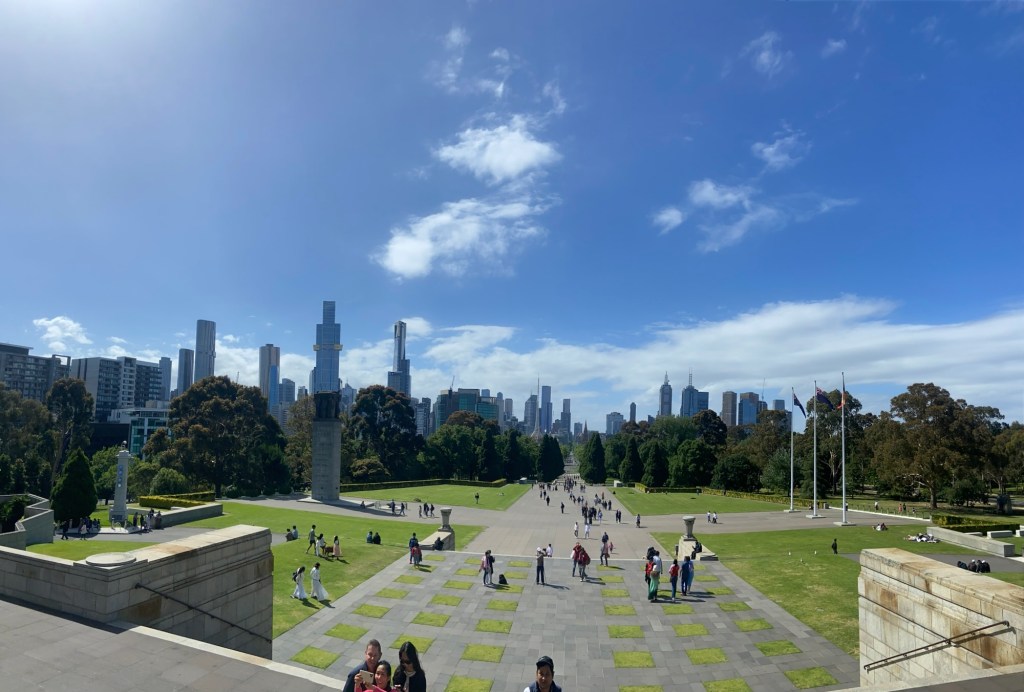
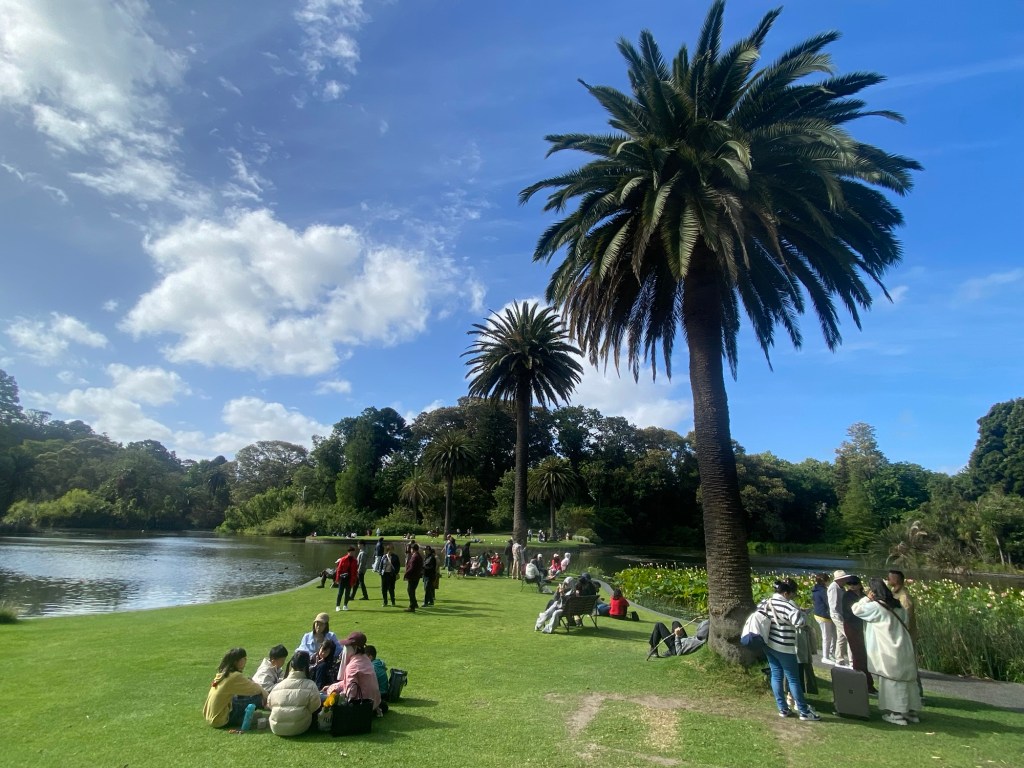
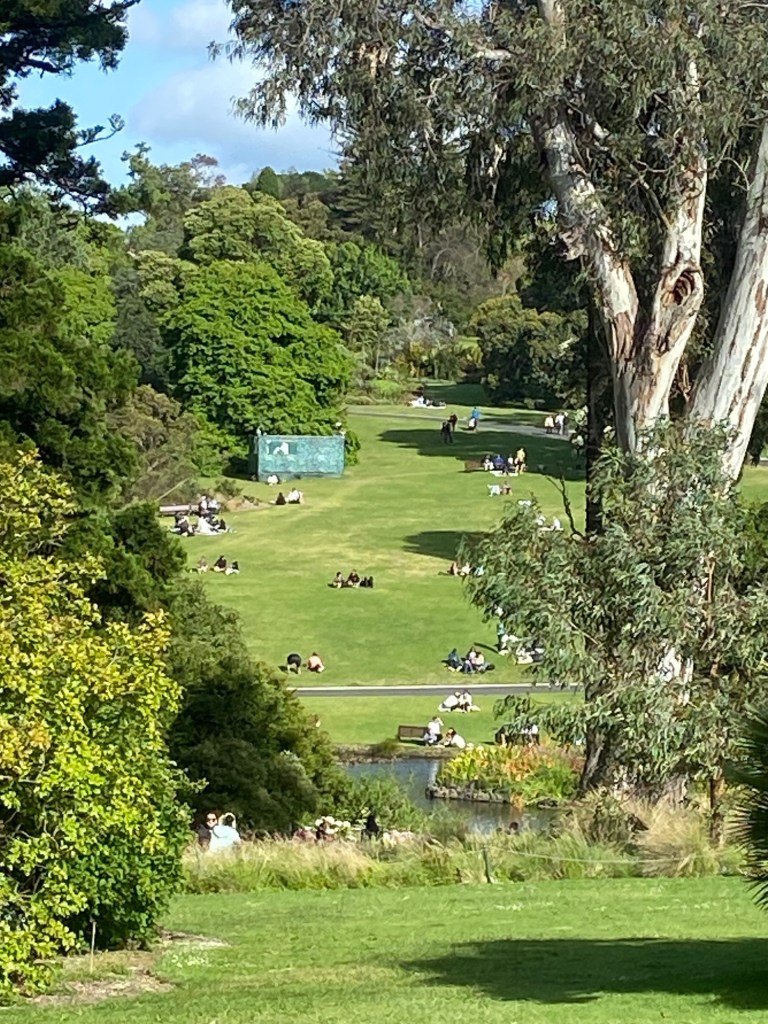
    First, however, I decided to go on a walk to the Shrine of Remembrance and into the Botanic Gardens. Despite an air temperature of only 17 degrees, one of Melbourne’s coolest Christmas Days on record, it felt warm in the Sun and it was lovely seeing families enjoying the day outdoors together.

    The view towards the CBD from the Shrine
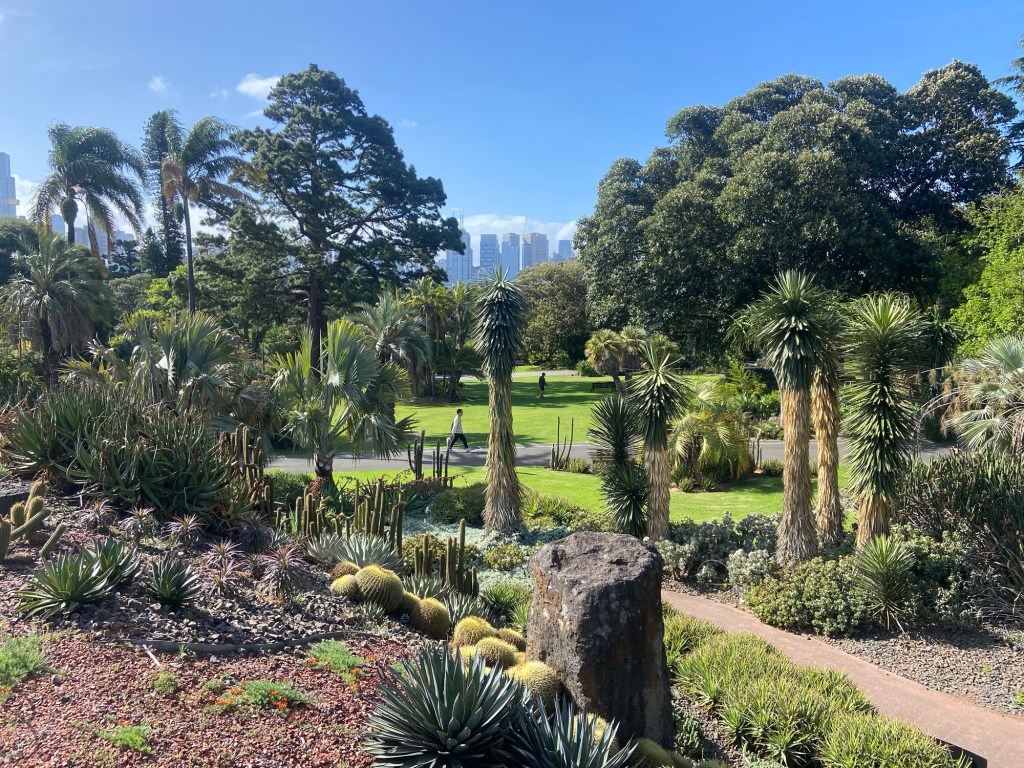
    Guilfoyle’s Volcano (not a real one!) in the Botanic Gardens

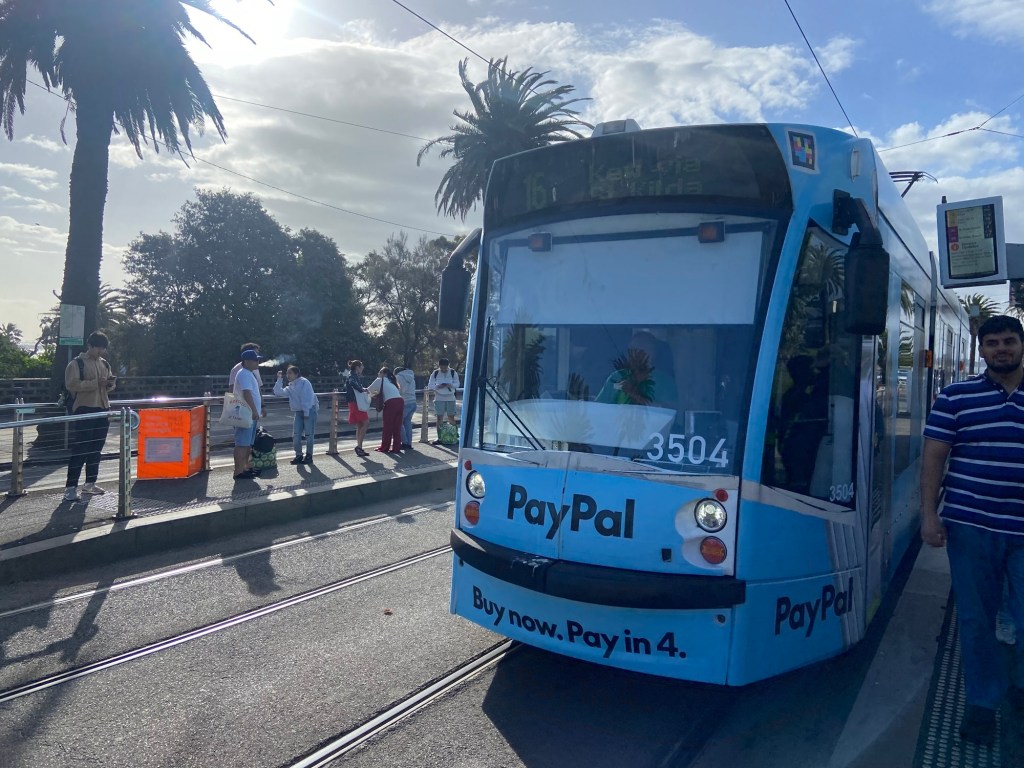
    All public transport around Melbourne was free on Christmas Day (as indeed it is at weekends this Summer), so I next decided to honour an Aussie tradition and head to the beach.

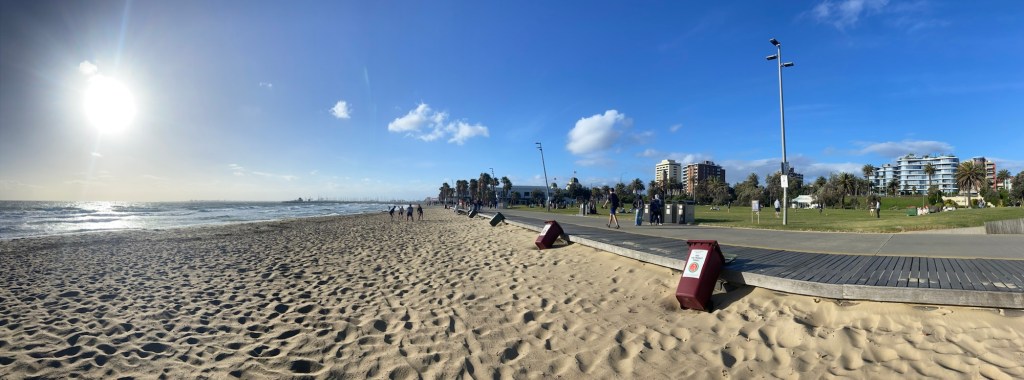
    St Kilda beach

    The park behind the beach was quite bracing in the wind, but that hadn’t deterred locals and tourists from spending the afternoon there. I found a couple of groups willing to let me join their games of cricket, in which any mistake was of course likened to those of the England XI…

    The hostel at which I’ve been staying in Melbourne is very efficiently-run, friendly and sociable. On my first night there, I’d been whisked from the rooftop bar for games and a bit of dancing at a jazz club, and the next evening I returned to find that someone in my dorm had bought his two roommates Christmas presents!

    I had my Christmas supper in the hostel’s dining room, with a delightful group of French and Italians. I’d stocked up on smoked salmon and a few other treats the day before and was soon sharing food and wine in the convivial setting.

    Later in the evening, I followed up on an invitation from the picnic and made more new friends at a vibrant bar near the hostel.

    As lunchtime approached in the UK, it was lovely to speak to family, rounding off a very different but nonetheless happy Christmas Day.

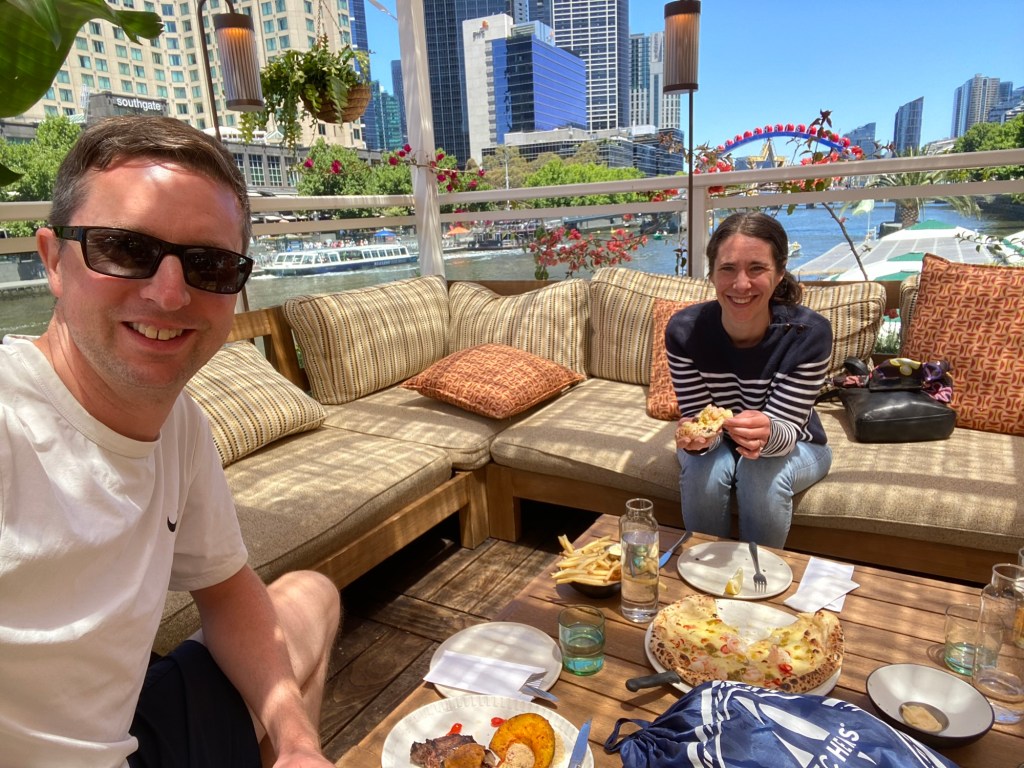
    Another highlight of the week has been reconnecting with Chantal, the fourth and final friend from Paris I’ve had the pleasure of seeing on this trip. We had a splendid lunch and catch-up at Afloat, a restaurant on a Yarra barge that has understandably become a hit with Melburnians.

    Food and drink aren’t cheap in Australia, but my Porterhouse Steak was much better value than it would’ve been back home…
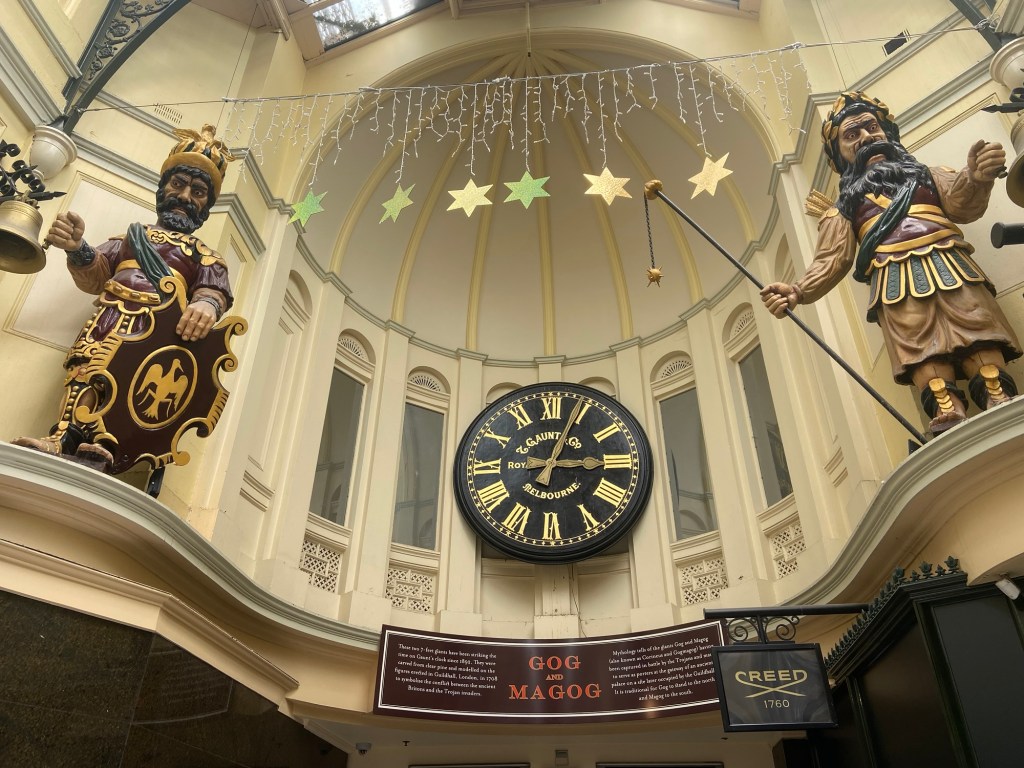
    The statues of Gog and Magog in the Royal Arcade, which we visited after lunch
    The Parliament of Victoria

    Of course, there has been another reason for my visit to Melbourne, but that has been sufficiently exciting to have earned its own post…

  • South Australia

    South Australia, or “SA” as it is almost universally known, is a state of extraordinary contrasts. After a week in its capital, Adelaide, I’ve had a very enjoyable couple of days touring the state and exploring its alluring and varied landscapes.

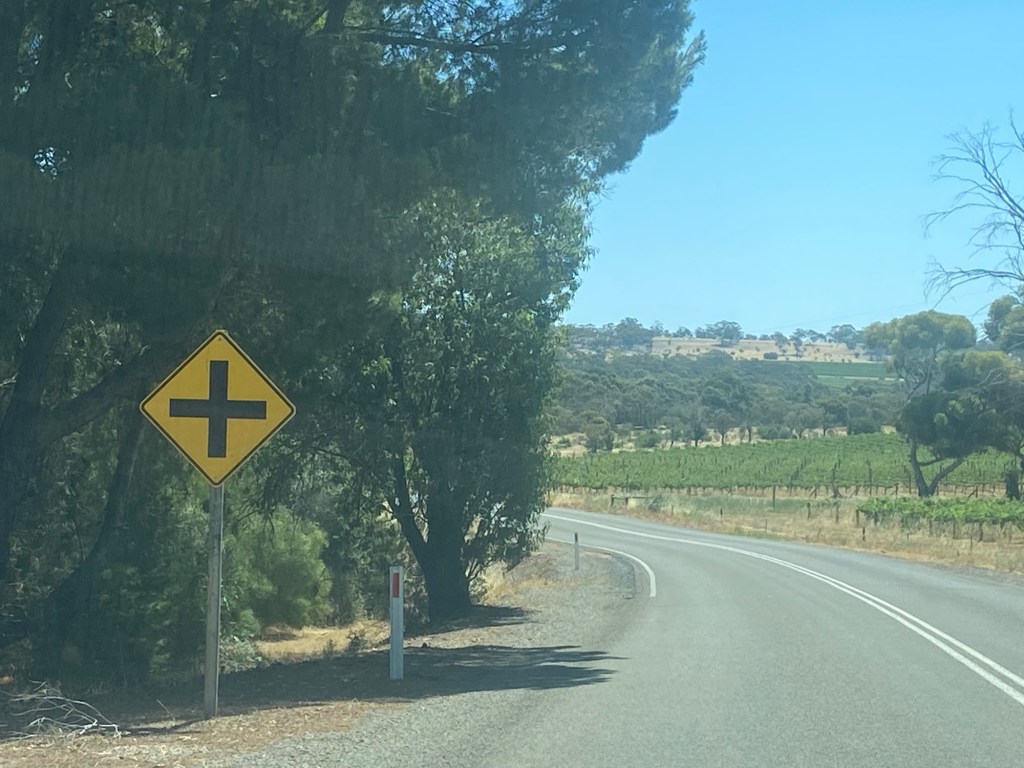
    SA is painted in a glorious and distinctly Australian palette: the soft blue of the sky, the rusty red of the soil, the pale yellow of the parched grass, the white of the eucalyptus bark, the various shades of green from the leaves and the vines, and the grey of the open road, which ripples in the heat haze. My photos don’t really do it justice, but I can assure you it was spectacular!

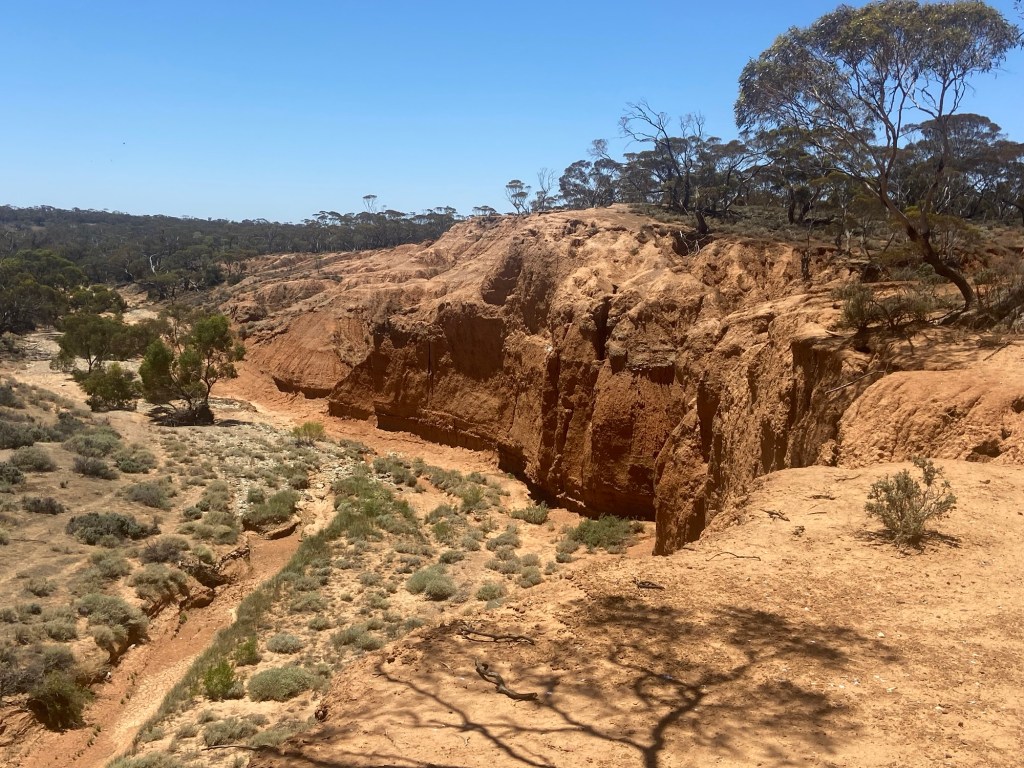
    The highlight of my touring was a visit to Red Banks Conservation Park. A two hour drive from Adelaide, it only came to my attention due to a picture on the cover of the map I used to plan my trip (not from a jigsaw puzzle this time)! I’d thought the picture was of the deep Outback, so was excited to discover such scenery was accessible from a location already on my itinerary.

    My bush walk in this little oasis definitely scratched my Outback itch!

    The park was reached down a 10km gravel track from the former copper-mining town of Burra, from where I picked up an information sheet. I didn’t see another human in the park, but was excited to spot two kangaroos and plenty of birds, including kingfishers. I was also spotted very quickly by legions of flies, so I spent most of my time there swotting these away!

    65,000 year old fossils of prehistoric Diprotodons have been found in the park
    The red cliffs are part of a ravine carved by the Baldina Creek, which was dry on my visit – unsurprisingly given the heat!

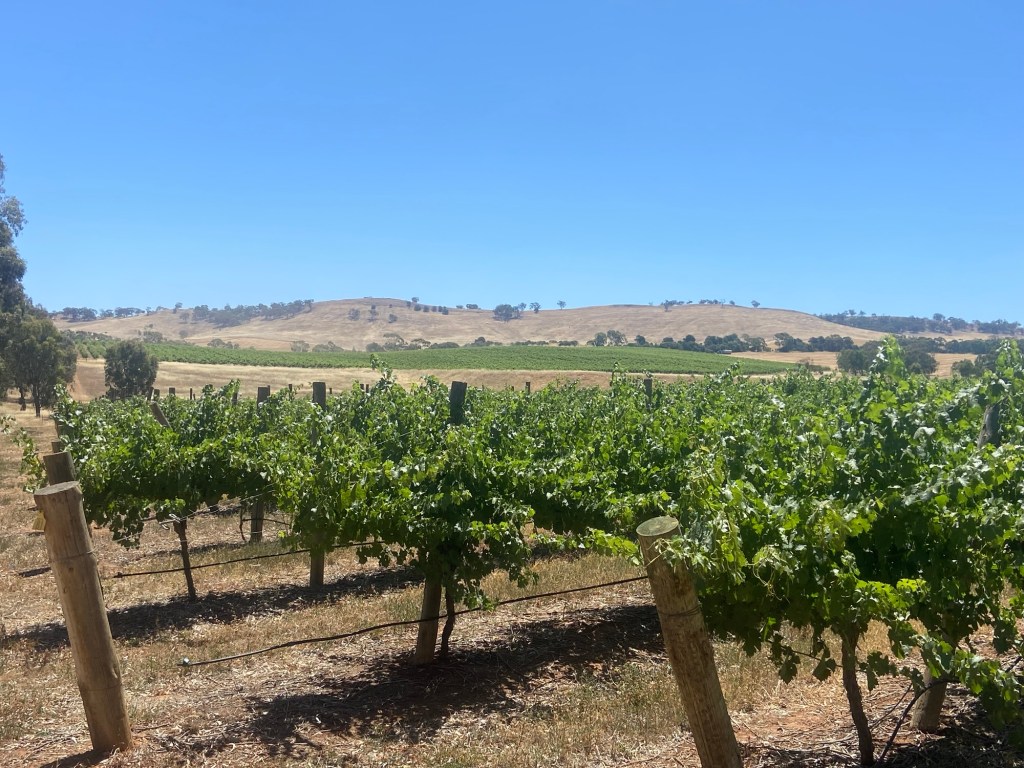
    I took a more scenic route back to Adelaide, through the Clare Valley wine region. The bright colour of the vines really stood out from the paler shades around them.

    Yesterday, I joined a bus tour of another wine region, arguably Australia’s best known: the Barossa Valley (home of Jacob’s Creek)! This was greener, and the Adelaide Hills to its south even more so.

    Towards the Adelaide Hills
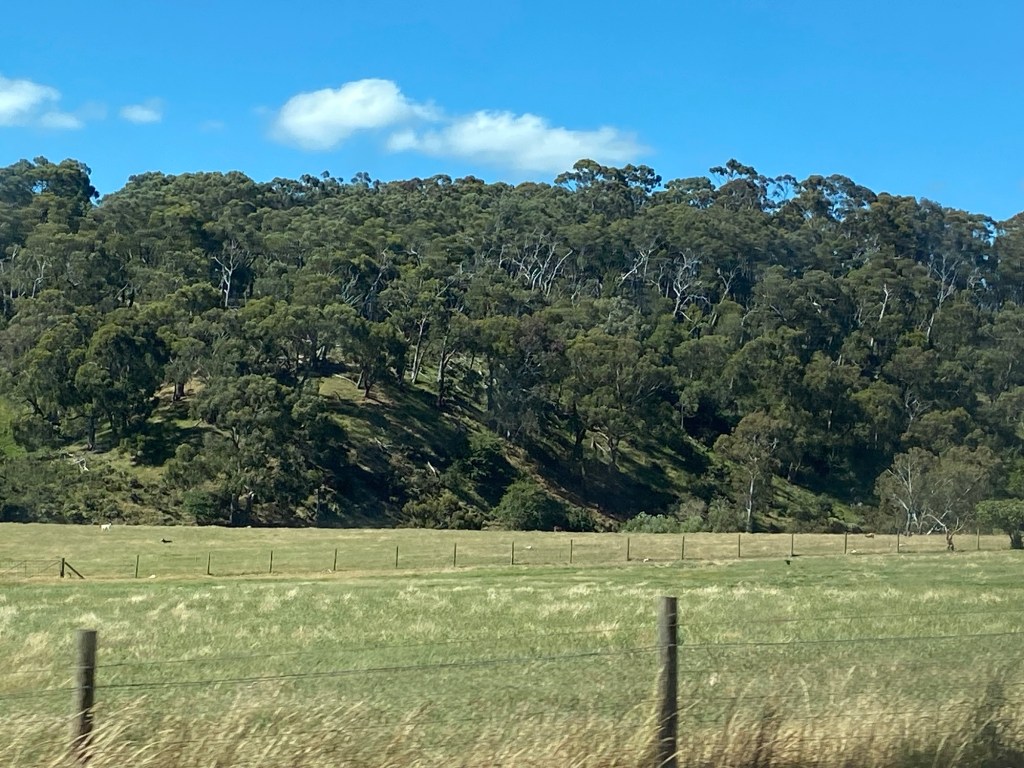
    Eucalyptus forest
    The village of Hahndorf in the Hills, famous for its German Lutheran origins. There was time in our visit there to grab some apple strudel and a Viennese coffee…

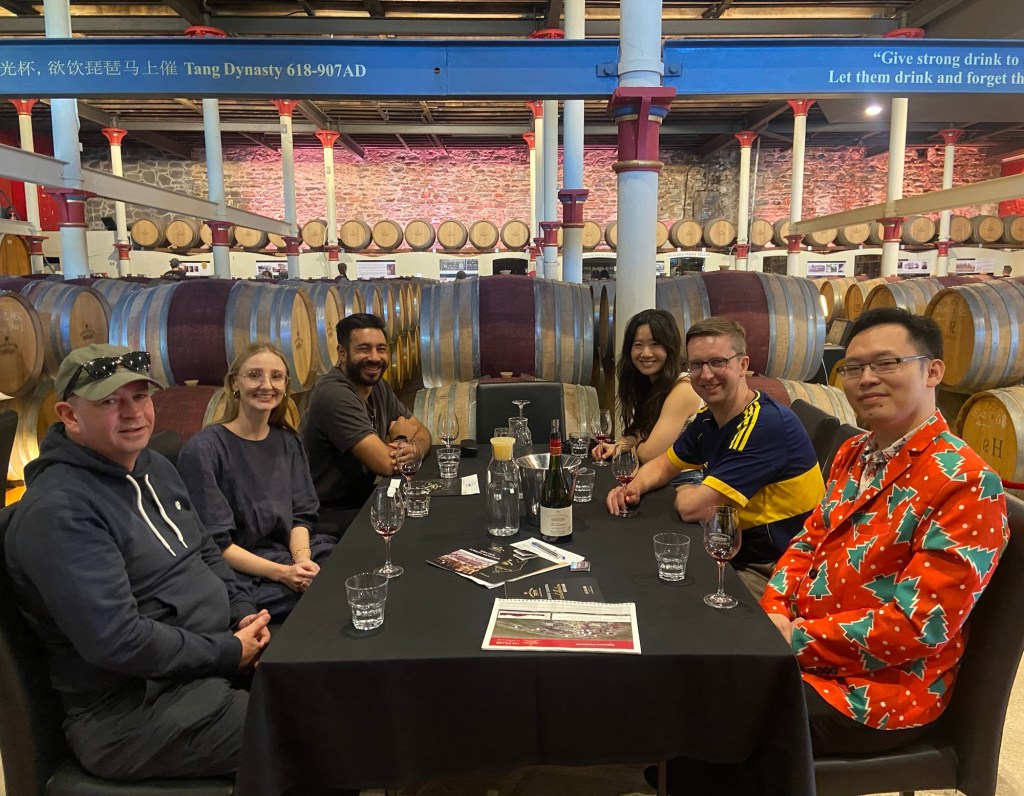
    In Barossa we stopped at two wineries: Chateau Tanunda and Kies. At the latter we enjoyed a locally-sourced lunch, and at both we were treated to wine tastings that showcased the fine liquid produce of the region – and I discovered why South Australians rave about their sparkling reds!

    Another tour group that turned out to be excellent company!
    Chateau Tanunda had the feel of an English stately home, complete with cricket pitch and croquet lawn!

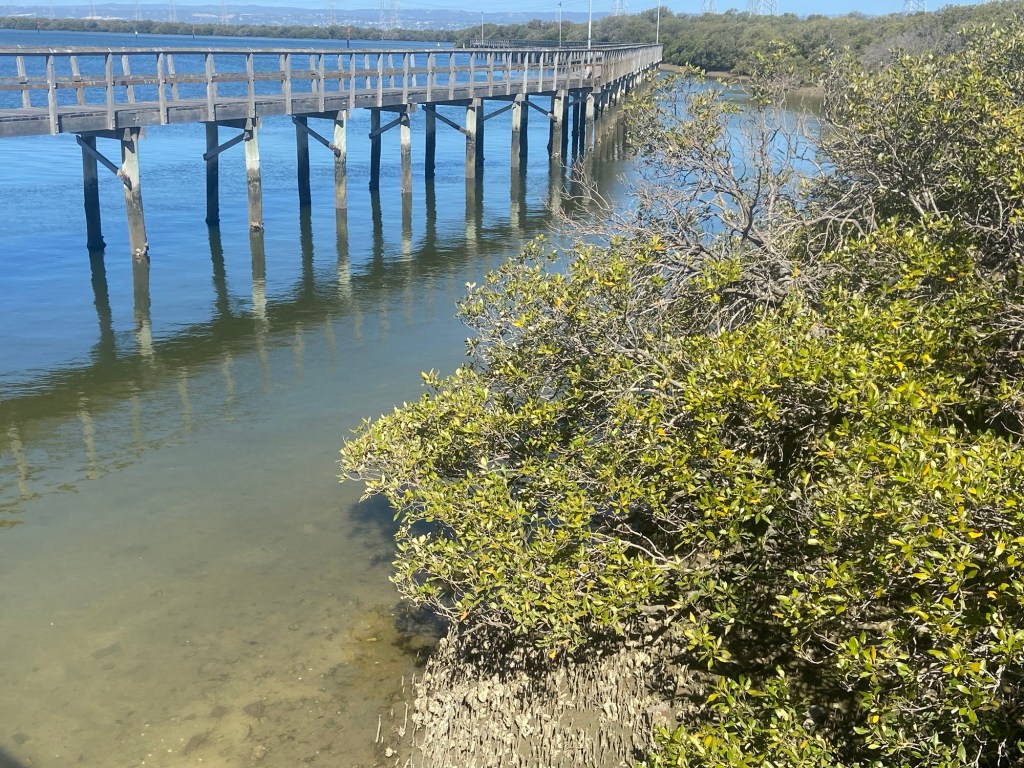
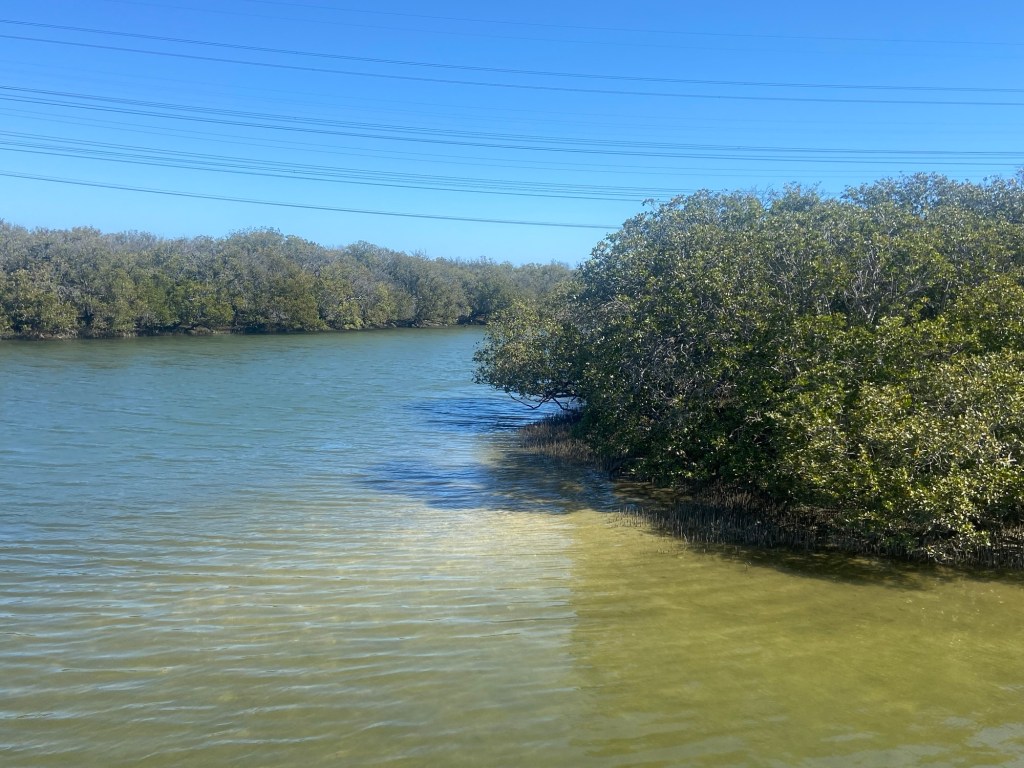
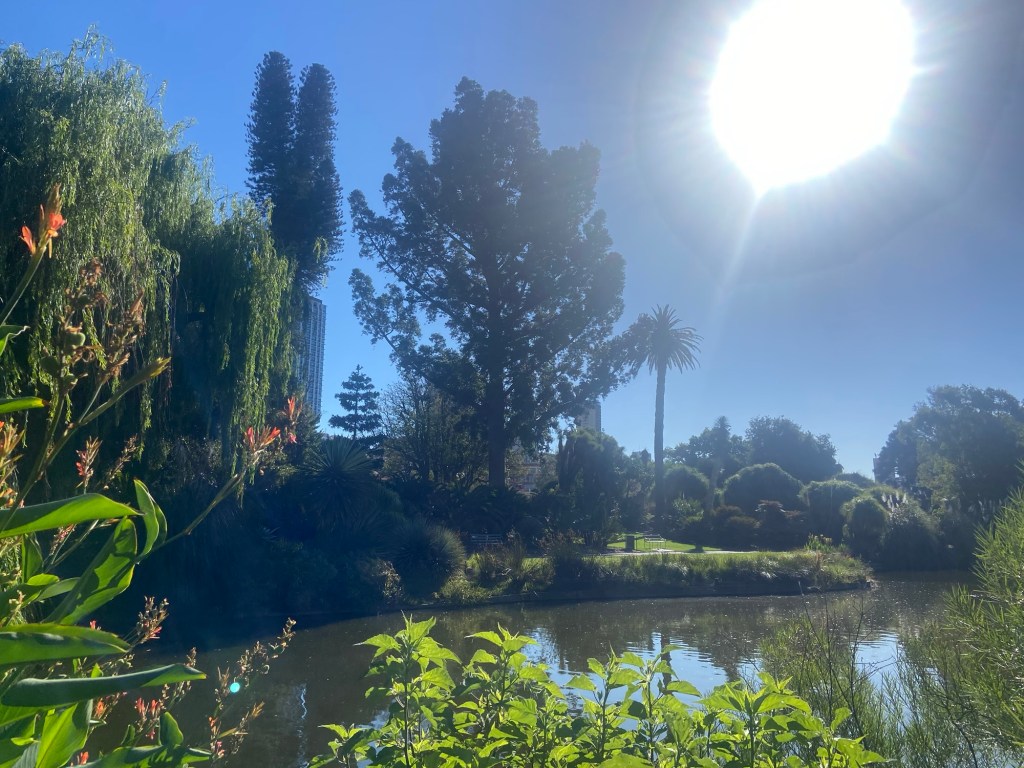
    Back in Adelaide, I experienced some altogether different landscapes: mangrove forests in a dolphin sanctuary and the rich flora of the botanic gardens.

    This walkway turned out to be more useful for viewing the mangroves than any cetaceans!
    It was a balmy and peaceful evening in the botanic gardens
    There was more colour on display from Rainbow Lorikeets
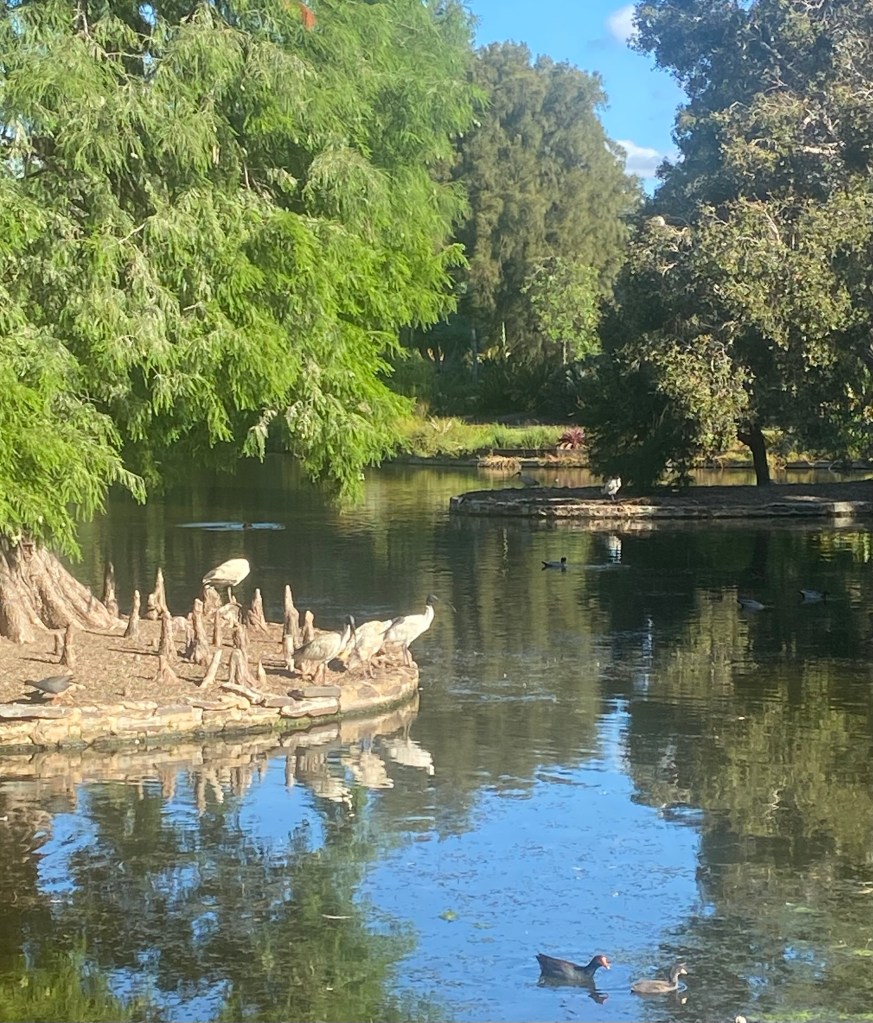
    There were also plenty of Australian White Ibises, here, and in fact throughout the city
    The walk to the gardens took me past these beautiful buildings, which are part of the University of Adelaide

    I have now arrived in the fifth and final new state/territory of my stay in Australia: Victoria, where I will be spending the festive period. I will report back soon on a Melbourne Christmas, but in the meantime I wish everyone following my travels a very Merry Christmas: in the UK, Argentina, France, or indeed wherever in the world you may be!

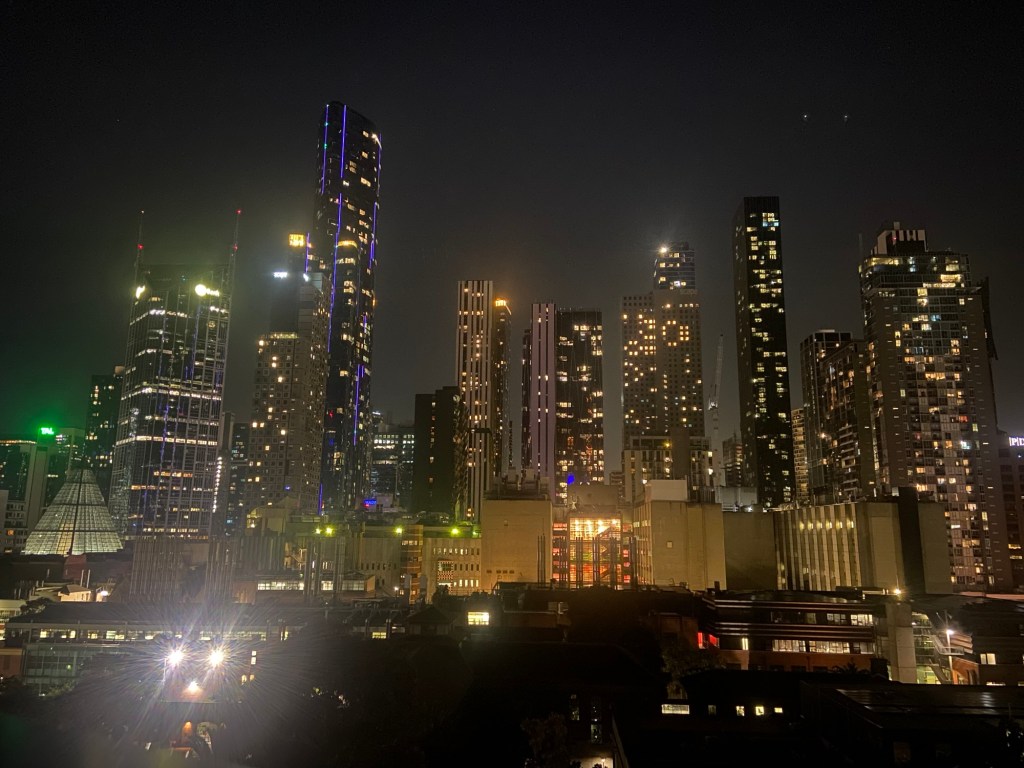
    Rooftop view from my Melbourne hostel
  • Adelaide

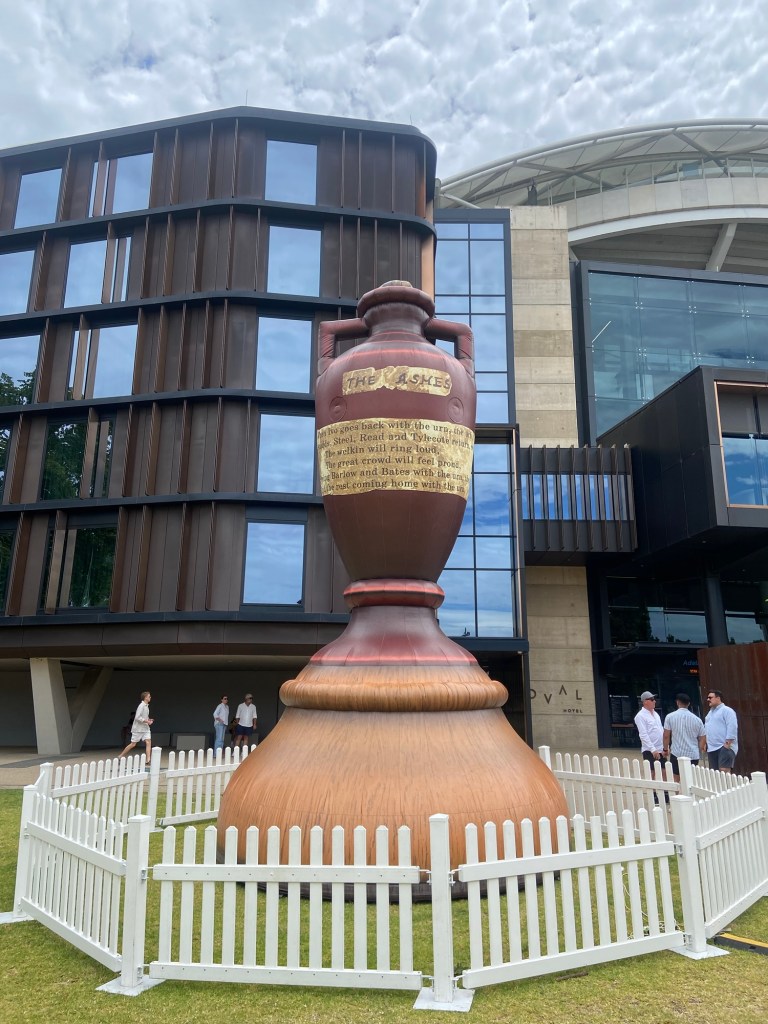
    So the urn is not leaving Australia. England have been holding on by a thread for much of the Third Test, with occasional glimmers of hope (even into Day 5, with a defiant display of batting). In the end though, they fell 83 runs short of what would have been a world record run chase, and Australia have an insurmountable 3-0 lead in the Ashes series.

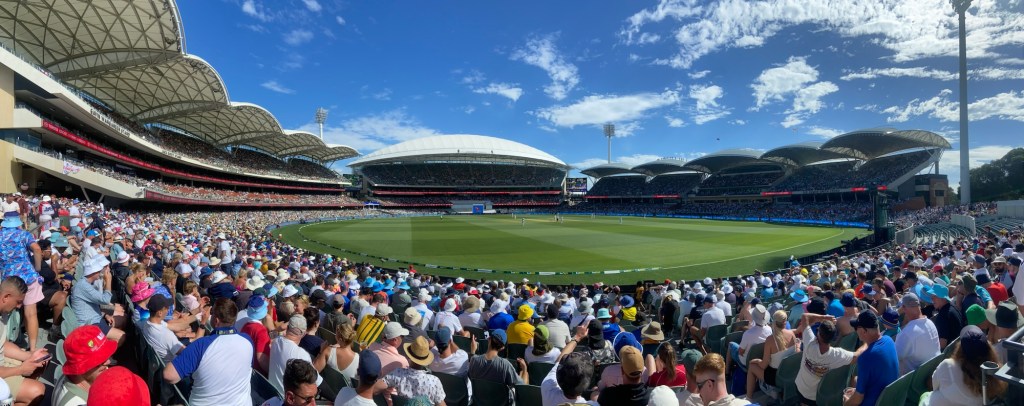
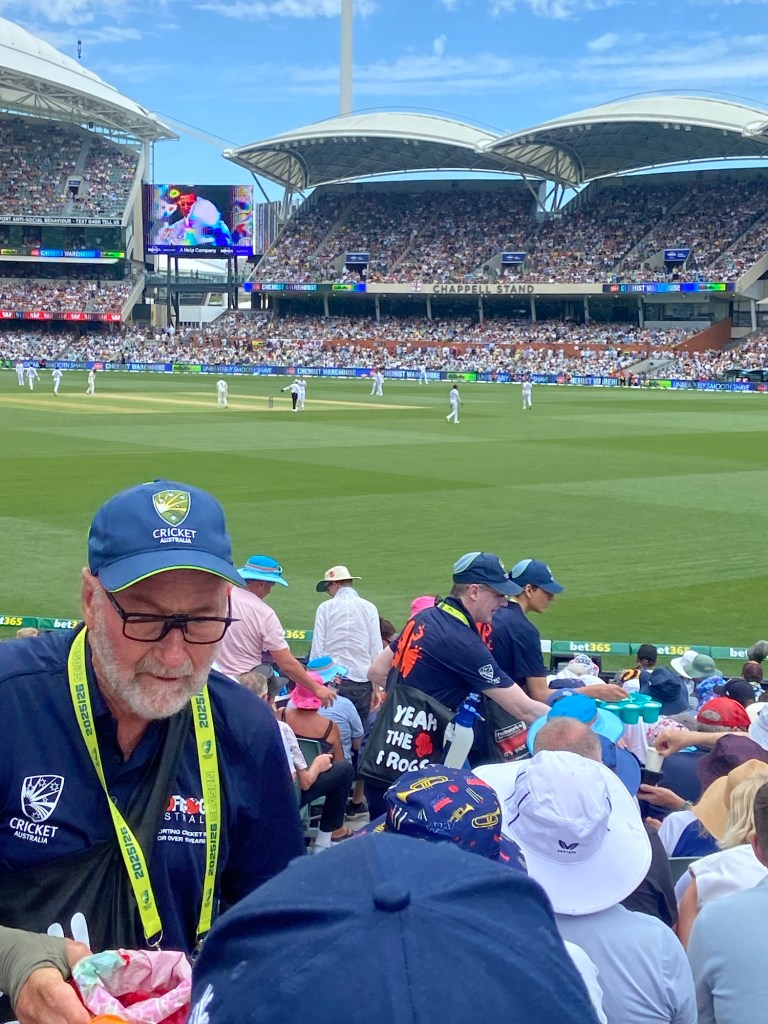
    The Adelaide Oval is a beautiful place to watch cricket and I’ve felt very privileged to have five days there watching a gripping contest, while the series was still “live”, in the December sun. The mercury hit 41 degrees on Day 2, but it’s thankfully been a more comfortable temperature since!

    The bridge across the River Torrens that connects the CBD to the Adelaide Oval, which had its record attendance for a Test Match this week
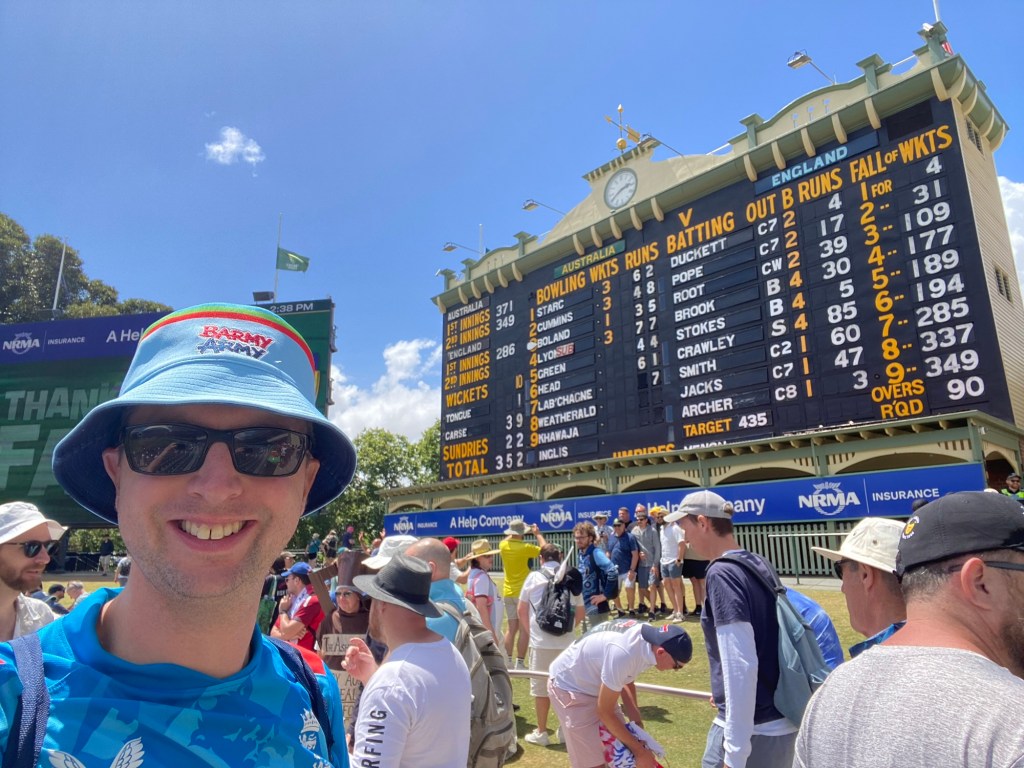
    In front of the historic scoreboard, detailing the story of England’s unsuccessful fourth innings run chase
    The statue of all-time great, Sir Donald Bradman, who had a long association with Adelaide
    The ground staff were very hospitable, providing water, sun cream and sweets to the fans throughout!
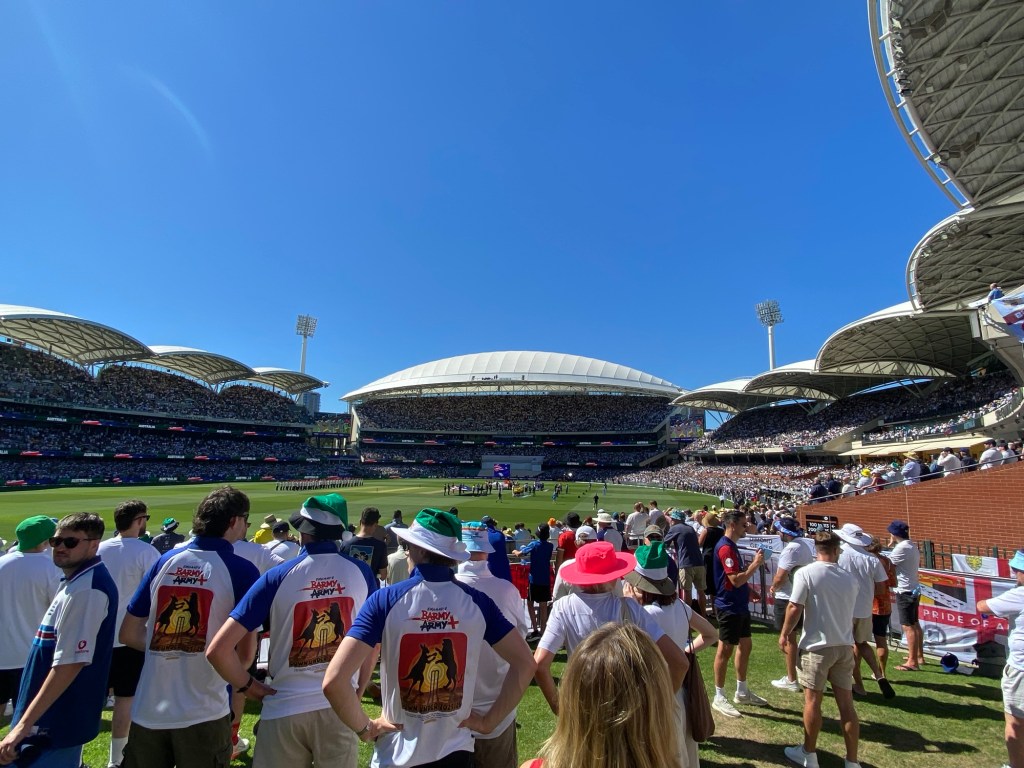
    The Barmy Army during the anthems
    The Army’s own anthem! You can see some of the Aussie fans who dropped by to spectate the spectators and sample the famous atmosphere generated by the English fans.

    The Barmy Army were in good voice again throughout the Test Match, although there were a few occasions when the chanting became a bit unsavoury and I wasn’t quite so keen to associate myself with them (I’ll leave it at that)!

    However, my faith in them was somewhat restored by the initiative of one member, Charlie, with whom I shared a few drinks as he is staying at my hotel. Following a comment by a journalist on Day 1 about the litter left behind on the hill where many of the Barmy Army were standing, he bought some bin bags and we left the lawn spotless on each subsequent day.

    This seemed a fitting way to thank our excellent hosts, and it even drew the praise of the South Australian Premier!
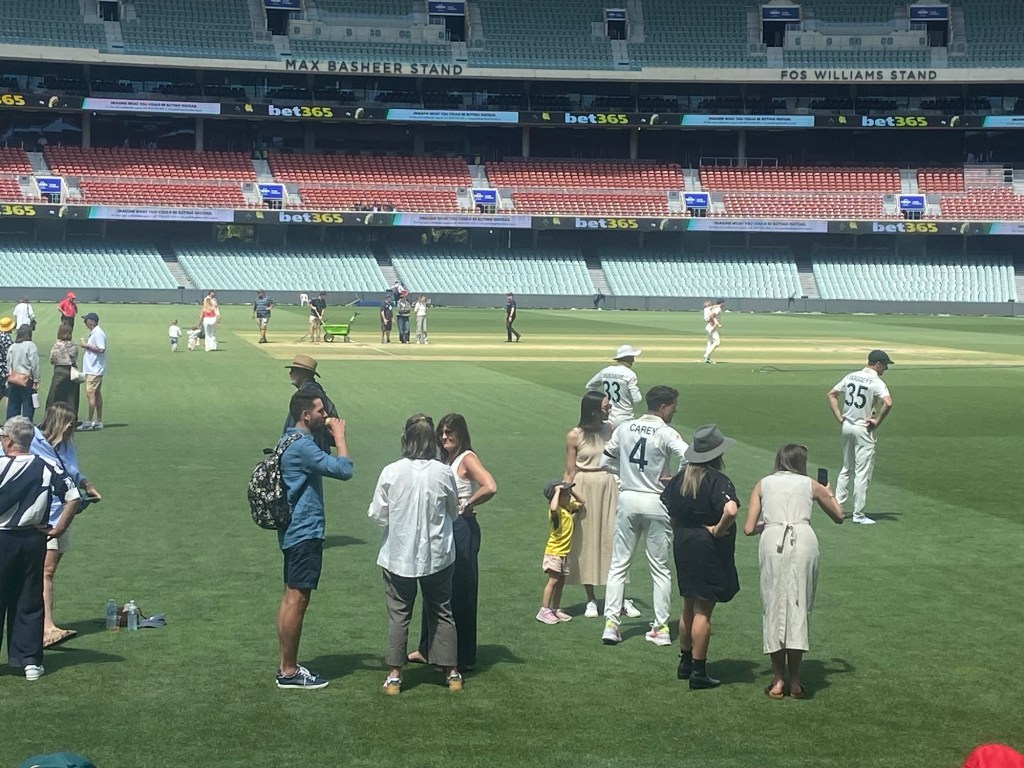
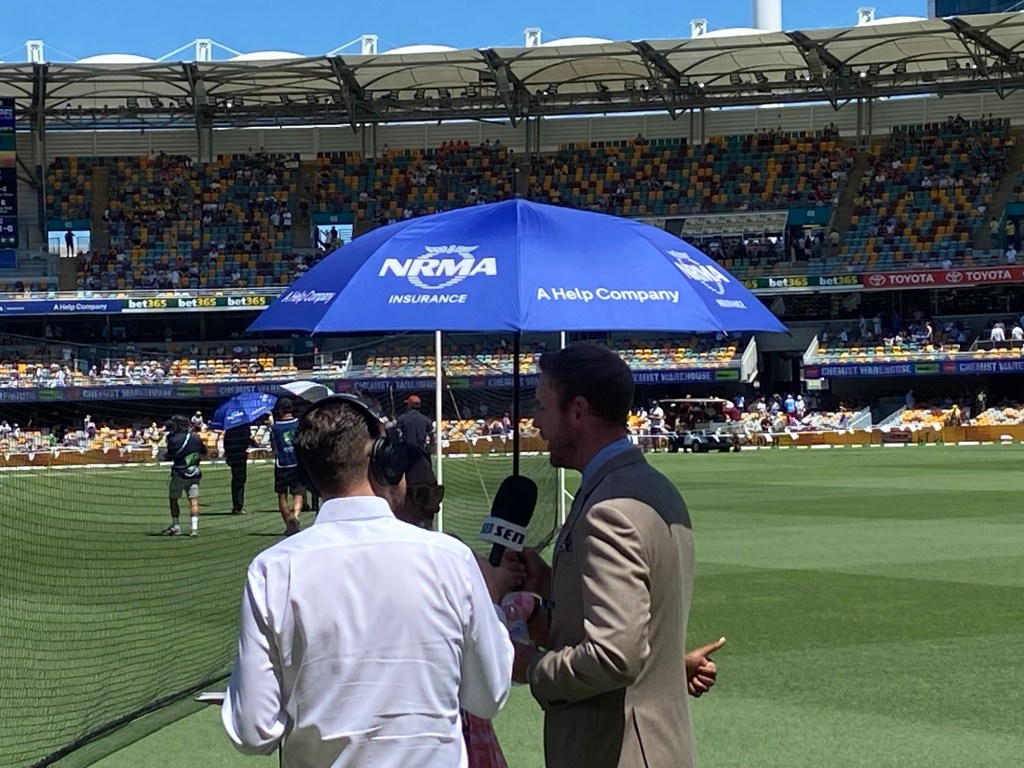
    It was also very wholesome seeing the Aussie players relaxing with their families on the outfield at the end of the match, while I was busy spotting current and former players doing their media duties. The series is being shown free-to-air in Australia – if only it were the same back home!

    In Brisbane, I became friends with those sitting near me and so had a ready-made social group. With unreserved seating, it wasn’t quite so easy in Adelaide, and I’ve had a week of engaging in one-off conversations at the cricket and tagging onto groups in the evenings – when it’s not been too awkward to do so! It’s the first time being a solo traveller has felt like a challenge, but it’s meant I’ve been able to enjoy many hours of radio commentary through my Test Match Special earpiece at least!

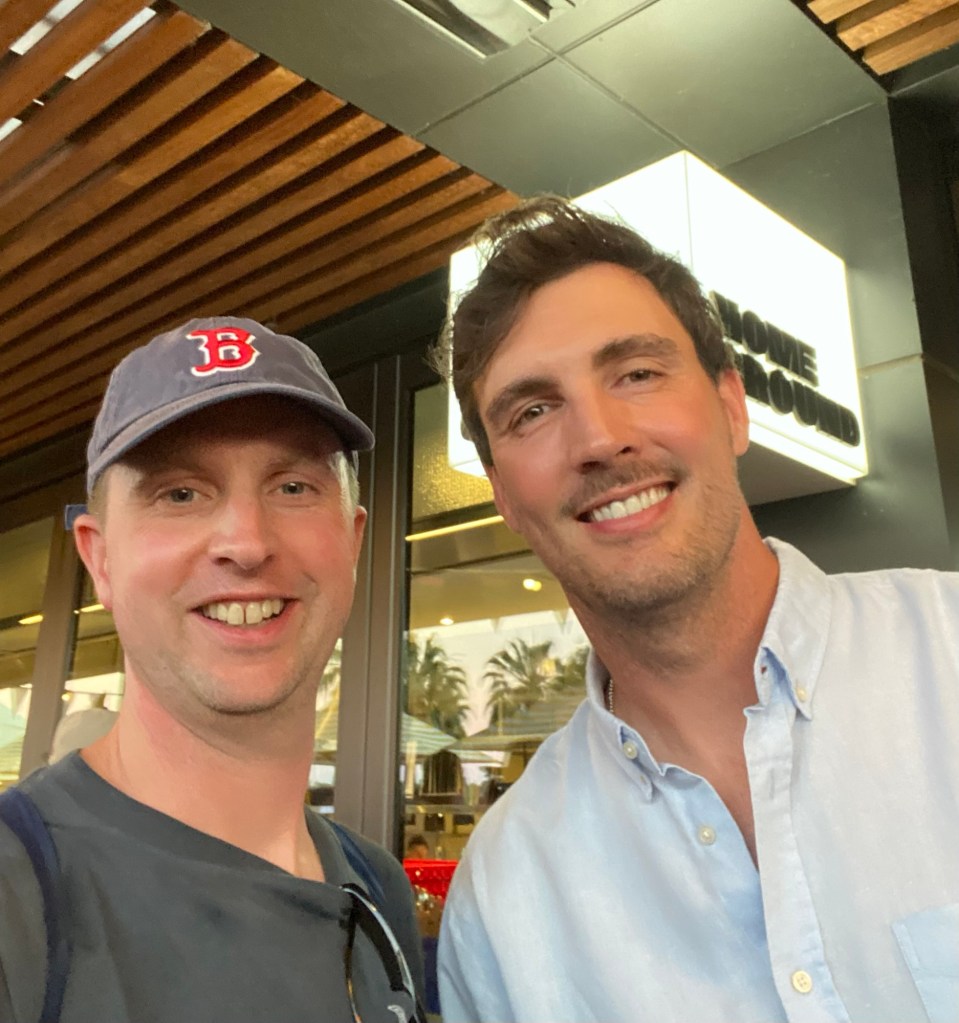
    One person with whom I did have a good chat was fellow Watfordian, TMS regular and ex-England fast bowler, Steven Finn. He was friendly, and was happy to discuss mutual acquaintances and Watford FC’s recent form!

    Finn had appeared with Graeme Swann and Dan Norcross at an entertaining Q&A at the Barmy Army’s pre-test party
    The party continued with the customary sing-song…
    … before concluding with a live band, whose set I really enjoyed!

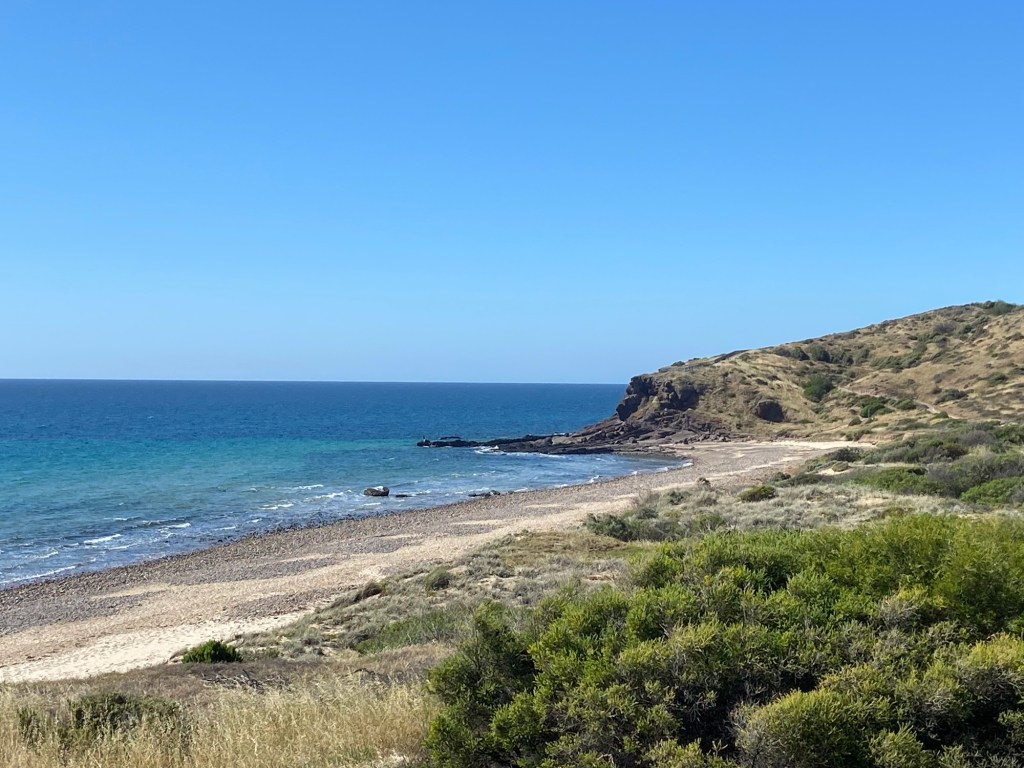
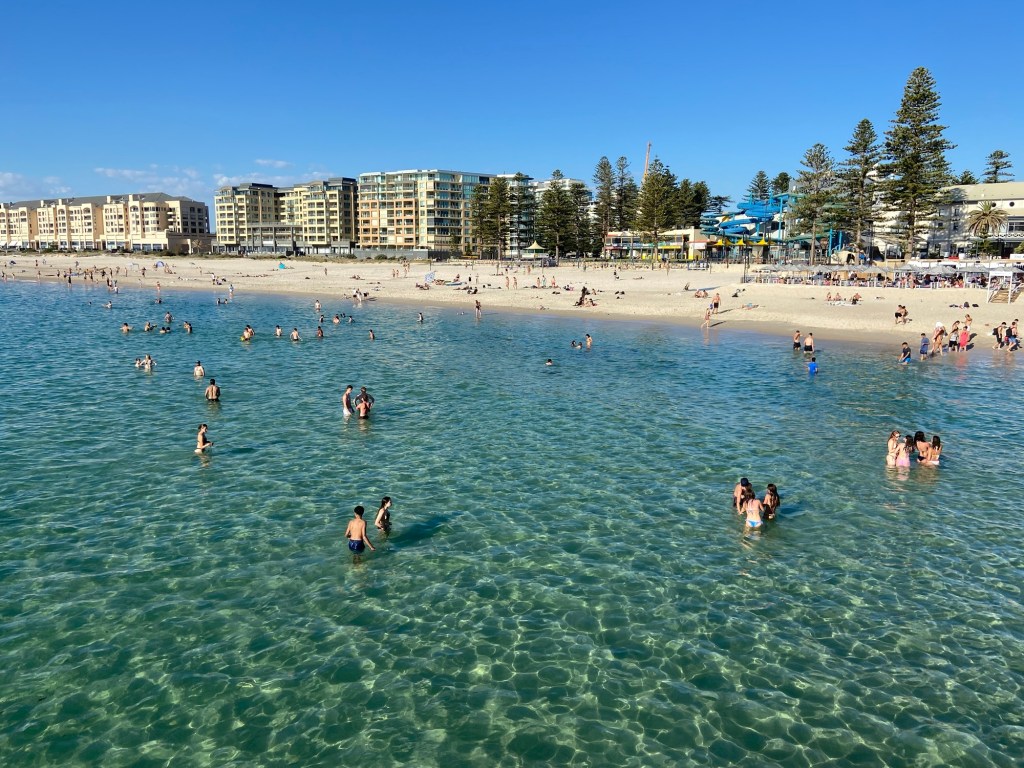
    Adelaide has a beautiful coastline, easily accessible by public transport, and the hot weather has lured me there a couple of times.

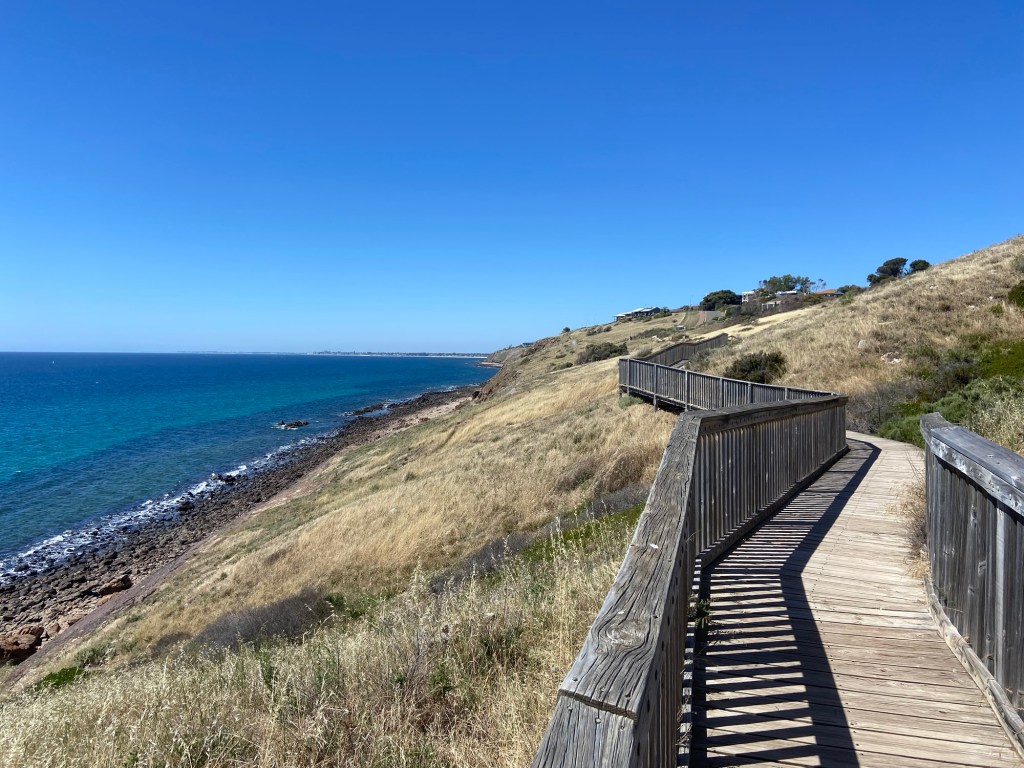
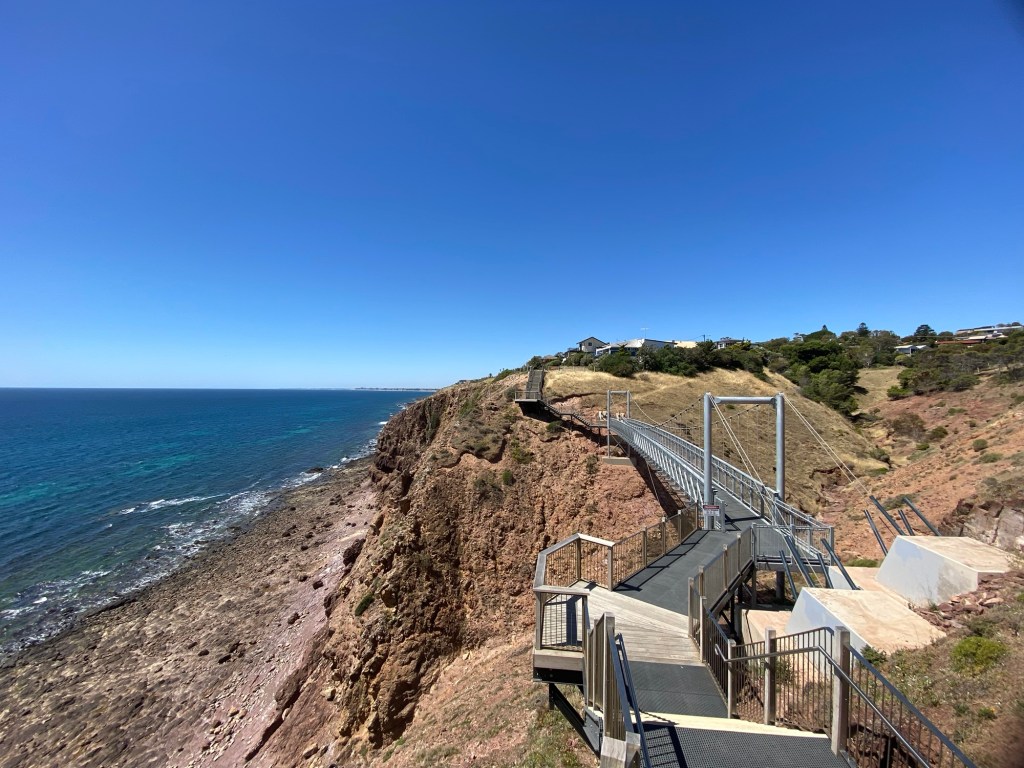
    On my first full day in Adelaide, I had a relaxed stroll along this boardwalk through Hallett Cove Conservation Park:

    Recently-constructed bridges extend across the gullies
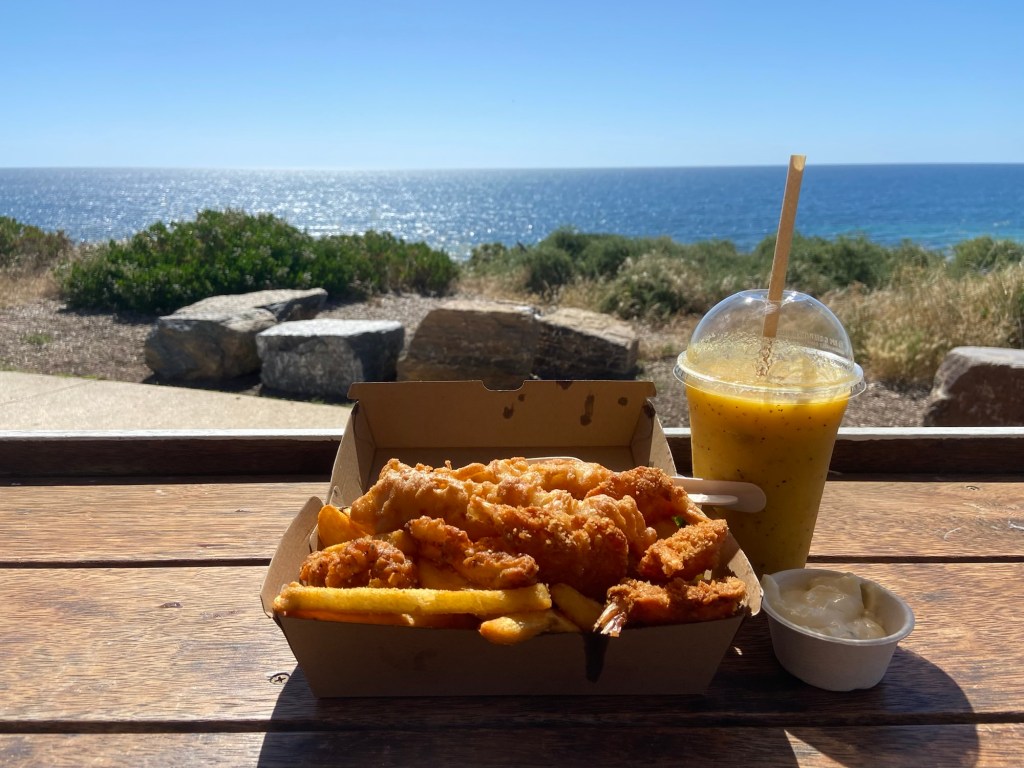
    Hallett Cove was the ideal spot for a late lunch…
    … of fish and chips, Aussie-style.
    And the beach at Seacliff was the ideal spot for a swim…
    … followed by a glass of red from the nearby Barossa wine region!

    I was melting at the cricket on Day 2, so left early for a swim in the clear, emerald waters at Glenelg:

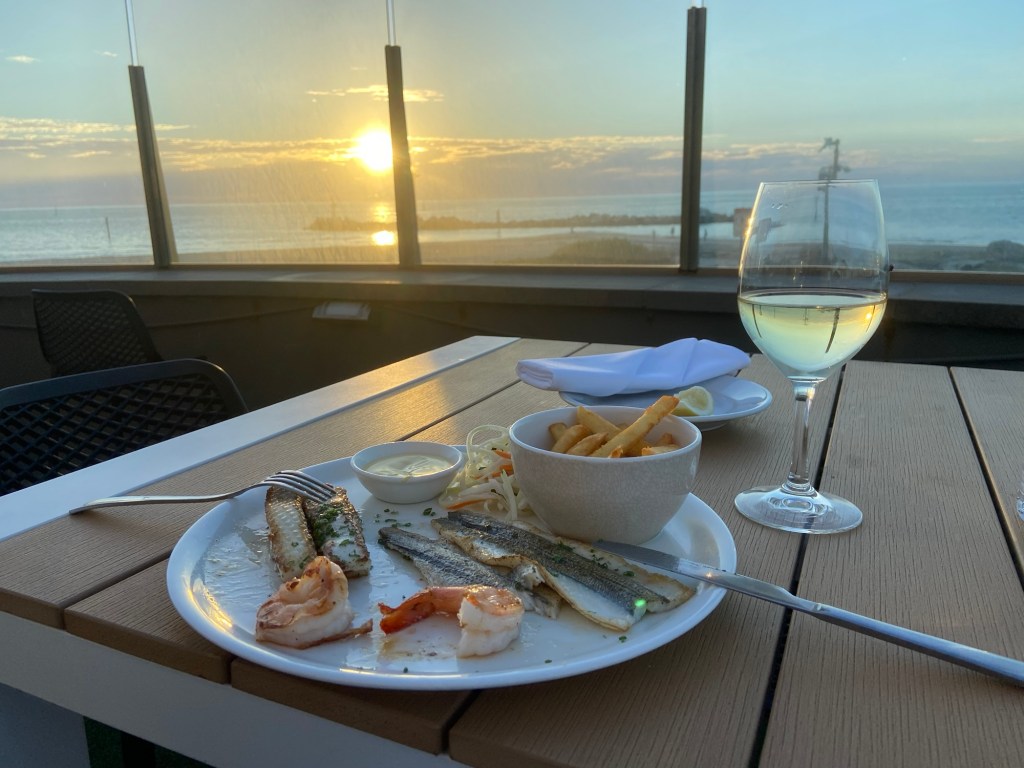
    I then watched the sunset while enjoying some fabulous fresh fish, and the company of some other sun-wearied Ashes tourists

    Incongruous as they seem in the Summer weather, there are frequent reminders that Christmas is approaching.

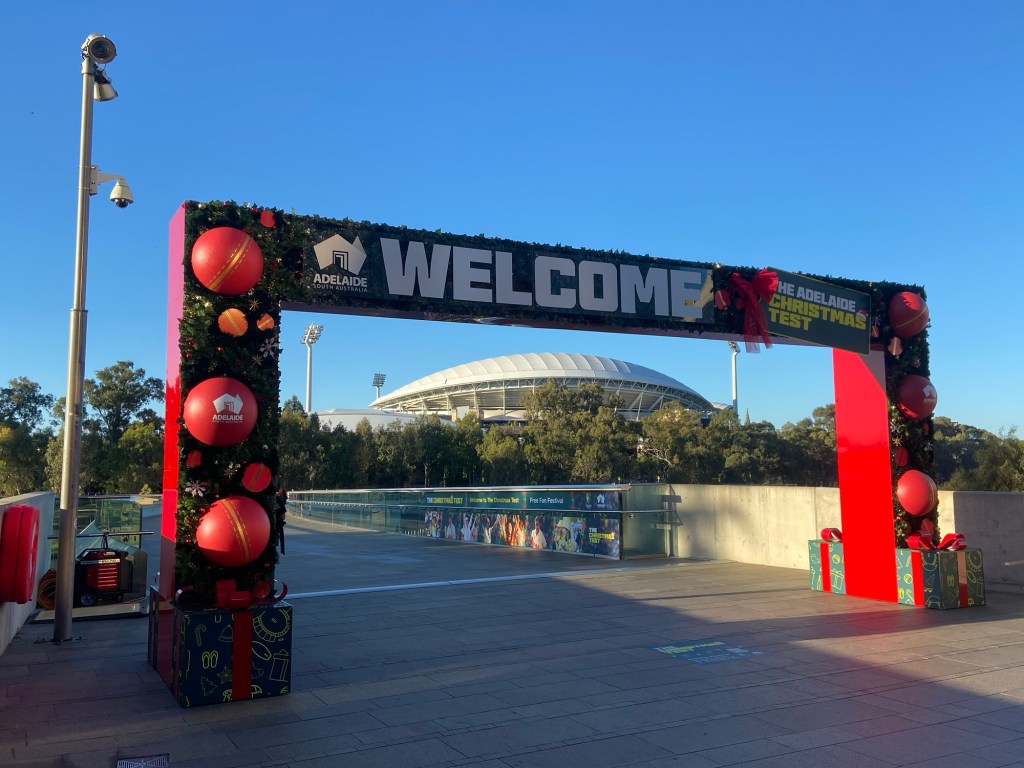
    The match is branded as the Christmas Test

    I enjoyed hearing carol singers in the Central Market after Day 3, and this evening went to a “Blue Christmasservice at the cathedral, one the most historic places of worship in the so-called “city of churches”.

    The cathedral is just behind the Adelaide Oval and gives its name to one of the ends of the ground

    The service was a reflective one, on this National Day of Reflection, a week on from the Bondi attack. A candle was lit in memory of the victims, alongside others for victims of war and lost loved ones. The Christmas message of Immanuel, “God with us”, was a comforting one, and in a particular way this year for me as a solo traveller! I also got to sing my first carols of the season, which was a thrill in a December that has been unusually lacking in them until now.

    My first Chicken Parmi, an Aussi staple, at the hotel this evening

    Having now been in Australia for three weeks, it’s really struck me how close the connections are with the UK. Culturally we are very similar, and Australia sometimes feels like a healthier, improved version of Britain, with better weather, more space and more efficient public services! And yet many people here have a strong affection for the “motherland”, and are perhaps better than we are at seeing its virtues. It’s all made for good conversation in any case, and the similarities between our two nations are what makes the Ashes contest the unique rivalry that it is. Sadly bragging rights will remain with our antipodean cousins for the next two years though…

  • Canberra

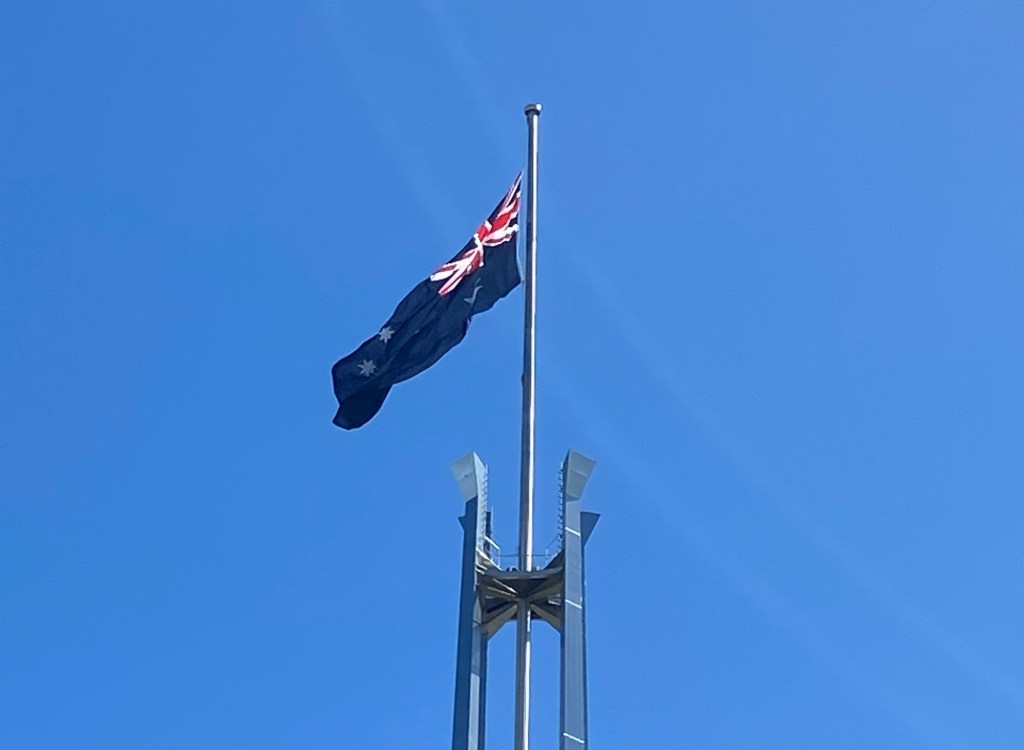
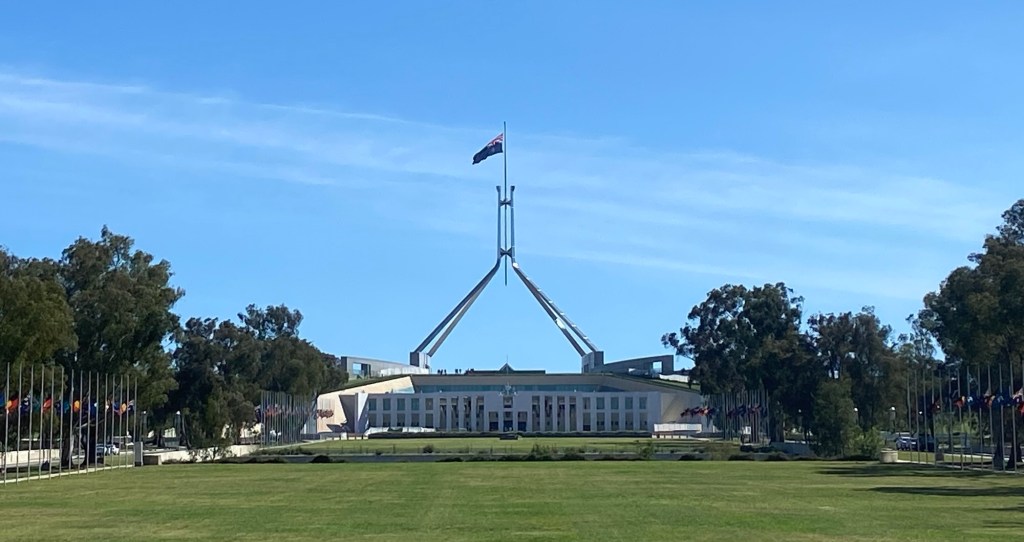
    The huge flag that flies above Parliament House in the middle of the capital

    From Sydney, I took a bus through the beautiful countryside of southeastern New South Wales, to Canberra. My main reason was to visit friends I made in Paris 18 years ago, but Australia’s capital also turned out to be most worthy of a visit in its own right!

    I was met at the bus station by Zoe, and it was a joy to be reunited 12 years after our last meeting. We headed straight to Burley Griffin lake, which was created in 1963 by damming the Molonglo river to give a watery centrepiece to the city.

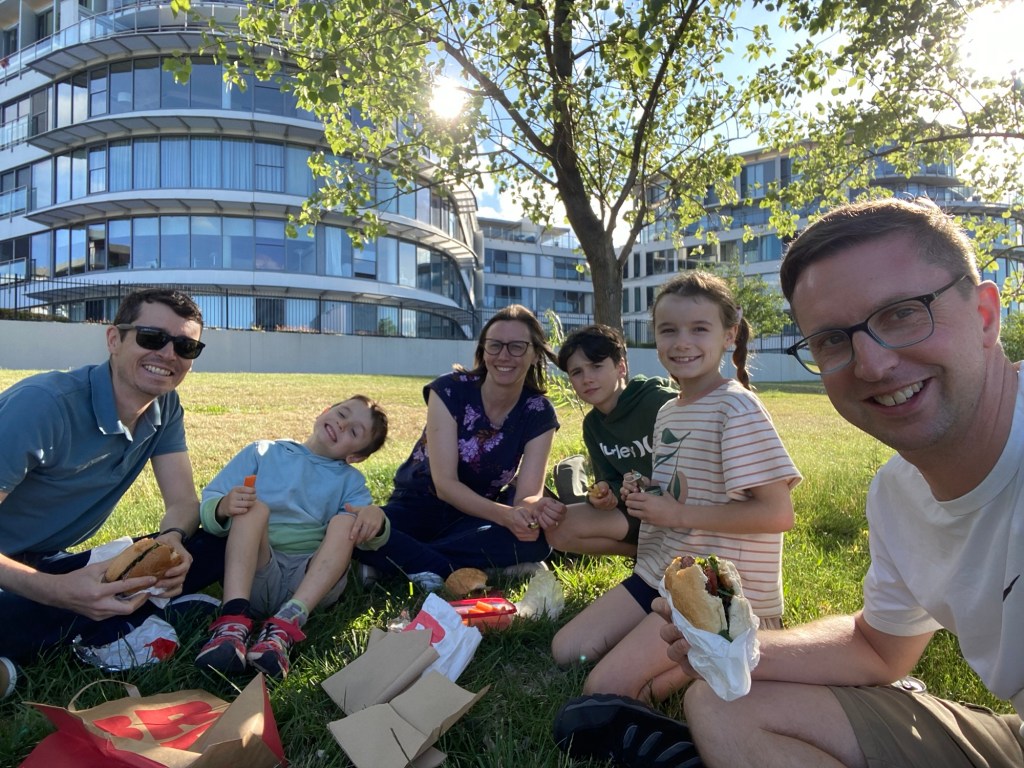
    I enjoyed beer and burgers on the lake shore with Zoe, her lovely husband Paul and their three delightful children – my very generous hosts throughout my stay

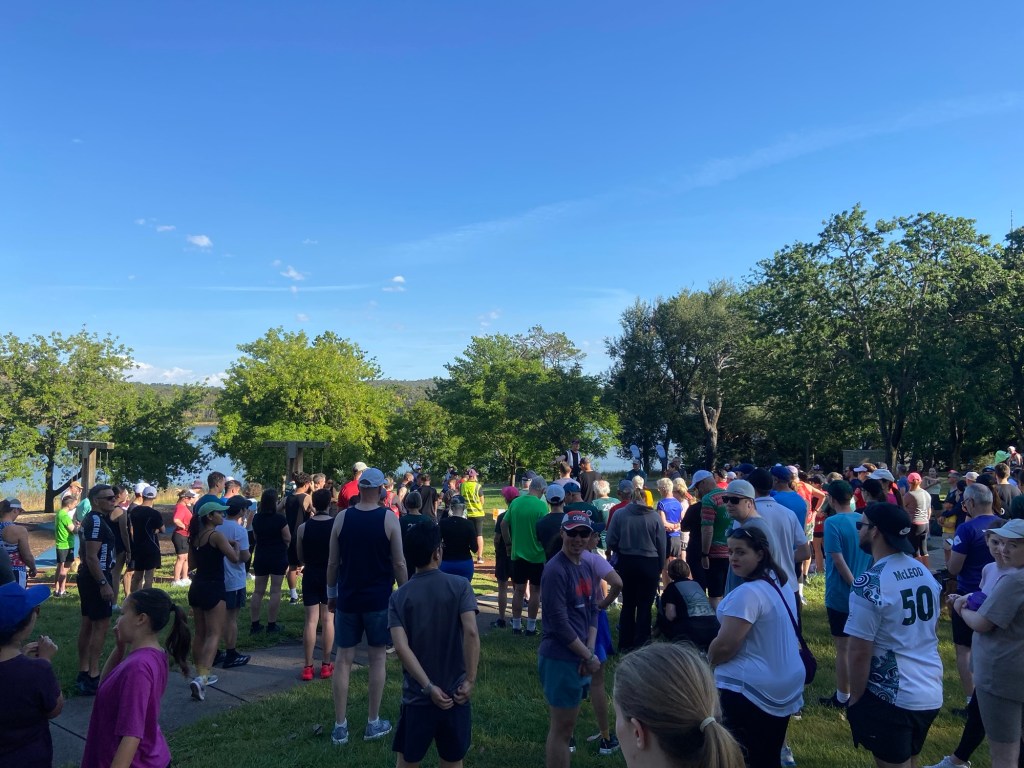
    I returned to the lake the following morning for my first overseas parkrun. I enjoyed being able to announce myself as the runner from furthest afield during the briefing, and also revelled in the novelty of finishing first in my age category!

    My fellow parkrunners were very welcoming towards “the English guy from the start” and I ended up going for coffee with some afterwards

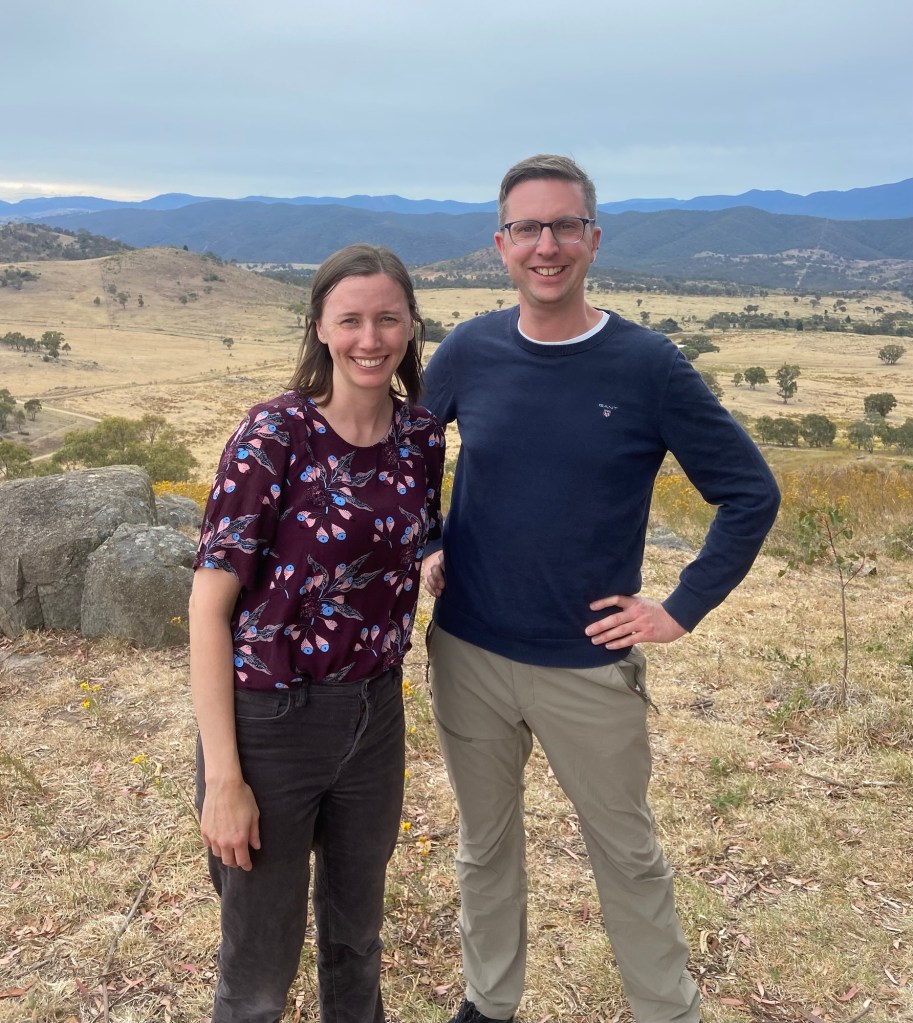
    After a birthday party with the kids (and a siesta!), we went for a walk in the surrounding hills. It was great to see some of the inland “bush” and also several kangaroos and cockatoos.

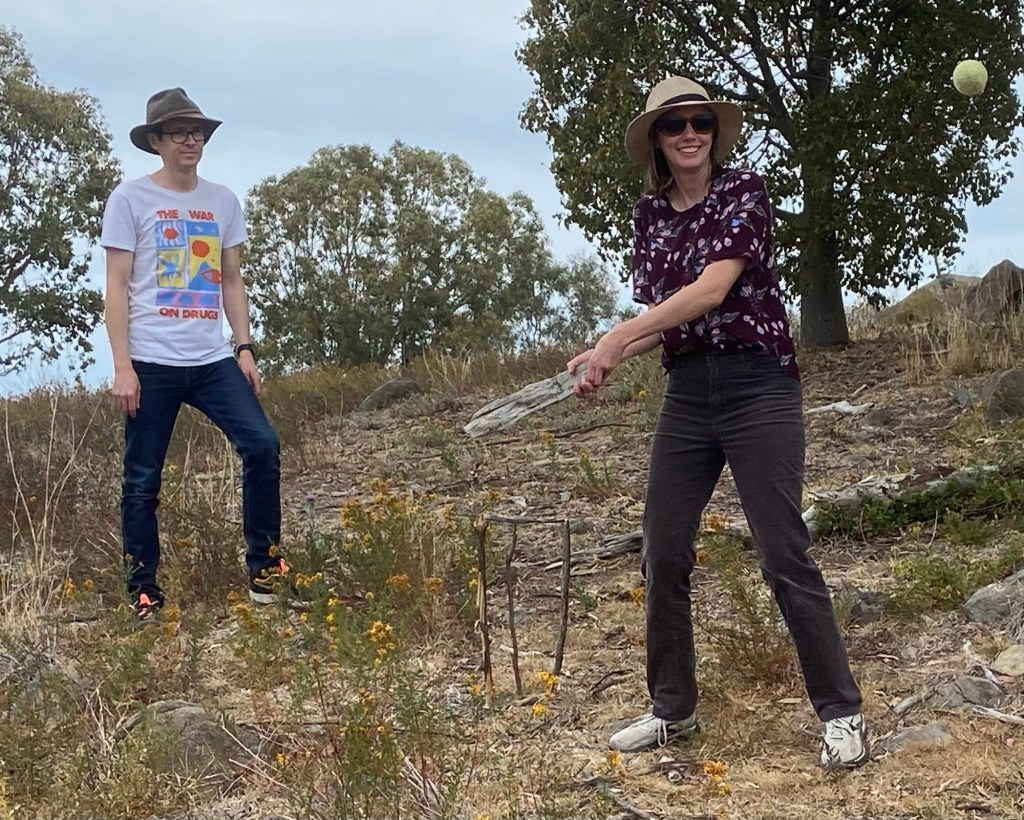
    An improvised game of cricket, arguably with better batting than in England’s second innings in Brisbane…

    That evening we got a bit more of the gang from Paris back together. With Natalie joining us, we regressed to our 2007 selves and had a wonderfully relaxed and happy evening.

    From this Thai restaurant, we found a wine bar appropriately serving the fruit of French vines!

    The next day we attended the church at which Paul is a minister, and it was great to worship with the family.

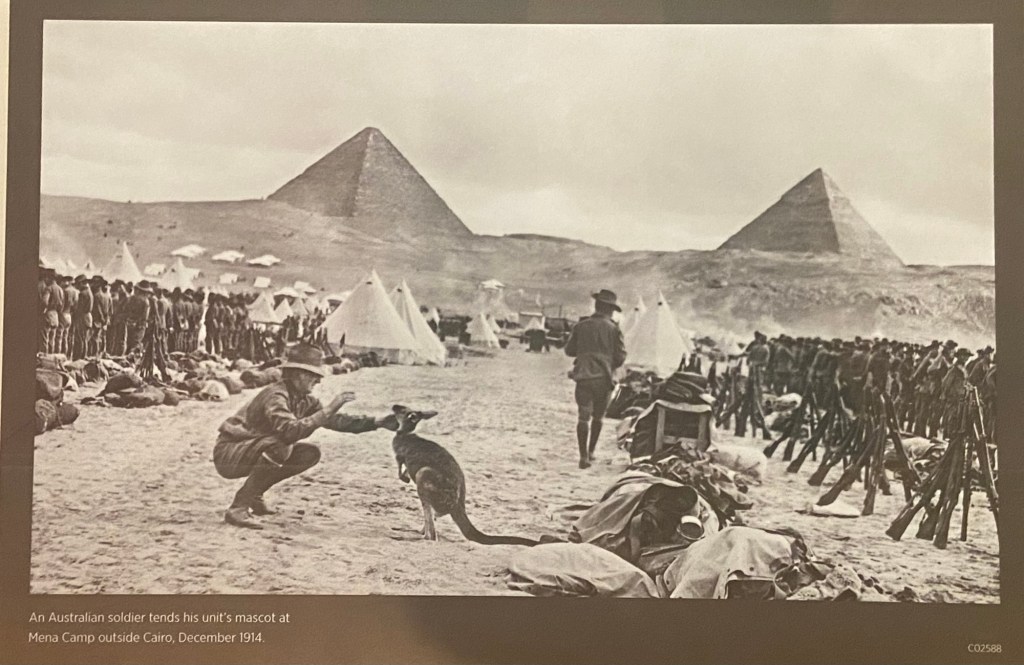
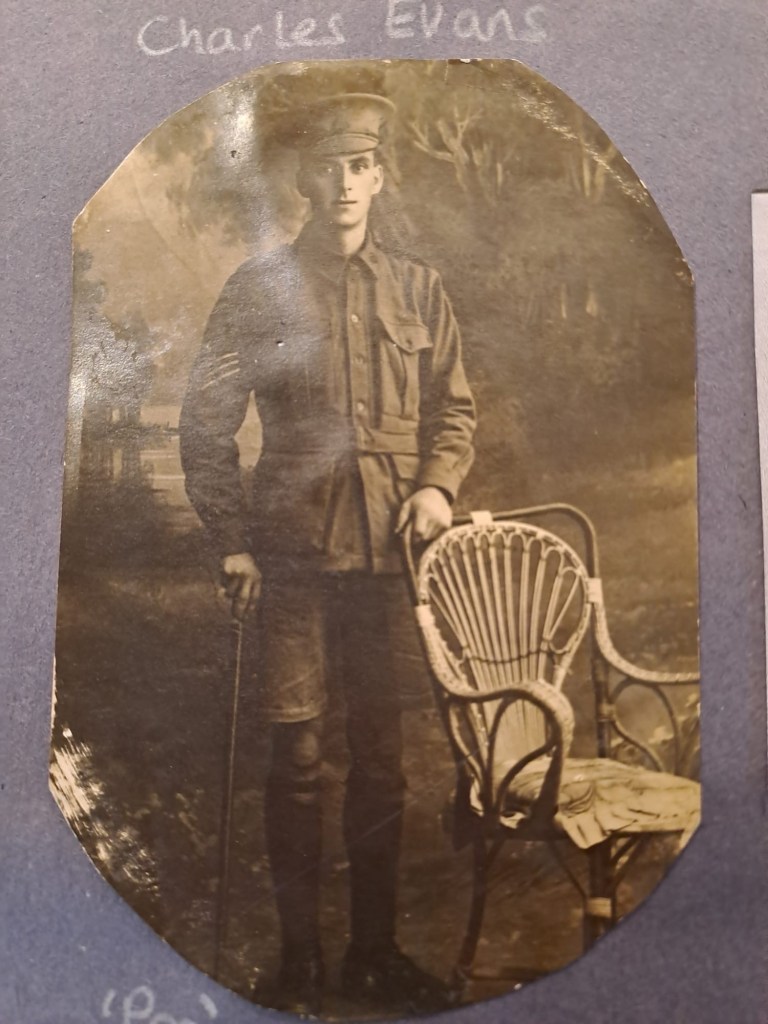
    In the afternoon we went to the Australian War Memorial. I was particularly keen to visit, as my Great-grandfather, Pop, had moved to Australia before the First World War and was an early enlister with the Anzacs (Australia and New Zealand Army Corps). He fought at Gallipoli, the ill-fated campaign that played such a big part in forging the identity of Australia, a mere 14 years after it achieved nationhood.

    A landing vessel used in the Gallipoli landings on 25 April 1915

    I studied every exhibit in forensic detail and found them fascinating and devastating in equal measure. The story of the Anzacs at Gallipoli is one of enthusiastic volunteers becoming trapped at the nightmarish Anzac cove, with the sea on one side and cliffs and Turkish gunfire on the other.

    We know Pop was among the Anzacs who trained in Egypt before heading to the horrors of Gallipoli

    What I hadn’t realised is that the War Memorial also holds all the military archives from Australia’s various campaigns, digitised and meticulously curated. Two volunteers were very generous with their time in helping me to find every record relating to Pop. I learned a huge amount about his movements and likely experiences in the war, and was left with many more avenues of inquiry for my return to the UK.

    A family photo of my great-grandfather, now even more a hero of mine

    Having explored a personal connection, it was particularly poignant to attend the Last Post Ceremony at the Pool of Reflection. Each day the story of a serviceman is told and wreaths are laid. We heard the heartbreaking tale of a young man who, unlike Pop, did not return home after the war.

    The domed structure houses Australia’s Tomb of the unknown soldier
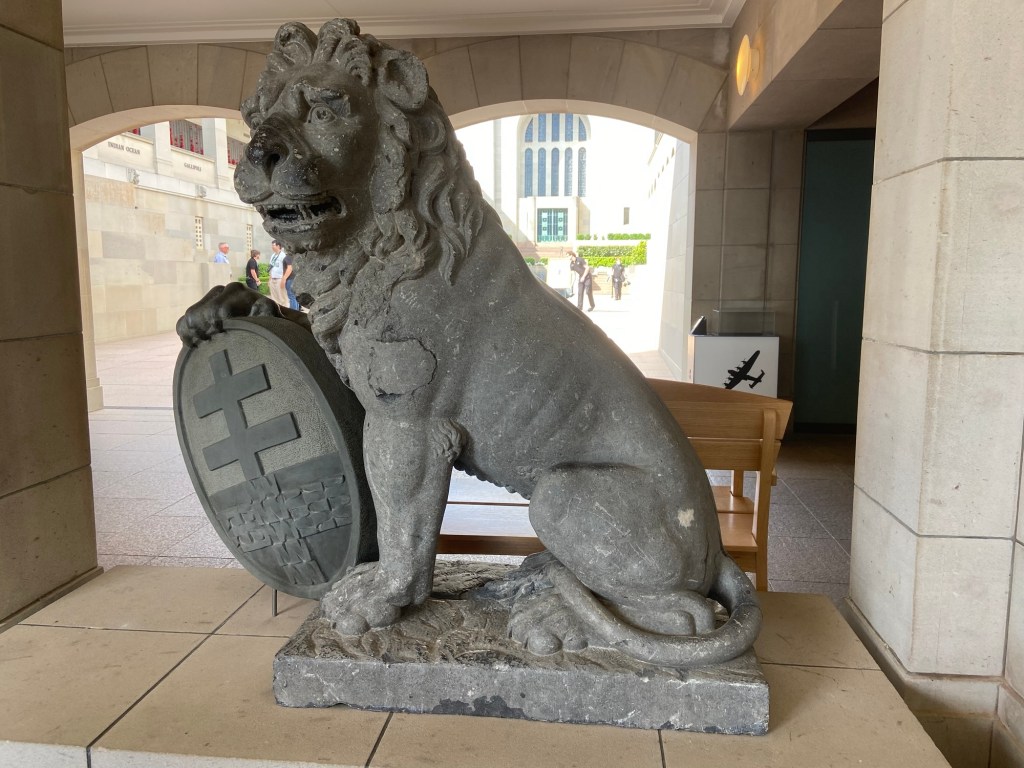
    This lion at the entrance to the War Memorial is from the original Menin Gate at Ypres and was a gift to Australia from Belgium
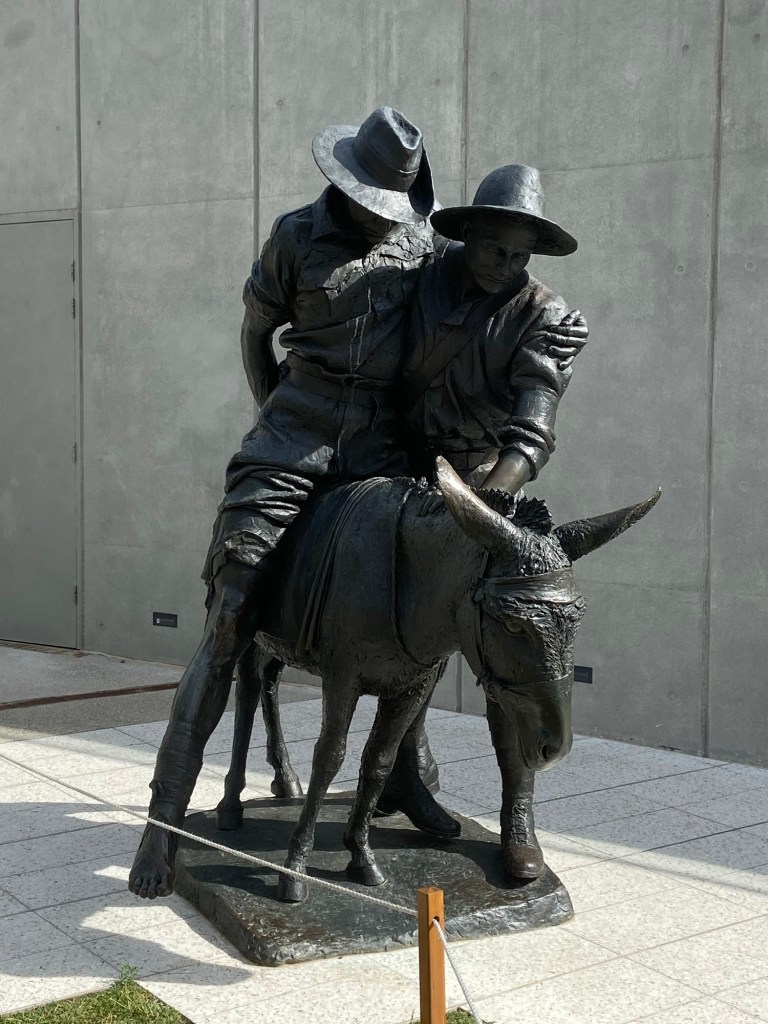
    This powerful statue shows John Simpson Fitzpatrick, a courageous stretcher-bearer at Gallipoli

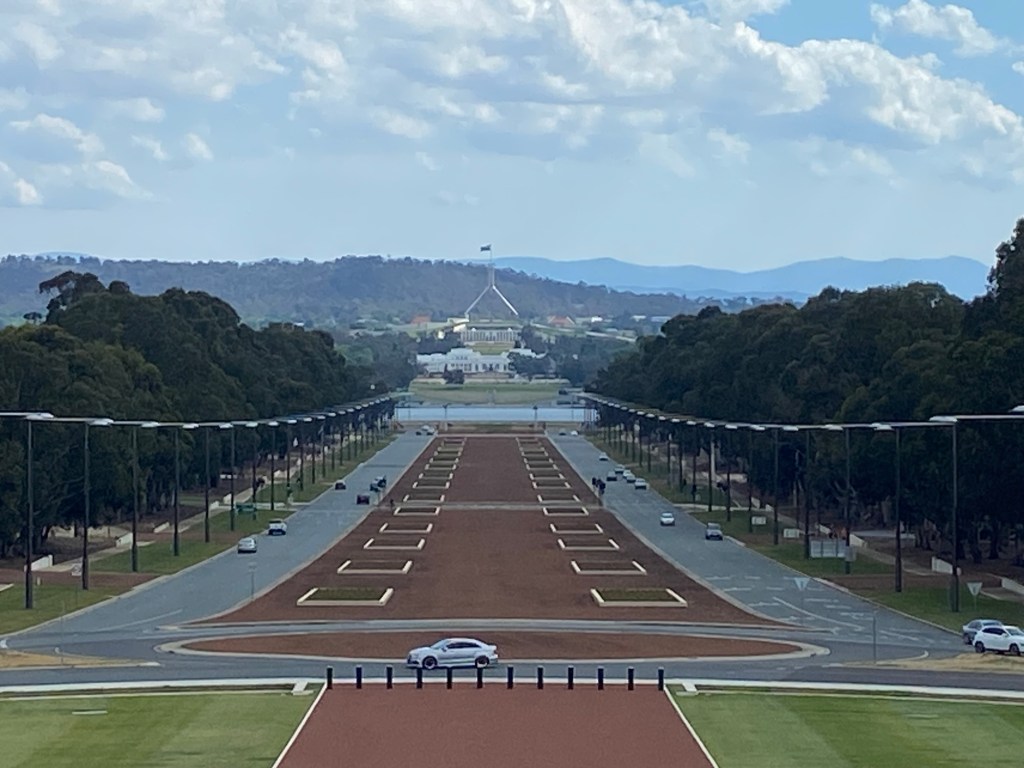
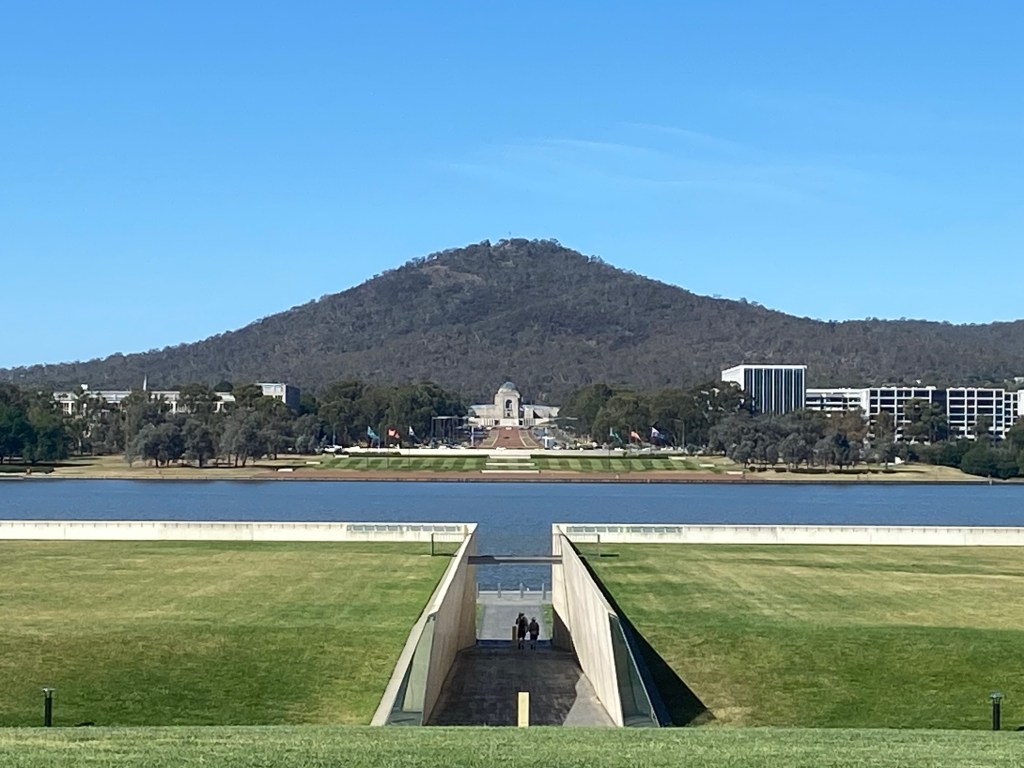
    Canberra was famously just a sheep paddock before being chosen as the site for Australia’s capital and its subsequent design is clearly meant to communicate something about the new nation’s priorities. The War Memorial faces the Parliament House across the lake, serving as a sobering reminder to lawmakers of the gravity of their decisions.

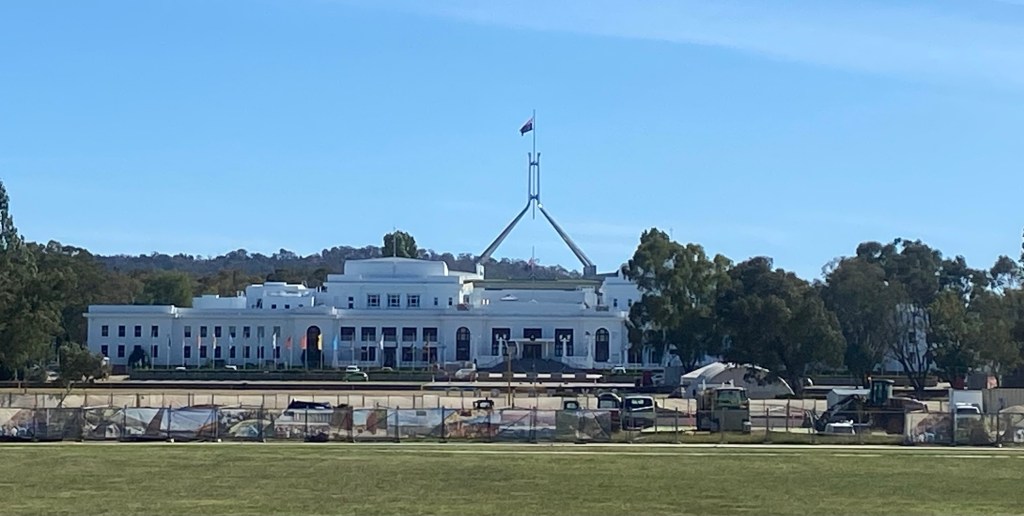
    The nearer white building is the Old Parliament House, with the current one sitting beneath the huge flag behind it

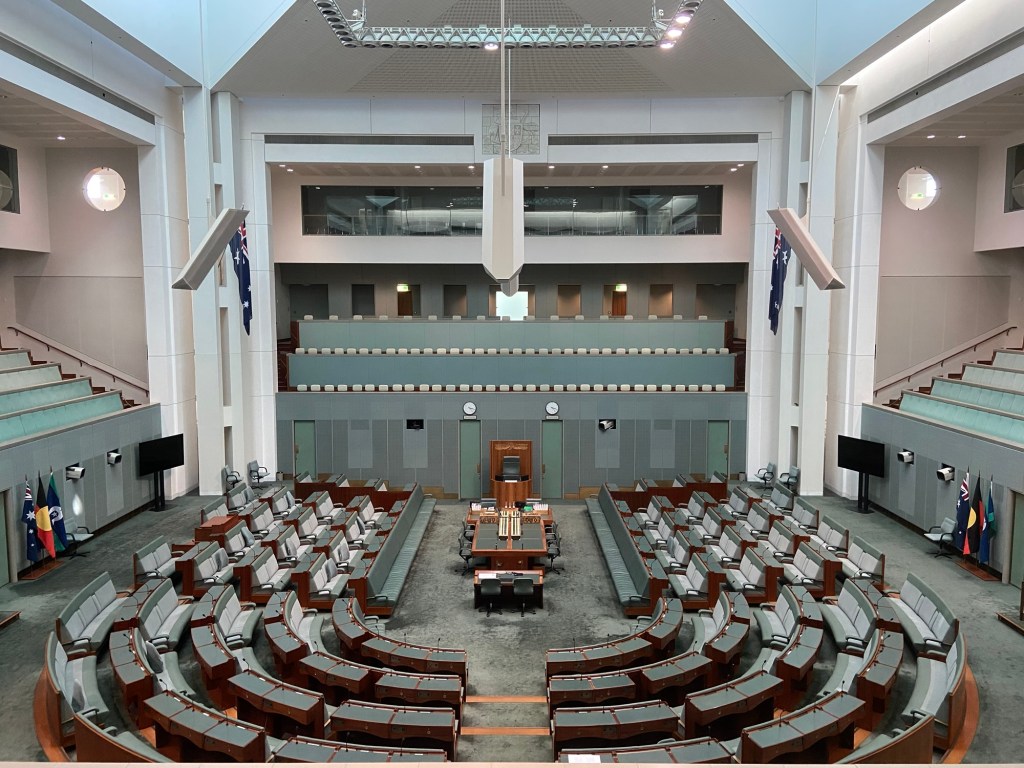
    Today, after my second visit to the War Memorial, I had a bit of time to visit the seat of Australian democracy. Parliament House was remarkably easy to access, and after a security check I was able to walk straight into the public galleries of both chambers.

    Parliament House
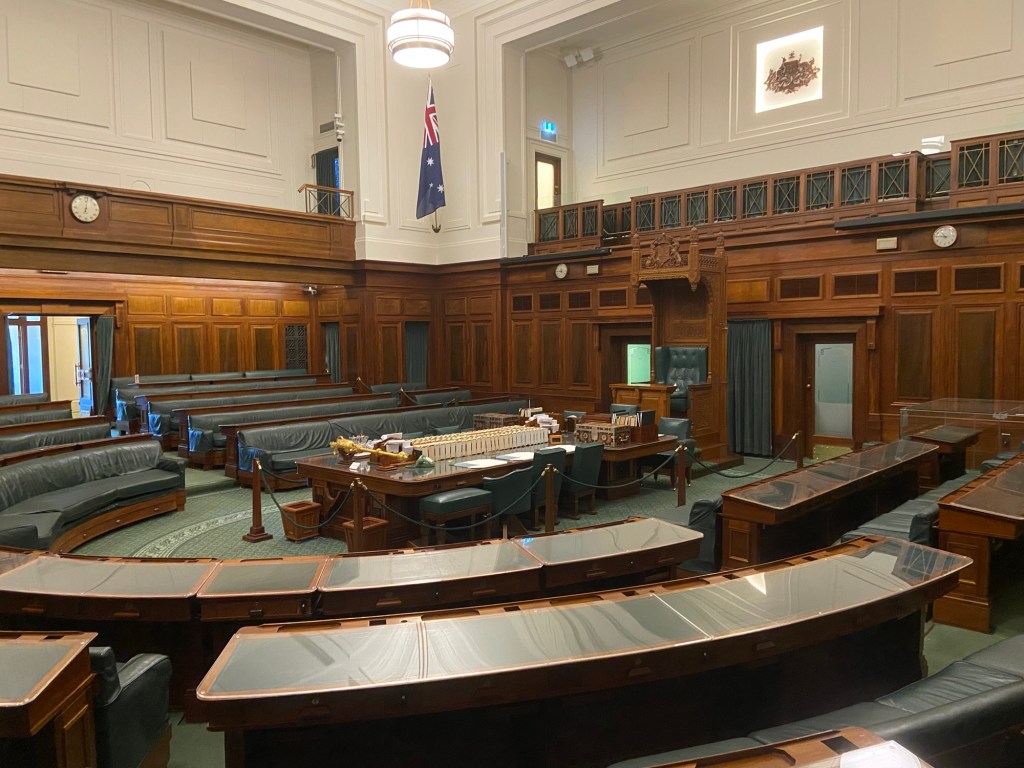
    The House of Representatives has green seats, like the House of Commons in Westminster
    And the Senate red seats, like the House of Lords
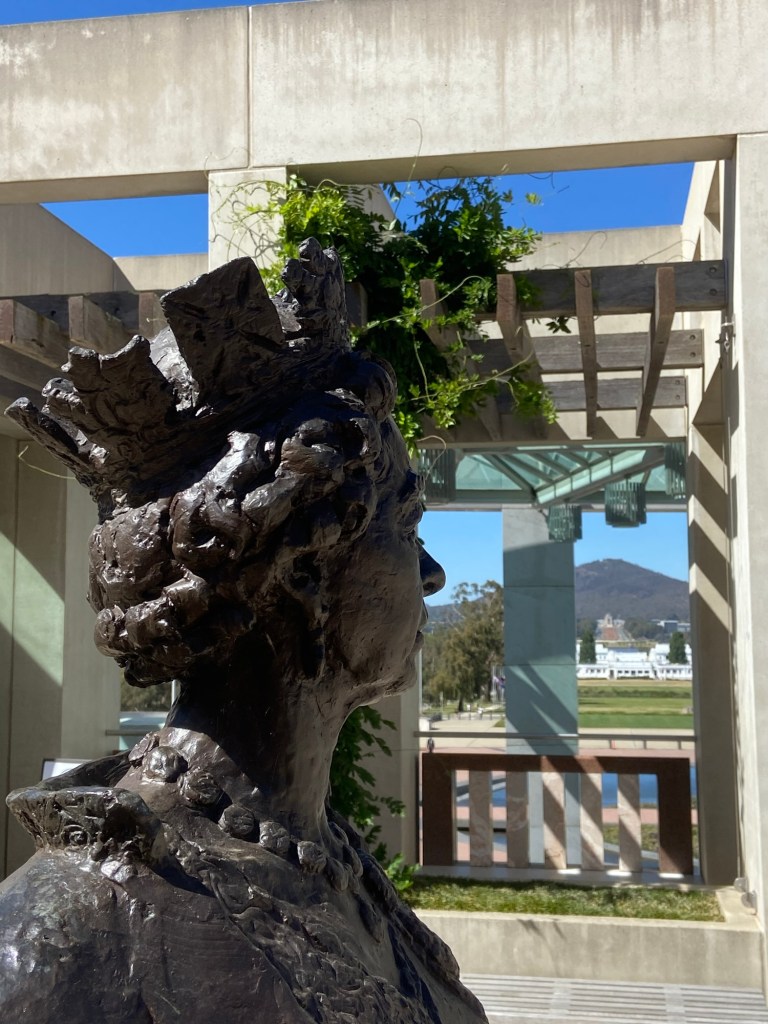
    The new Parliament House was opened by Queen Elizabeth II in 1988, the bicentenary year of the arrival of the first European settlers on the continent. I wondered if her statue deliberately had her gazing towards the War Memorial
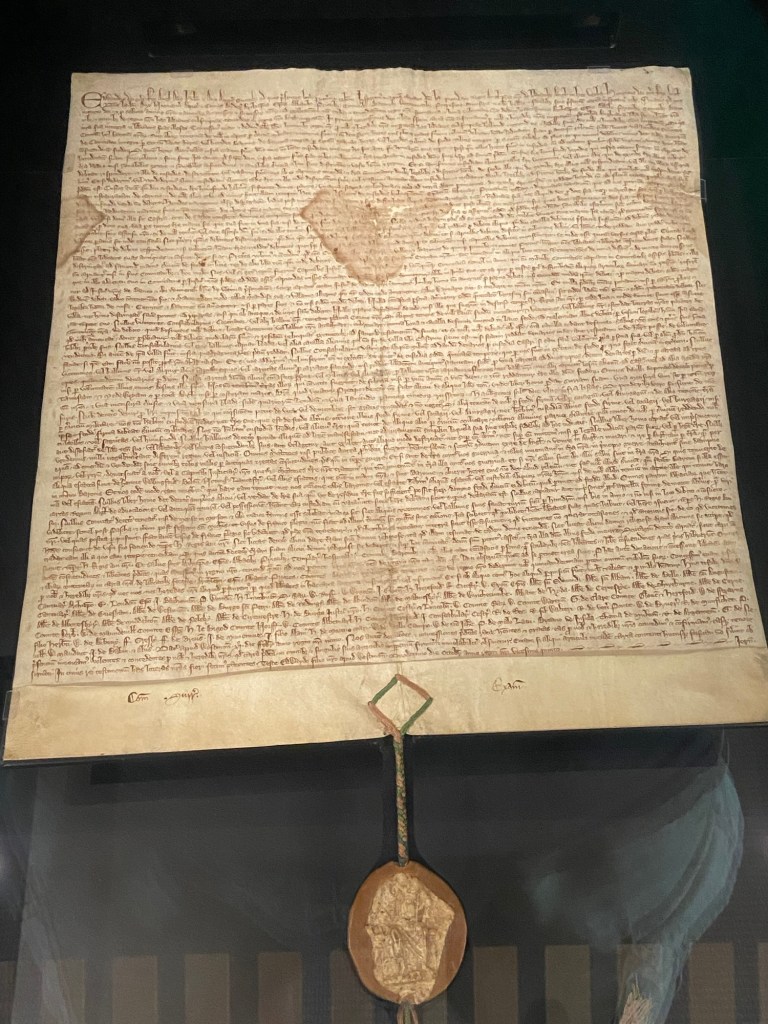
    The Parliament House has a precious 1297 copy of Magna Carta
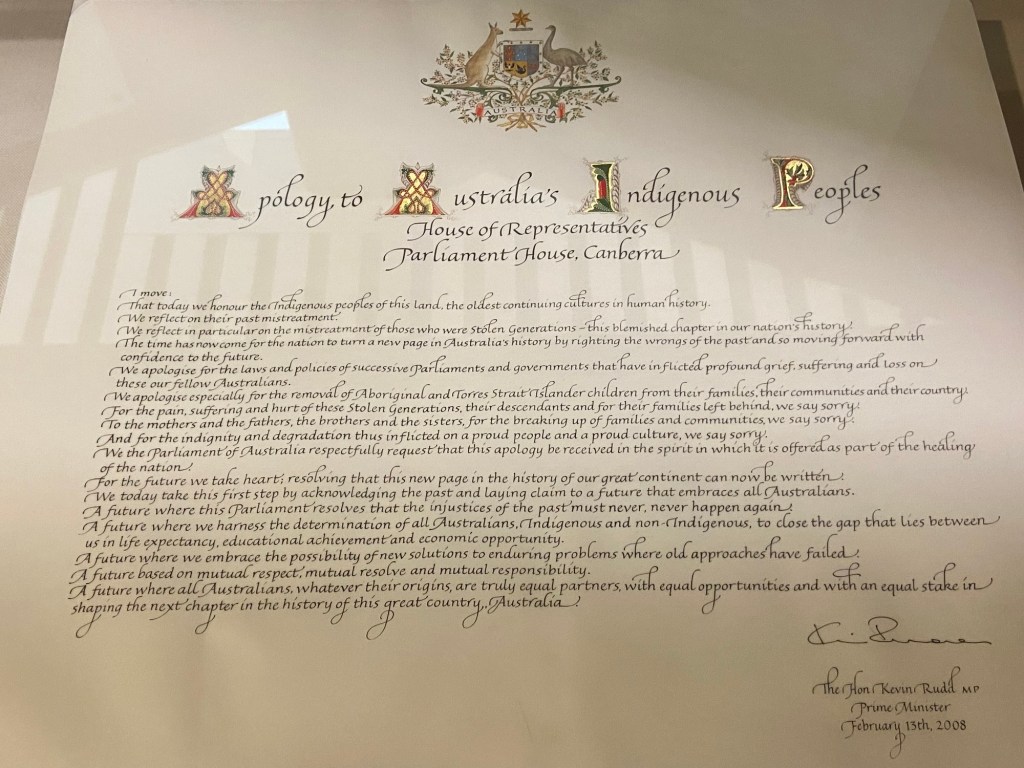
    … and other significant documents, such as Parliament’s official apology for the heinous removal of children from indigenous families
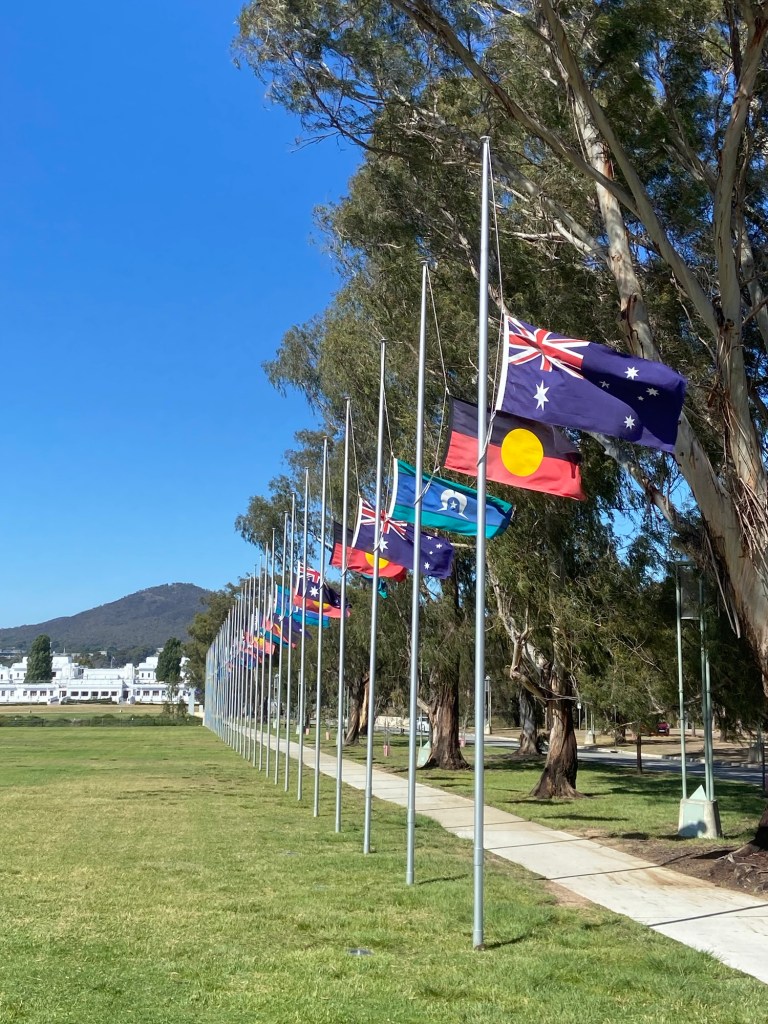
    By order of the Prime Minister, all flags were flying at half mast to honour the victims of yesterday’s sickening attack on a Hanukkah celebration at Bondi Beach

    I then made a brief visit to the Old Parliament House. The structure had been intended to be temporary, but ended up being used for 61 years, and is now the Museum of Australian Democracy.

    Being from the old country, I actually preferred the original chambers, but by 1988 they were too small to accommodate the elected officials of a growing nation
    Looking back towards the War Memorial, perfectly framed by Mount Ainslie behind
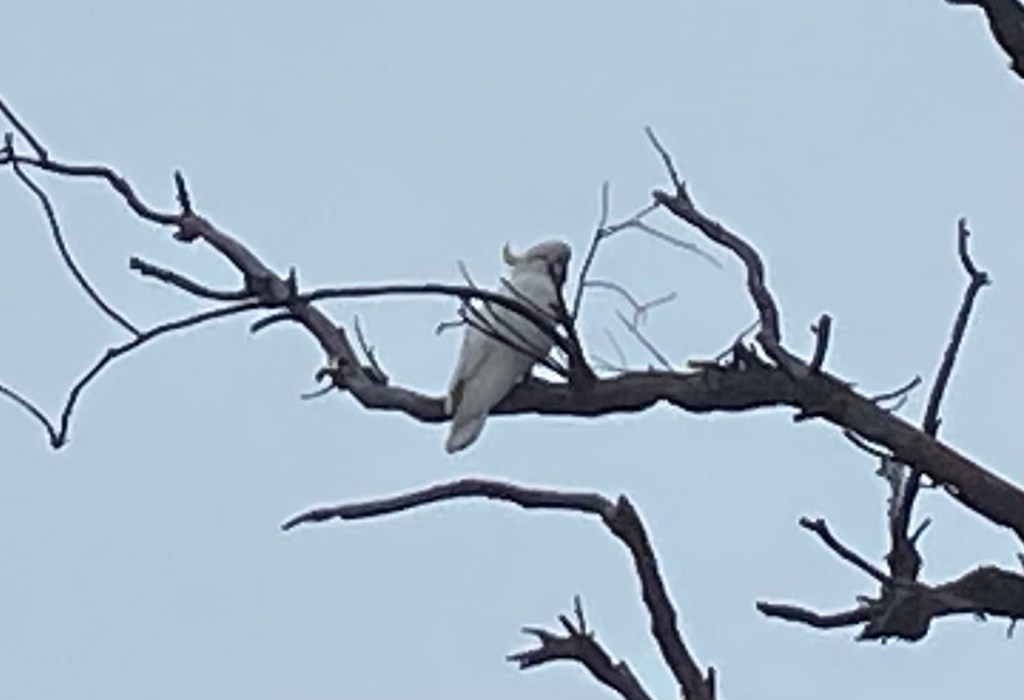
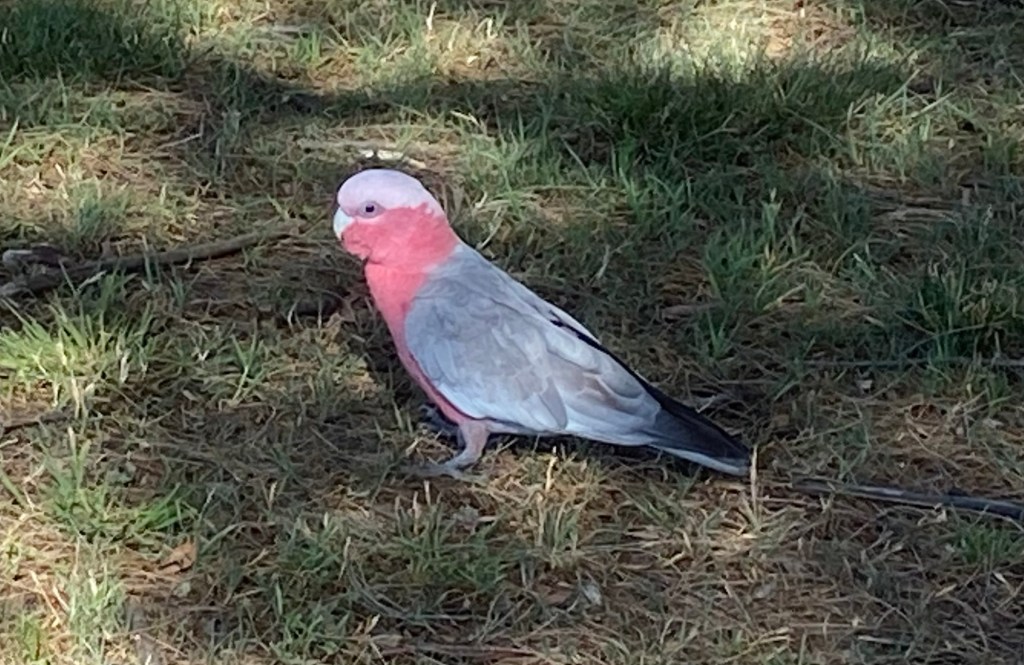
    A galah, Australia’s most common cockatoo, in the gardens leading down to the lake

    Canberra will retain a special place in my heart, as the home of Zoe, Natalie and their families, but also a place where I was able to engage with the history of a nation, and my own family’s connection to it.

    My time here has also made me reflect on the preciousness of peace: at church, but also as I’ve been reminded of the horrors of war. Yesterday’s terrible events at Bondi Beach, where I spent such a happy afternoon last week, have reinforced those thoughts, and have shocked a country unused to such disturbances of its own peace. They have added a tragic chapter to Australia’s story, but also, as accounts of great courage emerge, given it some new heroes…

    I have now arrived in Adelaide, ahead of the Third Test. I haven’t seen the city yet, but South Australia does have one feature of instant interest to a mathematician: it’s wacky time zone. At midday in London the time here is 22:30. Barmy! Just like the (very much non-military) army I am about to rejoin…

  • Sydney

    Almost 90% of Australians live within 50km of the coast, and the 20% who live in Sydney have 240km of shoreline to enjoy around the largest natural harbour in the world. I was only able to explore a small amount of it during my three days there, but that was long enough for me to be taken in by the charms of this coastal metropolis!

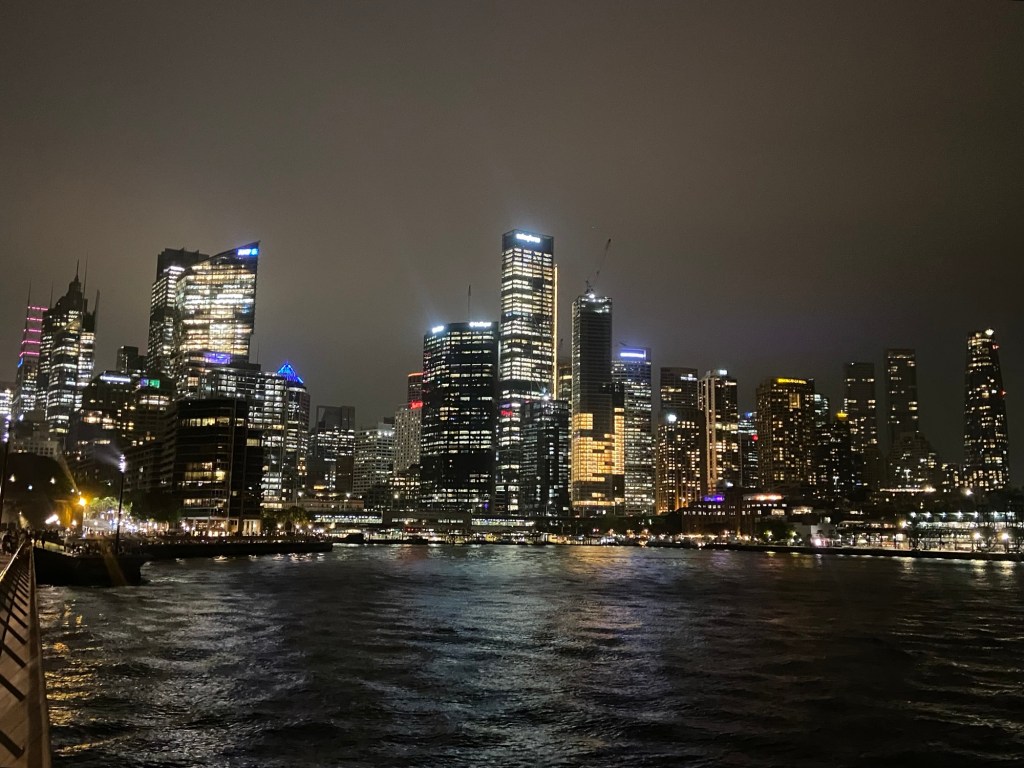
    Within minutes of dropping my bags at my modern and comfortable hostel, I got talking to a French traveller, Timothée, who became my enthusiastic guide for the evening. We first explored the impressive CBD, with skyscrapers and wide streets that had a Manhattan feel to them.

    This huge Christmas tree could have been in New York too, but for the balmy weather!

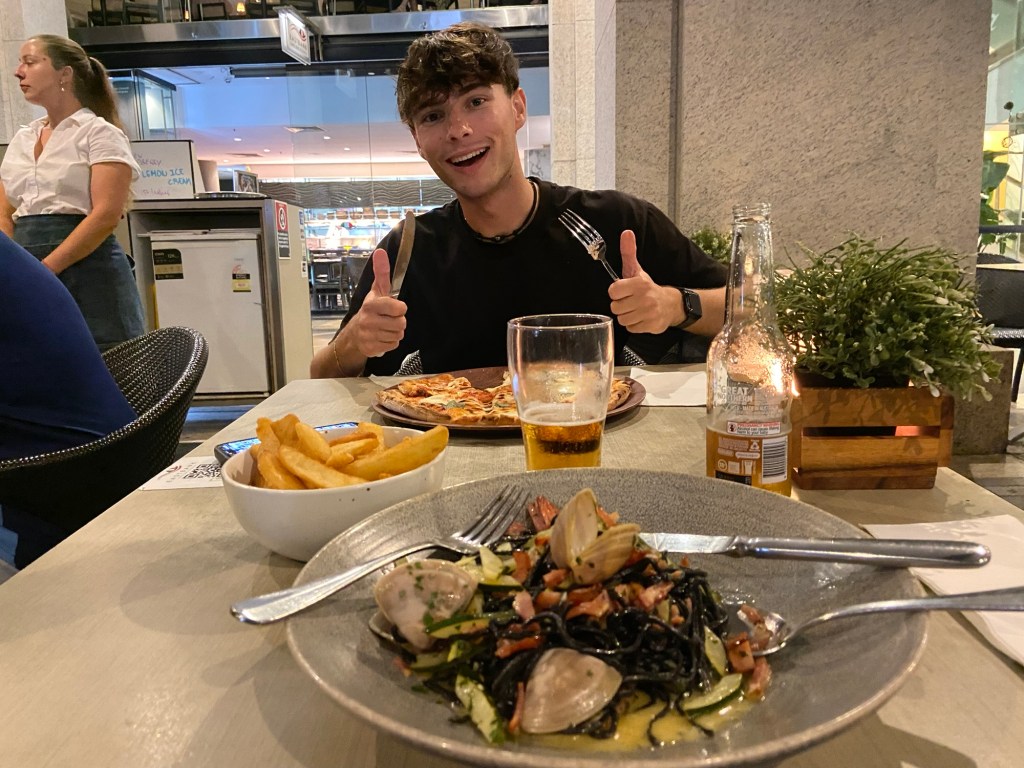
    We then headed down to the harbour for dinner, and I was having to pinch myself that I was actually in such an iconic and beautiful location!

    Squid ink and shellfish pasta for dinner!

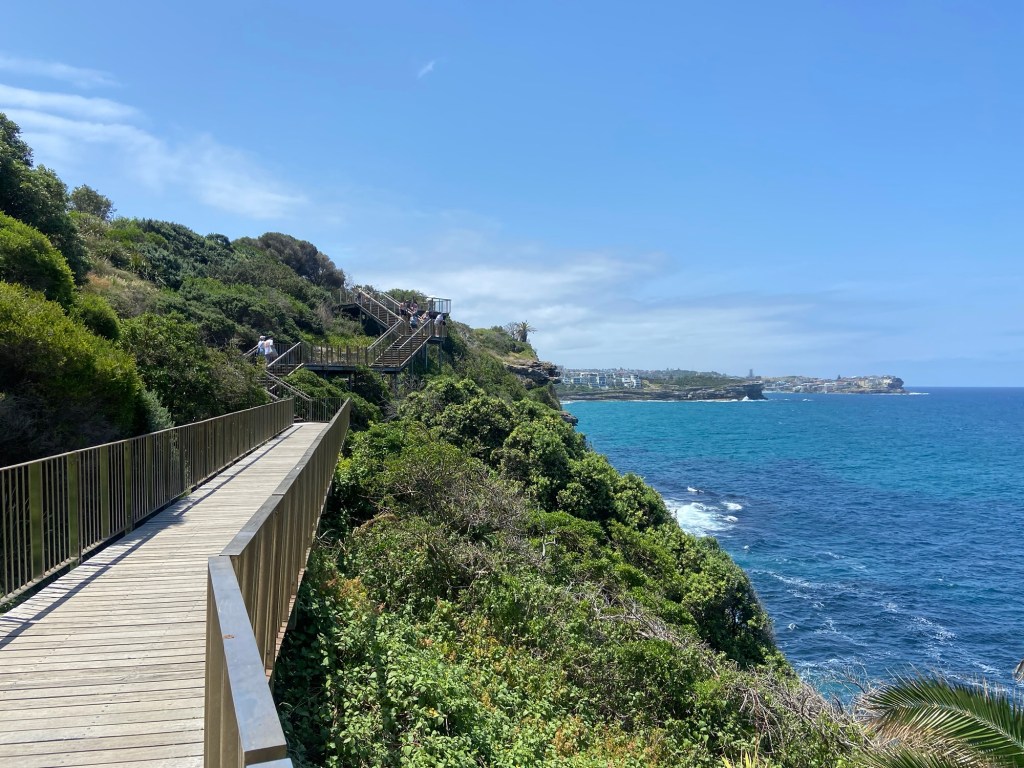
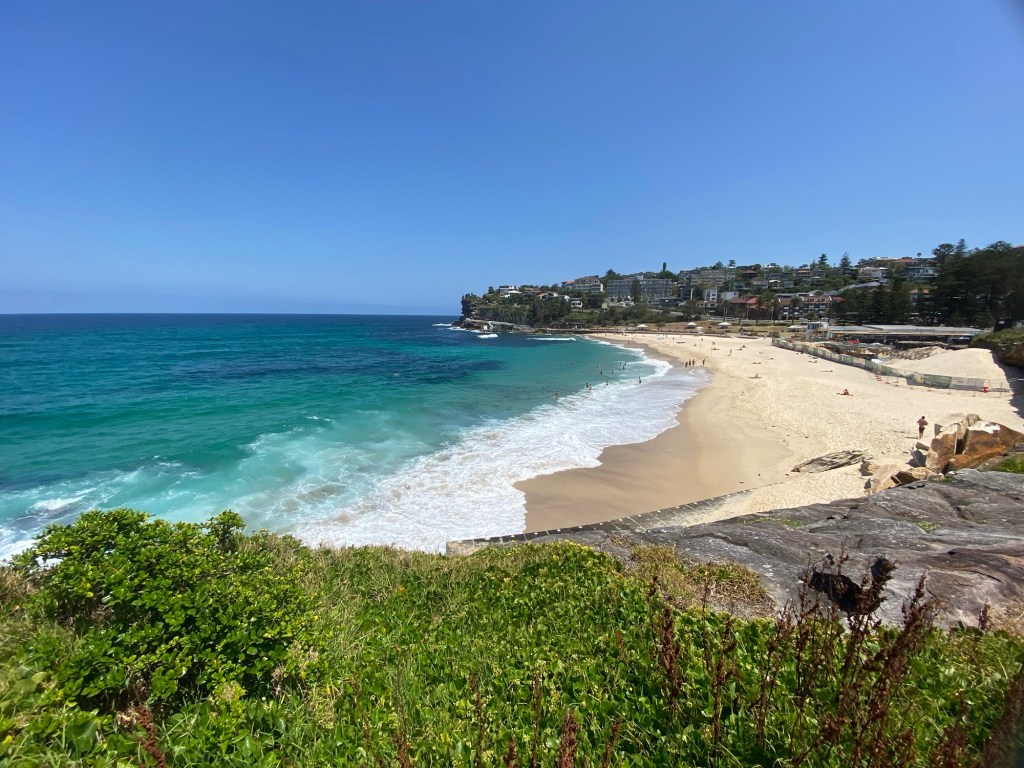
    The next day, I took the bus to Coogee Beach, and did the 6km walk along the coast to Bondi. The forecast was for rain, but instead it was sunny for much of the afternoon, making the scenic route even more spectacular.

    Coogee Beach
    There’s nothing like a coastal walk on a sunny day to blow away the cobwebs – and to give the chance to process the sensory overload of recent days!
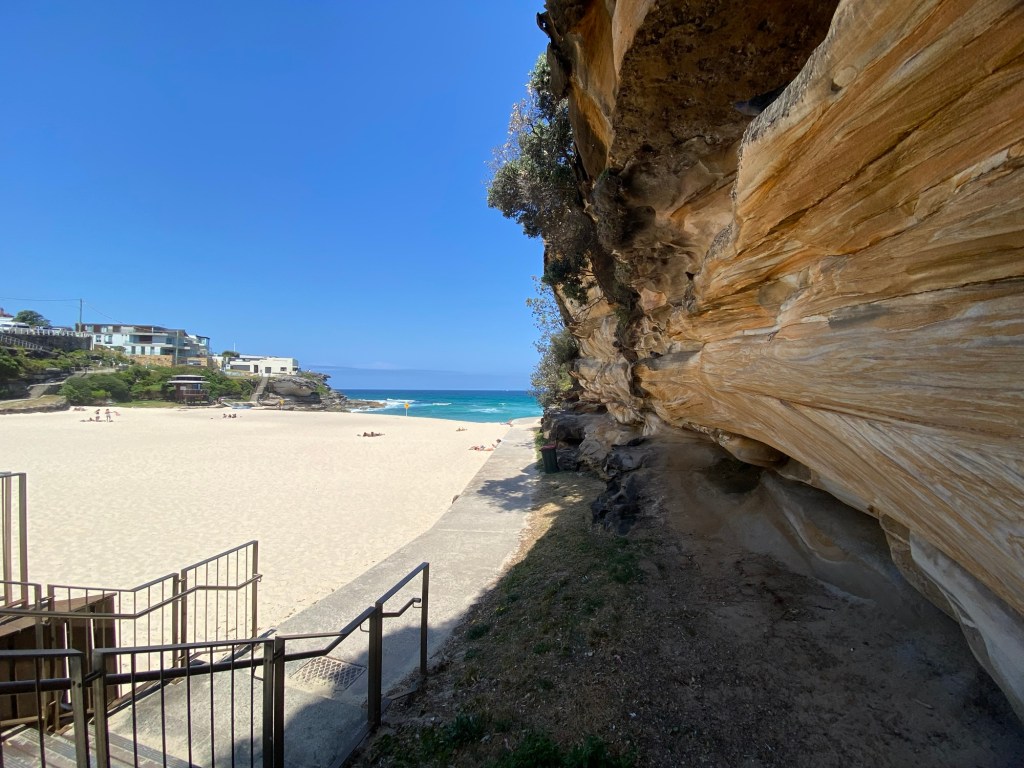
    Bronte Beach
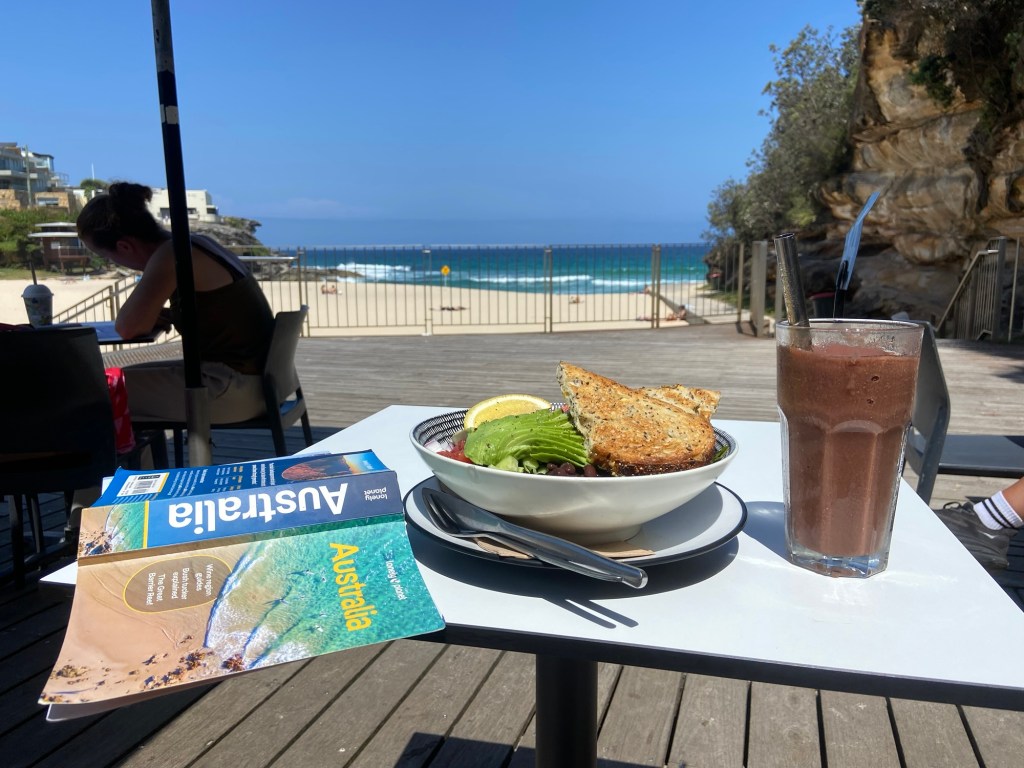
    A healthy lunch on Tamarama Beach!
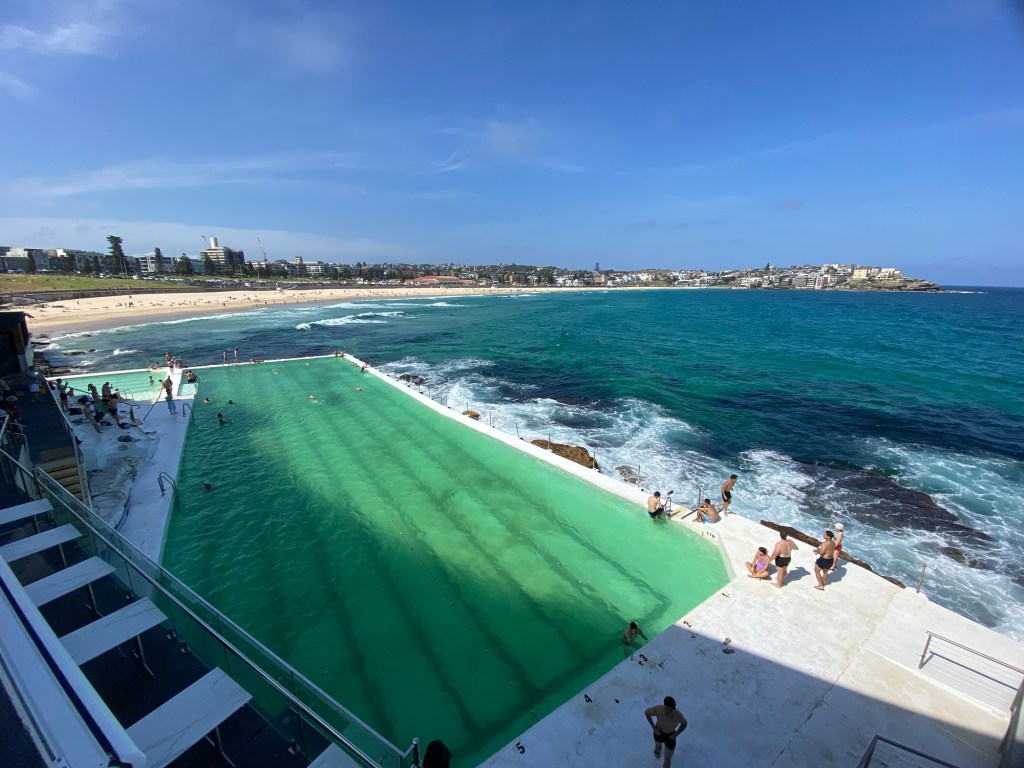
    Bondi Icebergs saltwater pool
    Bondi Beach, where I couldn’t resist a dip in the world-famous surf!

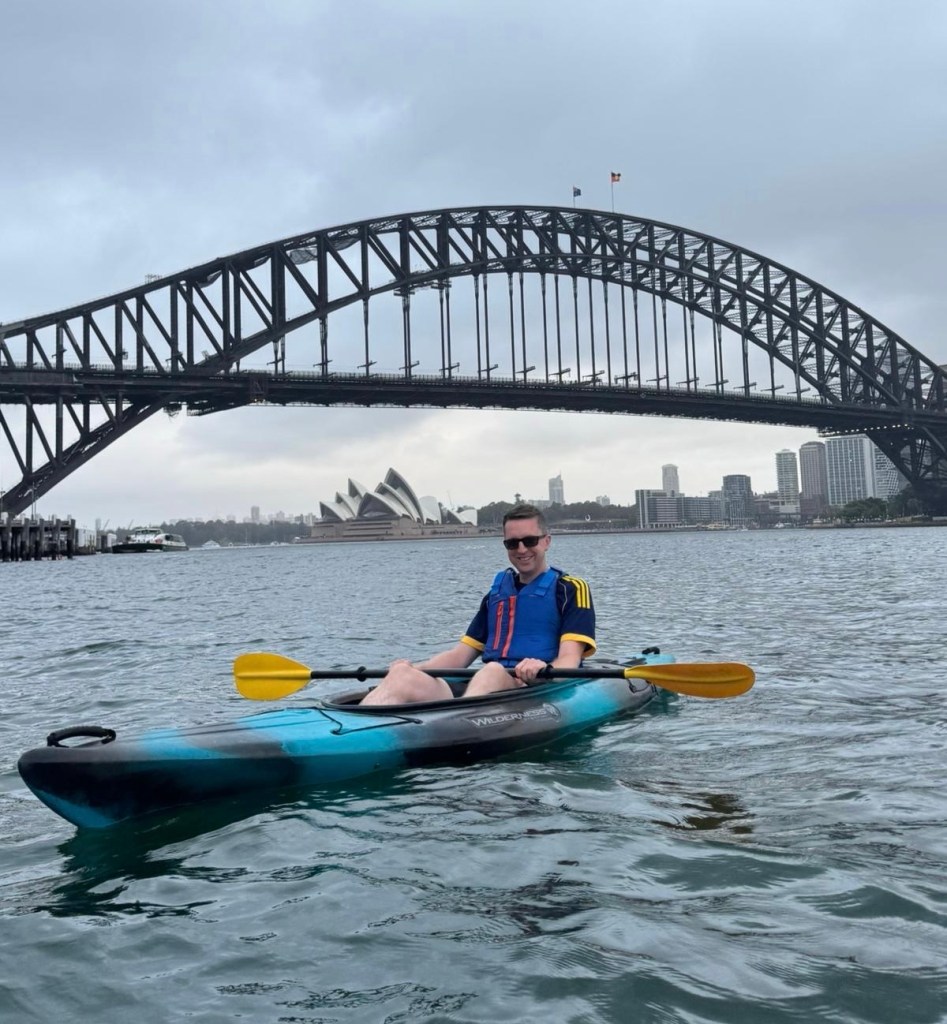
    From Bondi, I took two buses, through the rush hour traffic and across the Harbour Bridge, to North Sydney. Here I went for a “sunset kayak”, although the sun was no longer visible by this point… It was nonetheless a very peaceful way to spend the evening and the other kayakers were great company.

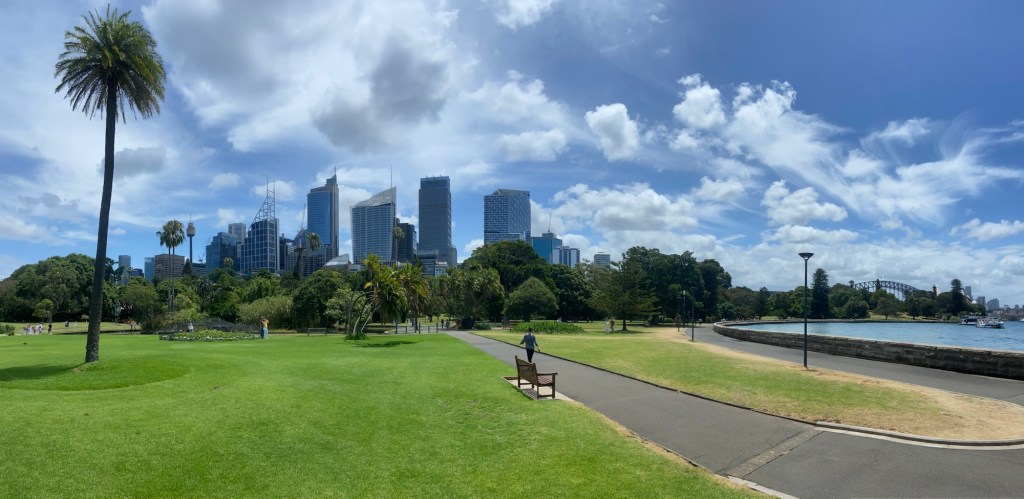
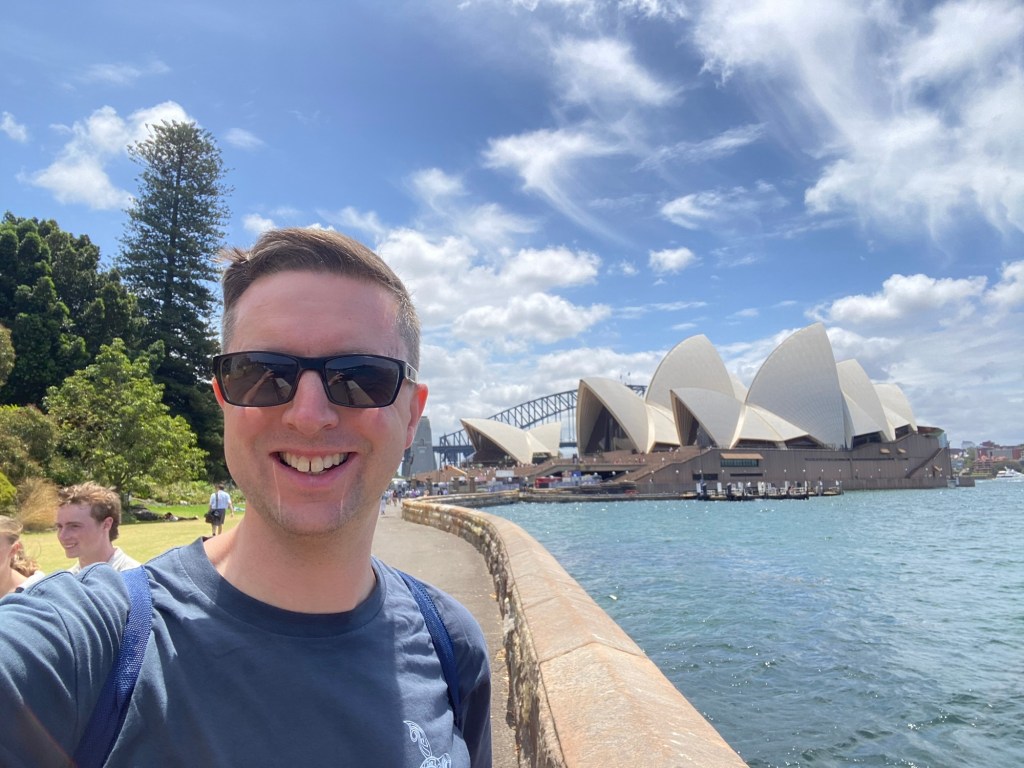
    I had a leisurely start the next day, having decided to continue being sociable when I got back to the hostel! When I finally got going, I walked through the Botanic Gardens to the Opera House, before boarding a ferry to Manly from Circular Quay.

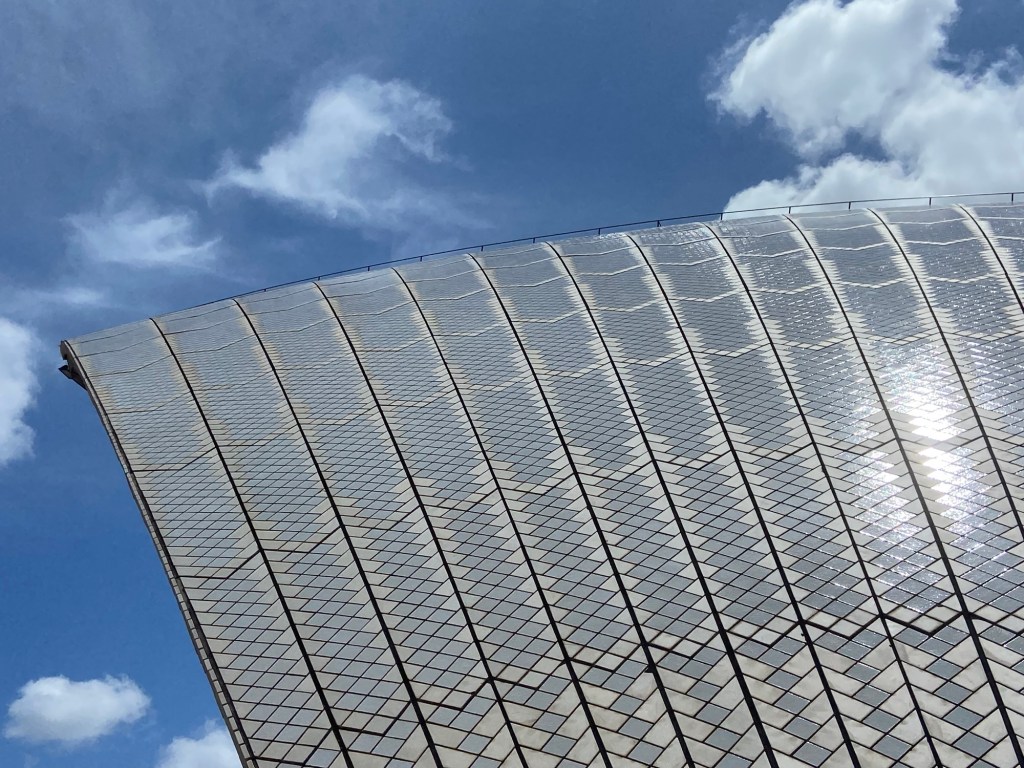
    Interesting to see the roof up close!
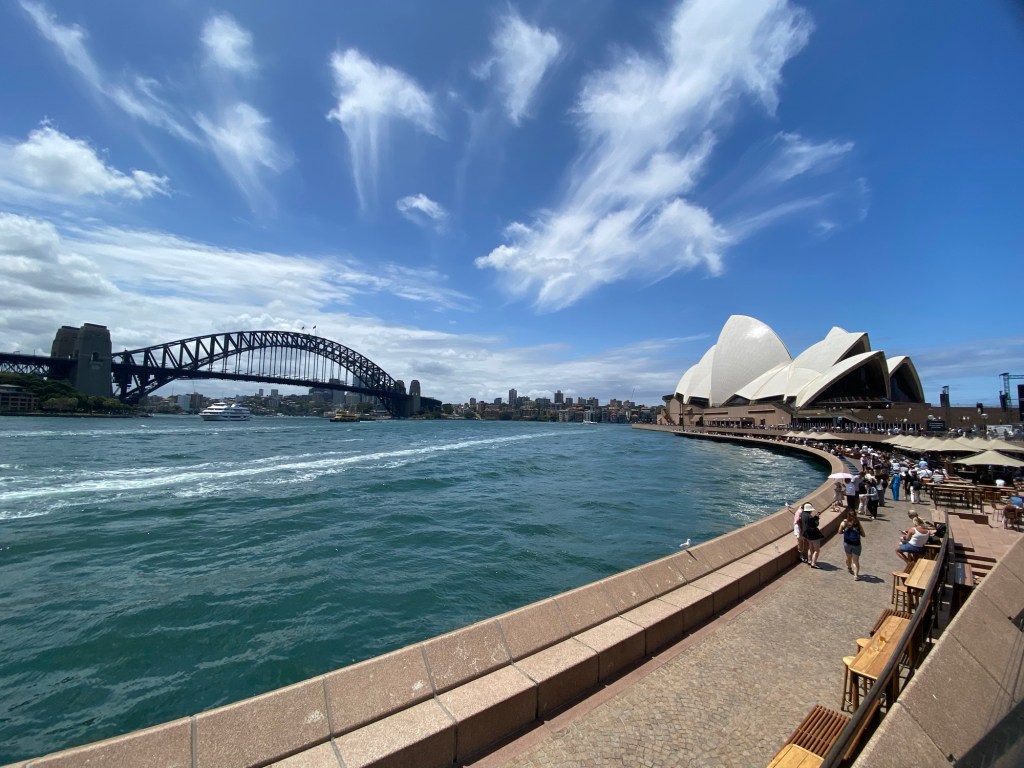
    There were great views of the CBD, Opera House and Harbour Bridge as the ferry headed to the outer harbour

    Manly is a very liveable suburb, on an isthmus between the ocean and the harbour. I fancied another walk, so spent several hours exploring the National Park up towards the headland at North Head.

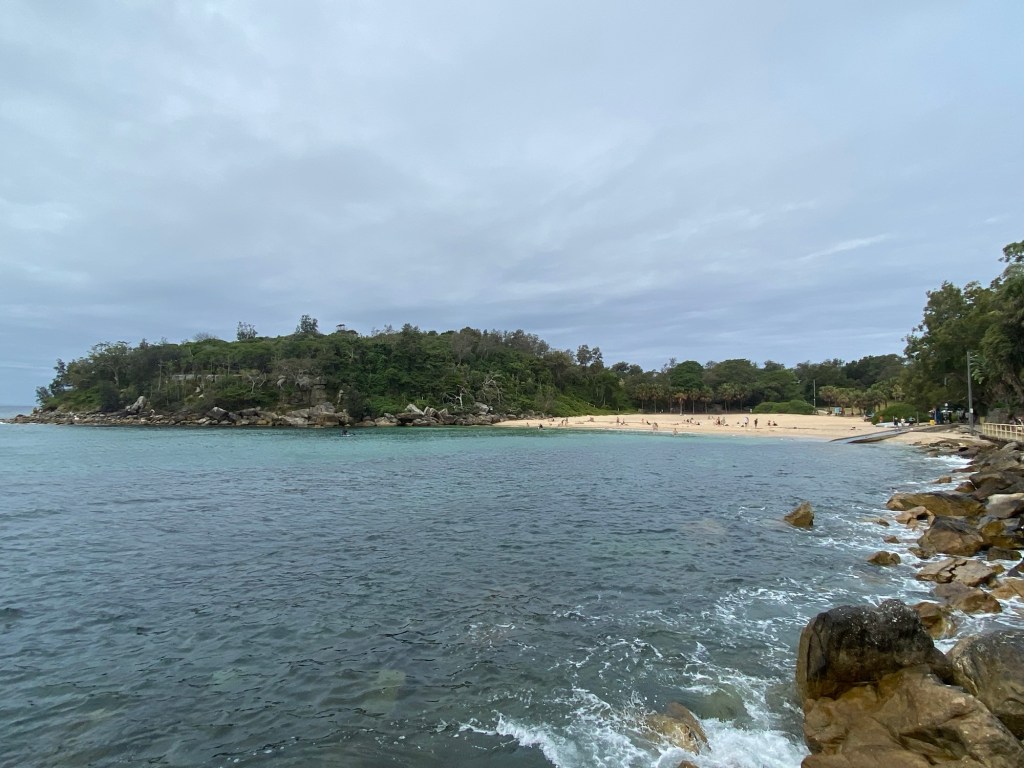
    Shelly Beach is a popular snorkelling location, although it wasn’t quite the weather for it!
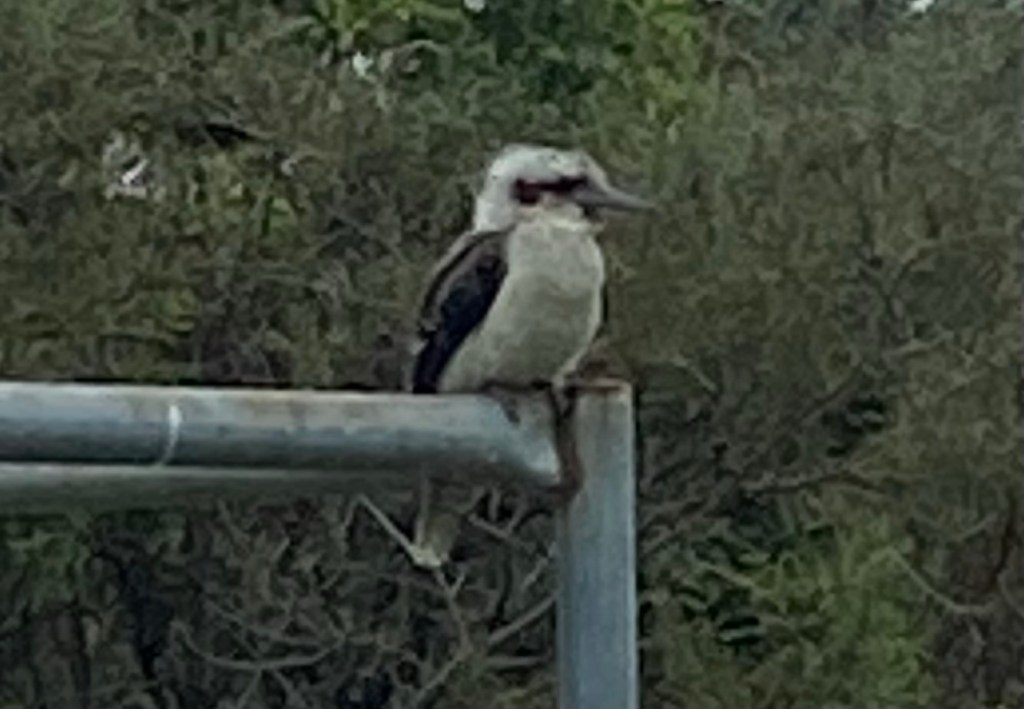
    I saw my first kookaburra at Josh’s, but this one was near enough to get a decent photo!
    Looking back towards the CBD from North Head

    Having ended up further away from Manly Wharf than I’d realised, I was relieved to find there was a bus back. Sydney has one of the best public transport systems I’ve ever experienced: it is cheap, user-friendly and makes the whole city incredibly well-connected.

    The journey back was eased further by a pit stop for fish and chips, and a beer, on the wharf…
    The ferries, trains and buses connect seamlessly, as here at Circular Quay, and are each accessed by a tap of the phone that costs a mere 1 dollar (50p)!

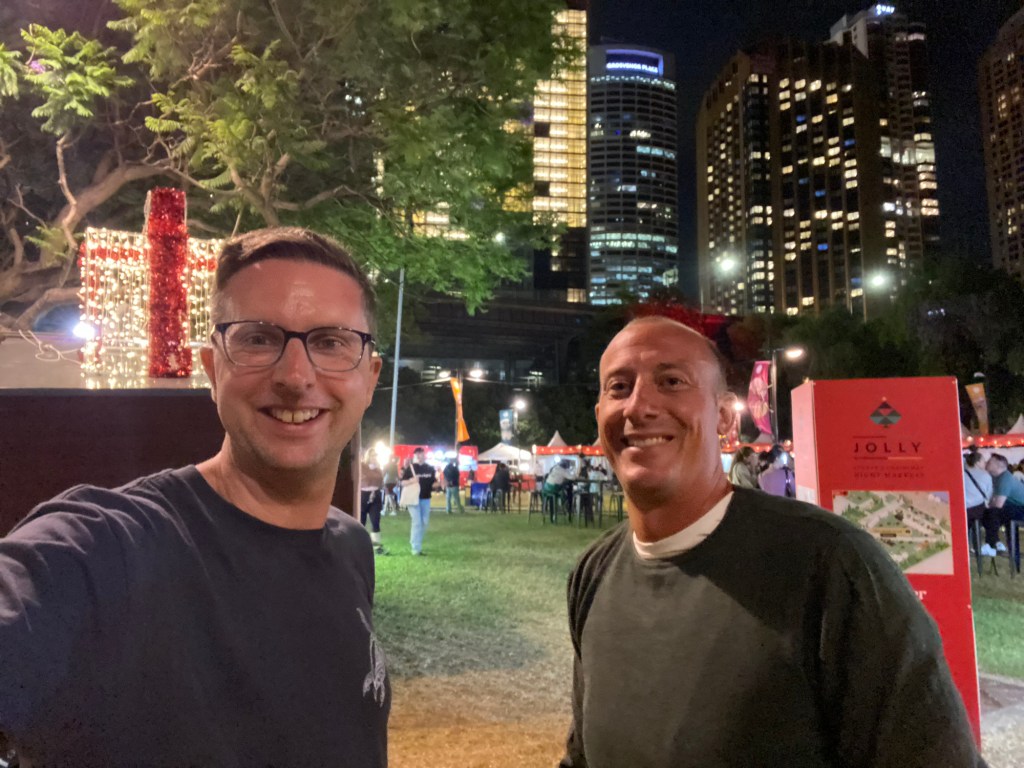
    I spent my final evening in Sydney at a very European-feeling Christmas market. It was festive and homely, but it did feel rather surreal to be sipping mulled wine in T-shirt and shorts!

    I was accompanied by Jannik from Belgium, another teacher on sabbatical staying at the hostel, with whom it was very interesting to compare notes!
  • Brisbane

    There’s been a steady rhythm to my days in Brisbane. Lazy mornings sorting various things out (including a visit to the GP as I left my prescription medicine in Argentina…), afternoons and evenings at the cricket, and the remaining hours at the pub!

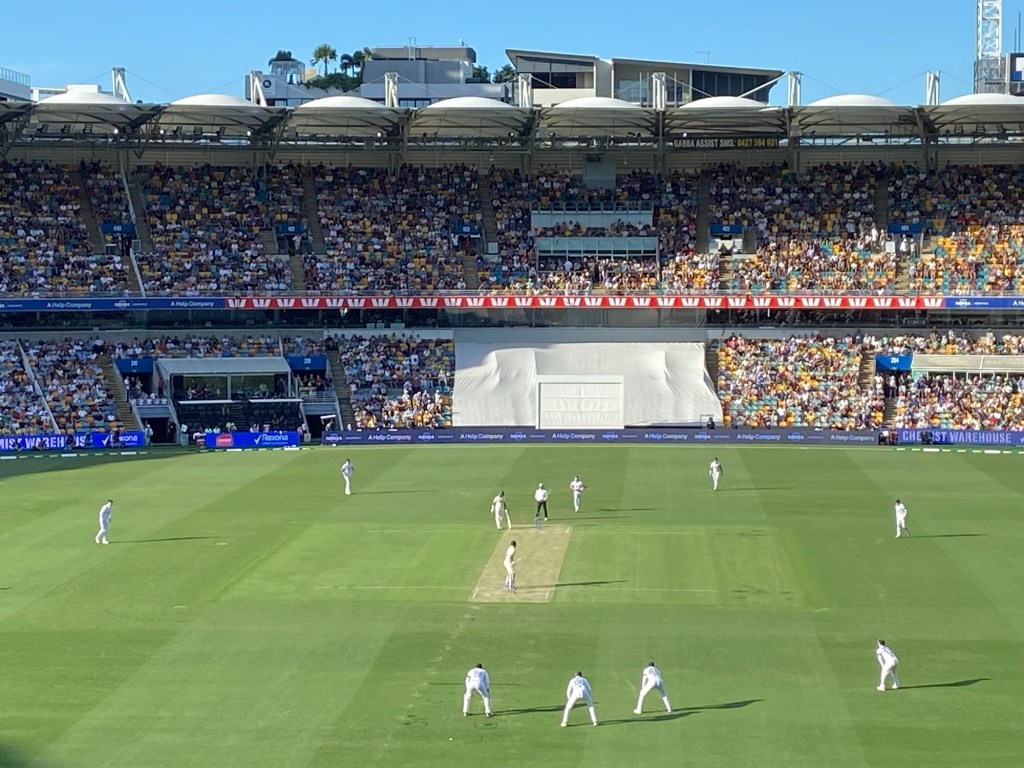
    My view of the Gabba for four days

    Optimism and excitement peaked on Day 1 of the Test Match, as after that Australia asserted their dominance and ended up with an 8 wicket victory. The cricket was gripping for most of the time though, and even on the last day there was a glimmer of hope while Stokes and Jacks were in the middle (and batting much less recklessly than some of their teammates had). The Barmy Army were in good voice and good humour throughout, and it was great fun to be one of their number!

    One of the many renditions of Jerusalem during the Test Match
    The name of the Barmy Army comes from the Aussies’ description of England fans supporting their team even when it’s a lost cause. This was probably the case here on the last morning, but we couldn’t give up while Stokes was still at the crease!

    On Day 2, I arrived early to meet Rob, the father of my former 2nd XI cricket captain at school. I then hovered around the media area and spotted many Ashes greats of the past, all there to see the current generation write the latest chapter in the story of cricket’s greatest rivalry.

    Stuart Broad was the easiest legend to photograph!
    Great to see Rob, who was very generous in supplying food and drink!
    His seats, where I sat for the middle session, were in hostile territory for an England fan, but they offered a splendid vantage point!

    On Day 3, I went to a brunch at the Pig ‘N’ Whistle (a pub taken over by the Barmy Army), at which we were entertained by stories from Phil Tufnell and Darren Lehman.

    With 24 hours of play over the course of the Test, there was plenty of time to get to know those sitting around me. Steve, next to me in the picture below, was also my roommate, as the Barmy Army had a system to pair up solo travellers in twin rooms to save money.

    The social aspect of the cricket was lots of fun, and different groups formed each night to go for drinks. After Day 4’s play, some of us went to the bar at the England Team’s hotel and were there to give Joe Root a guard of honour as he returned (while we were waiting for an Uber)!

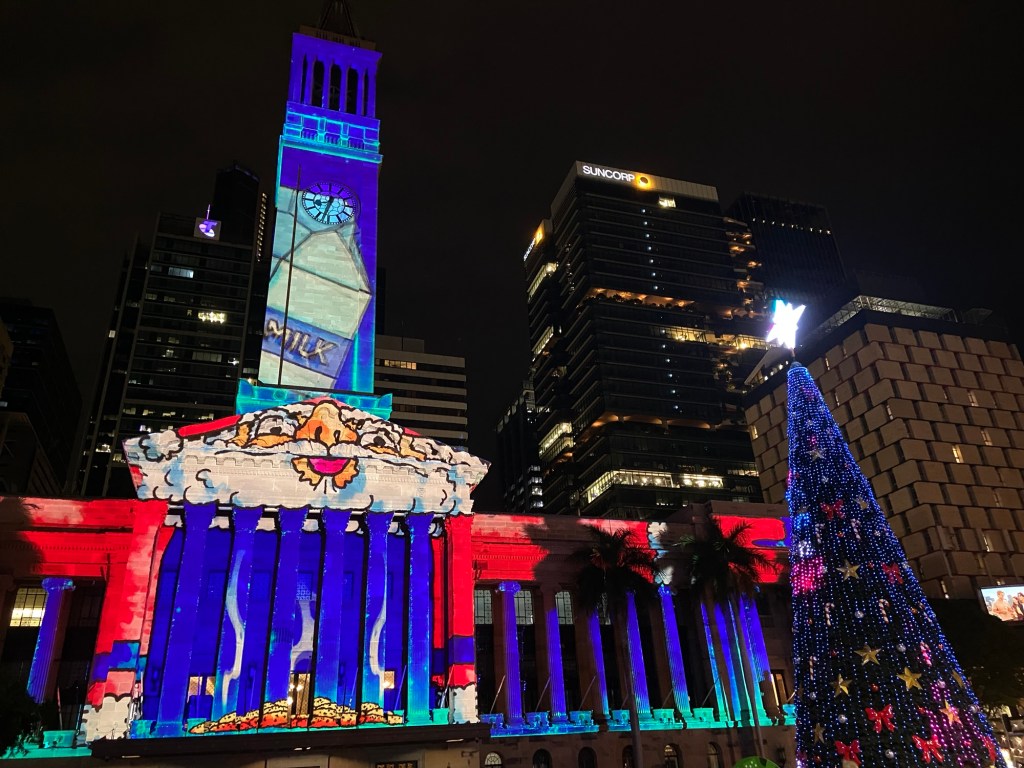
    Prior to visiting the hotel, we had a drink overlooking a festive sound and light display at the City Hall
    On my last night in Brisbane, a card school formed at an Irish pub, only interrupted whenever the live musician chose a song for which it seemed rude not to join in!

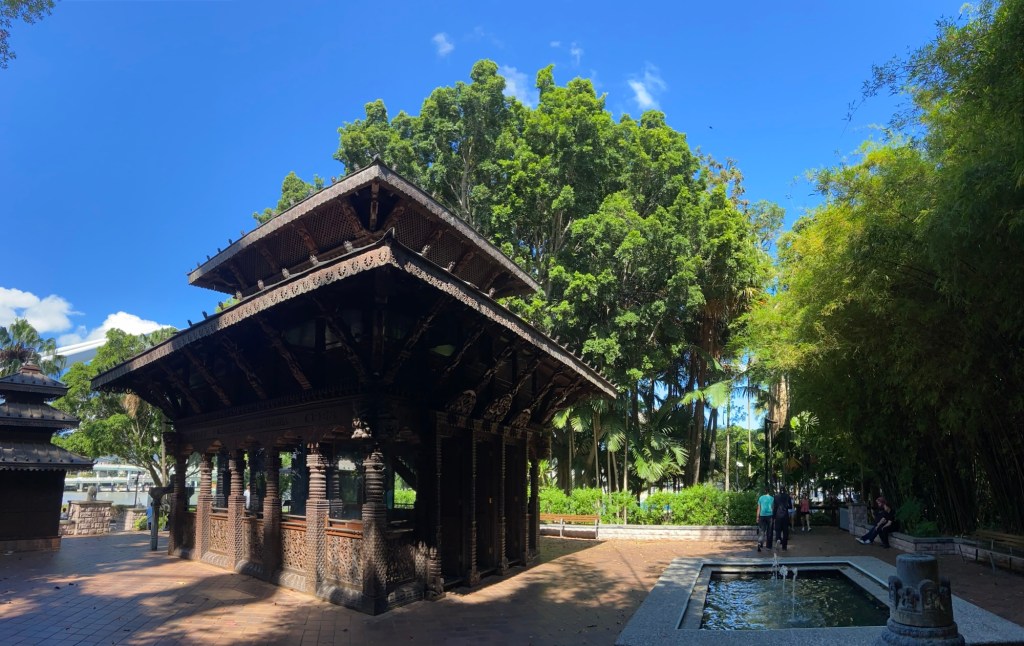
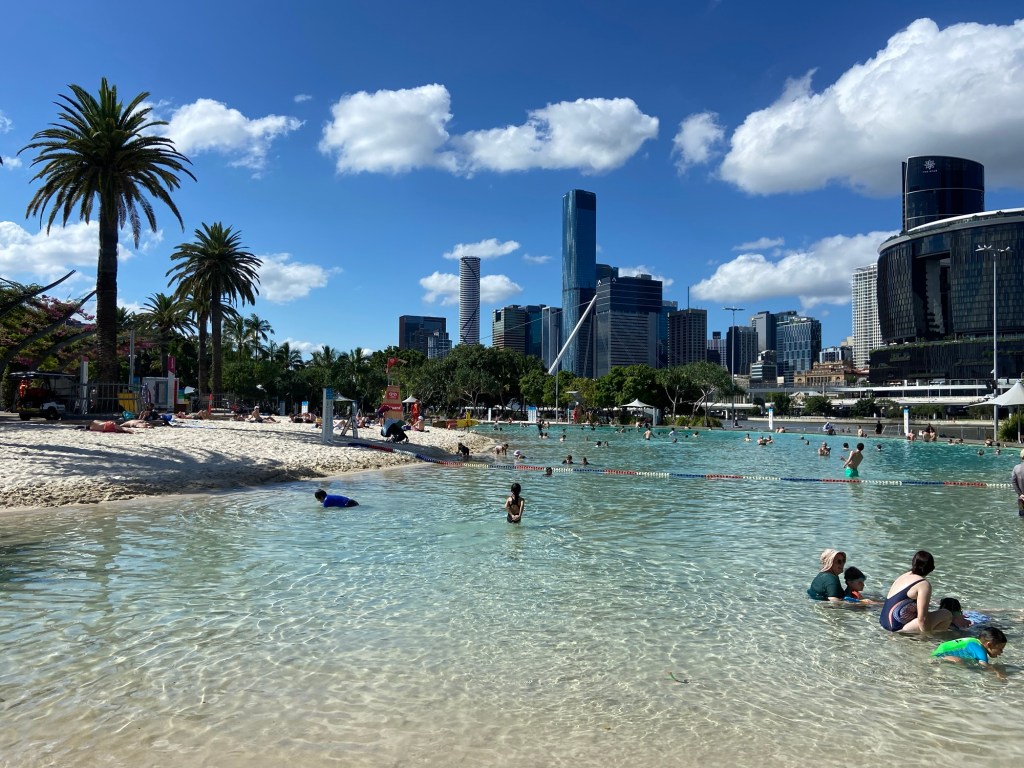
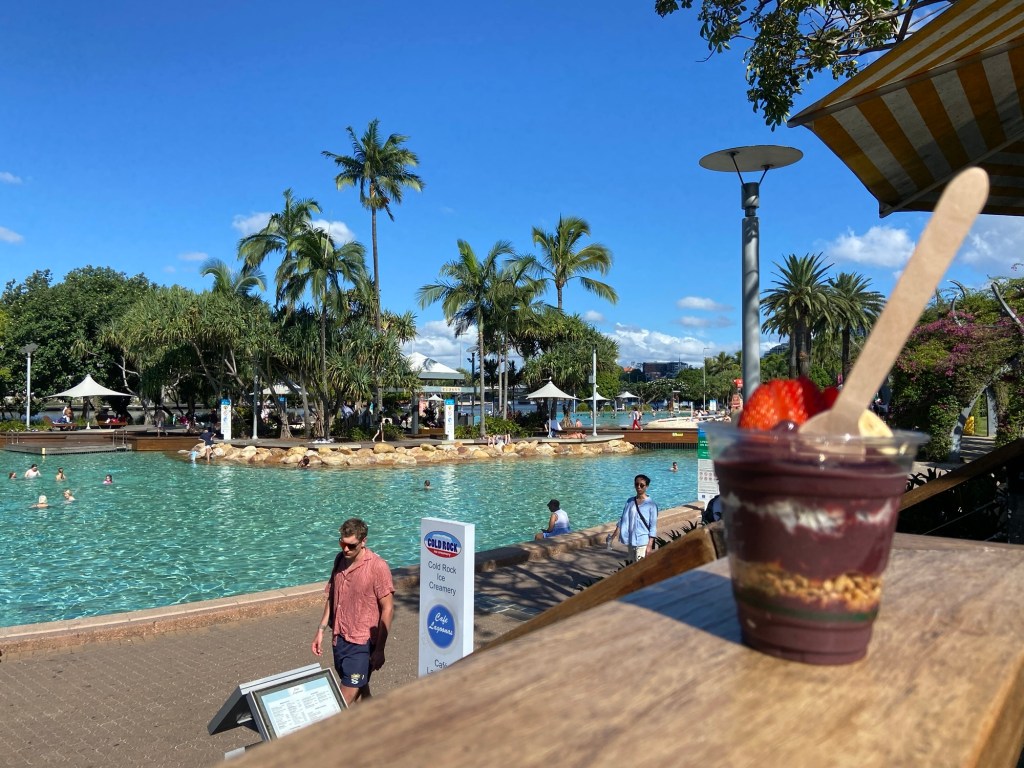
    With the match completed in four days, I had time for some sightseeing on Monday. I spent a relaxed afternoon on the South Bank, where there were a Nepalese Peace Pagoda, an area of rainforest and an urban beach!

    A refreshing açai on a hot afternoon

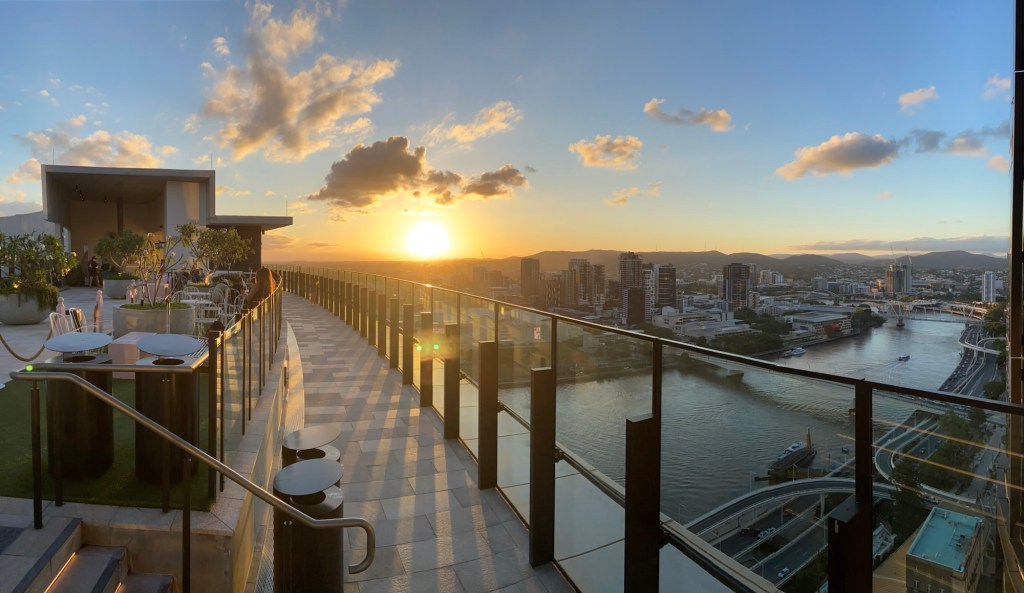
    I then watched the sunset from the observation deck of the Star Hotel, one of many impressive buildings in this modern and affluent city.

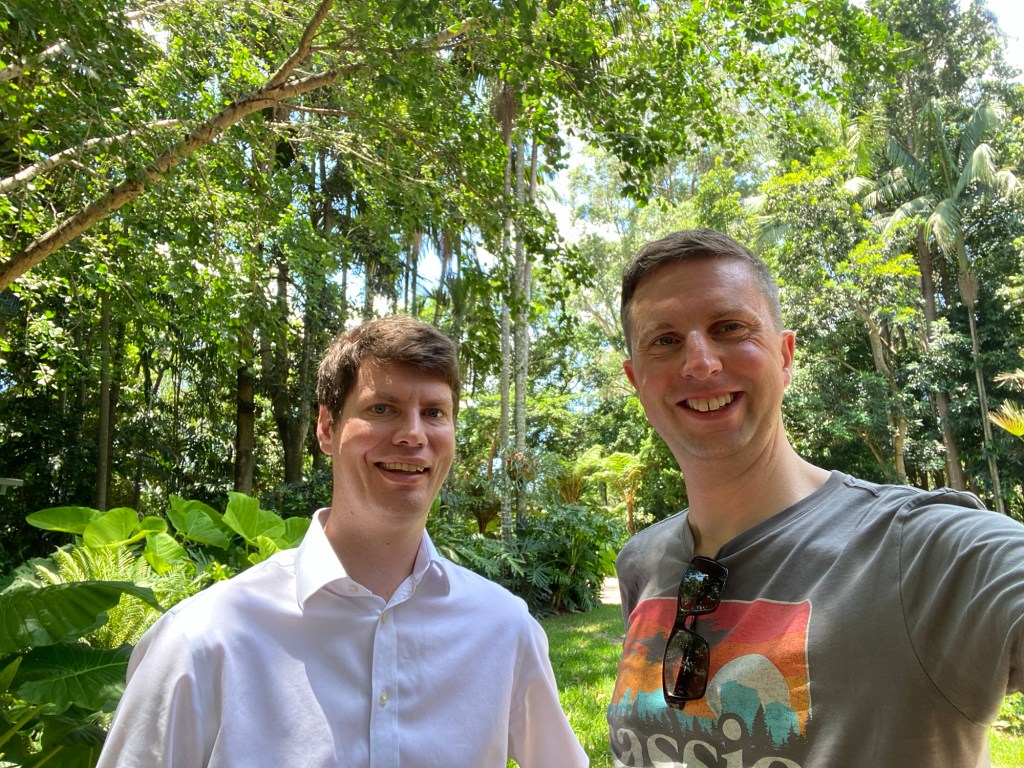
    Before leaving Brisbane this afternoon, I had a final coffee with Josh in the Botanic Gardens. Renewing my friendship with him has been a definite highlight of my time in Queensland.

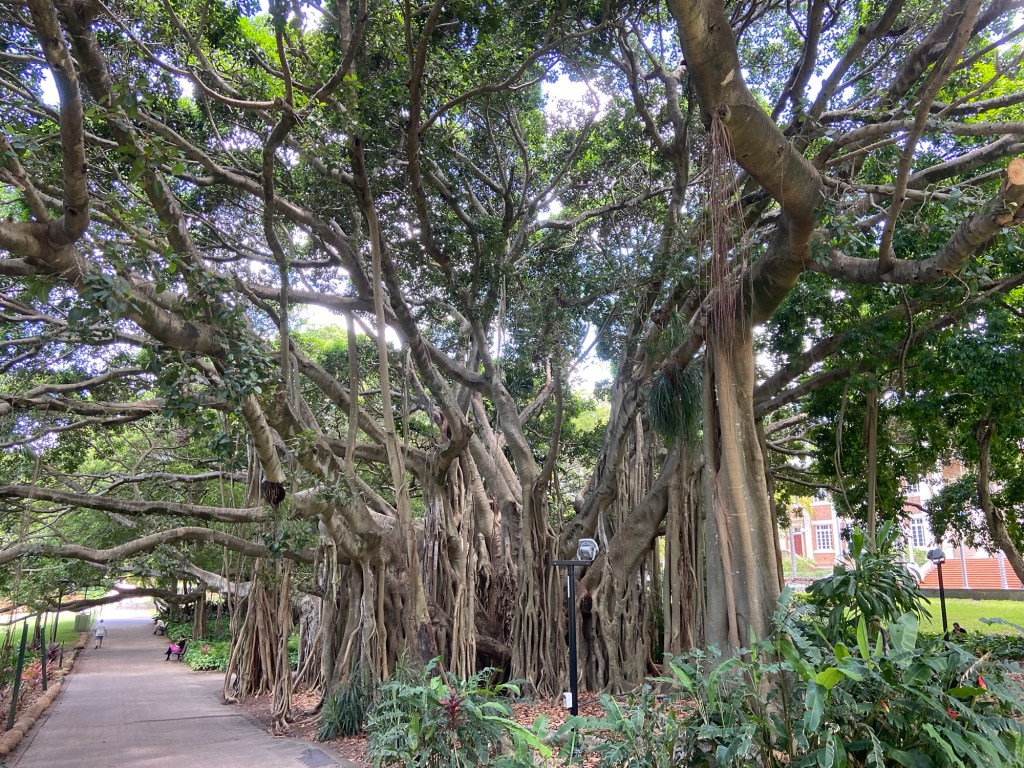
    This Indian fig tree in the Gardens was particularly interesting

    It’s not so obvious from the other pictures, but I’m embarrassed to say I may have also made a dubious attempt to go native with my hair… I doubt the style will accompany me back to work, but if you can’t making a fool of yourself when travelling the world, when can you…?

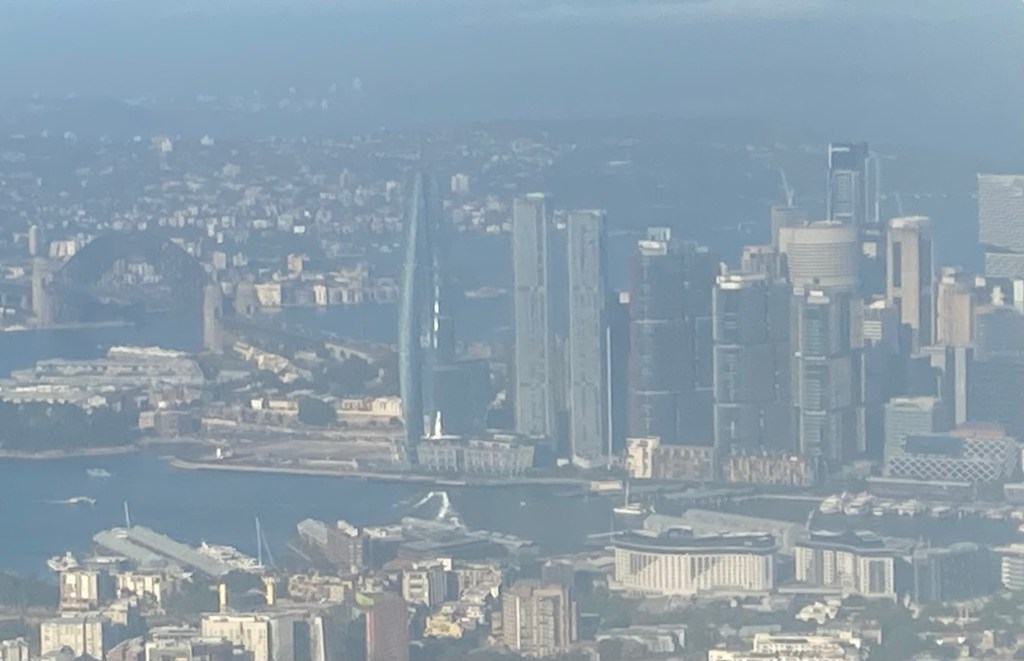
    After a flight over the Gold Coast (where I’m sure the mullet is pulled off better than by me), I’ve now arrived in Sydney. I wasn’t quick enough to snap the Opera House, but I was greeted by a fantastic view of the harbour as we came into land, which has definitely whet my appetite for my brief stay here…

  • Roooooot!!!

    The main reason why my sabbatical was planned for this winter was so that I could fulfil my biggest sporting ambition of attending an Ashes series Down Under. Day 1 of the Second Test at the Gabba was a more than adequate start to that experience!

    Ashes fever has gripped Brisbane – this was in the lobby of my hotel…

    The day started though as the First Test had ended, with England under the cosh. By the third over, we were 5-2.

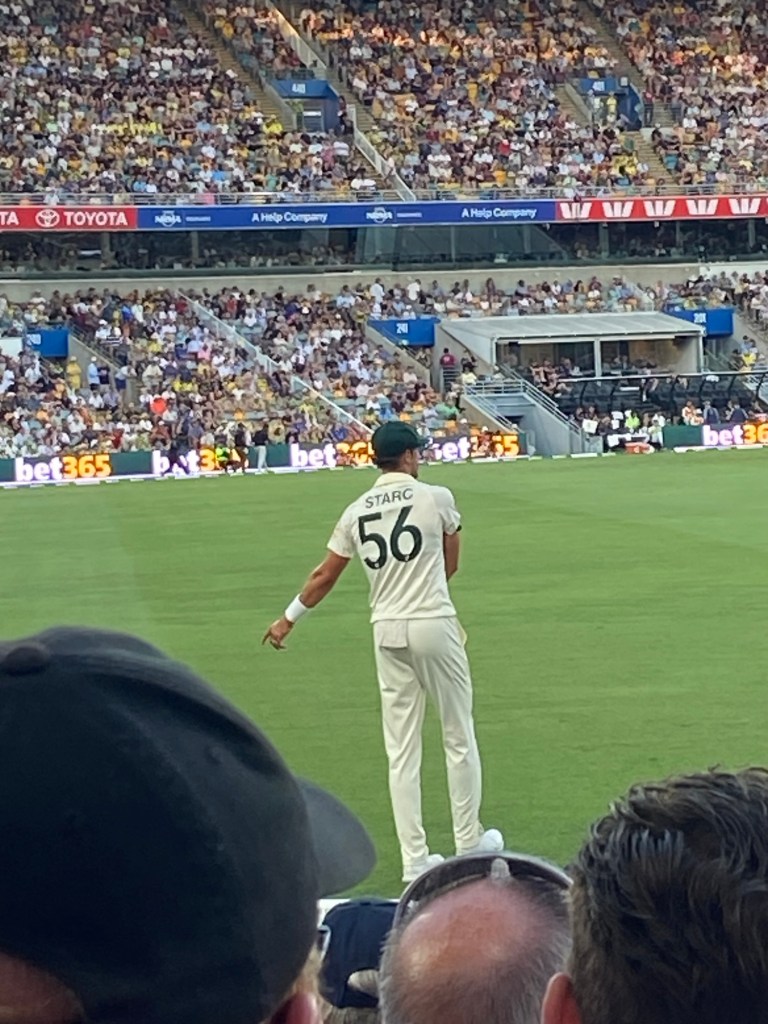
    Mitchell Starc was England’s main tormentor again, taking 6 of the 9 wickets to fall in the day. Here he is joining in the actions of a Barmy Army chant designed to goad him. He then casually counted to 6 on his fingers: a display of chutzpah that we all applauded!

    Step forward Joe Root. England’s all-time leading run scorer had failed to score a hundred in his three previous series in Australia, and this has long been claimed to be a blot on his otherwise stellar copybook. As he batted and batted though – steadily, but not without shaky moments – it felt more and more as if this could be his day. He had decent partnerships with Crawley, Stokes and Jacks, but, with wickets falling at the other end, he was starting to run out of partners (Stokes indeed was run out with a piece of precision fielding from Inglis). But then, with the England fans sick with nerves, he finally got over the line.

    He then put on an undefeated 61 for the last wicket with a swashbuckling Jofra Archer, ending the day on 135 not out. The words evolved a bit over the evening, but the Barmy Army (of which I became a member to get my tickets!) soon had a new chant.

    Oh, what a night. Watching England on a Thursday night. Rooty’s century, ‘cause he’s dynamite. Barmy Army, what a night!
    I was sent this still from the TV coverage back home. I was also interviewed by a Brisbane local radio station!
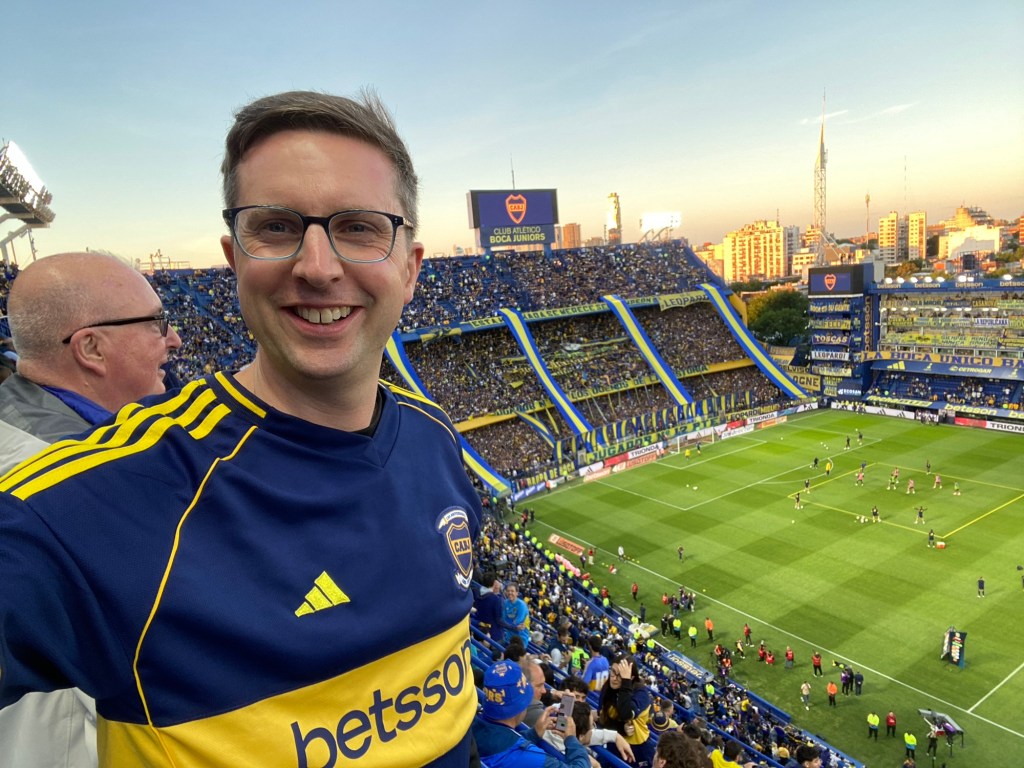
    The atmosphere in the night session was superb. A bit like Boca Juniors, only this time I knew more of the words! It was a seesaw day, but there had been plenty for us England fans to cheer about and it ended with the match evenly poised.

    We were still going strong as we headed to the exit!

    As we walked back into the city centre, we did acknowledge to the Aussie fans that wicket-keeper Alex Carey’s diving catch to dismiss Gus Atkinson was the “wow moment” of the day (we had a great view and couldn’t but applaud). There was no debate though about the identity of the star of the day: away Ashes centurion, Joe Root!

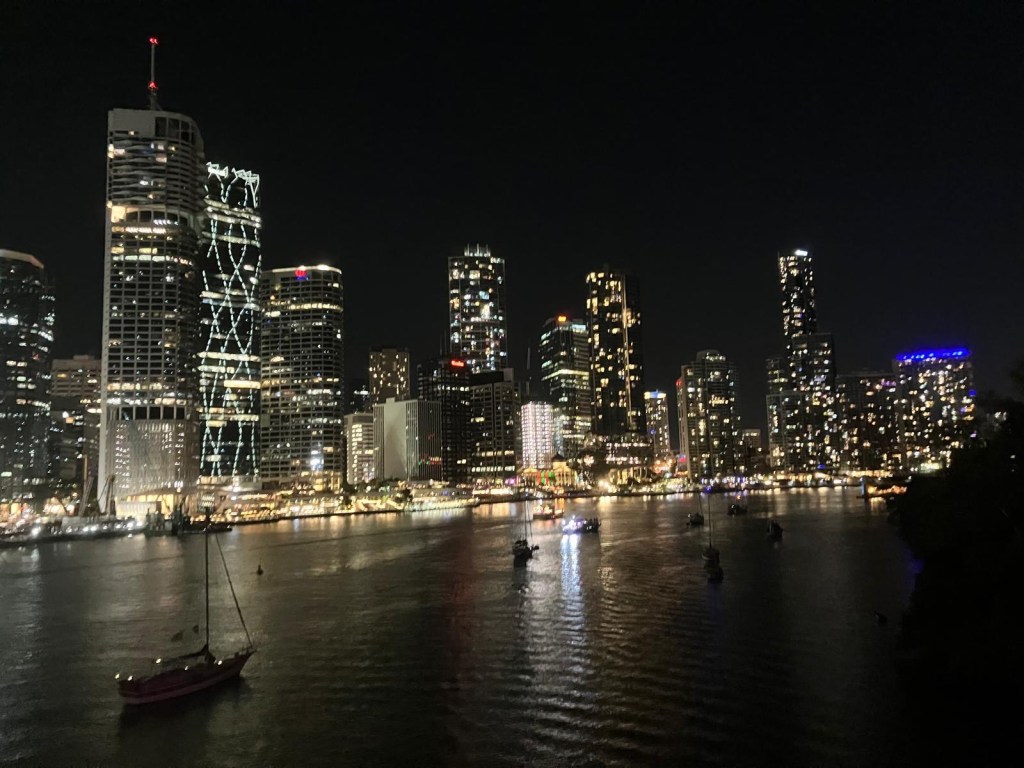
    Brisbane’s impressive skyline
  • K’gari

    After my stay on a coral island, yesterday I went on a day tour to the largest sand island in the world. K’gari is now know by the name given to it by the Butchulla people, which means “paradise”, but it is better known as Fraser Island.

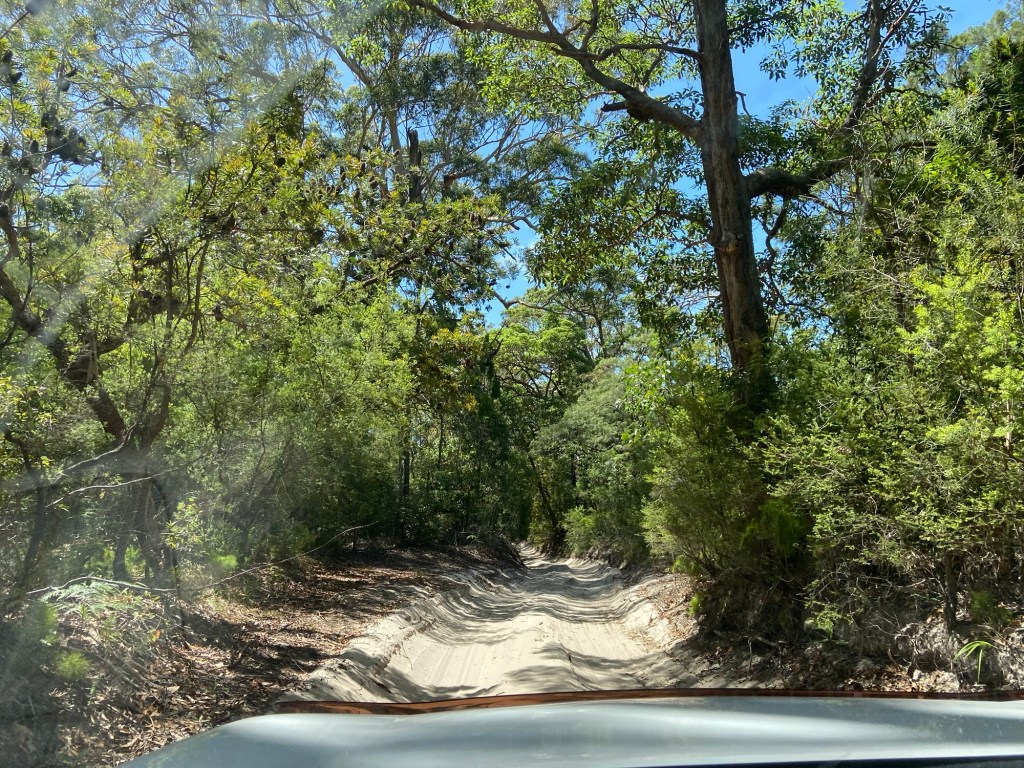
    Only 4WD vehicles are allowed on the island, as the roads are unmade, so their surface is just the sand which constitutes the entire island. After the ferry crossing from River Heads, we had a bumpy but enjoyable drive through forest to the ocean-facing east coast. Here, we headed onto 75 mile beach, which is actually part of the national road network!

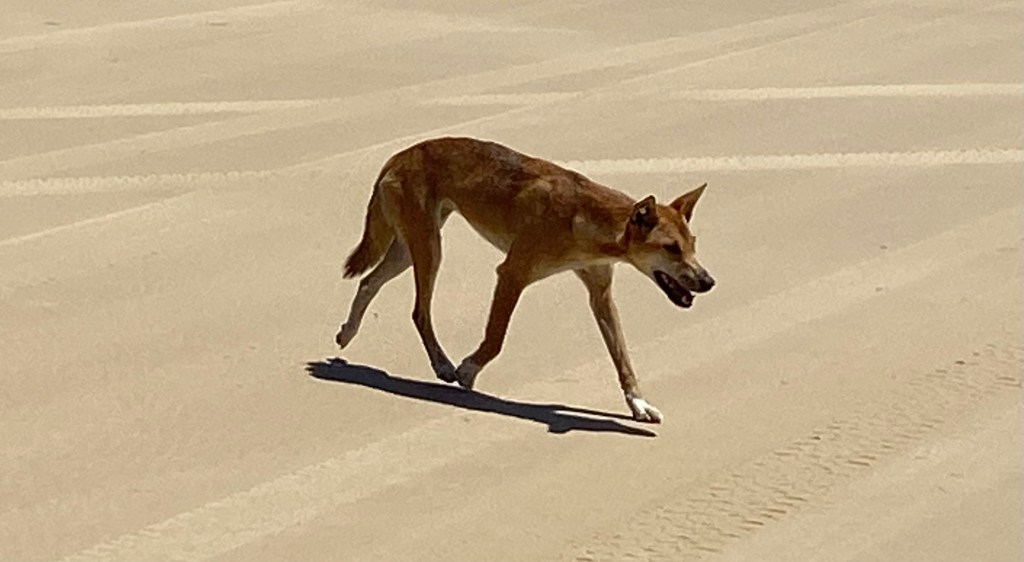
    En route, we were excited to find a dingo. Only about 100 of these wolf-like animals remain on the island, but they are the purest blooded in Australia, having never had the opportunity for cross-breeding.

    Dingos can be dangerous, but this one was more interested in a sea gull than in us!
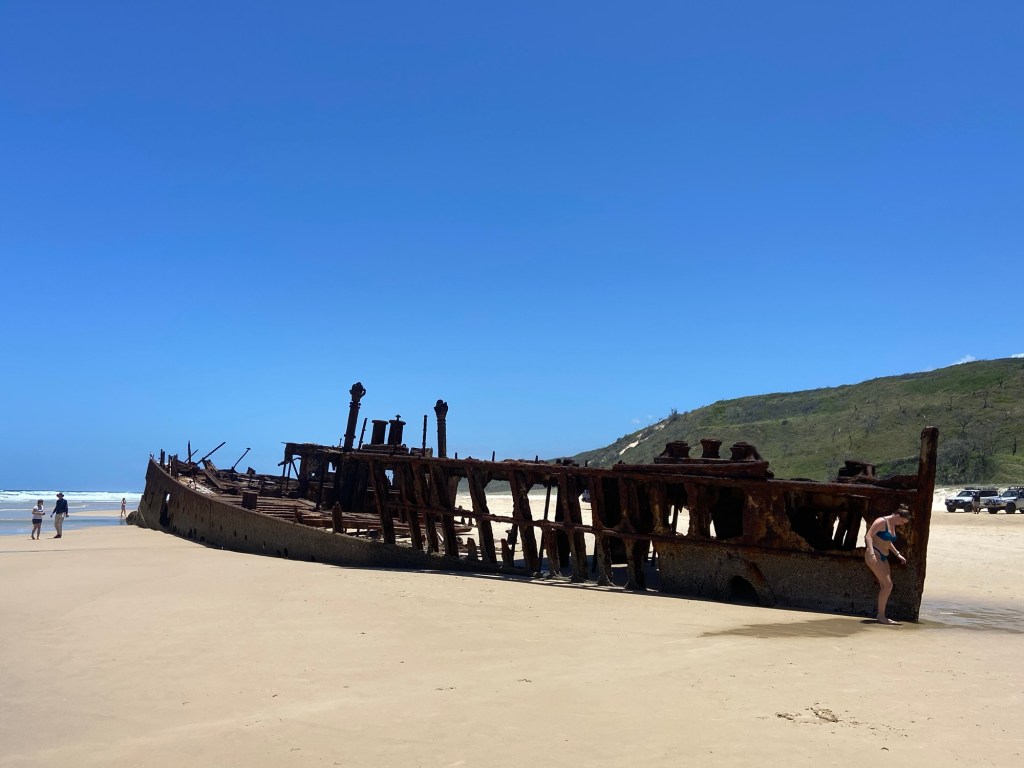
    We also saw the wreck of the Maheno, a decommissioned passenger ship blown ashore by a cyclone on 1935

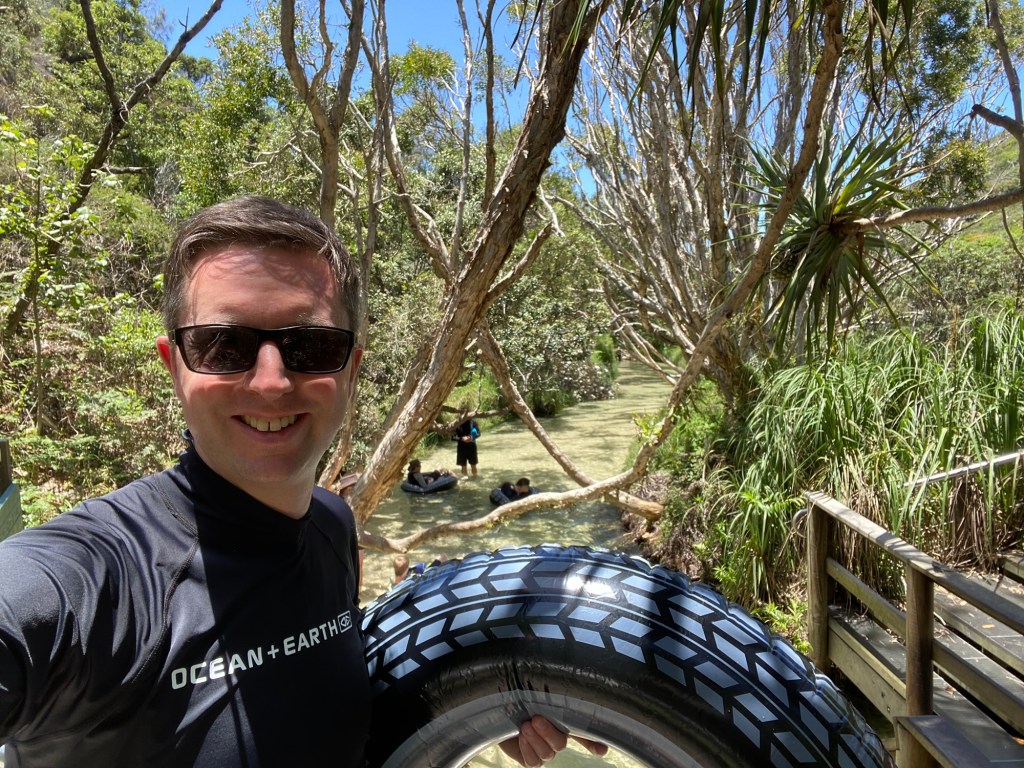
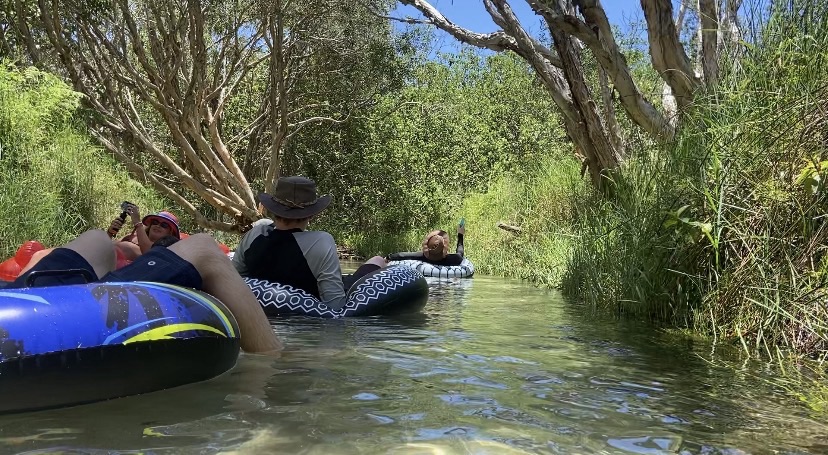
    A bit further along, we stopped at Eli creek: I had been looking forward to this! A boardwalk leads to a small jetty, from which you can float down the creek, just like in the lazy river I know from the Jay Peak waterpark.

    The best way to ride the creek is on an inflatable…
    … and our guide had kindly taken a detour to the office earlier so we didn’t miss out!
    So much fun!

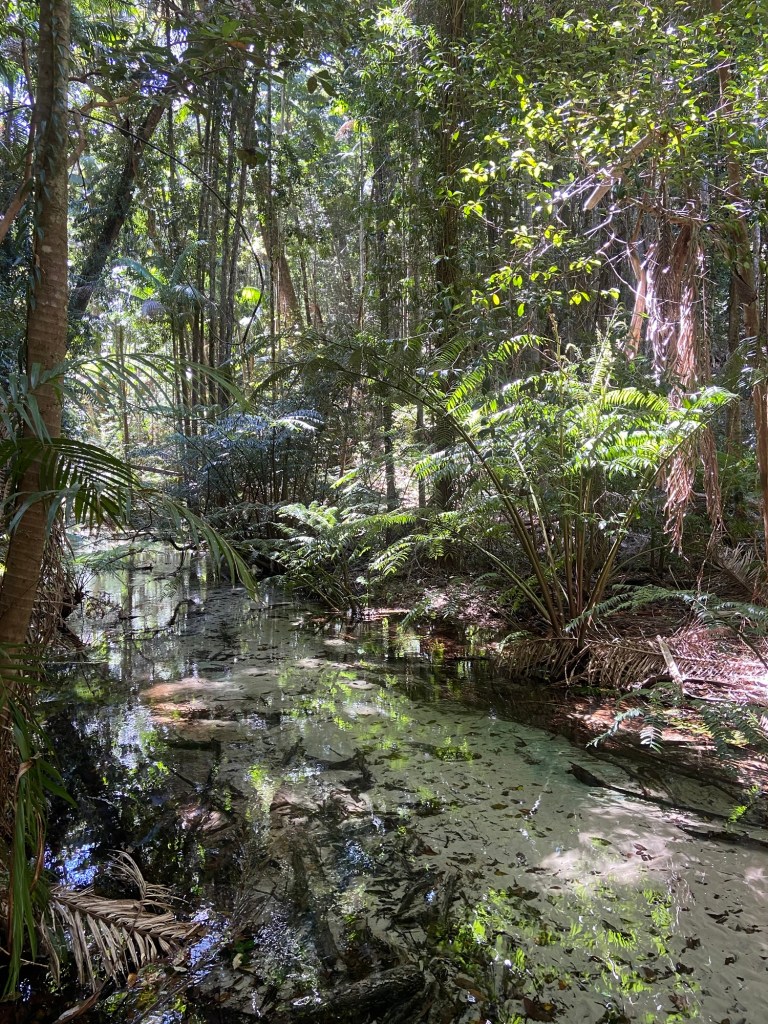
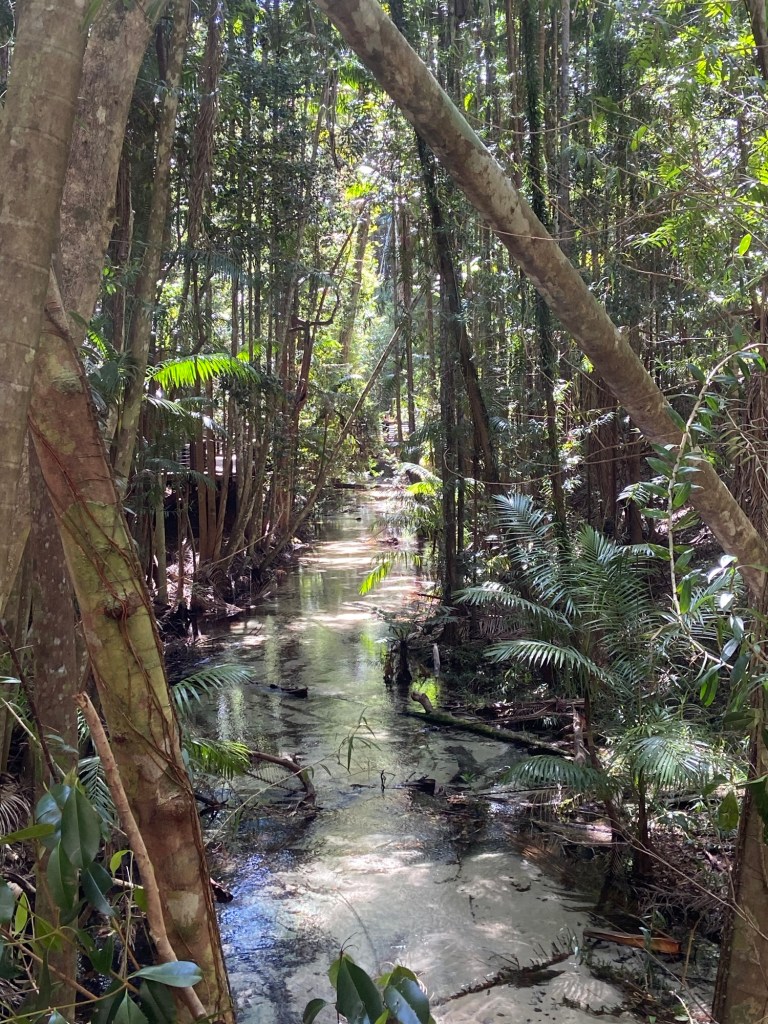
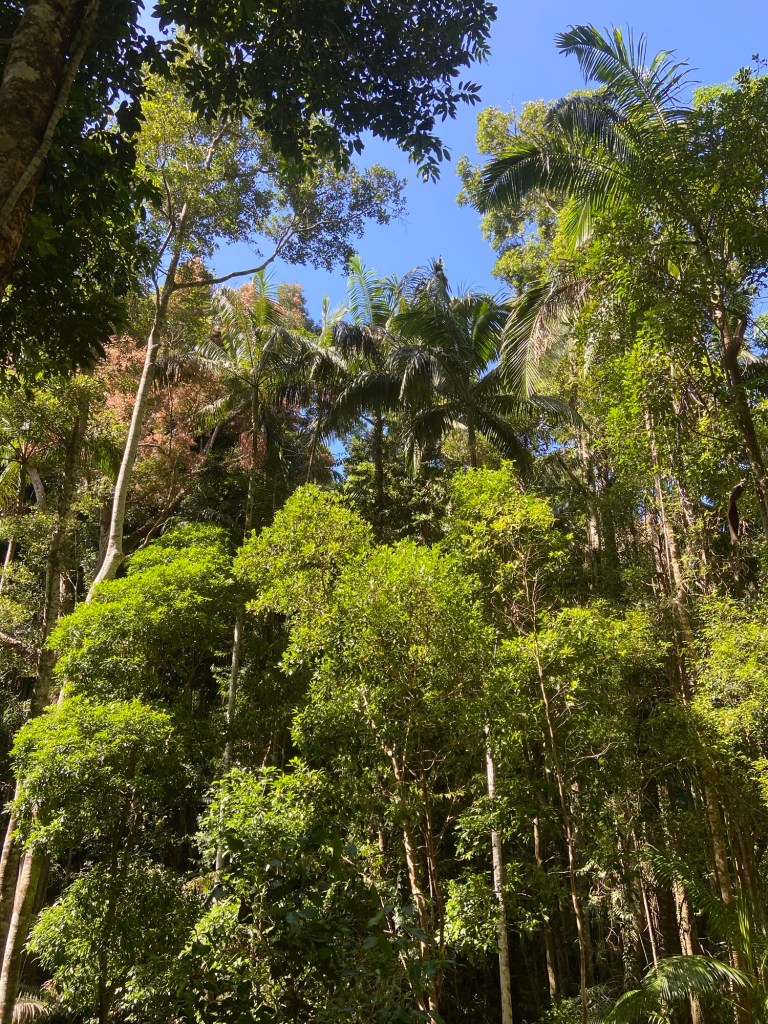
    With its sandy bed and lack of rocks, the water in the creek was clear and made only the slightest, hushed, trickling sound. The same was true of the inland Wanggoolba creek that we visited next. The micro-climate in the deep gully formed by the creek is ideal for rainforest development and it was a truly enchanting place.
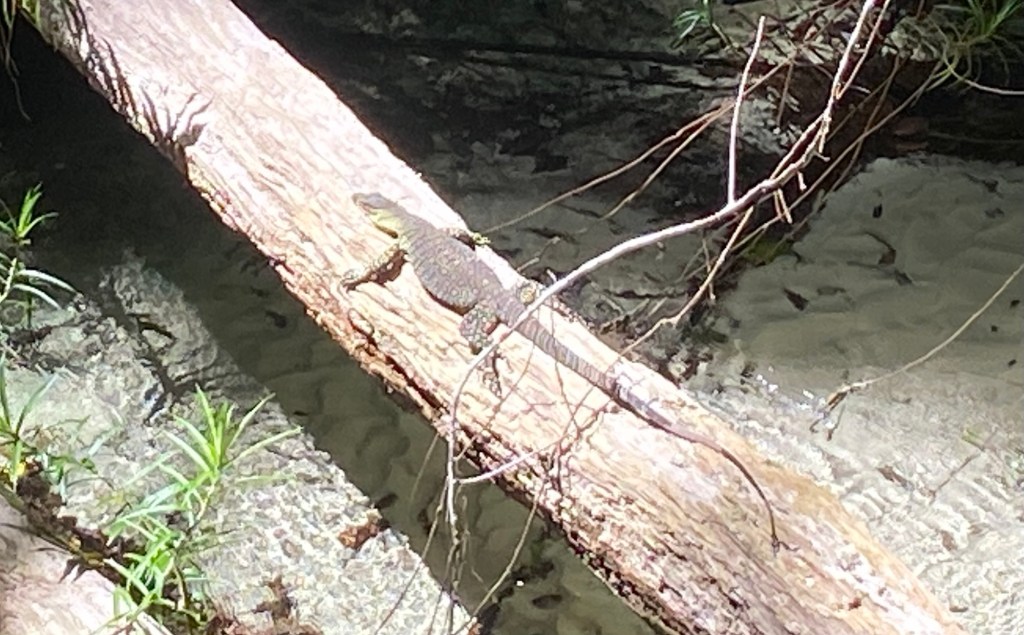
    We saw this reptile, a lace monitor, looking for a a suitable location to sun itself!
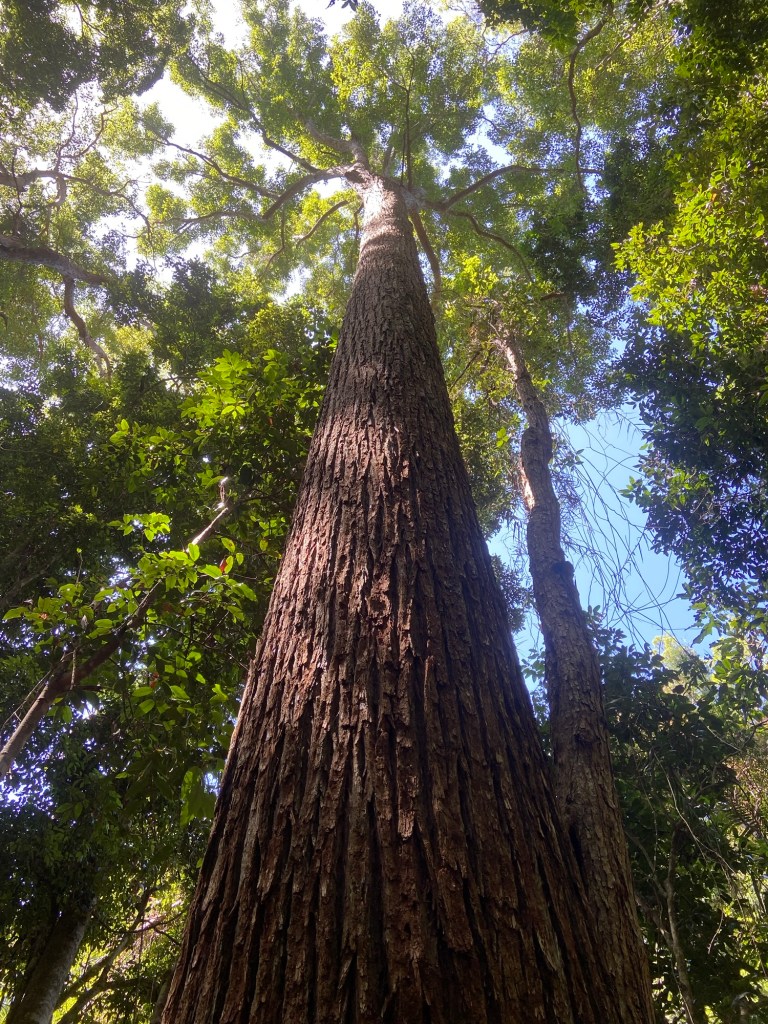
    The huge hardwood Satinay trees are native to the island
    There was also plenty of white-barked eucalyptus
    Picnic lunch in the beautiful forest with my group. This was at Central Station: a logging settlement until the trees on the island became protected
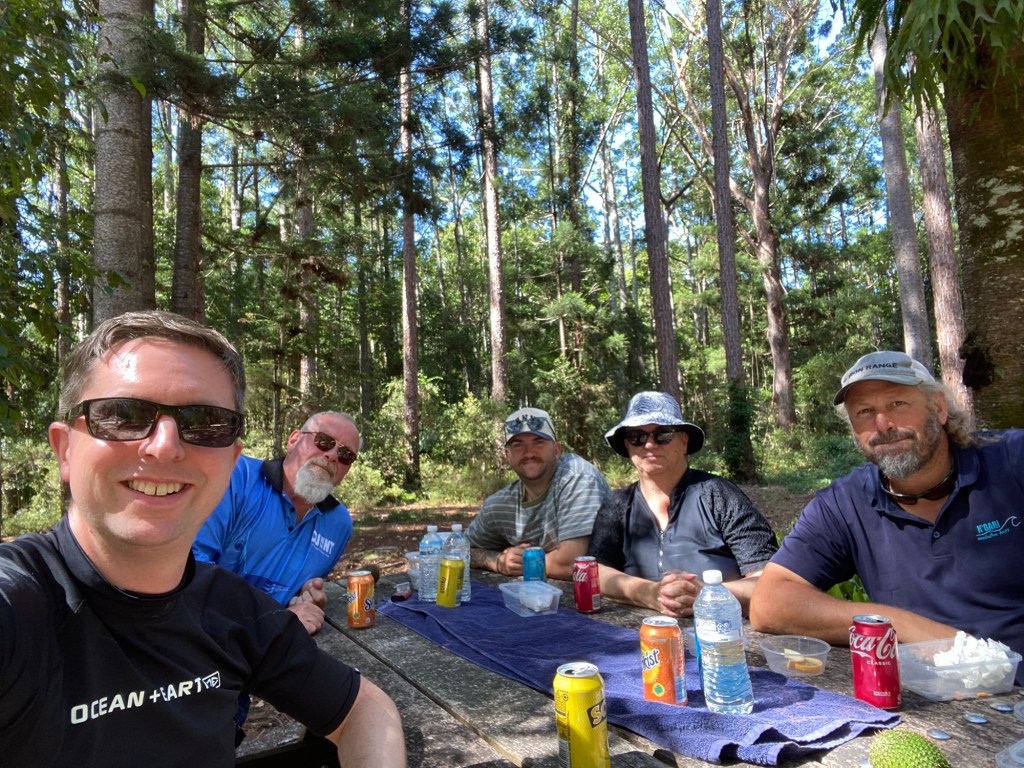
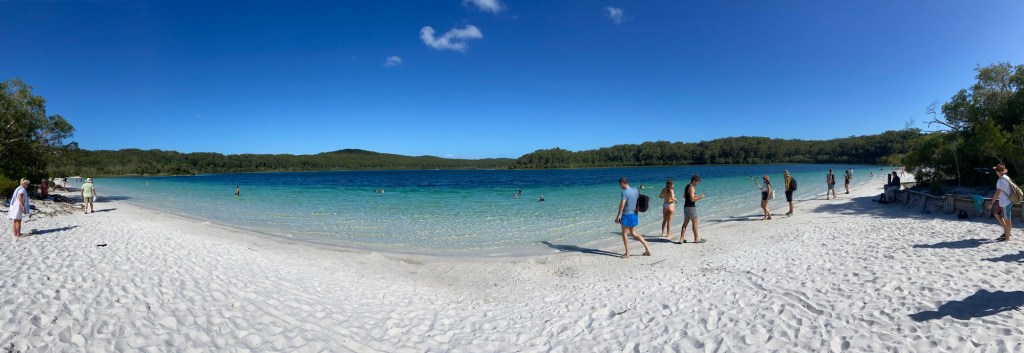
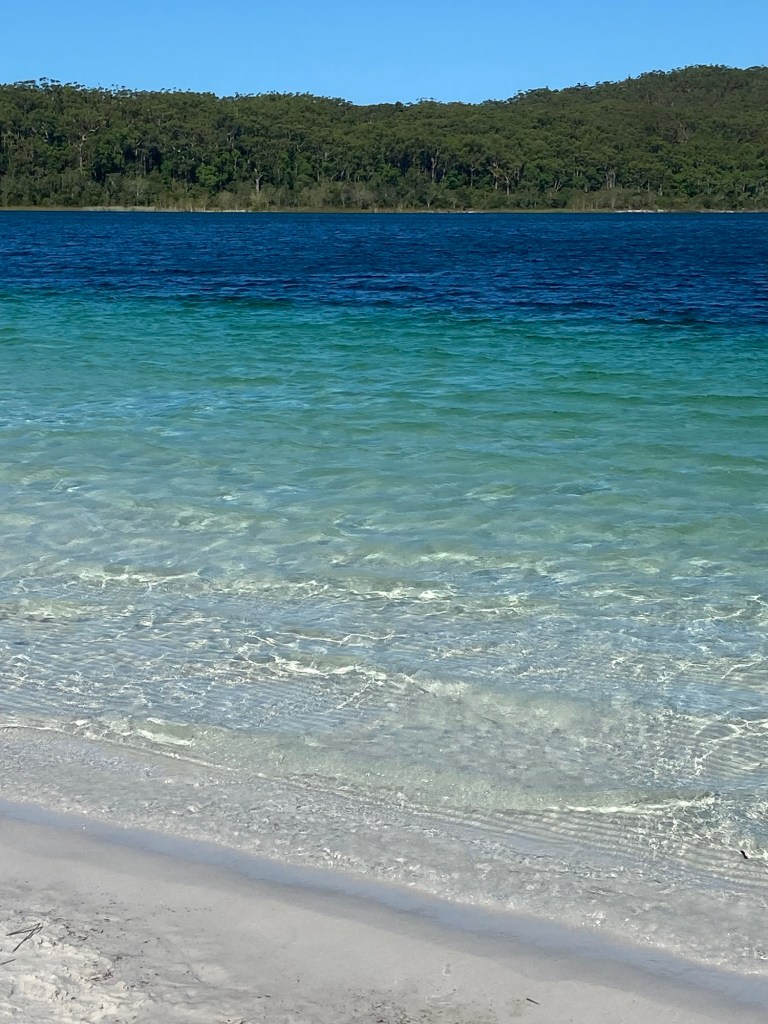
    Our final stop was at the stunning Lake McKenzie. Formed only by rainwater and with a bed of organic material preventing drainage, the lake is known for its iridescent blue waters and white sand. I spent a very pleasant hour bathing in the warm, shallow waters and chatting with a British fellow traveller I’d met at the hostel.

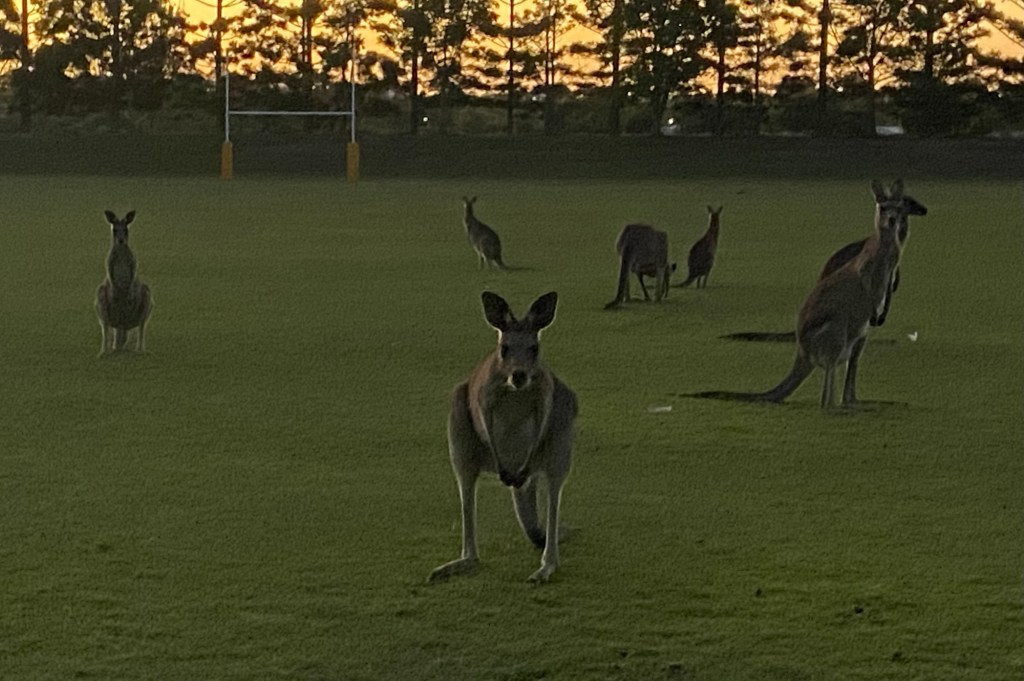
    After another amazing day, it was time to return to the mainland and prepare for the long drive back to Brisbane. Having told the guide I was yet to see a kangaroo in Australia though, I first took a detour to a spot he recommended so that that could be rectified!

    For the first part of the drive, I was revelling in the experience of an Aussie road trip, but soon tiredness hit and the radio and cold air-conditioning were no longer sufficient to stop my eyes from drooping. I found a spot to park up on the edge of a village and slept for the best part of two hours (but for the interruptions of a niggling mosquito…). Sufficiently refreshed to continue, I then completed the journey, returned the hire car and was very glad to collapse onto the bed in my hotel room at 3am, to recharge ahead of the cricket. Good thing it’s a day-night Test, so doesn’t start until 2pm!

  • The Great Barrier Reef

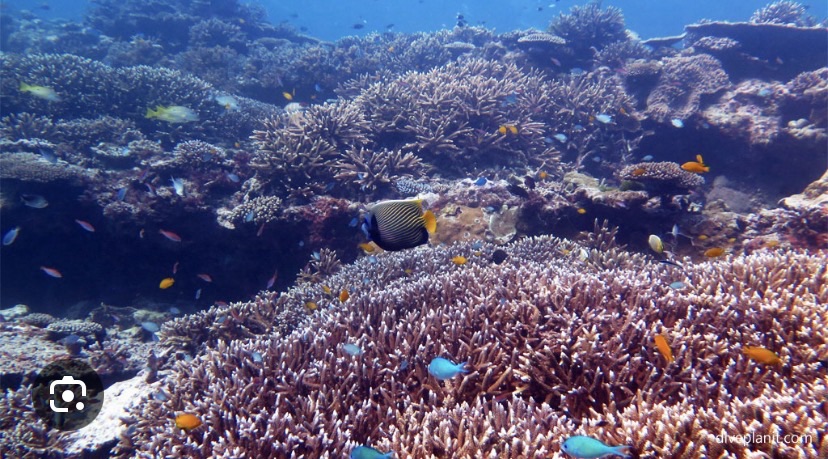
    Not my picture, but it corresponds pretty closely to what I saw!

    Along with the Amazon, the Great Barrier Reef was the destination on my itinerary that most stirred my imagination. Having now returned to the mainland after my stay there, I can report that it was every bit as spectacular as I’d imagined!

    To get there, I first had a 250km drive from Brisbane along the Pacific Coast Way. It seemed a long way, but the road signs to Cairns were displaying a distance of 1600km. Things are on a different scale here!

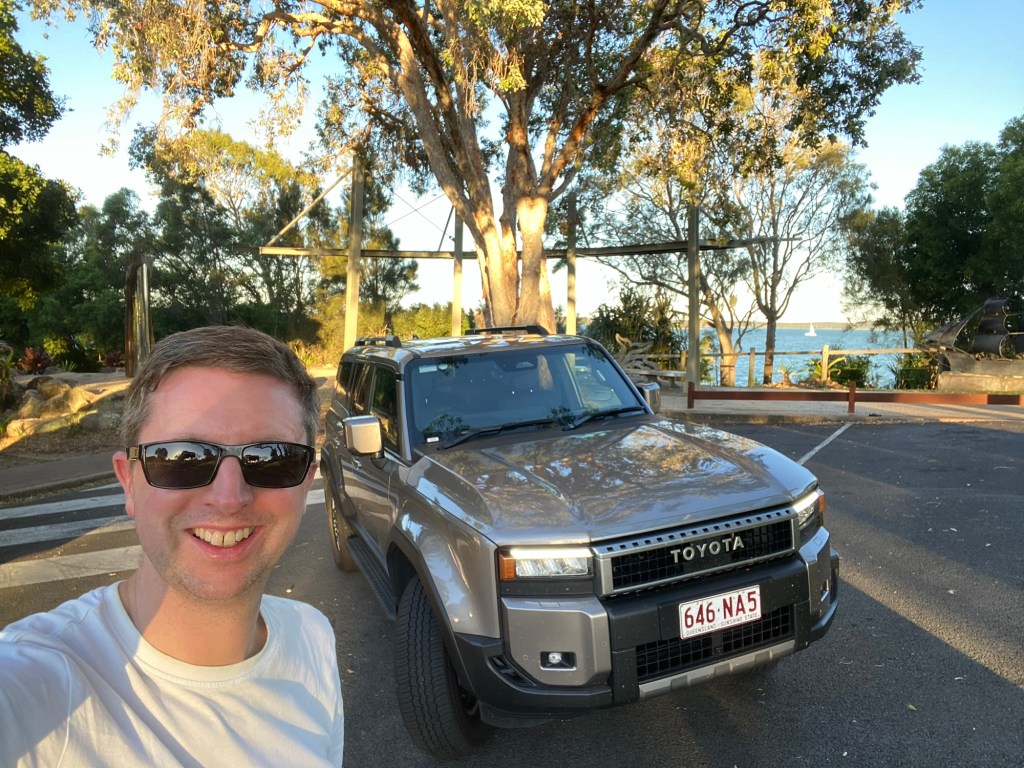
    With my wheels: a Toyota Prado

    The city centre car rental location with which I’d booked was closed when I arrived, but thankfully a vehicle was available at the airport. I was very relieved as I had had half an hour of frantically trying to work out what to do (rather like my experience with car hire in Norway last year…).

    I enjoyed the drive up, which took me through eucalyptus forest and among some of Queensland’s mountains. I stopped off for a late lunch in Caloundra on the Sunshine Coast, recommend both by Josh’s family and by my Kiwi guide, Simon.

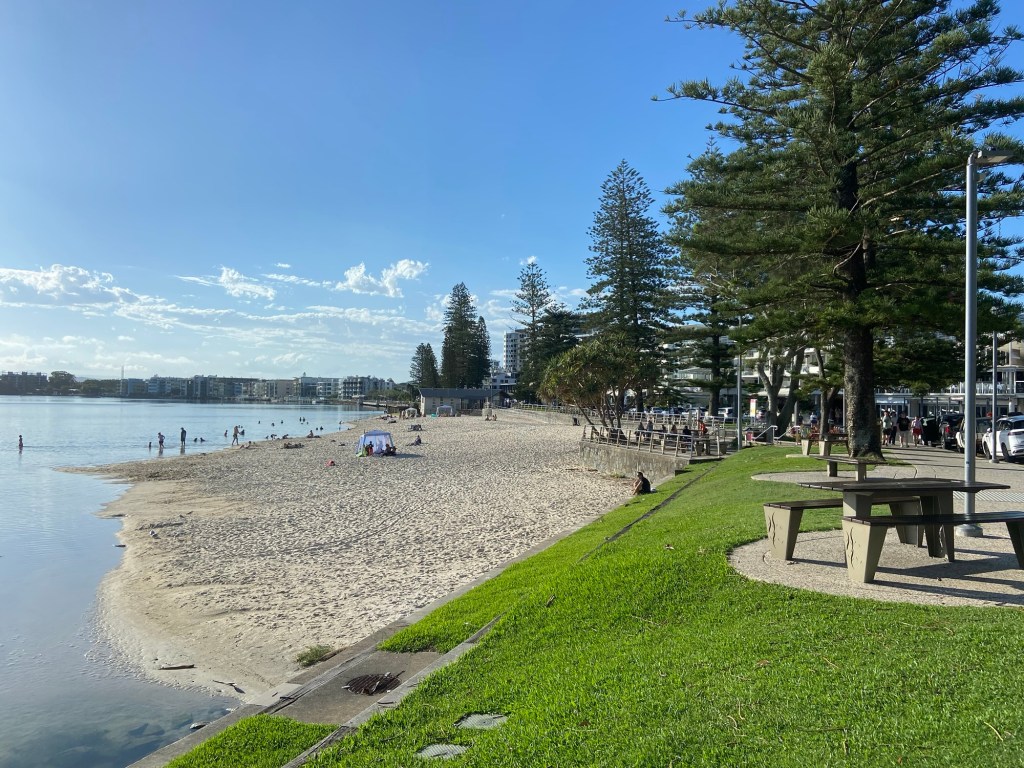
    The Aussies know how to look after visitors! There were a free car park, bathrooms and conveniently located showers at the beach.
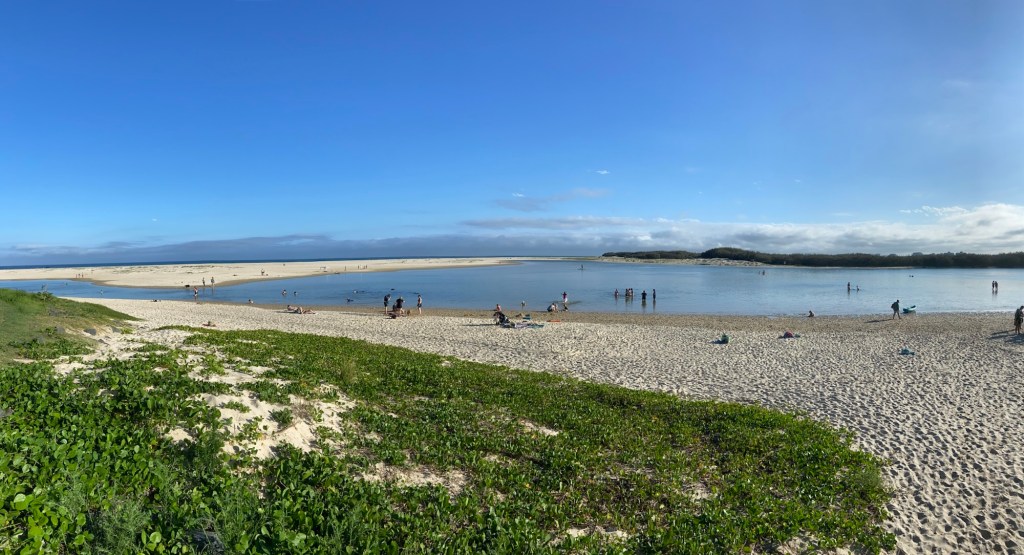
    I had a relaxing swim in the shallow bay that is produced by a sand spit

    I spent the night at a comfortable hostel in Hervey Bay, ready to fly out to Lady Elliot Island, at the southern tip of the reef, the next morning.

    No time to use the hostel pool sadly. I was also too late to find any food in the town on a Sunday night, but I did have a hilarious and lengthy conference with some locals, who eventually directed me to a McDonalds on the edge of town…
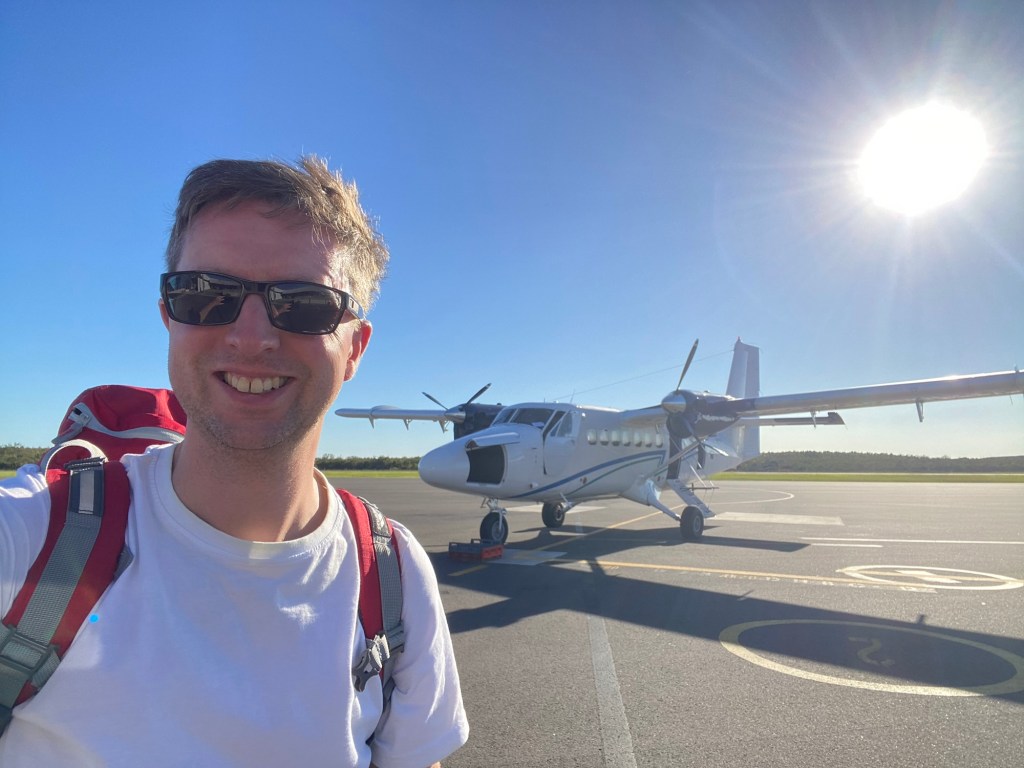
    The plane for the 35 minute flight
    A bumpy landing!
    The island from the air, with the runway visible in the middle, and the reef around the edge!

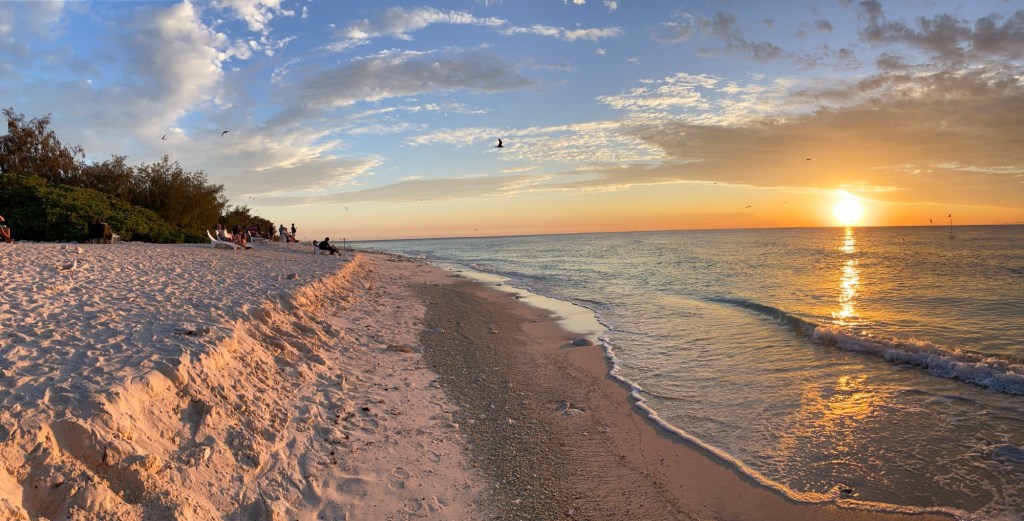
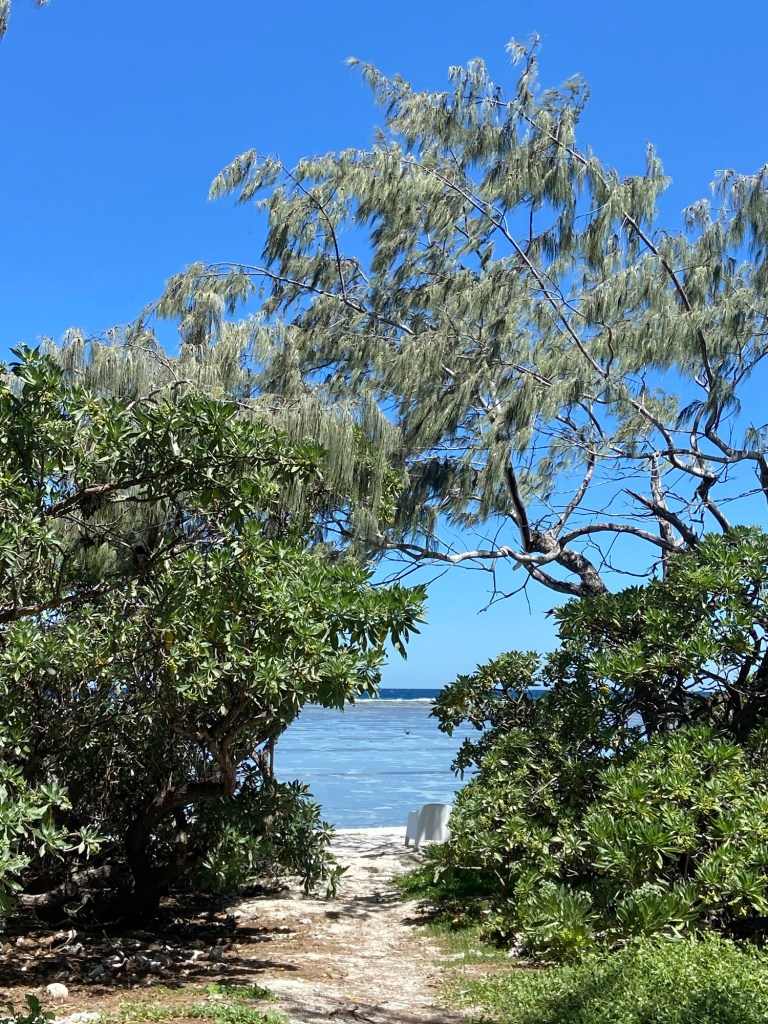
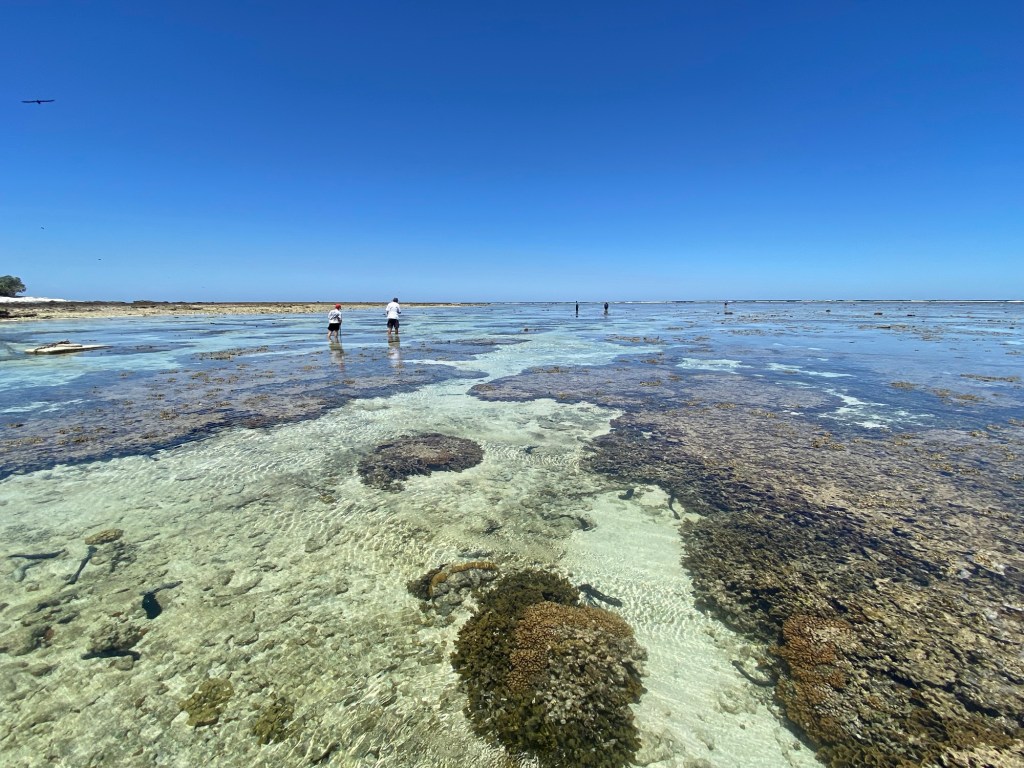
    Lady Elliot Island is a “coral cay” (coral island), 80km from the Queensland coast. It is run sustainably as an eco-resort and is one of the most wonderful places I have ever visited. It is Lonely Planet’s top snorkelling location in the world for 2025 and it is internationally renowned for the clarity of its water and its abundance of sealife.

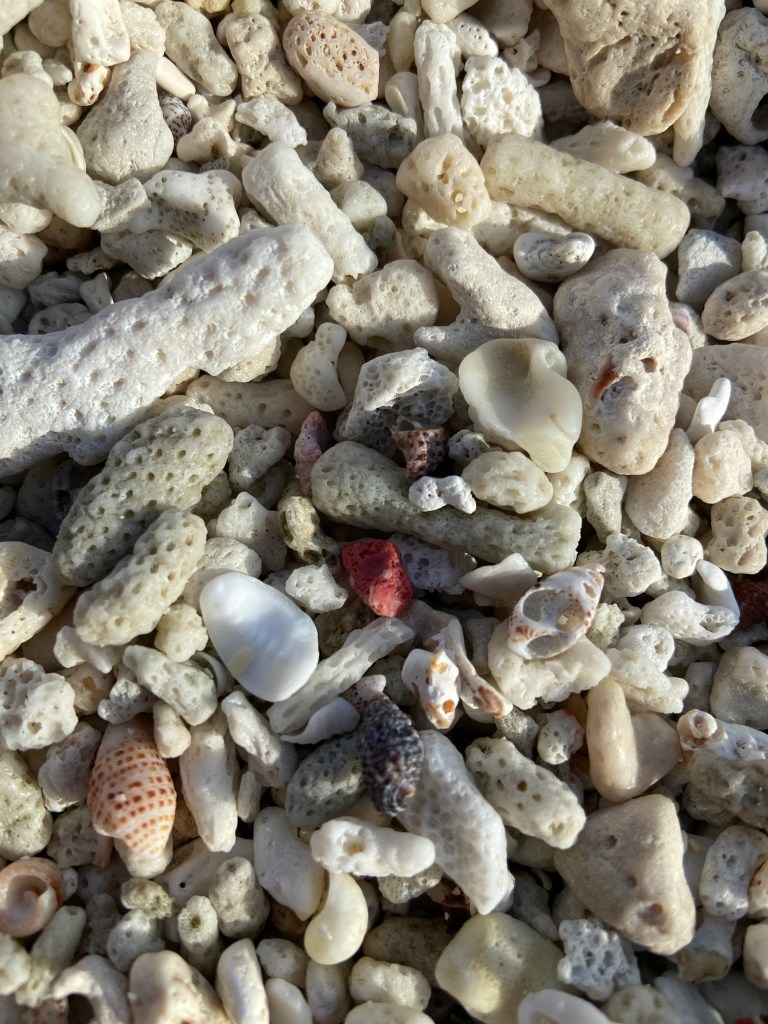
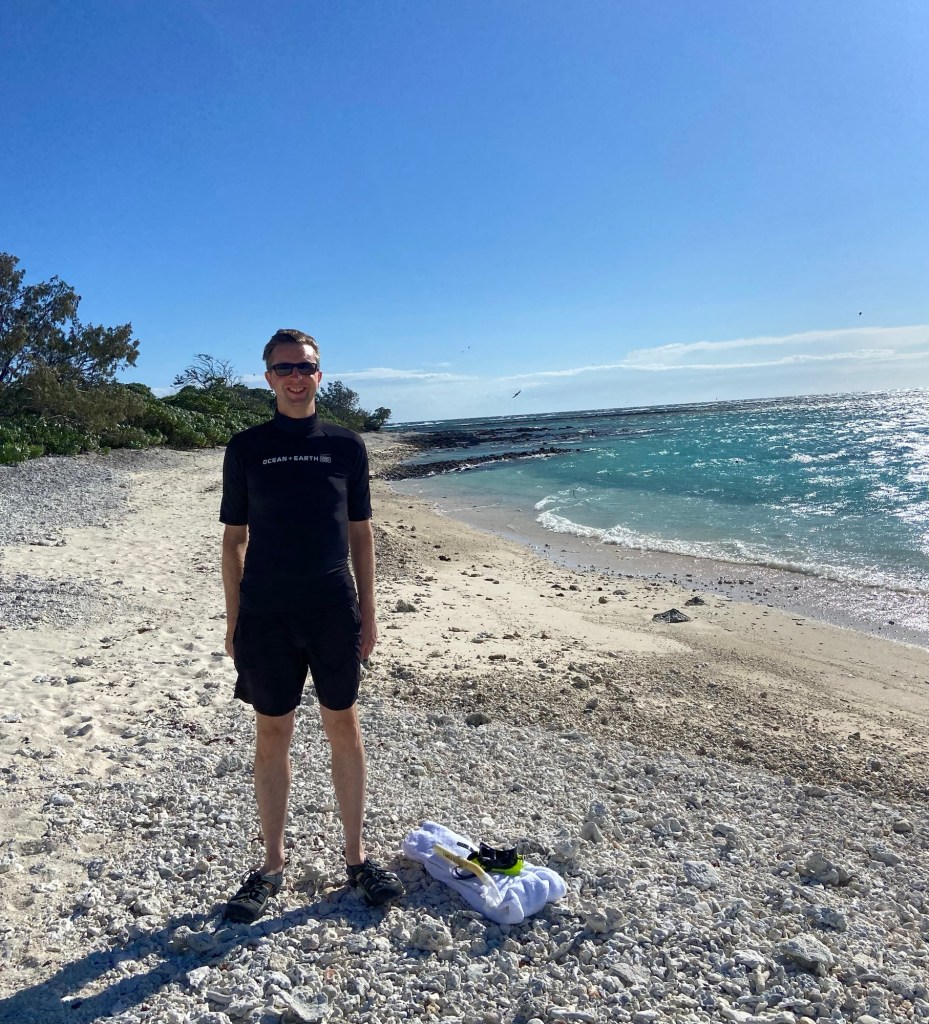
    The island is made from coral sediment and the beach pebbles are all either coral or shells, which cloud the water much less than sand

    I packed as much I could into my 30 hours on the island, bouncing from one organised activity to another and often having to rush my food…

    My four meals from the buffet were nonetheless delicious!

    I used to love snorkelling and scuba diving in the Med with Mum, Dad and Paul, and it was great to do both again in the legendary Great Barrier Reef. I didn’t feel confident doing the latter after 20 years without a refresher, so I took a “Discover Scuba Diving” course (although this did involve a frantic dash around the island to find a doctor who could help me prove that I met Queensland’s stringent medical requirements…).

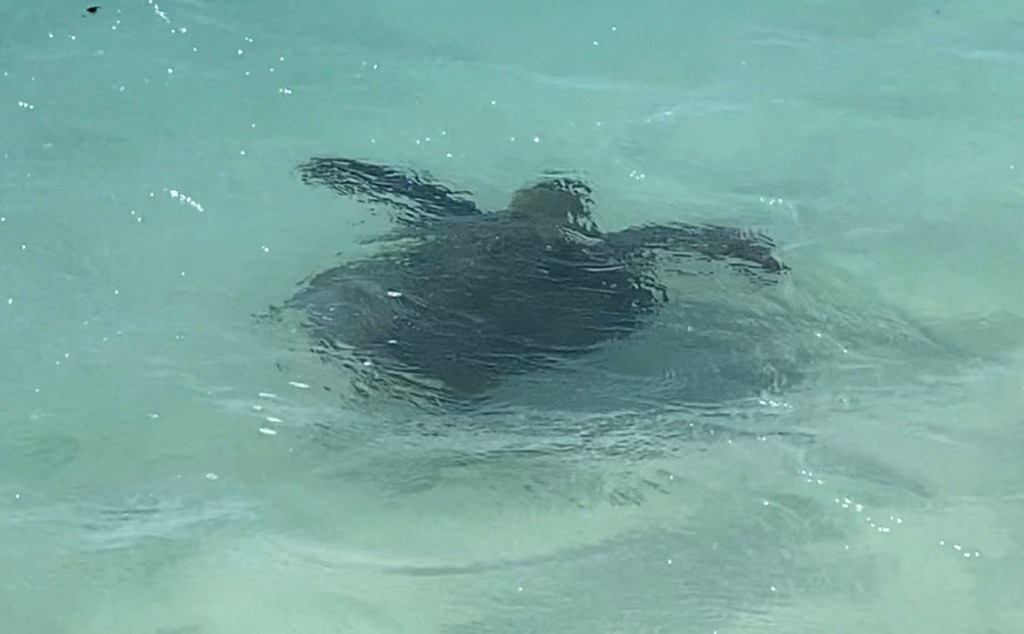
    The course culminated in a thrilling dive to 9.5m (I’d forgotten how amazing it is to explore the sea’s depths!), in which we swam into a huge shoal of colourful fish and I saw my first green sea turtle. These are the most beautiful, graceful creatures, much bigger than the jungle turtles I saw in Brazil, at over a metre in length. I ended up swimming with many during my stay.

    The next day, I followed this one along the shallow waters by the shore

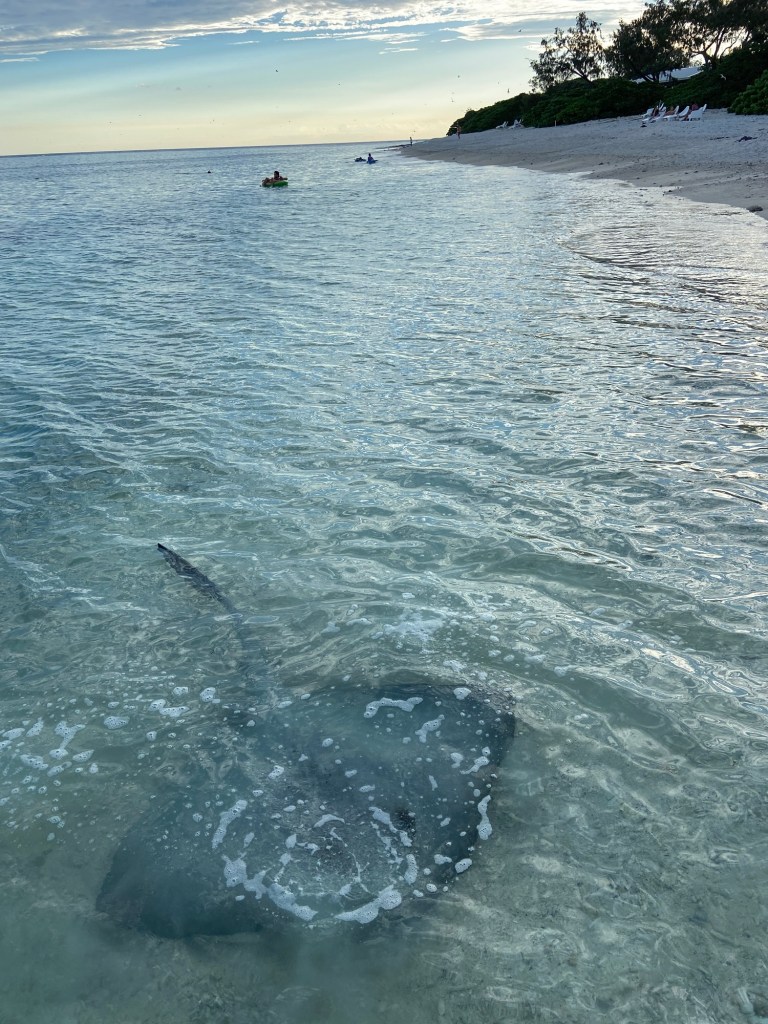
    In the afternoon, I went snorkelling in the lagoon, the shallow area in the foreground of the aerial view of the island. The highlight was seeing this cow-tailed ray:

    Evening on Lady Elliot was magical. I watched the sun go down by the lighthouse, with a cider and good company. Everyone seemed to be revelling in their time on the island and this bred a lovely camaraderie among the guests and with the staff.

    I could get used to life on a tropical island!

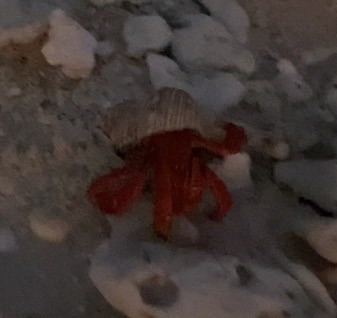
    On the beach we also found a female turtle making a nest to lay eggs, and some hermit crabs, both of which we saw again (alongside tree frogs and birds that sounded like crying babies!) on a night walk later.

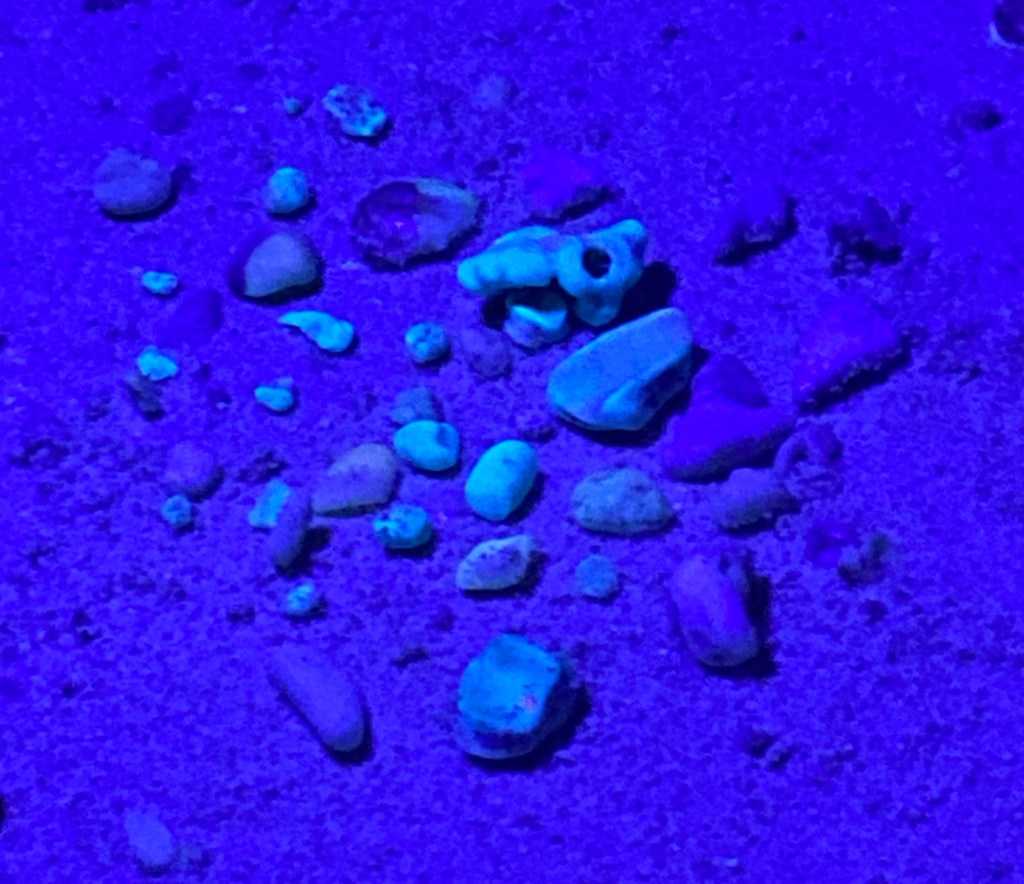
    Some of the corals are fluorescent. I saw this when snorkelling, but the guide also highlighted it on these fragments with ultra-violet light

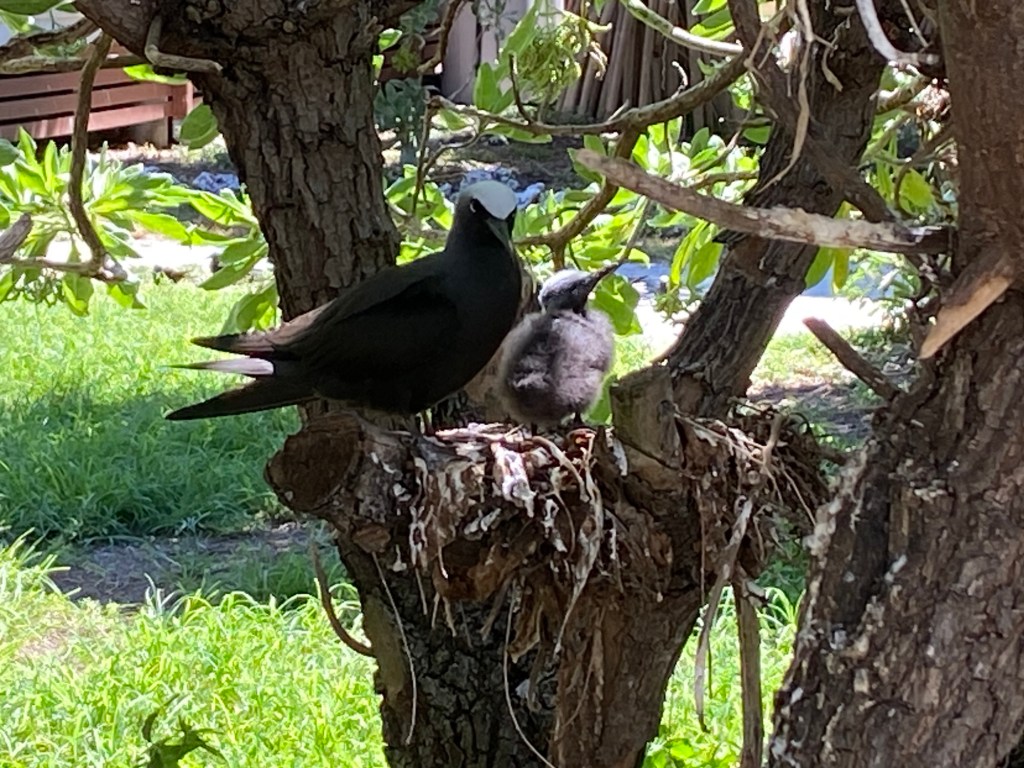
    The island is covered in beautiful tropical vegetation and is also, at this time of year, a major nesting ground for seabirds, particularly the white-capped noddy.

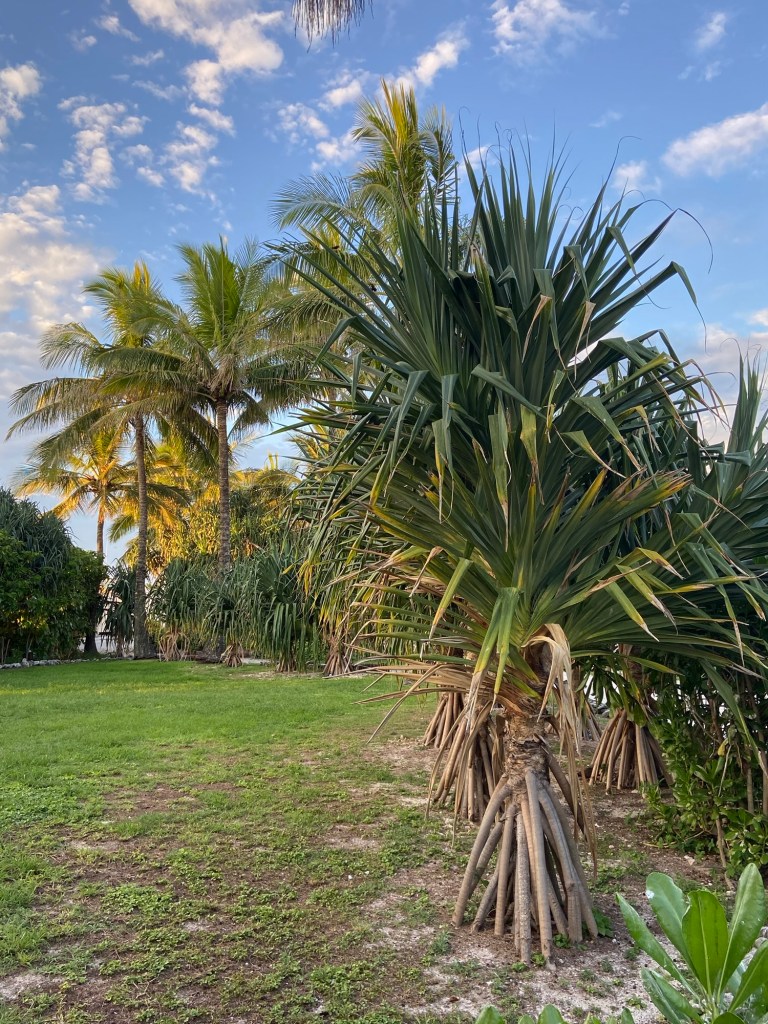
    Pandanus trees, with their exposed roots, are all over the island
    No potential perch was left free by the noddies!
    The parents and young were still in most of the nests
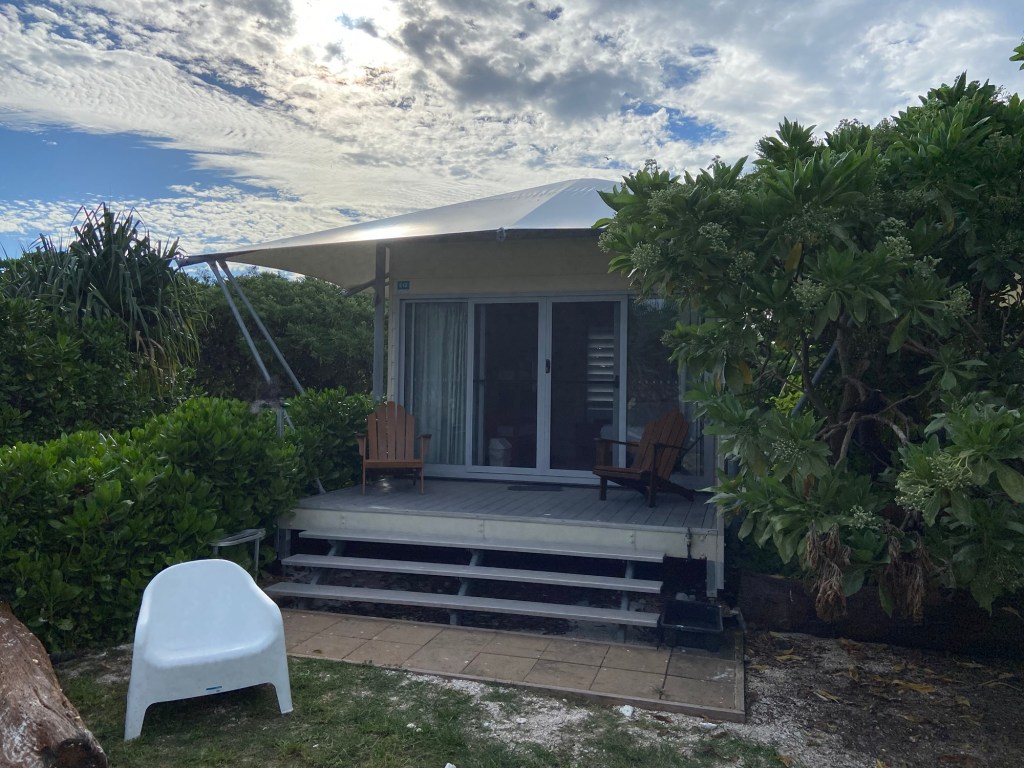
    There was a cacophony of sound all night and day, including outside our accommodation…
    … which was none too shabby…
    … and I had this room all to myself even though I’d chosen the “budget” option!

    I got up early on my second morning to benefit from the high tide, which enabled snorkelling in the lagoon, then walked around the perimeter of the island after breakfast.

    This gives some idea of the many different shades of blue on display. None can rival the turquoise of the water a bit further out though!

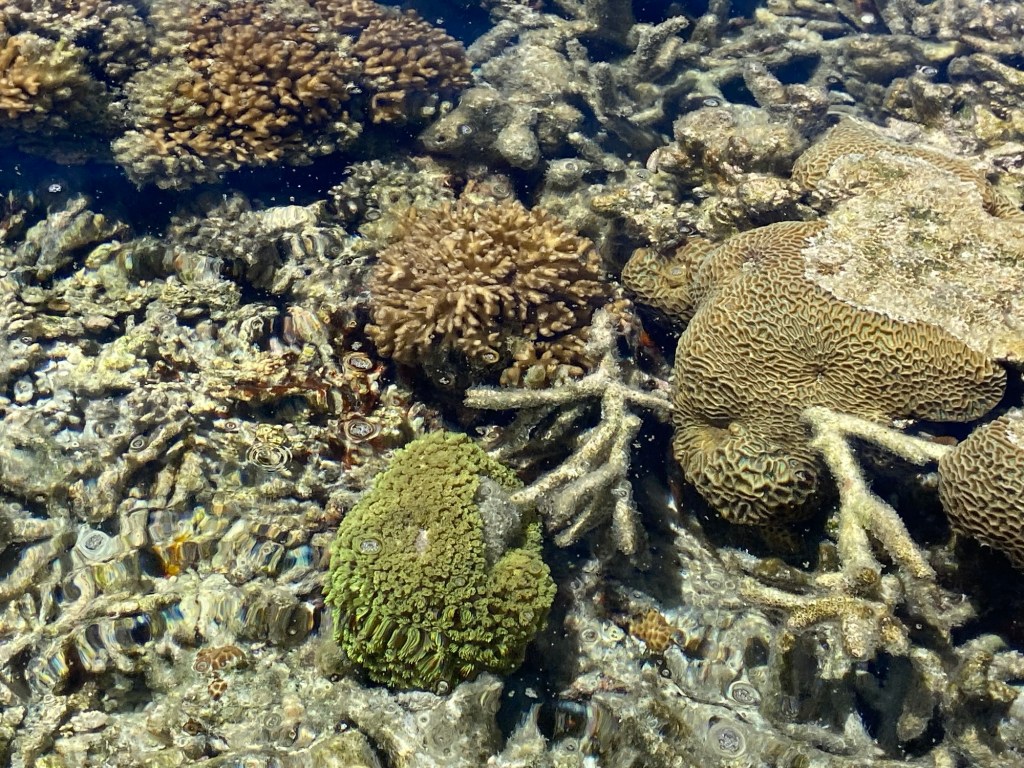
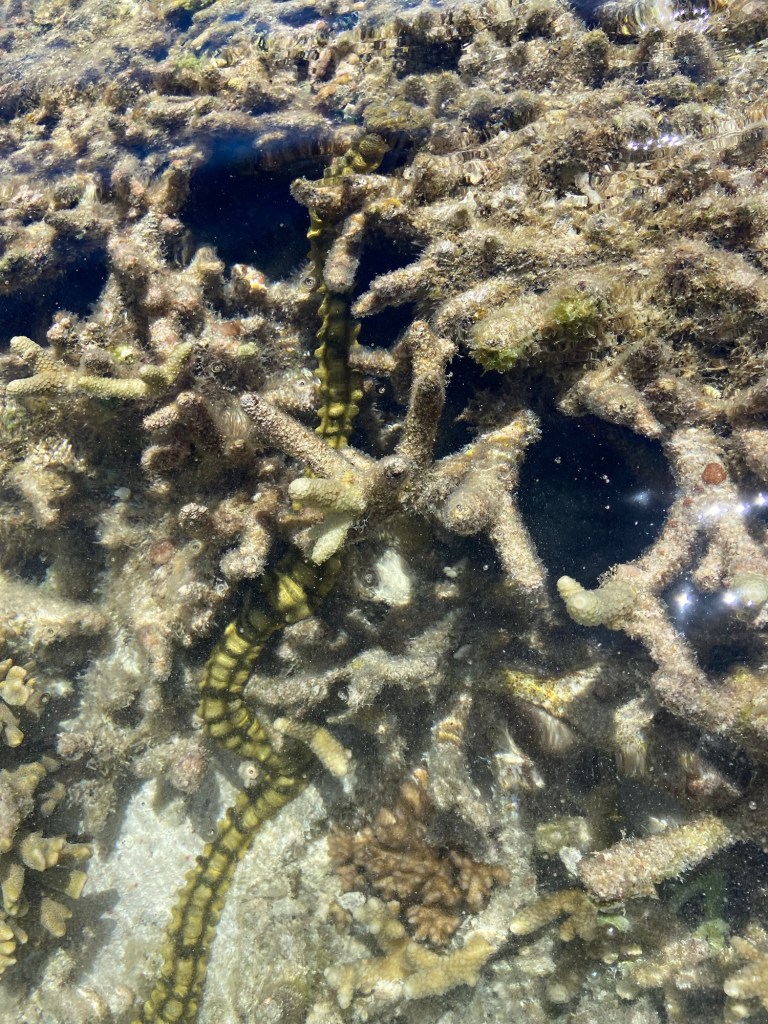
    The sea was rougher than the day before, and the only snorkelling allowed when the tide had gone out was as part of a glass-bottomed boat trip, which was another fun experience. We were also able to “reef-walk” on the lagoon, which allowed me to take a few pictures of the coral…

    Bizarrely, coral is an animal, not a plant!
    There were lots of bright blue seastars and sea cucumbers
    The algae on the coral is the main food source for most of the sealife

    Two hours before my departure, one of the snorkel sites, “coral gardens”, was reopened. I checked the current, ran across the island and waded out to the platform where reef shoes were replaced with flippers. What followed for the next 45 minutes made everything I’d seen up to that point pale by comparison.

    The moment I got into the water I was surrounded by a shoal of foot-long parrotfish, as colourful as the macaws I saw in South America. The colour in the coral here was much more vivid, and almost as varied as it was among the fish.

    Again, not my picture, but this is the nearest I could find to what I saw

    I was mesmerised by the large shoals, and the turtles that passed by, undeterred by my presence.

    But I wanted to see a shark. A few other guests had seen one, but I was telling myself not to be greedy. Then just as I’d returned to the shallow waters by the platform, one amazingly appeared. A black tip reef shark, about the same size as me, ominous-looking but not dangerous. I was overwhelmed by it all, thanking God that yet again such a treat had been pulled out the bag at the last moment.

    I can’t recommend Lady Elliot Island highly enough. They’ve thought about every detail to make the guest experience as comfortable as possible and everyone there wants to enjoy and protect the unique environment. I had a very happy two days there.

    As I sat in the warm sunshine or under the star-filled night sky, listening to the wind, sea and birds, and absorbing the visual feasts around me, I had a few moments to reflect on the great privilege it has been to experience another wonder of the world. There is something very stimulating about being in a place teeming with life in the way the Great Barrier Reef is, and in a community like Lady Elliot Island. My friend Claire expressed a hope that my travels would afford moments of peace, wonder and connection. As I tried to take it all in and hummed one of my grandmother’s favourite hymns, this felt like one such moment.

    All things bright and beautiful
    All creatures great and small
    All things wise and wonderful
    The Lord God made them all!

  • Ben Stokes!!!

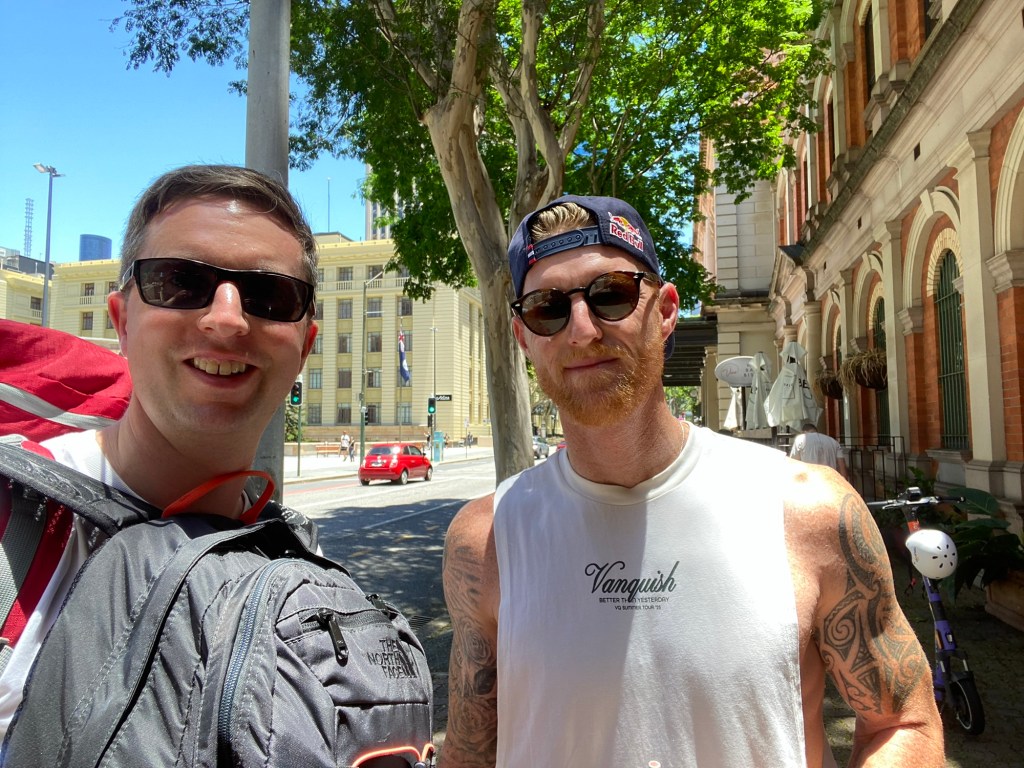
    That was exciting! I walked out of the station on arrival in Brisbane city centre and the England cricket captain was there to greet me. He was friendly and I’m still buzzing two hours later!
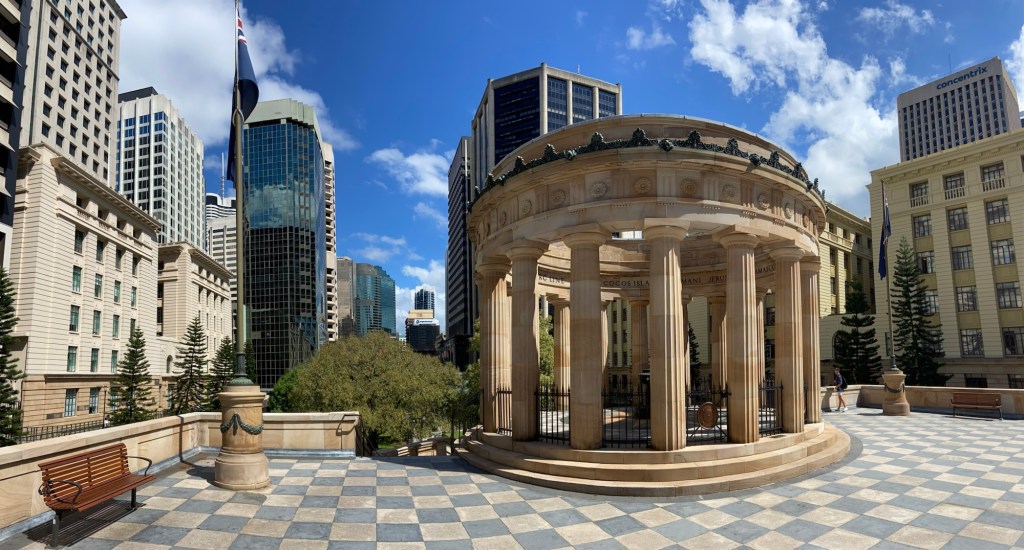
    The Anzac memorial, which I was keen to see due to my great-grandfather Pop’s involvement at Gallipoli, was also just outside the station!

    I’m also buzzing having received just the warmest welcome to Australia. I was picked up at the airport by Josh, whom I haven’t seen since happy days in Paris 17 years ago. It was a reunion full of smiles and laughter and it was so lovely to meet his wife Annie and his delightful kids.

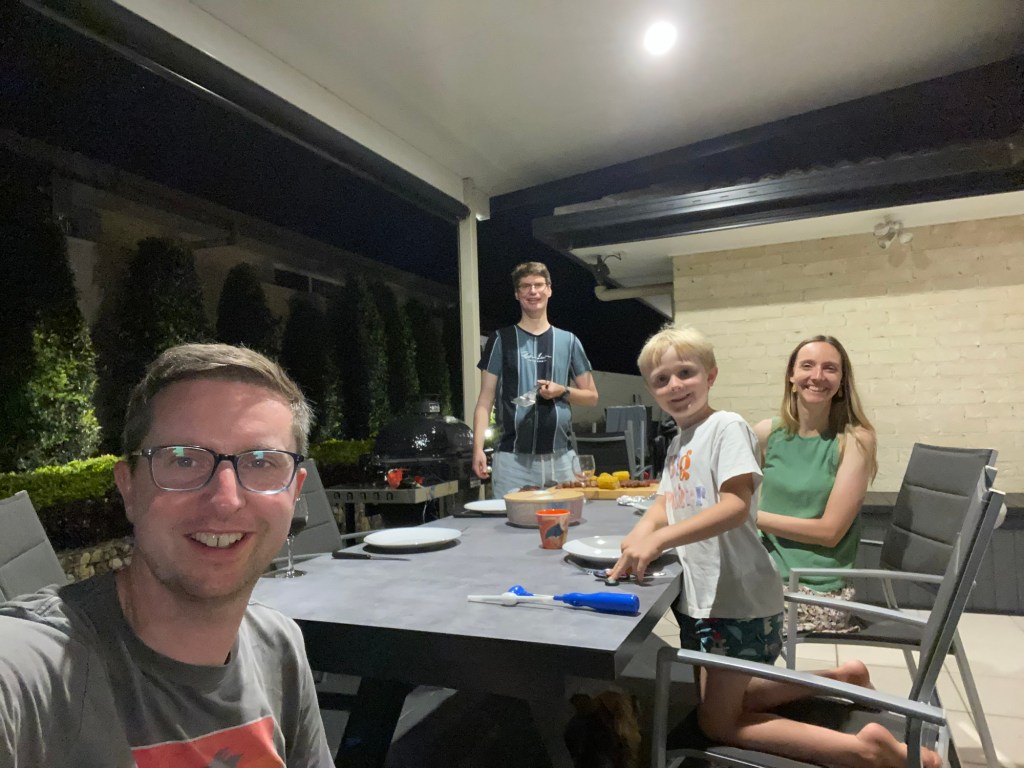
    My first meal in Australia was a “top drawer” BBQ on the patio of my generous hosts’ idyllic home
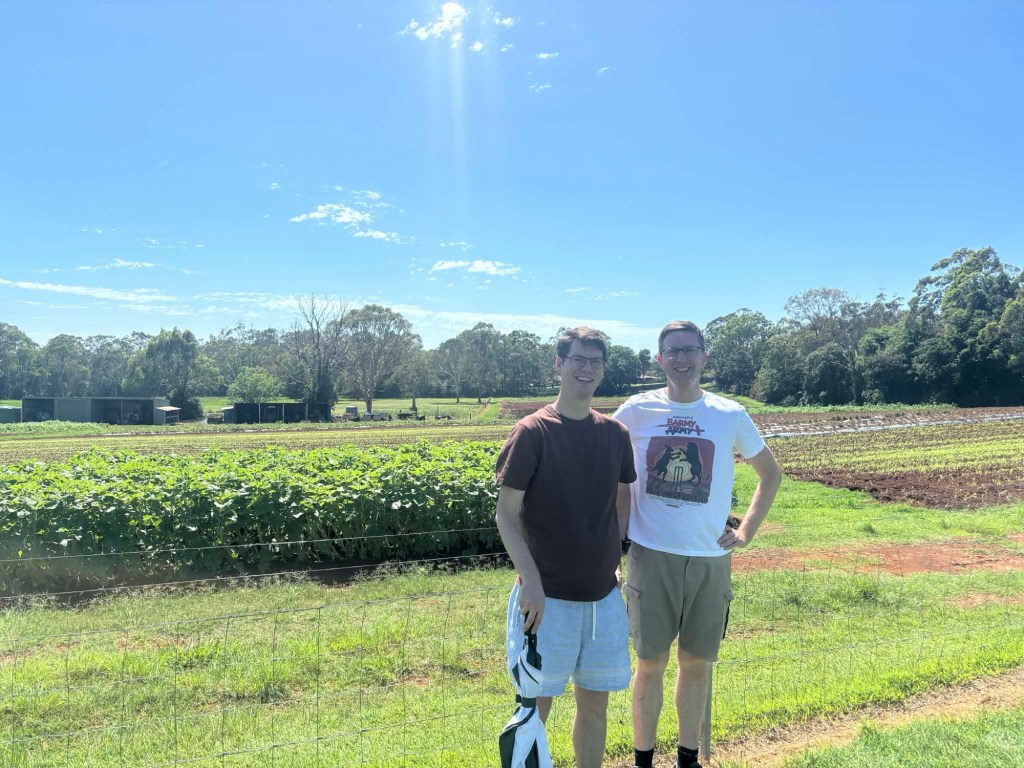
    My second was a wholesome breakfast in wholesome company at the local farm
    They live in such a beautiful place!
    “How many tests will Australia win this Ashes?”
  • New Zealand

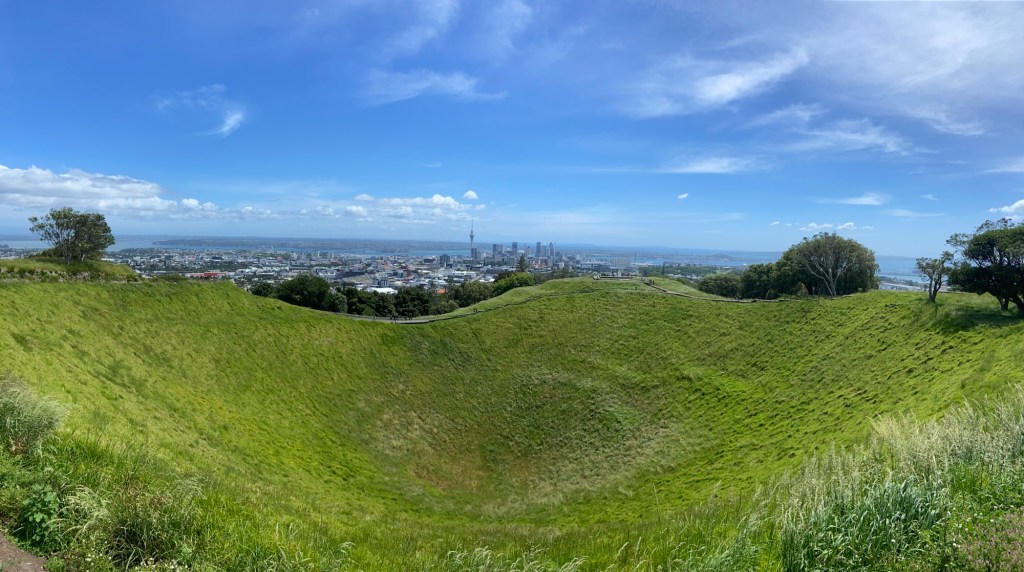
    Central Auckland from Mount Eden

    It is almost insulting to a country as rich in wonders as New Zealand only to spend two nights there. My brief stay was really just an extended stopover, as I couldn’t fly directly from South America to Brisbane, so I opted to come via Auckland rather than go straight to Australia. I had thought I would have three nights though, forgetting that I lost a day by crossing the International Date Line! Circumnavigating the globe in a westerly direction does make the jet lag easier, but it also means I am having the opposite experience to Phileas Fogg when it comes to the calendar!

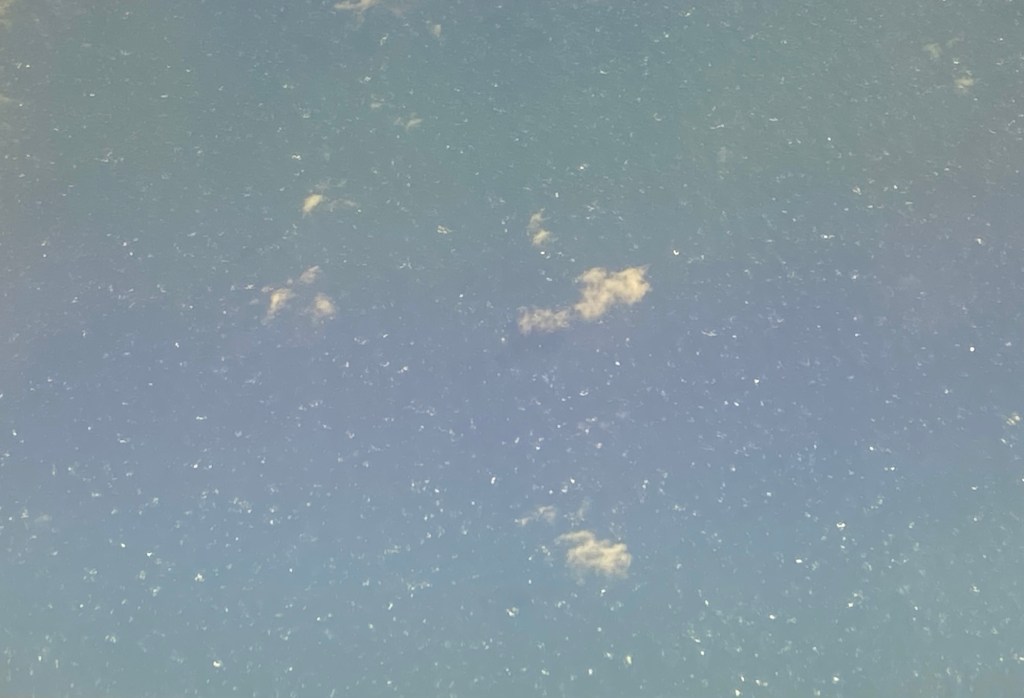
    The 12 hour journey across the southern Pacific Ocean took me nearer the South Pole than I’d ever been before. I thought I could see chunks of ice from the plane, but the white specks might just have been waves!
    Our flight path also took us over Chatham Island…
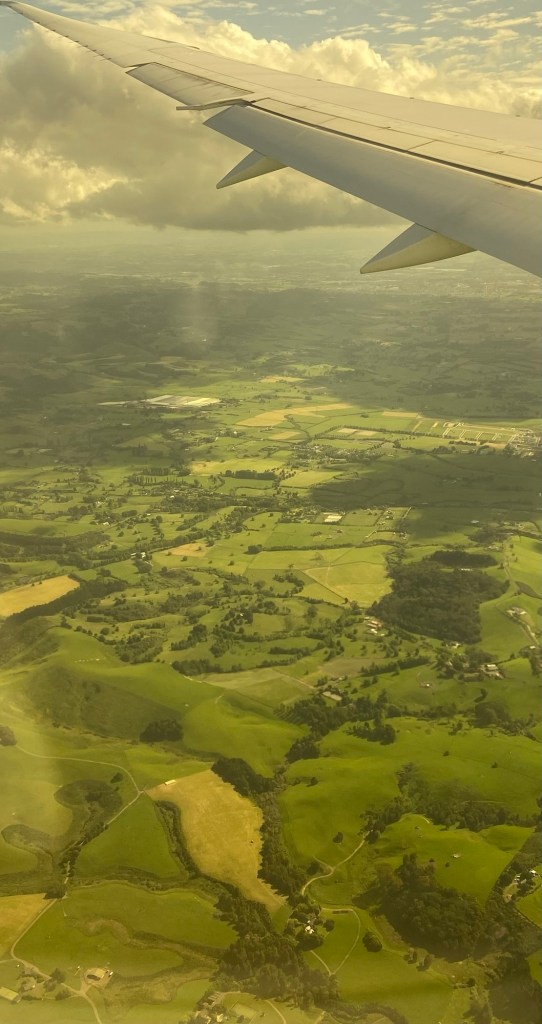
    … before reaching the North Island: the Shire of The Lord of the Rings films!
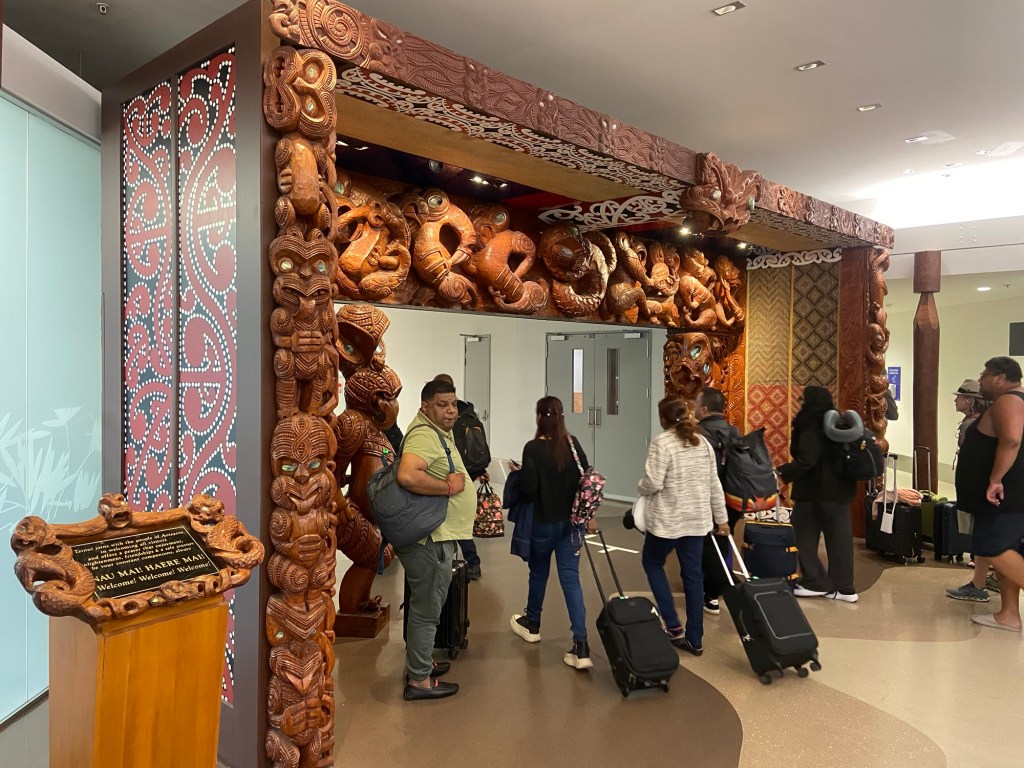
    The Māori welcome arch at Auckland airport

    It was a bit of a shock returning to an English-speaking country: one in which the Christmas playlist was already being given a thorough airing in shops and cafés. And it was somewhat incongruous being transported to a Winter Wonderland when the day of my arrival was the country’s warmest November day on record!

    I spent my one full day in New Zealand on a fabulous tour that took us to some of the North Island’s star attractions. Our guide, Simon, had questionable tastes (he was a Luton Town fan…), but once I got over that I thoroughly enjoyed his detailed and knowledgeable commentary!

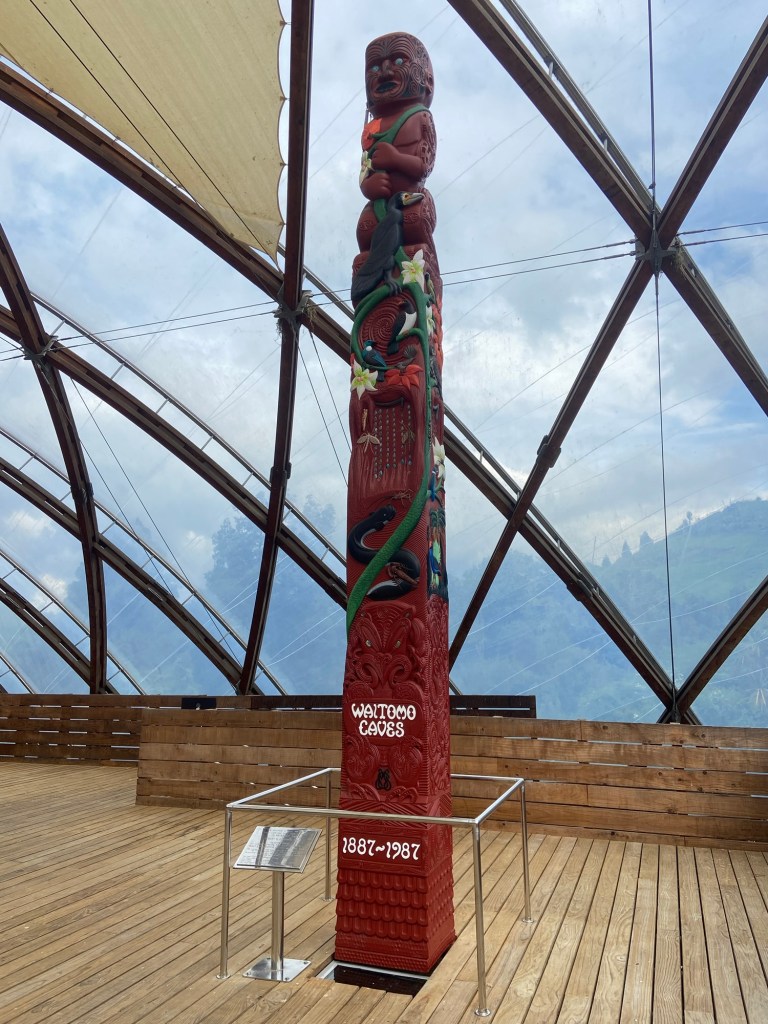
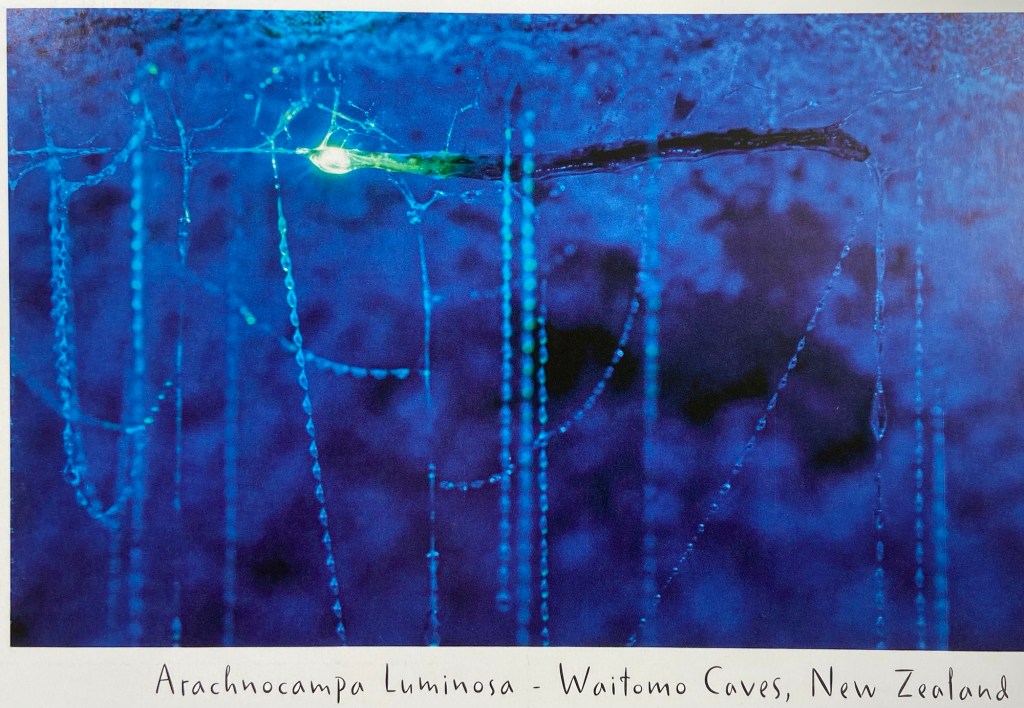
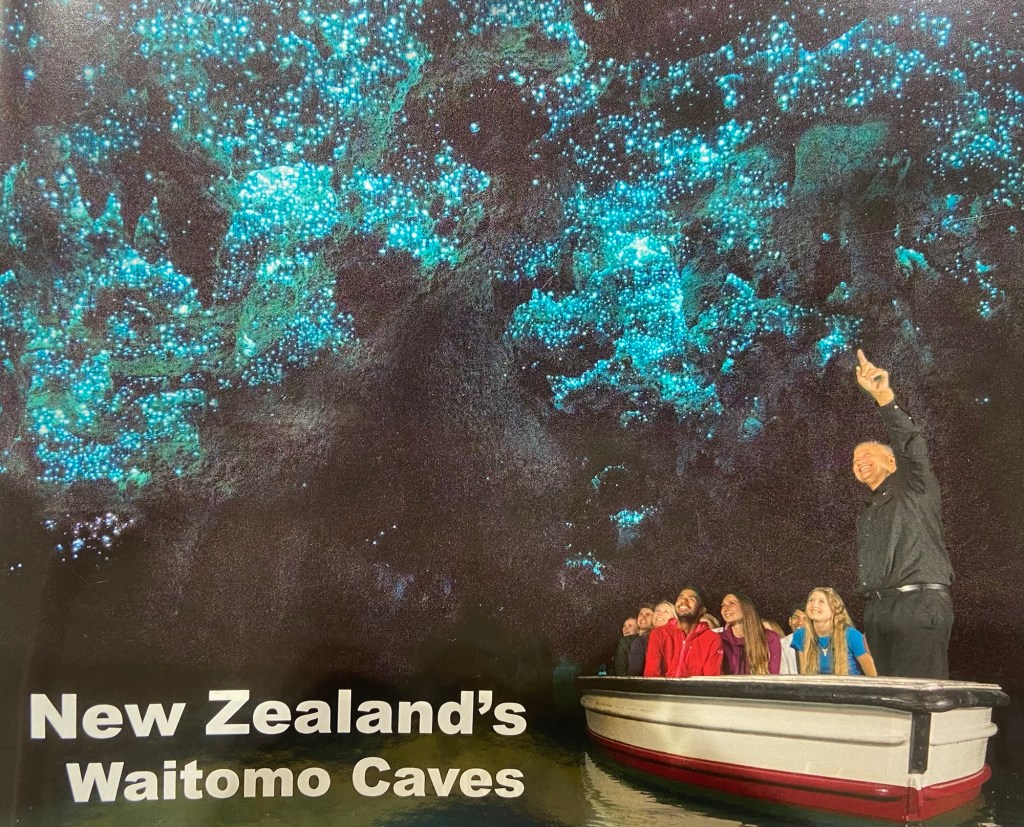
    Our first port of call was the Waitomo caves. These are impressive in their own right, but the main event is seeing the glow-worms that light up the ceiling like stars in the night sky. It really was a magical experience taking the boat along the underground river to see them. They are actually flies in the larval stage, so maggots rather than worms. The constellations they form are three-dimensional and have a gentle, hypnotic motion as the wind catches the threads they dangle to catch prey.

    This postcard shows what the glow-worms look like up close. The bioluminescence comes from a chemical reaction in the tail
    No photos were allowed in the main chamber, but this gives an idea of how extraordinary it was
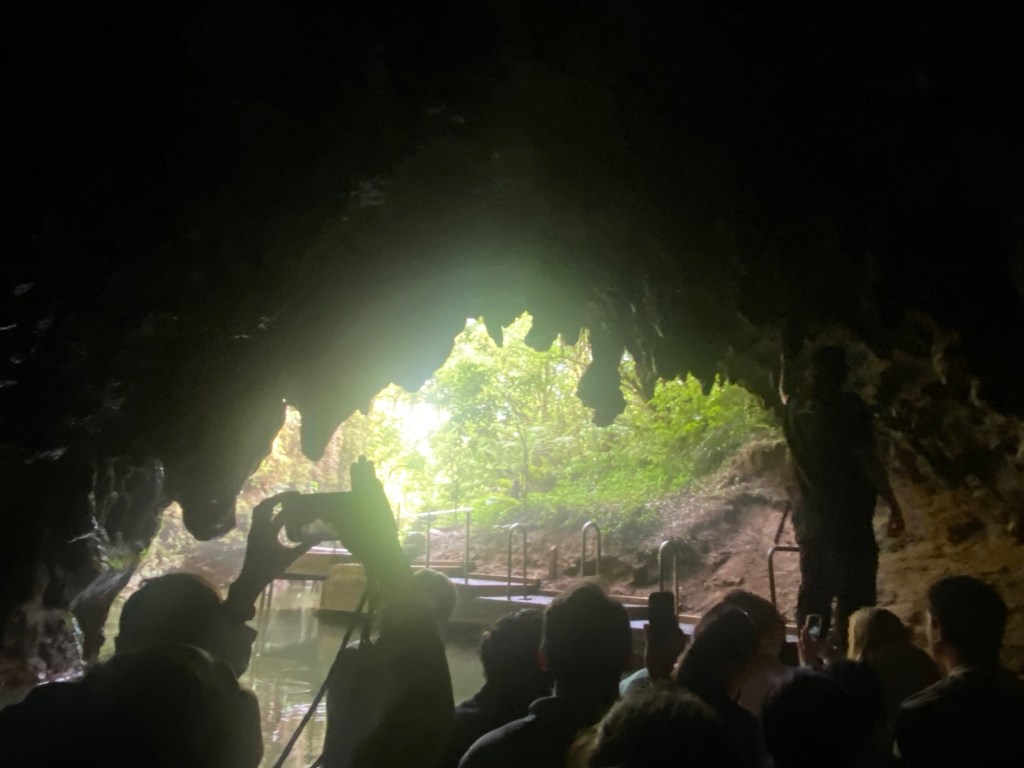
    At the end of the boat trip, we emerged into the surrounding rainforest. The stalactites and stalagmites inside the cave were much more impressive than those visible here, and it’s mind-blowing to think they have taken millions of years to form
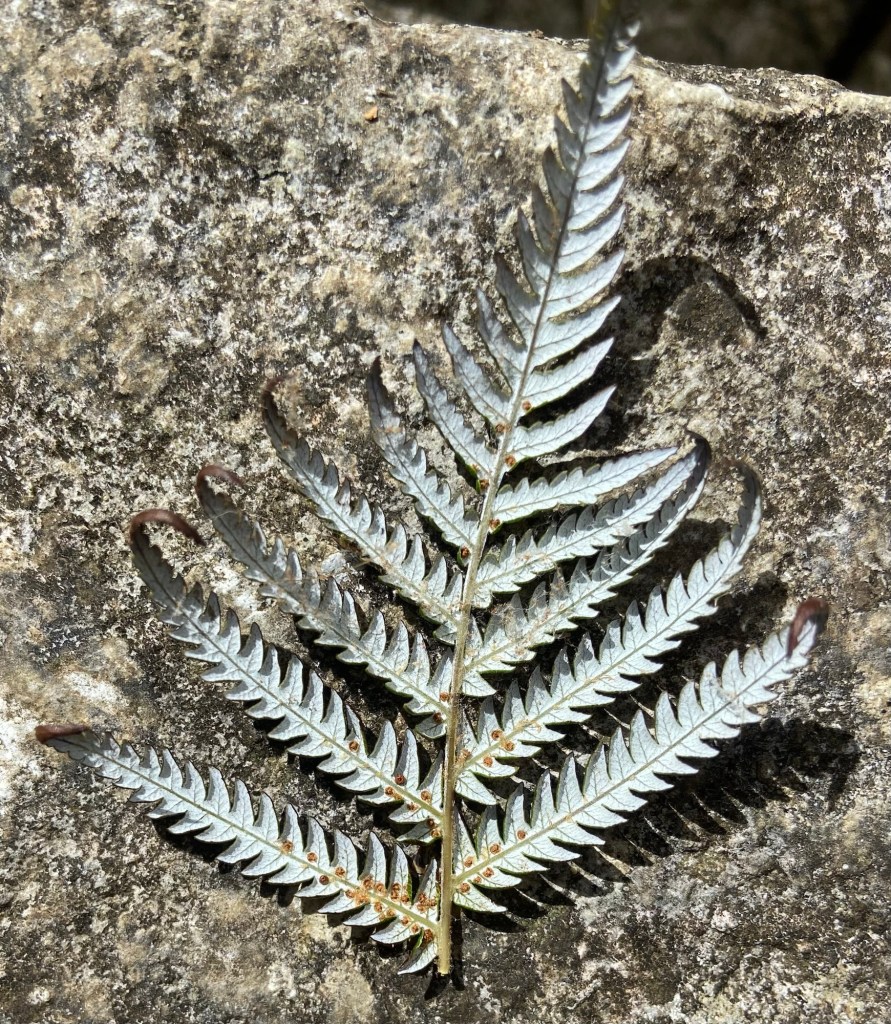
    A silver fern, native to New Zealand and an emblem of the country. This is the underside: the top is green!

    From Waitomo, we drove to Rotorua, a hotbed of geothermal activity (quite literally) and an important centre of Māori culture.

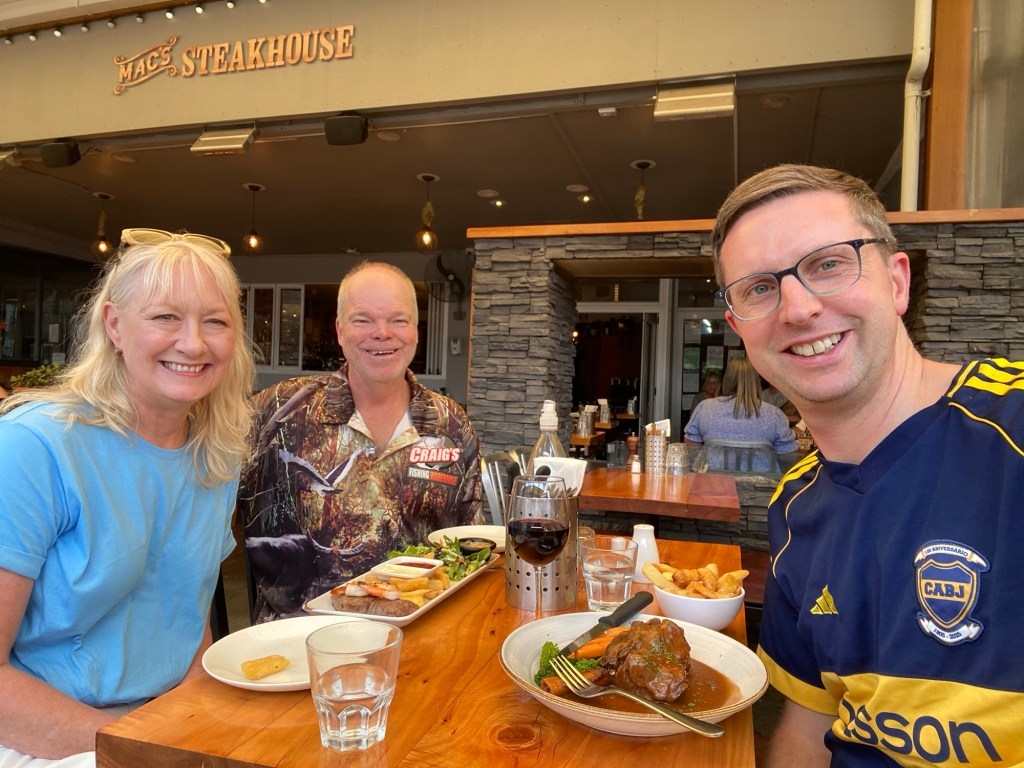
    New Zealand lamb and merlot for lunch. This Australian couple on the tour very kindly footed the bill!
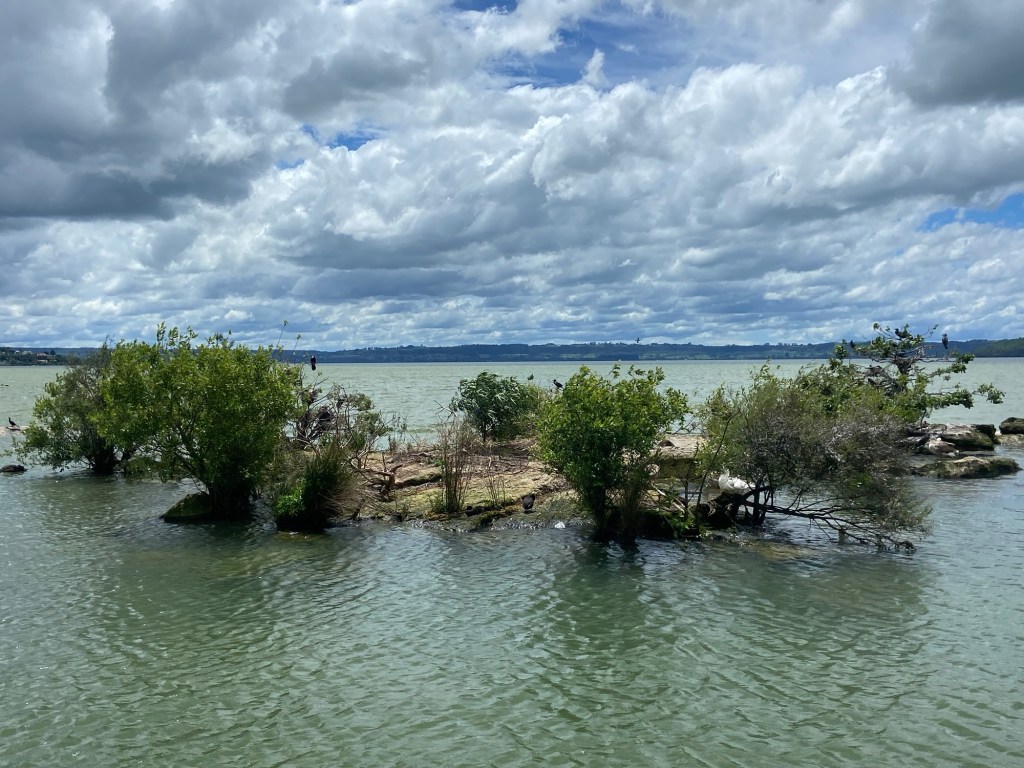
    Birds nesting on Lake Rotorua. They must become immune to the smell of sulphur and algae!

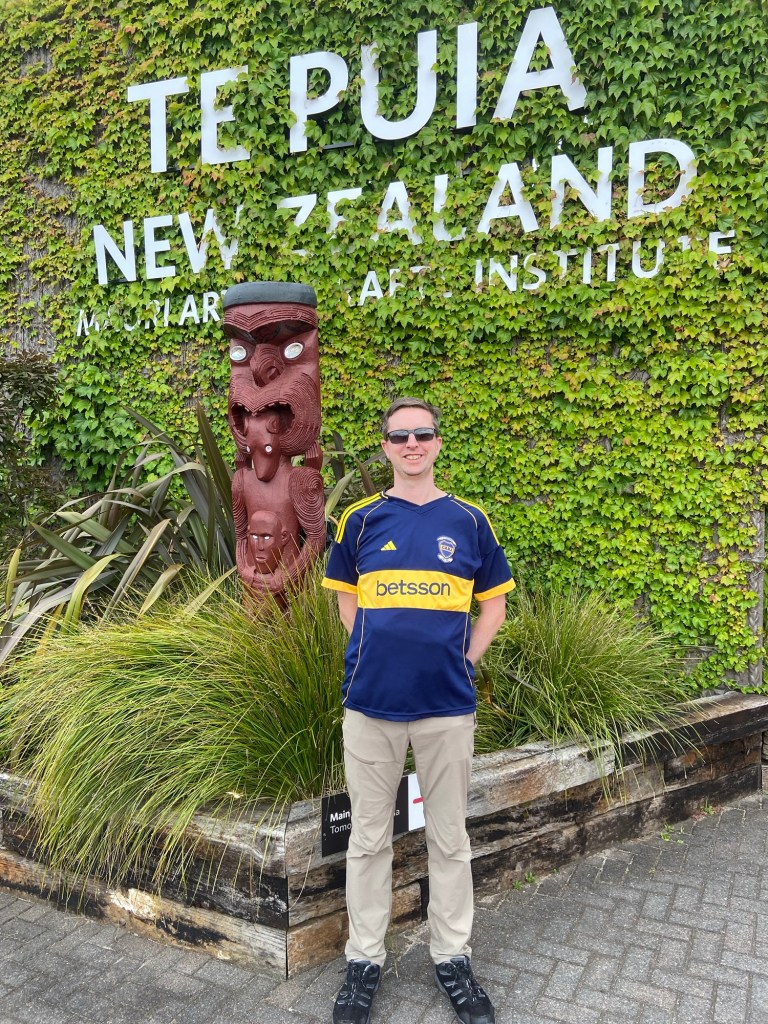
    In Rotorua, we spent a thrilling hour and a half at the Te Puia cultural centre and geothermal site. It was a veritable New Zealand highlights tour!

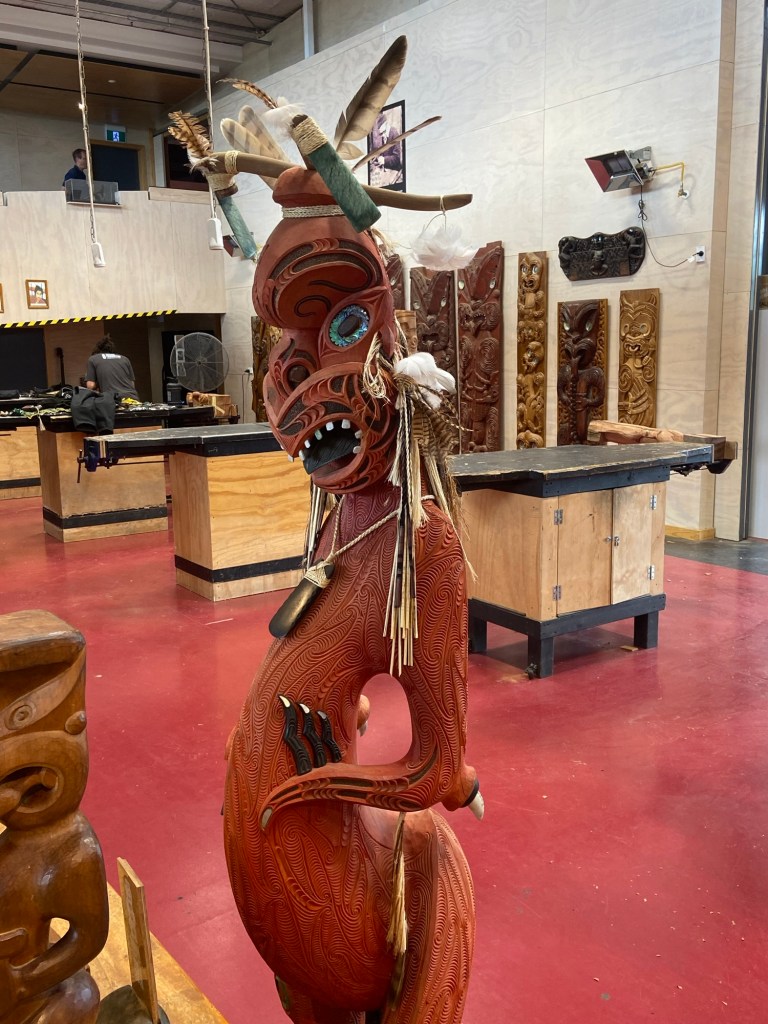
    In the Māori Arts & Crafts Institute, we saw students at work, and some of the impressive fruits of their labours:

    We also saw that other great emblem of New Zealand: the kiwi. Only 68,000 of these endearing, flightless birds remain in the wild. They evolved in a place without predatory mammals, so are under severe threat from introduced species.

    No photos were allowed inside the building, where day and night are reversed to allow visitors to see the birds out of their nests and foraging for food. You can see some hairy (not feathery) birds on the lower screens here.

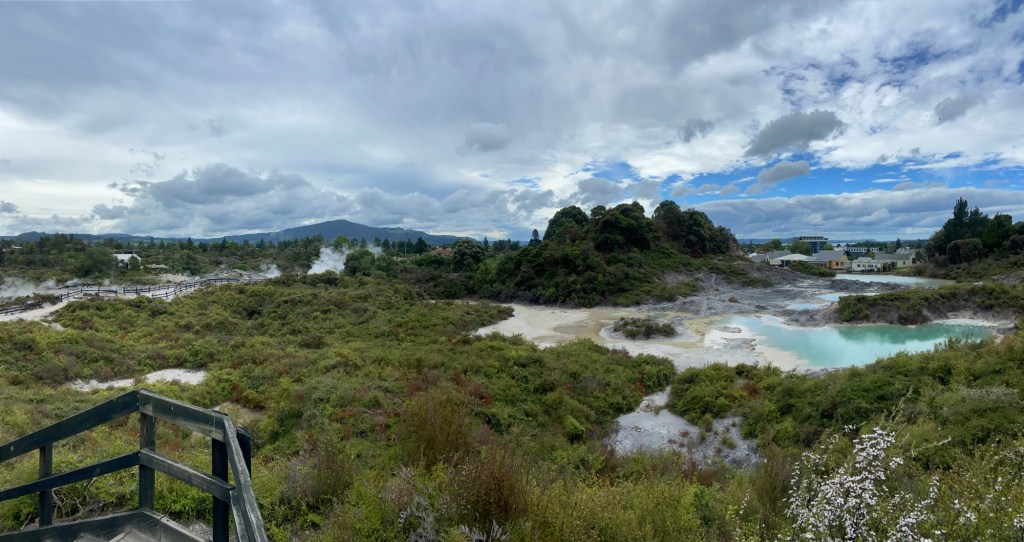
    The tour concluded with a walk around the other-worldly pools and geysers of the geothermal park:

    The colourings in the rock and water come from the various minerals thrown up by the volcanic activity
    Water boiled by magma rises to produce this steam-heated mud pool
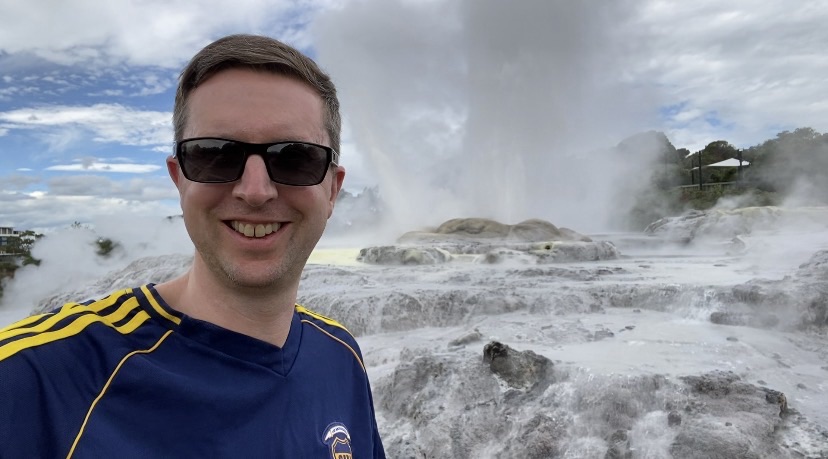
    This is the biggest geyser in the southern hemisphere and it explodes into action like this once or twice an hour, to put on quite the display!

    The three hour drive back to Auckland was through some lovely countryside, but I was nodding off after my long day of travel and then the excitement of the tour. I found second wind back in the city though, sampling its nightlife with George (the former WBGS Head of Cricket) and then chatting with other travellers back in the hostel until the early hours.

    George kindly made a detour to see me en route to a stag do. It was great to catch up, and I hope the late night will have the unintended benefit of helping me adjust to the Brisbane time zone!

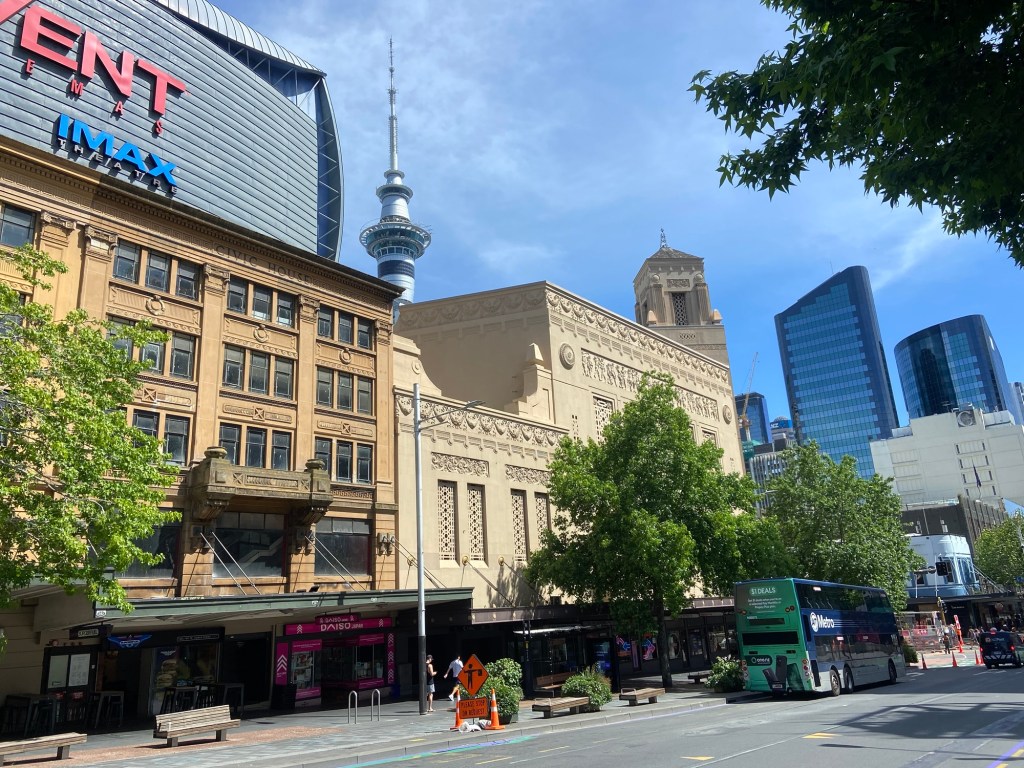
    Arriving in a slightly shabby area, I didn’t get the best first impression of Auckland, but the city certainly grew on me. The downtown area towards the harbour feels very cosmopolitan and has skyscrapers looming overhead, including the famous Sky Tower (which was next to my hostel).

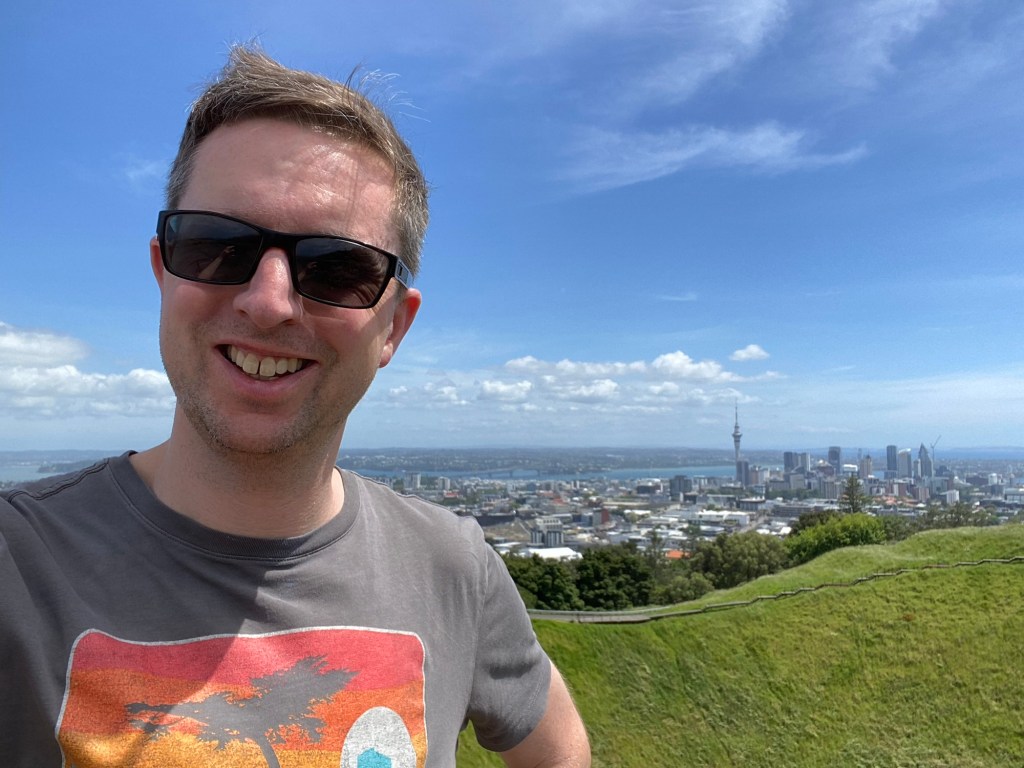
    Before heading to the airport for my flight to Australia, I climbed up to the crater of the dormant volcano Mount Eden. Seeing the glorious views was a fitting way to end my short but sweet visit to this beautiful country.

    The legendary rugby and cricket stadium of Eden Park
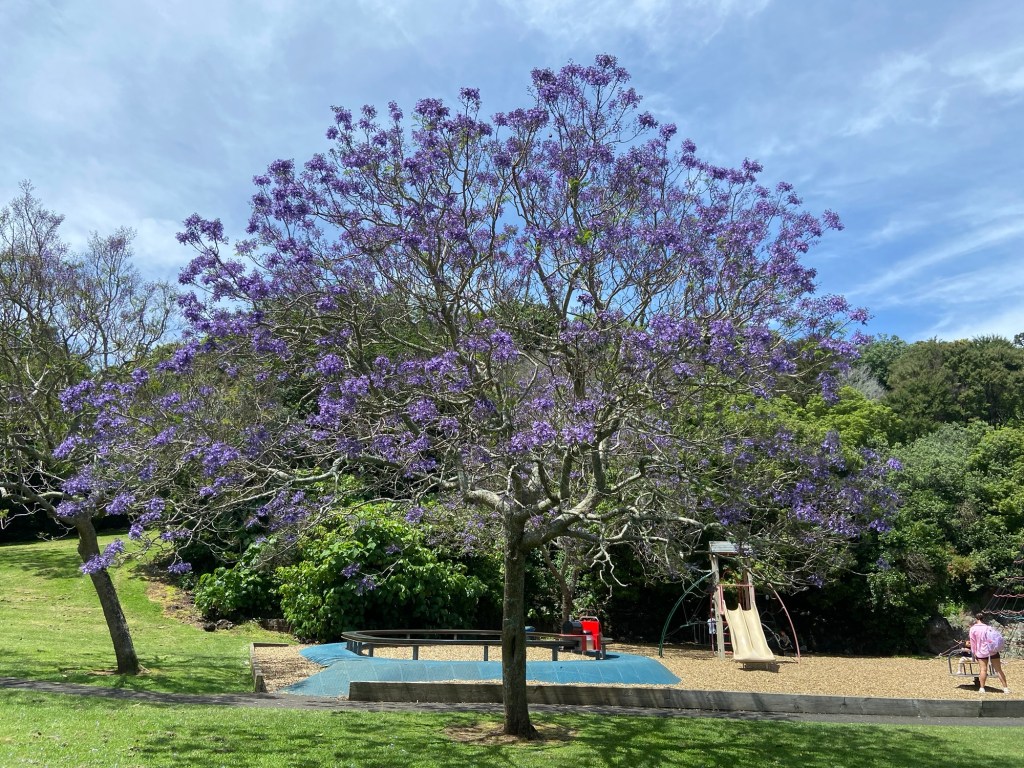
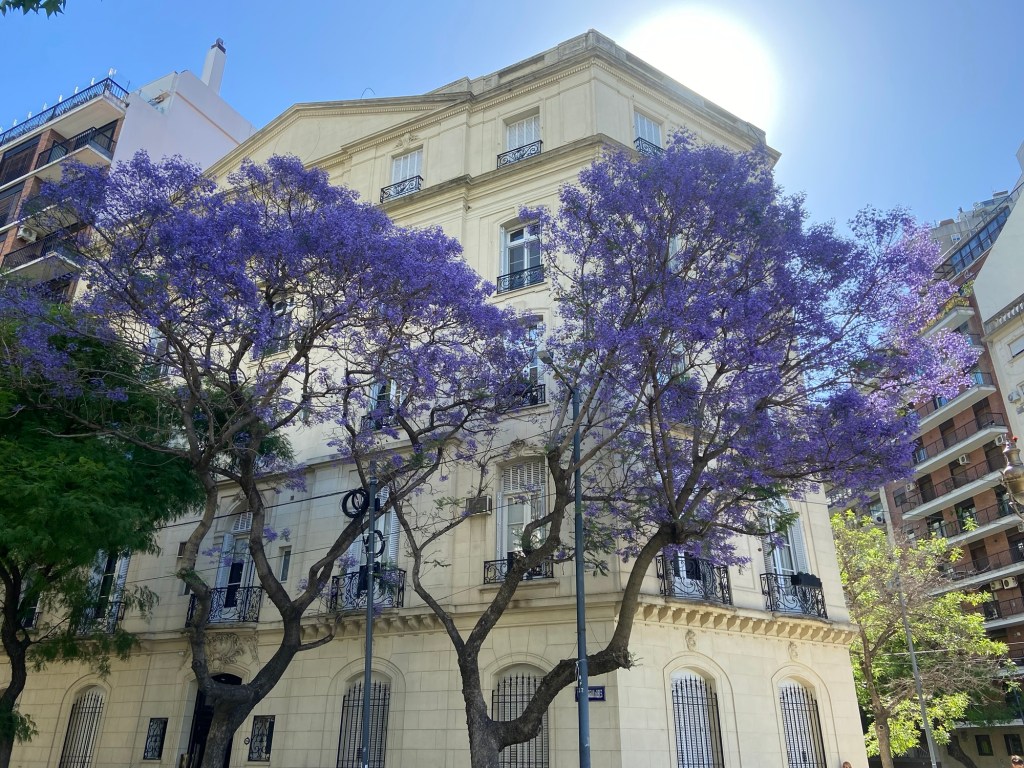
    This tree took me back to Buenos Aires!
    My final view of Auckland was from even higher up!
  • “Don’t cry for me Argentina”

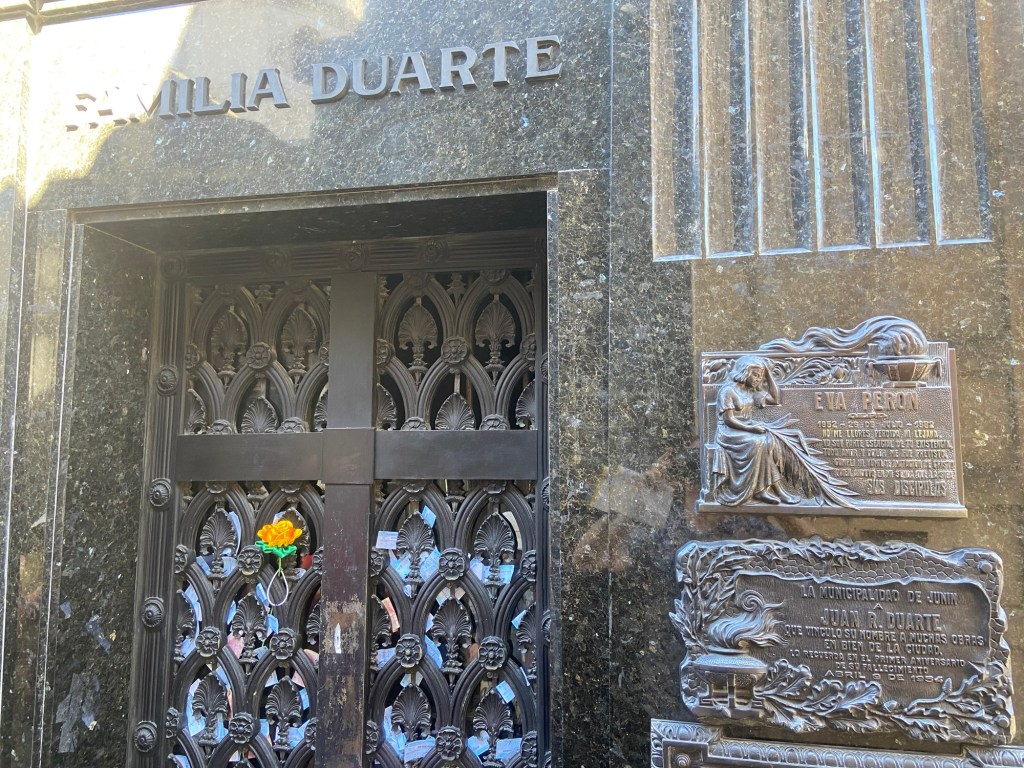
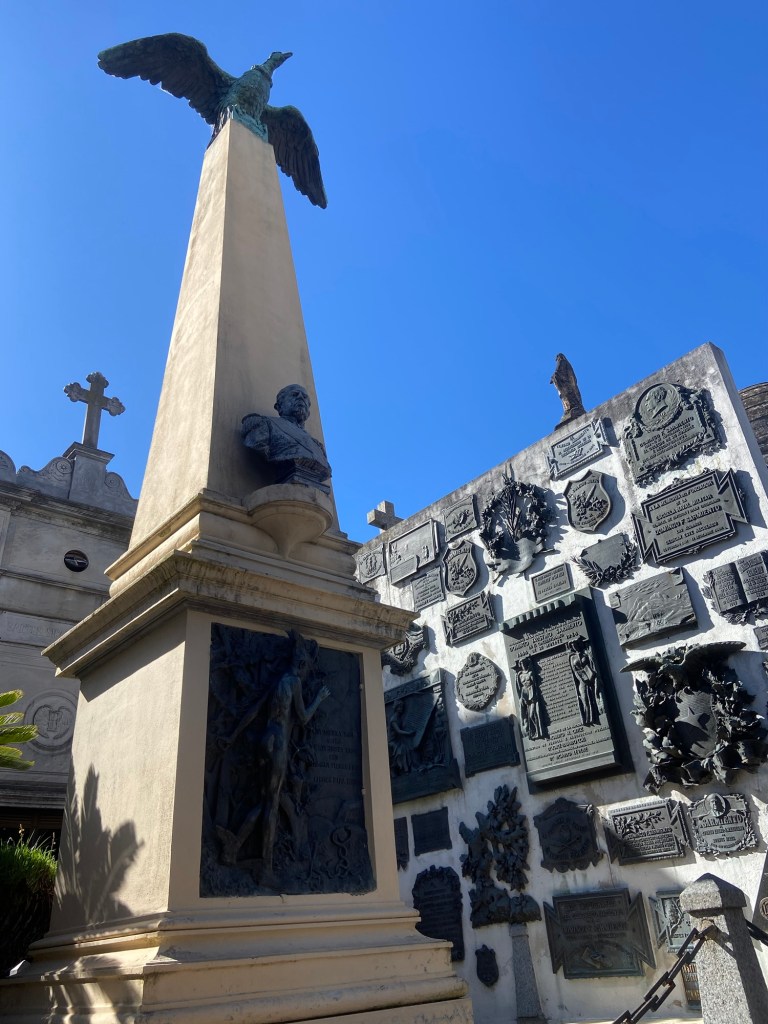
    Evita, Eva Perón, is buried at the renowned Recoleta cemetery. Compared to some of the other tombs there, hers, deep in the family vault, is relatively simple. When she died in 1952, aged only 33, three million people lined the streets of Buenos Aires for her funeral. Soon afterwards though, her husband Juan’s government was in turmoil and her body was taken to Italy. After Juan’s death in 1974, following his brief second stint as President, it was returned to Argentina. But, despite Evita retaining the affection of many, the Perón legacy was divisive, and so the decision was taken not to give her an elaborate memorial, but to bury her privately and securely with the Duarte family of her birth.
    I watched people placing tags from their voting slips in the door, in recognition of the part Evita played in securing women’s suffrage

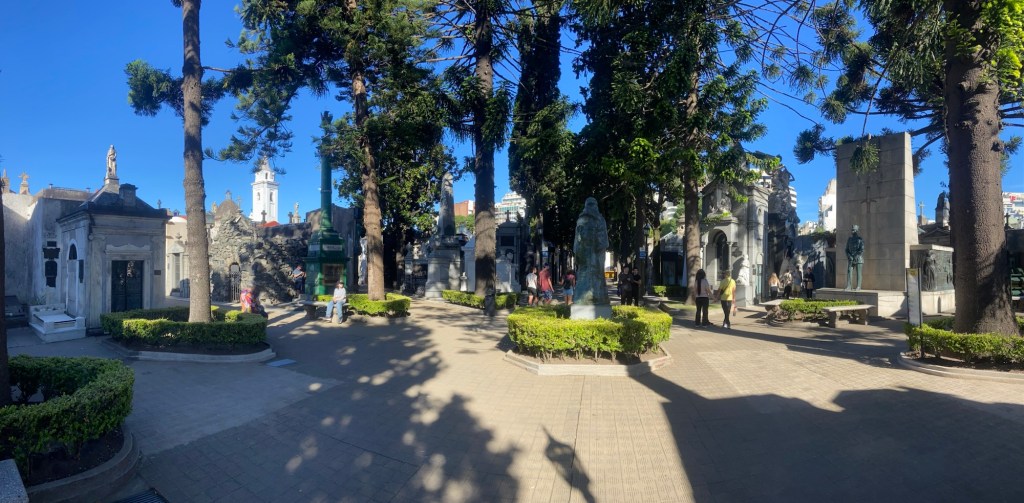
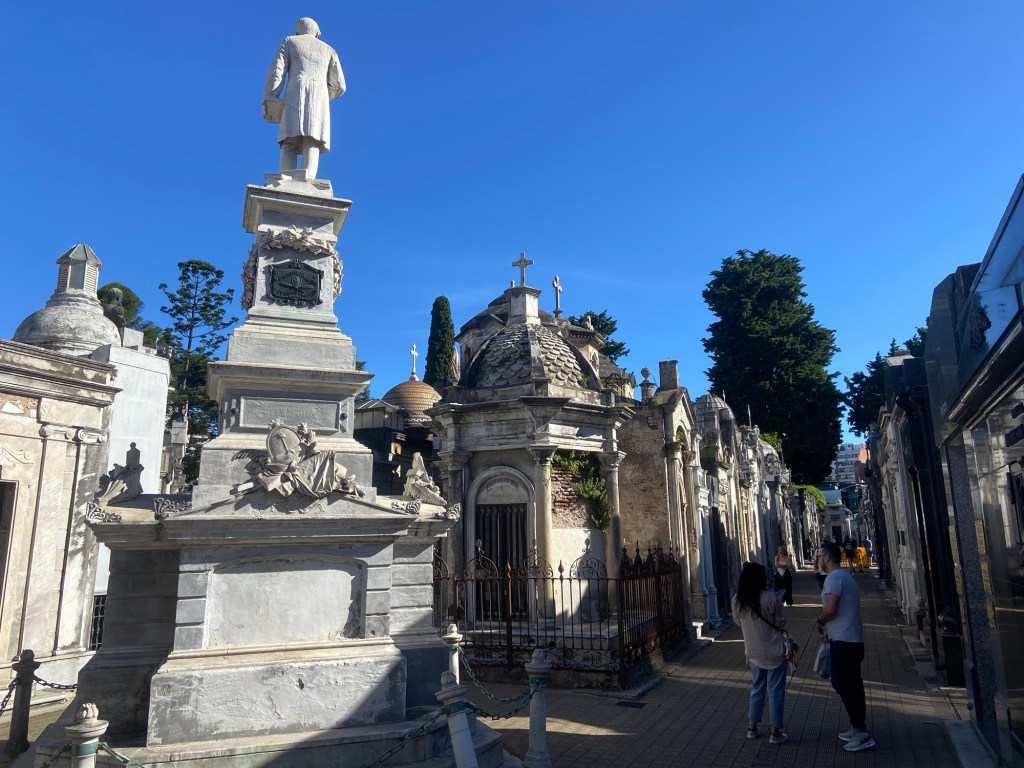
    The cemetery is a fascinating, if rather sobering, place. Many of the great figures from Argentina’s past are buried there and the tombs represent many different architectural styles.

    Sarmiento, President in the 19th century, is celebrated for his role in introducing the country’s education system
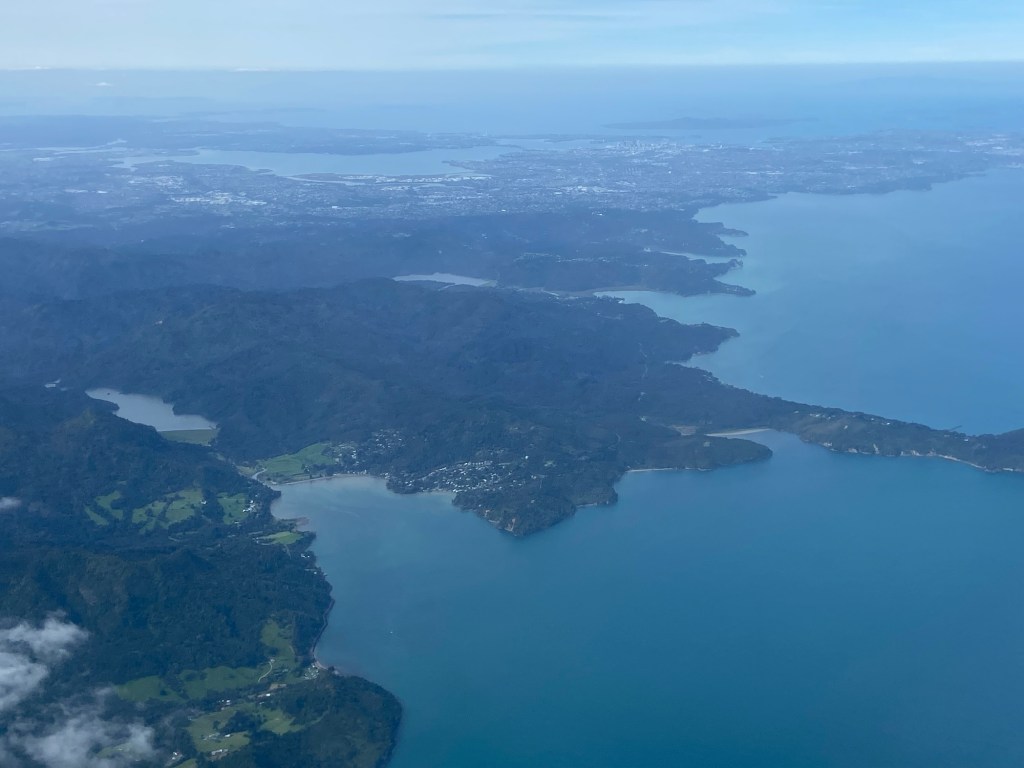
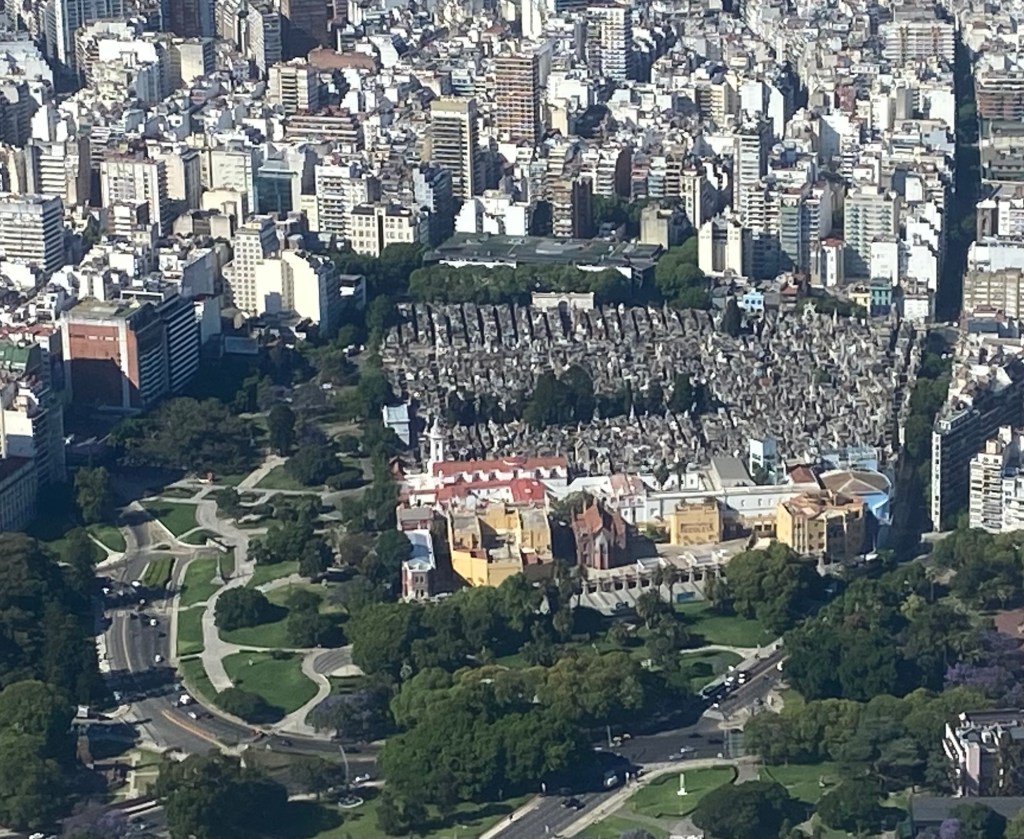
    The cemetery from the air as I left Buenos Aires this morning

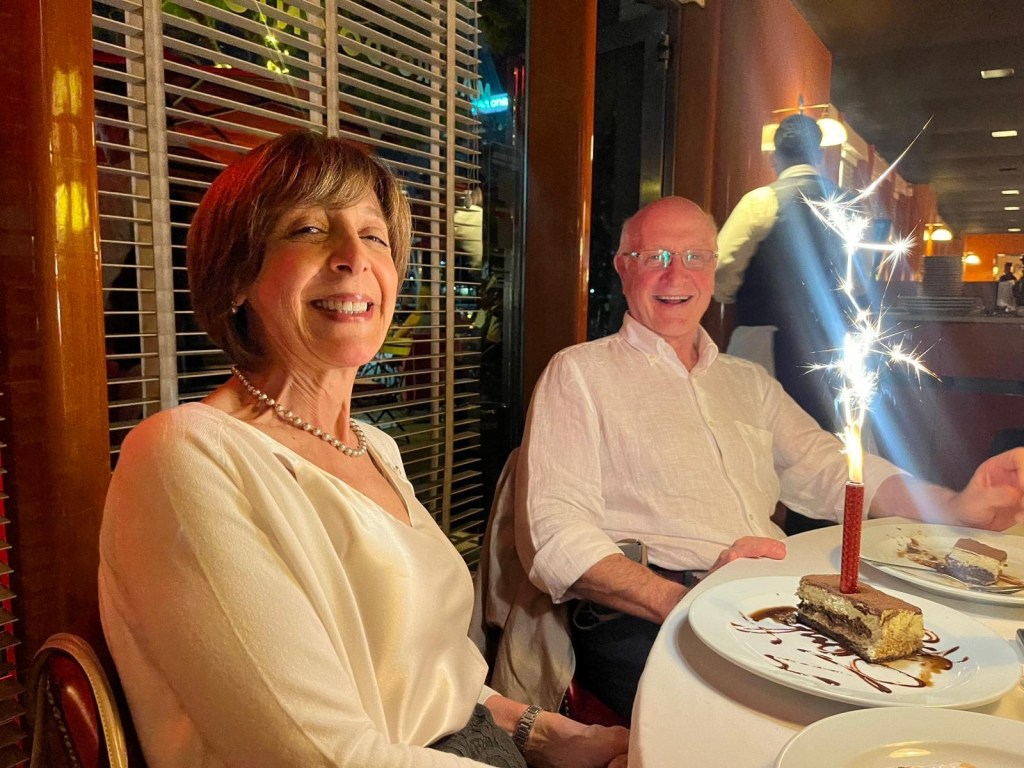
    Andrew Lloyd Webber’s famous aria from Evita has been in my head for the last couple of days, probably reflecting my own sadness at leaving the country it implores not to cry! I couldn’t have asked for a better stay though, and there was a satisfying completeness to ending it with a happy family occasion: the celebration of a “significant birthday” for Estefi’s Mum, Adriana.

    Feliz Cumple! And a warm hello to Adriana’s English reading group, who have been dipping into this blog!

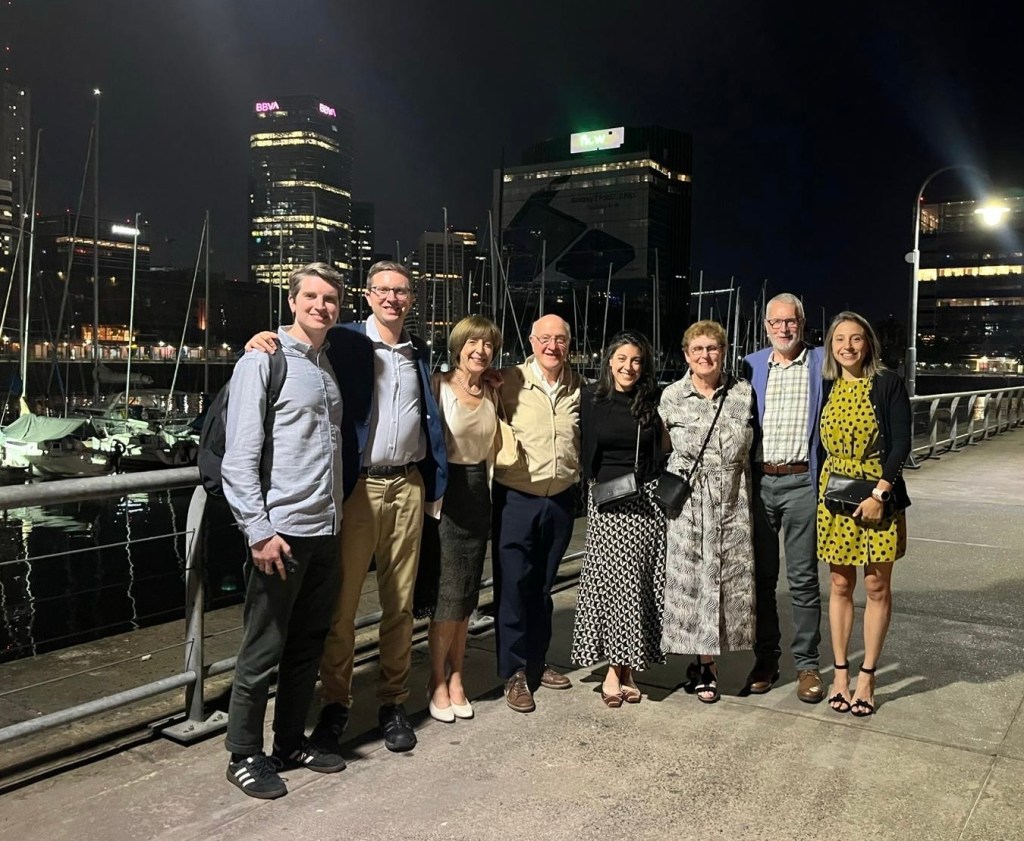
    We are hugely grateful to Jorge, Adriana, Caro and Estefi for hosting us, and particularly to Estefi for her impeccable organisation of our various excursions.

    The perfect little apartment we were given as our base in Buenos Aires

    I’m posting this from Santiago airport in Chile, the fourth and final South American country in which I’m setting foot on this trip. I had a great view of some favourite haunts as the plane took off from Buenos Aires:

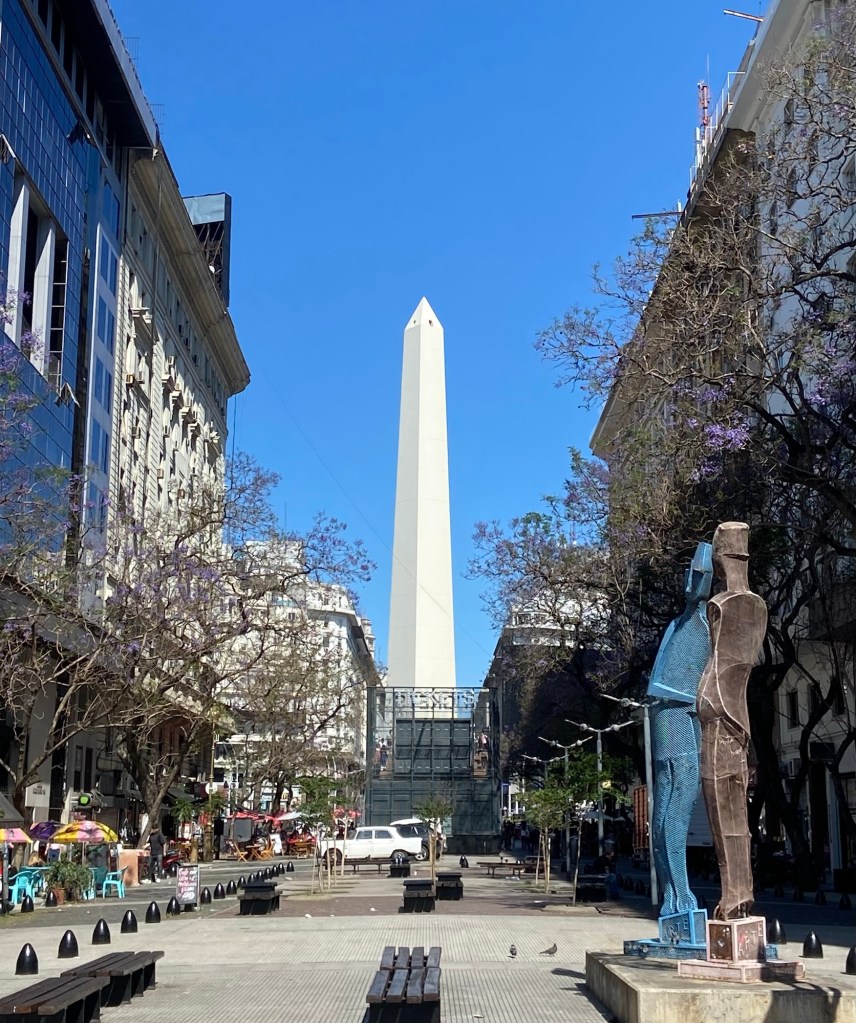
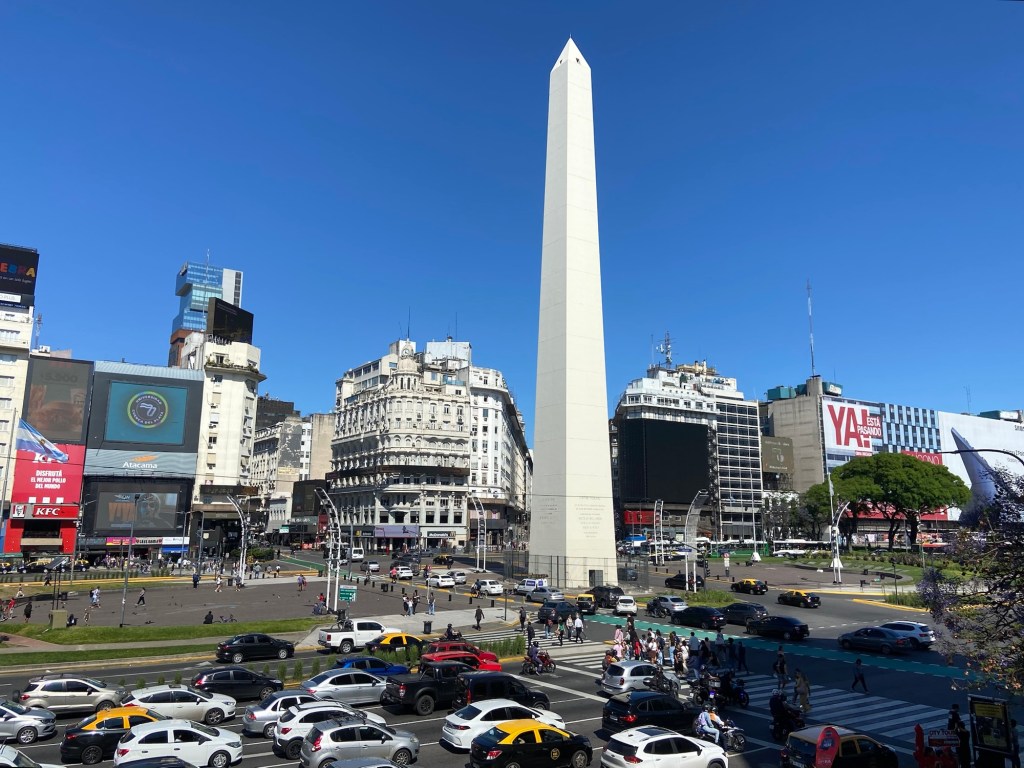
    The obelisk
    La Bombonera

    It’s a month to the day since I left England and it certainly has been the trip of a lifetime so far. South America has long been the continent I’ve most wanted to visit and it has not disappointed. The natural beauty, the flora and fauna (particularly in the rainforest that I loved so much), the historical sights, the vibrant cities: it’s all been great and I’ve felt very protected and blessed as I’ve explored it.

    South America is not without its problems, with threats to the natural environment, political unrest and economic inequality (even affluent Buenos Aires has sizeable shanty towns). I often sensed a heartening whiff of optimism in the air though, particularly in Argentina, where the economy has stabilised in recent months, and I pray that optimism is well-founded…

    For me though, it’s time to cross the Pacific. Next stop: New Zealand!

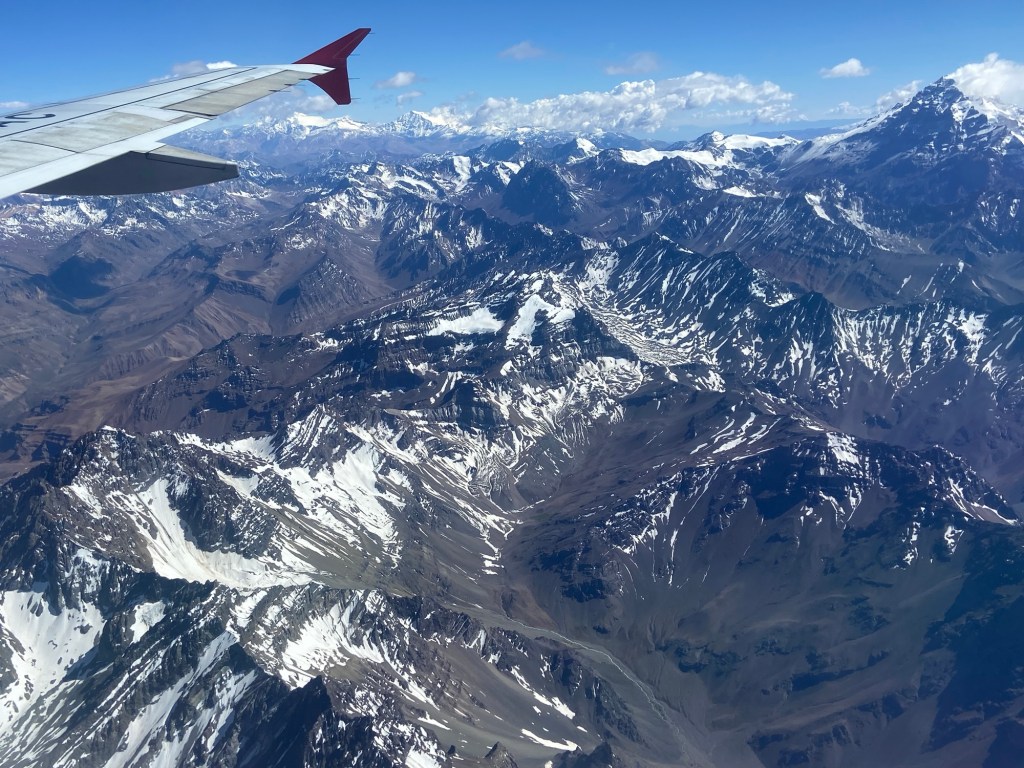
    A final view of the Andes as we approached Santiago
  • Boca Juniors

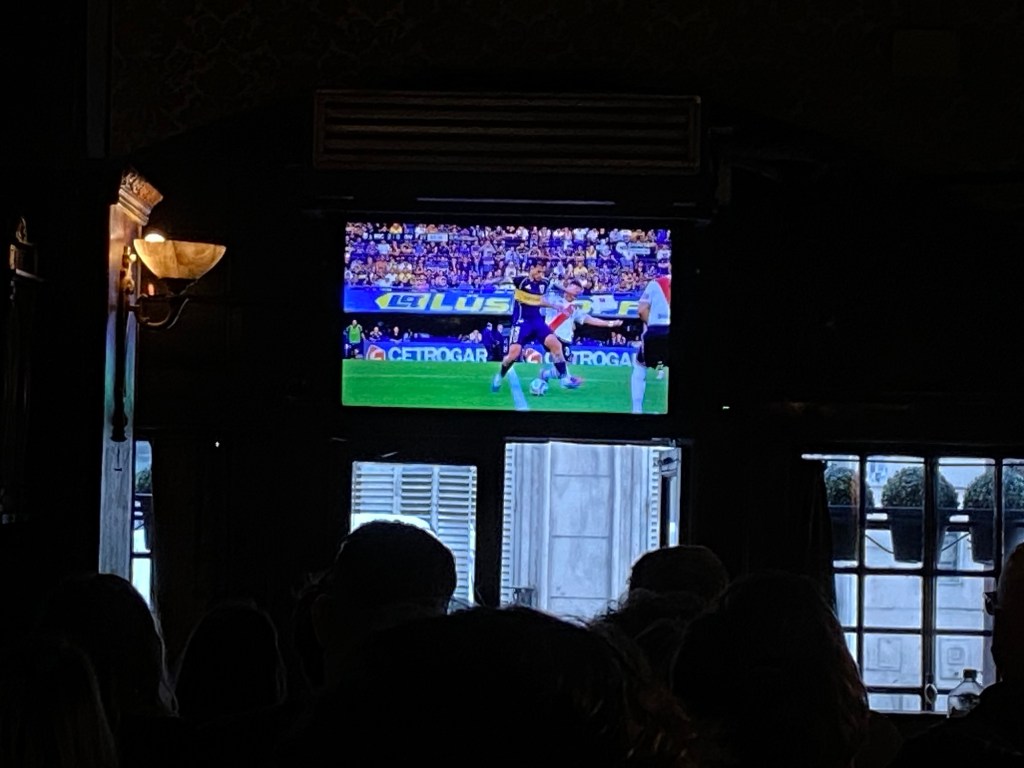
    Yesterday was a day of music. It started with hymns at the Anglican Cathedral (more on that shortly) and ended with 3 hours of being serenaded by some of the most passionate fans in world football!

    I’ve never before experienced an atmosphere like the one last night at La Bombonera. The ultras were already in good voice as we arrived at the stadium an hour before kick-off (rare for me!), and were still going as we descended the cavernous flights of stairs at full time.

    The fixture was only announced a week ago, as it was a last-16 game for the end of season playoffs in Argentina’s rather complicated league structure. I was very excited to be able to get to a game at one of Buenos Aires’ iconic arenas while in the city, and had a great experience with the agency Homefans.

    Our host, Chan, a Boca devotee, picked us up and took us for a pre-match pint, over which our group of Brits and Americans enthusiastically shared sporting anecdotes, much as you’d expect on such an occasion!

    Argentina’s narrow defeat at Twickenham, which I’d been watching earlier, also necessarily featured in the conversation!

    Chan then helped us navigate the crowds and entry checks to reach our vantage point high in the steeply banked stadium.

    The view from the top concourse, with a mural of Club President Riquelme embracing national hero Messi.

    And so to the music. It was like being in a 57,000-strong choir. Some sections sang the whole time; others, like ours, just joined in when the chants reached a crescendo. And they were songs not chants really, much more so than back home, and they certainly sounded more melodious! The main anthem, which has been in my head since, had its first outing after the fireworks (I wasn’t quick enough to film these) before kick-off:

    ‘Por eso, yo te quiero dar, Boca, mi corazón. Yo te sigo a todas partes. Gracias por salir campeón’ = ‘That’s why I want to give you, Boca, my heart. I follow you everywhere. Thank you for becoming champion’

    As the fans worked through their songbook, various banners appeared then disappeared, celebrating club greats and the fans themselves: “Jugador no.12”, the 12th man.

    Maradona of course featured, on the left
    Fan favourite Carlos Tevez was back at La Bombonera as coach of opponents Talleres. Two other former Man United players, Ander Herrera and Edinson Cavani, made substitute appearances in the game.

    Then, after a moment’s silence (which only the players and officials seemed to be observing), the action began on the pitch. Talleres had the best of the game for the first half hour and the fans were getting a bit restless, with whistles sometimes interrupting the otherwise constant singing from the ultras. Then this happened:

    GOOOOOL!!!

    The seating was a bit of a free-for-all and, as the regulars claimed their preferred spots, I’d had to move to the one place I could find a free seat. The fact Boca scored while I was filming brought me to the attention of the fans now sitting around me, and suddenly I had a bunch of new friends! They seemed genuinely excited that this stray Englishman was in their section, were entertained by my attempts at joining in the chants, and humoured me by letting me show them my Watford FC photo reel…

    Having a laugh with these guys really completed the experience for me

    At half time, tunnels appeared to get the opposition and officials safely off the pitch. The Boca players could just walk directly off!

    With no away fans allowed for domestic fixtures in Argentina, La Bombonera must be a very intimidating place to come as an away team!

    Just before half time, Boca saved a penalty, and just after they went 2-0 up, ending the game as a contest. I was perfectly content listening to the fans though, and reflecting on how much I’ve come to love the people here.

    I felt a similar way at the cathedral in the morning, when our singing was directed to an even more worthy recipient! The service was in Spanish, but I more or less managed to follow it with the help of some attentive members of the congregation (one of whom kindly gave me and some Canadians a live translation of the sermon).

    Bilingual booklets and Bibles also helped!

    It was a real joy to worship with the friendly church community there – in Spanish, even though my pronunciation left a lot to be desired…

    As my month in South America comes to an end, there’s a lot I’m going to miss. Presenting myself as “Felipe” and managing some level of communication with non-English speakers is certainly one of them. The genuineness and warmth of the people are what have marked me the most though, and will form my indelible memory of my time here.

  • Brazil

    Puerto Iguazú, where we have been staying, sits at the “triple frontier” of Argentina, Brazil and Paraguay. The actual borders are the Iguazú and Paraná rivers, the latter being the second longest river in South America (after the Amazon).

    We visited the park at the confluence of the two rivers, from which you can see all three countries at once.
    Obelisks like this are positioned on each of the three banks. Notice the shortness of my shadow, at midday, 2 degrees from the Tropic of Capricorn and 1 month from the solstice!
    We enjoyed some Paraguayan fritters at the hotel, as well as catfish and pacu (related to piranha) from the Paraná river.

    Yesterday, we crossed into Brazil to see the waterfalls from the other side of the Iguazú river. 80% of the 3km length of the falls is in Argentina, so while we could get up close and personal with them on that side, the Brazilian side afforded the most spectacular views of all.

    The falls are made up of 275 individual cascades and our first view was of those that drenched us on the boat trip!
    The view from about halfway along the trail
    Soon we neared this walkway overlooking the horseshoe at the top of the system. The devil’s throat viewpoint we visited the day before is at the top of the furthest cascade.
    The view from the end of the walkway was breathtaking!
    Although we had to endure another soaking to get there!
    The torrent of water heading over the falls on the Brazilian side was a sight to behold
    Here you can see the swifts disappearing into the water to reach their nests
    And here are the turkey vultures, which, alongside greater white egrets, filled the skies
    Having ascended the hill, we were treated to this final view of an extraordinary place

    The tours we had both days at the falls were exceptional, although we found the Brazilian side a bit more relaxing. The Argentinian side was almost like a natural Disneyland, with large crowds, the boat ride and the tourist train that took us between viewpoints.

    Our next port of call though was basically my bird-loving Mum’s Disneyland: the Parque das Aves (“bird park” in Portuguese).

    The park sits at the very edge of Iguazú National Park (the Brazilian one) and is a remarkable place of abundant life: of jungle flora, and of the fauna that inhabit its aviaries and open spaces. Its mission is to be a shelter and sanctuary for the avian life of the Atlantic Rainforest, in which the National Park is located but of which only 8% remains, due to aggressive deforestation.

    “Our Atlantic Rainforest”

    The Atlantic Rainforest was once connected to the Amazon, but no longer. It is home to many of South America’s big hitters, but also to several species found nowhere else.

    Here is the highlights reel from the magical few hours we spent in the park:

    The dazzling Scarlet Ibis
    It is thought that only five of these Alagoas Currassows were left in the wild until the park intervened to save them from extinction
    The Toucan is the iconic bird of the region
    No need for binoculars today!
    Outside the aviaries, there was also a reptile enclosure
    I was very excited to see Caimans, as well as Leonardo, Donatello, Raphael and Michelangelo!
    Iguana (my favourite animal as a child)!
    The Potoo always wins at musical statues and hide-and-seek, as it stays motionless and camouflaged for most of the day.
    The Crested Cariama seemed to prefer the game “stare”
    Parrots & Parakeets
    “Shall we ask them if they know our cousins in London?”
    Macaws
    I saw lots of Hummingbirds in Peru, but this is the first one I managed to photograph. These are not in an aviary, so we were thrilled when a few appeared right at the end of the trail.

    We absolutely loved our day in Brazil, as you can probably tell from the length of this post! The vibrancy of the colours on a hot, sunny, Spring day. The overwhelming richness of nature, from the scale and power of the falls to the abundance of plant and animal life. The generous spirit of the people we met, both towards us and the fragile natural environment.

    I must also mention the food! We had a delicious and incredibly reasonable lunch of steak and rainforest fare in the bird park (the açai was on point…).

    And we bade farewell to this little corner of paradise today with Brazil’s favourite cocktail:

    Toasting the triple frontier area with a caipirinha!
  • Iguazú Falls

    I have seen some spectacular natural wonders on this trip, but Iguazú Falls are something else! One of the seven natural wonders of the world, for good reason, and the largest waterfall system in the world. This miracle of creation is nature on the grandest scale, and it left me in awe, feeling very small and, (if you’ll allow me to get philosophical for a moment), feeling mankind’s delusions of grandeur are just that: delusions compared to the majesty with which nature sometimes confronts us!

    The falls are deep in the subtropical Atlantic Rainforest, on the border of Argentina and Brazil – which are separated by the Iguazu river. Today we explored the Argentinian side, and our first sight of the falls was at the so-called “devil’s throat”:

    To reach the viewpoint we had to follow walkways across the 1km width of the river
    The viewing platform was very crowded, but we managed to find a space for the obligatory selfie!
    Not visible here, but swifts were darting into the mist and turkey vultures circled overhead
    This is but a small part of the full waterfall system, but the power on display was awesome

    After lunch, we approached the base of several cascades by boat: a hugely exhilarating experience! We swerved through the rapids, paused for some pictures then, with phones, shoes and other belongings consigned to waterproof bags, headed for a shower! In the mist of the falls, the air became water. We were soaked through, could barely see a thing and all I could hear above the roar of the water was the shrieks of laughter coming from Mum!

    Before the drenching!
    Another boat heading into the spray
    The journey through the jungle to reach the boat was also a feast for the senses

    As we dried off in the 30 degree heat, we walked around the elaborate network of walkways that connected islands in the river at the top of the falls.

    Individual cascades were named after great explorers or figures from the nation’s history. There was also a pair named “Adam and Eve”, due to the paradisiac nature of the place.

    Each new vista was spectacular, and the Genesis theme continued with gloriously bright rainbows appearing in the mist.

    With our guide Matias, who did a great job of looking after us when it turned out we were the only non-Spanish speakers in the group!

    The colours, the power, the scale: photos and videos can only capture these to a small extent.

    The area also has a fascinating array of wildlife:

    These lizards were a foot or two in length
    There were lots of colourful birds, including this magpie
    The coatis were seen as a pest: we saw one raiding someone’s picnic!
    As in Peru, there were a huge number of butterflies

    Estefi found us a lovely hotel, so, after busy days, we have enjoyed unwinding in the pool, bar and restaurant. It’s been the first time on my travels I’ve engaged in more classic holiday pursuits, and I won’t pretend not to have enjoyed it!

    Cheers!
  • Tango

    On Sunday night we returned to Buenos Aires. The city named after “fair winds” was quite gusty as we came into land on the runway of Jorge Newbery airport, racing (and significantly outpacing) the cars on the adjacent highway. We caught a glimpse of the Oasis concert concluding at El Monumental, and marvelled at the fact the sprawling city we could see from the air was matched in size by the Perito Moreno glacier.

    The British Embassy

    We’ve been enjoying exploring the different quarters of the city – on foot, by uber or by “colectivo” (local bus). From smart residential areas in which we’ve dined and foraged for supplies, to the Mayfair-like Recoleta – in which the British Embassy is just one of the many buildings built in a Parisian style.

    This could be St Germain des Prés!

    The purple Jacaranda trees make the area particularly attractive, and the smell of perfume hangs in the air from the yellow Tipa blossom, which seems to have appeared since we left for Patagonia.

    The colonial Basílica Nuestra Señora del Pilar interrupts the French vibe with a dose of Andalusia!

    Recoleta is teeming with chic cafés, including one which was a favourite haunt of the great authors Borges and Casares, who still occupy the table by the entrance!

    Much of the city is a dense grid of high-rise buildings, but these are punctuated by well-maintained and flower-laden parks. Near to our flat in the Belgrano district, there is also the pretty Lago de Regatas, which has become the running location of choice for Dad and me:

    In Buenos Aires, they don’t have a clásico, they have a superclásico. They also don’t have Tesco, they have Super Tesco!

    This evening we all had a great time taking our first steps in the classic Argentine dance: the tango.

    Practising what we learned with my sister-in-law (and sporting my new haircut that I hope will expedite my selection for the Argentine football team…)

    At the end of the excellent lesson, as we had a drink to recover (Pisco Sour – that I discovered in Peru – in my case), we enjoyed the thought that our grandparents would have approved of our evening’s activity. And probably of the nightcap too…

  • Gauchos & dinosaurs

    Patagonia’s most iconic inhabitants are arguably the gauchos: skilled horsemen/horsewomen and Argentina’s answer to the cowboy/cowgirl. This morning, Paul, Estefi and I saw some in action, as they accompanied us on a horse ride in a nearby estancia.

    Despite the experience gained from my mule ride up the Salkantay Pass, the gauchos were rather more adept at riding than we were! It was fascinating watching the synergy between them and their animals.

    Gaucho on the left!

    The ride took us up the side of an enormous, U-shaped, glacial valley. I found it irresistibly calming to journey through such an epic landscape with my equine companion…

    Patagonia’s most iconic prehistoric inhabitants are the dinosaurs. A wealth of fossils have been found here, including that of the Patagotitan mayorum, claimed to be the largest known dinosaur. After lunch at the estancia, I enjoyed seeing the fossil casts (of smaller but no less impressive dinosaurs) that are displayed at the El Calafate history museum:

    There were also casts of the skeletons of giant mammals, which were contemporaneous with the early humans:

    The bench gives you a sense of scale!
    The museum also excitingly exhibited these original fossils: the skin of one ancient, scaled creature (whose name I forget!) and the jawbone of another

    Other displays recorded, in rather depressing detail, the mistreatment of the indigenous people by the European settlers in the region. A painful history from which many lessons can be learned: not least to be grateful for the many blessings we enjoy today…

  • The land of the glaciers

    Today we took a 130km catamaran trip deep into Los Glaciares National Park, to see glaciers even bigger than the Perito Moreno!

    The journey there was spectacular, even before reaching the port, as we spotted a family of Andean condors. With a 3m wingspan, these are the largest birds of prey in the world. I’ve been on the look out for them throughout my time in the Andes so was thrilled finally to have a sighting!

    It’s hard to see from the picture, but this is an adult, with the distinctive white feathers on its neck, and a juvenile. In flight they were majestic.

    The boat trip took us into one of the “fingers” that emanate from the “hand” of Lago Argentino. It bore some resemblance to the Norwegian fjords I visited last year, with the addition of ever larger icebergs, of which, amazingly, 90% of the mass is below the surface of the water.

    The water was a beautiful turquoise colour when the Sun was out
    The crew “fished” for glacial ice, which was incredibly smooth and crystal-like

    And then the glaciers came into view. The furthest one we reached was the most impressive: the Spegazzini glacier, named after an Argentine-Italian explorer:

    These ice walls are the biggest in the National Park, reaching to a height of 135m!
    We enjoyed a lunch of empanadas in a café that was surprisingly well-equipped, given its remote location

    This glacier is reassuringly stable, but others are in hasty retreat as the climate changes: a sobering reminder of the fragility of the natural world.

    The stunning springtime waterfalls from this glacier reduce it in size by more and more each year
    The glacier on the right no longer reaches the lake 😦

    We all fell in love with this remote corner of Patagonia, and hope it will be preserved for generations to come.

  • In Patagonia

    Few places conjure up the same sense of mystery and remoteness for me as Patagonia, the region in which we are currently spending a long weekend. We are now nearer to Antarctica than to Buenos Aires, and although we are at a similar latitude to London, albeit in a different hemisphere, there the similarity ends.

    As we flew down over the barren, semi-arid steppe, it was almost as if we were looking out on a lunar landscape. On closer inspection though, the sand-coloured hue came from wispy, dry grass and the lunar rocks were in fact small shrubs, as well as the boulders of glacial moraine that cover the Patagonian desert.

    There’s more grass and fewer boulders here, but you can get the idea!

    This is gaucho country, and these cattle herders roam estancias (ranches) that cover vast areas. On the flight down, I started reading Bruce Chatwin’s celebrated “In Patagonia”, a collection of stories from his travels here in the 1970s. The wide sweep of the book includes: gauchos and estancias; Butch Cassidy and the Sundance Kid; Charles Darwin and dinosaur fossils; Welsh settlers and the Chubut Valley (north of here but which to this day echoes with the lilt of the Welsh language and male voice choirs).

    At this estancia, you can see why the Welsh were so drawn to settle in the more fertile areas of Patagonia!

    Around El Calafate, near the southernmost tip of the South American mainland and the town in which we are staying, there are at least as many sheep as cows. For our first meal here, the customary steak and Malbec were accompanied by the most deliciously tender lamb.

    This is also the land of the glaciers, and the westernmost portion of Argentine Patagonia, which is in the Andes, contains part of the second largest non-polar ice field in the world (after Alaska). Lago Argentino, the largest freshwater lake in the country, can be seen from our hotel, and has a brilliant turquoise colour that comes from the glacial meltwater.

    My view as I write this!

    Today we took an excursion to the world-famous Perito Moreno glacier. The first sign of it was the icebergs in the lake that had “calved” from it. Until 2020, the glacier was stable but it is now receding, with ice breaking off it more quickly than new snow is being compacted in the ice field. We saw the dramatic calving first hand as we approached it by boat, coming up close to the 70m ice cliffs and imagining a further 170m of ice below the surface!

    The less oxygen in the ice, the more light is refracted to create the blue colouring

    The glacier is 30km long and, on average, 5km wide, advancing at a glacial pace of up to 2m per day. It’s hard to get a sense of scale, but from the picturesque walkways on the hill, overlooking the glacier’s snout, we were left with an overwhelming sense of awe at its vastness.

    The Chilean firebush are in flower in November, painting the landscape with dashes of bright red
    All in all, a magnificent day!
  • Buenos Aires

    After a non-stop start to my travels, it’s been good to slow down a bit and catch up with family, sleep, laundry and some life admin in Buenos Aires!

    It’s a sprawling and impressive city, which has its own unique charm, but also has buildings and streets that seem lifted from other American or European cities.

    Its iconic centre-piece is the obelisk commemorating the foundation of the city. This sits in the middle of the Avenida 9 de Julio (9th July is the date of Argentina’s Independence Day in 1816), the widest avenue in the world. With the imposing surrounding buildings and bright advertising screens, this area reminded me of Times Square, although my first thought was of the images of 4 million jubilant Argentines descending on the thoroughfare after the World Cup triumph in 2022!

    Nearby is the Teatro Colón, named after Columbus and one of the world’s great opera houses. We enjoyed admiring the views as we walked around the neighbouring park in the spring sunshine (apologies to those reading this under grey autumnal skies)…

    From here we walked to the Plaza de Mayo, the city’s main square, commemorating the revolution in 1810 that led to independence, and the focal point of numerous other revolutions since. One side of the square faces the Casa Rosada (Pink House), the seat of the President and site of the famous balcony from which Eva Perón, and husband Juan, once appeared to the masses.

    The changing of the guard took place as we arrived

    Across the square is the Metropolitan Cathedral, which is beautiful inside and contains the elaborate and closely guarded tomb of José de San Martin, known as the “liberator of Argentina, Chile and Peru”. There were also several displays featuring the kindly face of Pope Francis, or Cardinal Bergoglio as he became known while Archbishop here.

    At this time of year, the Jacaranda trees are in bloom across the city, adorning it with their enchanting, purple blossom, as seen here in front of a former colonial government building in Plaza de Mayo:

    The hospitality here has been top notch, from our exceedingly generous hosts to those we’ve met in restaurants and shops. Outside of the tourist areas, not many people speak English, but we’ve enjoyed having a go with the Spanish (at least until we invariably hit a dead-end)!

    We’ve sampled a mixture of local and international cuisine. A real treat was our visit to the Café Tortoni, the oldest café in Buenos Aires and modelled on another of the same name in Paris. I must confess to feeling a bit under-dressed though as we tucked into our sumptuous cakes while tango dancers graced the aisles!

    Outside the café

    Another highlight was having a morning coffee and “medialunas” (half moons – Argentine croissants) overlooking the pitch at Estadio Monumental, the home of River Plate:

    The club’s name is the anglicised version of “Rio de la Plata”, the wide river estuary that separates Buenos Aires from Uruguay
    The staging was being put up for two Oasis concerts this weekend. We’re keeping our eyes peeled for two Mancunians in parka coats!

    We then all had a fantastic time looking around the club museum, which had an incredible, immersive 270 degree simulator of a matchday – the next best thing to actually being there for a game! I was heartened when someone on the turnstiles recognised my Watford top, and we briefly spoke about a certain Roberto Pereyra, who played both for one of the biggest clubs in the world, and for River!

  • El Superclásico

    “Un clásico” is the Spanish name for a football derby and Buenos Aires hosts one of the most famous and hotly contested in the world: “el superclásico” between city rivals Boca Juniors and River Plate. They are by far the best supported teams in the country, with Boca claiming that 50% of Argentinians, plus one, follow them. If so most of the other 50% minus one would be for River!

    I was predictably excited that the fixture was taking place the day after my arrival in Argentina. The tickets were prohibitively expensive, but I was nonetheless able to get a real feel for the passion the match elicits in the city.

    River’s stadium, El Monumental, is very near to the apartment in which we’re staying, in an affluent and European-feeling part of the city. Today’s game though took place in the neighbourhood of La Boca (the mouth – of the Matanza river), formerly a port district, which feels somewhat edgier but which has heaps of character, with its colourful facades and murals to great players. The contrast in social backgrounds of the clubs’ traditional fanbases sets the tone for the rivalry.

    CABJ = Club Atlético Boca Juniors
    Boca’s darling: Diego Maradona
    Lionel Messi hails from Rosario, but is unsurprisingly fêted across Argentina

    Our hosts, my sister-in-law Estefi and her family, very kindly drove me into La Boca during the game. The streets were busy, with almost everyone wearing Boca’s iconic blue and yellow, and huge crowds congregating around every bar, trying to get sight of a screen. We got out of the car just as Boca scored the first goal, leading to scenes of wild celebration that made the atmosphere at Watford v Luton look very tame!

    They were apparently singing something about River fans being poultry, although I think the language was rather more colourful than that!

    Not being in club colours and having attracted the attentions of a few individuals sadly the worse for wear for drugs, we decided not to stick around for long. On the way back though, we realised there was actually a safer route, with a higher police presence, to the stadium itself. And so we walked up to the legendary Bombonera, so-named by the fans because, with its three sides of stands, it resembles a box of sweets. Our arrival again turned out to be perfectly timed, as it coincided with Boca going 2-0 up (which ended up being the only other goal of the game) – cue more singing and jumping, inside and outside the ground:

    Very satisfied that we had sampled the superclásico atmosphere without paying the exorbitant cost of a ticket (they were $550 when I first looked but three times that this morning), we headed into the next district to watch the rest of the game in a British pub. There was a friendly atmosphere, with fans of both teams present, although quite a few of them were from our islands and were just lending their support for the day!

    The British presence is quite noticeable in Buenos Aires, not just in pubs and in the popularity of the ball games we brought over (and the English names the teams were given), but also in some of the architecture and in the fact the British built the railways here. This morning I attended the Remembrance Sunday service at the Anglican Cathedral. Two days after being in the Amazon, it was somewhat surreal to be singing “God save the King” in a familiar-feeling setting! It was a lovely service, featuring a choir, organ and bagpiper, who played a hauntingly beautiful rendition of “Amazing Grace” at the end.

    It turned out the flag-bearers and bagpiper, all in kilts, were Argentinian (although the piper had a Scottish parent). I spoke to some of them and they had a deep affection for Scottish culture, feeling it was part of their own national heritage too.

    My first meal in Argentina last night was, after much anticipation, one of the steaks for which the country is famed. It didn’t disappoint! It was lovely to be reunited with family, and the restaurant was bedecked in football shirts, one of which was donated by the first of Argentina’s two legendary number 10s.

    Some wally was trying to recreate the “hand of God” in front of the shirt…

    My second meal out was a joyous coming together of two families: my brother Paul’s, and Estefi’s. It was so lovely all to be together after their nuptials last year and the warmth of the welcome we have received has been quite overwhelming.

  • A fond farewell to Peru

    A day that started in the rainforest now sees me boarding my flight to Lima, ready to travel to Argentina in the morning.

    Our activities began at dawn again, after a huge thunderstorm in the night, as we took the boat to the “clay lick” from which parrots feed early in the morning:

    We saw a flock of parakeets having their fill of the nutrients, as well as pairs of male and female macaws (who couple together “til death us do part”) flying overhead.

    The best picture I managed of macaws in the wild!

    We were also treated to the sight of capybaras swimming in the river and sleepy howler monkeys perched on the highest branch of a tree.

    We then enjoyed a delicious, final breakfast of rainforest fare, before preparing for the long trip back to Cusco. I enjoyed watching and listening to the oropendolas as I waited: their exotic call has been the soundtrack to our time in the Amazon.

    On the way back we stopped briefly at our first lodge and were greeted by this little visitor, a band-tailed manakin, in one of the rooms:

    Just like the Salkantay Trek, my rainforest expedition has taken me outside my comfort zone, but has been an absolute privilege to experience.

    I’ve met some fantastic people during my time in Peru, from Eddy the barman and my fellow travellers at the Cusco hostel, to the wonderful groups I’ve joined for the Trek and the Amazon Tour. As well as being painted in a colourful palette and rich in treasures, I’ve found Peru to be really welcoming and full of charm. My experience of the tourist industry here has also been very positive: everything has been done professionally and, as much as we’ve appreciated those who’ve looked after us, they’ve also shown a rather humbling appreciation of those who pay their wages.

    I’ve so far resisted the urge to post too many food photos, but the cuisine has certainly lived up to its reputation. I’ve sampled many specialities made from Andean or jungle ingredients, although I did decide that the famous “cuy” (guinea pig) must be an acquired taste!

    I did enjoy the accompaniments to the “cuy”, and the crispy skin was more appetising than the flesh!

    The passion fruits, fried bananas, huge avocados, jungle potatoes and many others have all been instant hits with me though!

    I will take the tastes, sights, sounds and personal connections of Peru with me, but now prepare for the next stage of my journey: joining up with my family in Argentina…

  • Rainforest Adventure

    Manu National Park, where I’ve spent the last few days, is a place of abundant life like I’ve never seen before, and really is a place to marvel at God’s creation. For the most part, we’ve been looking for wildlife in its natural habitat, venturing deep into the jungle, armed with mosquito repellent, binoculars and a telescope (to boost the zoom on our cameras)!

    I have raided two photos from another member of our party with a better camera though, as he got some brilliant shots of the cock of rock we saw on the day 1, and of one of the monkeys that stealthily approached our lodge through the trees at breakfast on day 2:

    The excitement at breakfast!

    Here are a few more highlights from our early morning wanderings:

    Cacao
    Inside these pouches are the seeds used to make chocolate!
    The beautiful oropendola, which makes its presence known with its watery and resonant call, so well mimicked by the Incan instruments I saw in Cusco.
    A different use of the telescope to capture this grasshopper!

    We next went to a wildlife rescue centre, which enabled some thrillingly close encounters:

    Squirrel monkey
    We saw more of these blue and yellow macaws in the wild later in the day
    A slothful sloth
    Tapir
    One of the many termite nests we saw in the rainforest – containing millions of the little critters!
    Baby parakeet

    From the Rescue Centre, we drove down to the great Madre de Dios river, a tributary of which we had followed down through the cloud forest, and which itself is a tributary of the Amazon.

    The view down towards the river
    A well-camouflaged, reptilian-looking bird our guide Willy somehow spotted en route. We also saw several huge vultures circling overhead.
    The boats we took for our journeys along the river
    On the river I finally snapped a blue morpho butterfly, with its iridescent wings that produce flashes of brilliant blue as it flutters around.
    The boat took us downstream and further into the rainforest: the only way to reach our next lodge.
    The lodge was deep in the jungle…
    … and reached by this muddy path, for which we definitely needed our wellies!
    There was an alligator in this swamp, although only the guides could see it!

    After lunch we set off by boat to visit a lake, and it was quite an adventure getting there…

    The current in the river was very strong, so we got up quite a speed going downstream
    My awesome group and Willy enjoyed the ride! NB – the others didn’t get the memo about needing to dress like Indiana Jones. 😂
    En route we saw capybaras, just like at Cassiobury Farm!
    We then waded across the shallow water…
    …. keeping our eyes peeled for birds…
    … before a long, sweaty hike deeper into the jungle!

    With the humidity, the tropical Sun at the zenith of the sky, and warnings from Willy to look out for snakes, it was tough going, but we were treated to more exciting sightings. There were many squirrel monkeys running and jumping through the trees, and Willy remarkably managed to find a baby alligator at the water’s edge, although even he was scared that its mother would disapprove of our proximity!

    When we finally reached the lake it was a hive of bird activity. We saw macaws, “prehistoric birds” and many other colourful species. Michael (in our group) and I took it in turns to steer our raft. It was fun trying to remember my punting skills and I then had to remember my new-found “dealing with heights” skills as we ascended the viewing platform!

    Rather different to the Cherwell or the Cam!
    Willy was a bit faster than us…
    “Prehistoric birds” with their rockstar plummage
    View from the platform
    Willy was very excited to find this bird, although I can’t remember its name!

    Night fell as we headed back, so an extraordinary day ended with a final look for wildlife in the vicinity of the lodge, using our head torches. Within a few minutes, Willy had located both a (non-dangerous) snake and a (very dangerous!) tarantula in the undergrowth.

    Tarantula!!

    Exhausted, very grateful for all our encounters and somewhat relieved none of them had ended badly, we took refuge in the lodge’s dining room, with a storm brewing in the distance. It was a jovial evening with a brilliant group of people, rounded off with a celebratory rum as our nightcap!

    No pictures of the evening, but this was lunchtime!
  • Into the Amazon

    Today I started a 3 day tour into the jungle from Cusco. We’ve now reached our accommodation: a comfortable, wooden lodge in the tropical rainforest, with a cacophony of sound outside from birds, crickets and cicadas.

    Where we’re staying!

    The journey began at 6am and has taken all day. The first section was in the Andes, passing through villages in which most people were wearing traditional dress and the classic, Peruvian wide-rimmed hats. We had breakfast in one such village, right next to (none other than) the potato museum, showcasing the hundreds of varieties grown here! We also stopped at some pre-Incan funerary monuments, high up in the mountains.

    We then descended through the verdant cloud forest, with our driver skilfully navigating the winding roads, and our guide Willy, who lives in the village near to our lodge, keeping an eagle-eye out for any wildlife worthy of a stop. The first sighting was in fact of an eagle, and we then saw various tropical birds, including, very excitingly, the orange-red Andean cock of the rock, the national bird of Peru. I had more success with binoculars than my camera, but I did get a picture of one of the less colourful (though no less magnificent) birds we saw:

    As on the Salkantay Trek, there were also many butterflies, as well as spectacular waterfalls (each of which would be a renowned beauty spot in Europe) throughout the landscape.

    Eventually the tree-covered mountains gave way to flatter terrain: the start of the fabled Amazon rainforest! We were surprised that there were more signs of civilisation here: our 4G signal returned and we passed through well-equipped, vibrant jungle villages. On arrival at our base for the night, we went for a walk, during which day quickly became night. We saw a flock of macaws, colourful oropendolas, numerous fireflies, bats and a poisonous toad! As we settle down now for a warm and humid night under mosquito nets, we are hoping for many more wildlife encounters tomorrow…

  • Machu Picchu

    Two posts in quick succession as I’m having a catch up day at my friendly hostel in Cusco!

    The culmination of the Salkantay trek was our visit to the lost city of the Incas, which required another 4am alarm! We had a brilliant tour from our guides (supplementing the insights from the Dan Snow documentary recommended to me by Mr Eddon Senior in the Summer!), and the best way to tell the story is through a few of the many photos I took…

    Panorama from the famous viewpoint
    The llamas seemed very content admiring the view
    Our first view of Machu Picchu on Day 4 was from the far summit at the start of the video. We then descended to the valley floor and around the route panned by the camera
    It was beautiful when the sun came out!
    One of the several Inca temples. The city has some very fine masonry and took almost 100 years to build. It was inhabited roughly between 1420 and 1530, when it was abandoned due to the Spanish conquest.
    This area was like a Roman forum. The chief Inca, Pachacuti at the city’s foundation, would address the crowds from the platform. The Incas were the ruling class; the populace were Quechua.
    The surrounding mountains are stunning. The town of Aguas Calientes is hidden behind the one on the right.
    The same doorframes we saw at Llactapata
    Some of the famous terracing for growing crops
    The temple of the condor, where sacrifices, including of criminals, were made. You can see the shape of the wings, and the bird’s beak is meant to be the stone in the middle.
    The city was known about by locals and reached by a Peruvian explorer Agustin Lizarraga in the early 20th century, before the American Hiram Bingham discovered it and conducted excavations and then some repairs. 80% of the stonework is original though.
    After our breathtaking visit, a few of us undertook the 90 minute walk back down to Aguas Calientes
    The town has both a river and a railway running through its streets!
    We celebrated completing the trek at a restaurant serving Peruvian specialities. This is “lomo saltado”, made from alpaca meat.

    The Salkantay Trek has been one of the most remarkable experiences of my life. It was full of challenges: the altitude, the cold, the rain, the early starts, the scary drops, the 75km of horizontal distance covered and the 2600m between the highest and lowest points. It’s tested me, but through lots of prayer, and support from the rest of the group, we all made it (many groups have a few who give up apparently)!

    Often being the one running school trips, it was great for this adventure to benefit from the incredible organisation of Salkantay Trekking. They’d thought about every detail, from the locations of our duffel bags (carried by mules or minibus) at every moment, to how to give us the best experience of Andean cuisine.

    This is kind of spread we were able to enjoy at mealtimes!

    The whole trip was good value but felt high-end, and it seemed that the employees of the company had better working conditions than at some of the other Cusco firms we heard about. It’s not an easy job undertaking the trek on repeat though and I had so much admiration for our guides, Sergio and Puma, who were unfailingly friendly and generous throughout the week. They called our group “family”, and it certainly felt like one, with our ragtag collection of Dutch, Canadians, Americans then a lone South African and Brit, really being drawn together by the experience. It was sad to say goodbye, but we part with great memories – and offers of places to stay in multiple new countries!

  • The Cloud Forest

    Between the high Andes and the jungle lies the cloud forest, an area rich in tropical vegetation that covers the mountains. Days 3 and 4 of the Salkantay Trek took us into this beautiful ecosystem, as we got closer to Machu Picchu.

    Bananas!

    It was fascinating seeing the avocados, passion fruit and orchids growing, and, as the temperature rose to a pleasant level, I enjoyed a refreshing mango juice in a tiny agricultural village.

    We also saw coffee beans growing and stopped at a small farmstead, where we roasted and ground beans before tasting our own rich, freshly-made drink.

    The accommodation on day 3 was amazing again: en suite domes in the cloud forest, from which I saw a red and blue macaw (I think) fly past soon after settling in!

    There were colourful butterflies throughout this trek, and we saw a few more tropical birds: noisy flocks of parakeets (rather like London!) and others I couldn’t name. This is one of the few I managed to photograph:

    Day 3 was a shorter walk of 16km, with the biggest challenge for me being the steep drops on the side of the narrow path. One of the guides, whom we called Puma, was very kind in escorting me through and trying to distract me from my fears!

    I woke up in a cold sweat thinking about these paths but the others seemed quite blasé about them!
    With Puma once we’d got through worst section
    One of the many waterfalls on the route

    Day 4 was a longer hike of 25km, which started with a 700m ascent just after dawn. In lower altitude, this was much more manageable than earlier climbs, and the conditions were perfect: dry and with the sun not coming out until we reached the top. During the first section, we joined the original Inca Trail and were treated to our first sight of Machu Picchu. It was so beautiful, had followed so many challenges and had been something I’d dreamed of seeing for so long, that I felt quite emotional as it appeared majestically amidst the green mountains – a definite “thank you, God” moment.

    Near this viewpoint we also saw the Inca remains of Llactapata, with their own irrigation system for glacial meltwater and doorframes tilted at 14 degrees to give stability during earthquakes: all most impressive!

    The remainder of the walk was hugely enjoyable: navigating our way down through the cloud forest, with the sun breaking through and spectacular views of Machu Picchu, the mountains or waterfalls at each clearing. Here are a couple of them:

    The last section on day 4 took us across the river then along the railway track to the town of Aguas Calientes, hidden deep in the landscape below Machu Picchu.

    The Peru Rail train, which would take us back towards Cusco on Day 5

    The whole day had made me think of “Paddington in Peru”, so in the town it was heartening to come across a familiar spectacled bear, donated in January by the UK government, before our restorative evening meal and night in a hotel.

  • Salkantay Pass

    Another challenging but rewarding day! We trekked 23km along the Salkantay Pass (up 700m then down 1700m), although the up section for me and the other altitude sufferers was on mules! An incredible experience to travel through the Andes that way and I found it fascinating watching my ride pick his route up the steep sections (whilst being distracted by any greenery that crossed our path)!

    The group celebrating reaching the highest point!

    The way down took 5 hours and in duration it reminded me of the descent of the Hochschwab in Austria with Matthew and Tom two years’ ago. My fear of heights also struck again, as I very hesitantly navigated the sections on which the path was flanked by a cliff edge – I fear there will be a few more like that tomorrow… The other challenge was the rain that stuck around most of the afternoon – Peru is just transitioning to the rainy season, so we all hope the transition isn’t complete yet!

    As we continued to descend, the high mountain scenery gave way to the start of the cloud forest. Eucalyptus trees and hummingbirds were among the evidence of the change. By the time we reached Mountain Sky View camp, it very much felt like Paddington territory.

    Arrival at Mountain Sky View!

    The accommodation is amazing here, as the video below shows. Being the only solo male traveller in the group, I have the pod all to myself, which is an added bonus! I continue to be taken aback by how kind all the staff are. They don’t have it easy, sometimes only having one day off between each five day hike, but they take great pride in doing their work well and in making those of us fortunate enough to come here feel welcome.

  • Humantay Lake

    I’m writing this from one of these domes in the “Sky Camp”, 3900m above sea level. After the early start we’ve already turned in at 7:30pm. The temperature has dropped to near freezing and the stars are starting to appear through the glass ceiling.

    The first day of the hike was quite a challenge. Having reached the camp at lunchtime, we attempted the 300m climb up to Humantay Lake. I was getting breathless after a few strides, and whilst I could get my breath back each time I stopped, it was all much harder than I’d expected. My parkrun fitness seemed to desert me, but apparently altitude problems are no respecters of baseline fitness (or at least that’s what the guide told me to make me feel better)! I was pleased to make it to the top though and the reward was these spectacular views:

    This part of the Andes is a stunning but fragile environment. Sadly the glacier above the lake has retreated significantly in the last 15 years.

    I’m hiking in a group of 12 travellers from all over the world, and there’s already a fantastic camaraderie. The local staff are incredibly hospitable too and so keen for us to enjoy the best that Peru has to offer – the food has been amazing. There are caterers travelling with us, as well as horsemen, and their steads, to transport equipment and our luggage. Those of us who struggled today may also become their passengers tomorrow for the gruelling climb to the Salkantay Pass at 4600m…

  • Acclimatising

    It turns out altitude sickness is a thing! Thankfully the fog seems to have lifted this evening, in time for my trek tomorrow, but I’ve had a couple of days of feeling quite groggy. And having to take frequent breaks as I’ve breathlessly ascended the hill back up to my hostel!

    As well as getting used to the altitude, I’ve also been adapting to the rhythms of backpacker life: it’s quite a contrast to last week at work! I really love my first hostel: it’s set around a traditional courtyard, with Andean artwork on the walls and a friendly, social area where I’ve spent many hours. It’s great fun meeting others on their own adventures, while sipping the free coca tea (dried coca leaves in boiling water – meant to help with the altitude)!

    I explored Cusco yesterday and am back in the main square for dinner this evening, overlooking a big celebration of a local school’s birthday, featuring all kinds of colourful outfits and enthusiastic dances.

    The Inca Museum next door was fascinating. The highlight was learning about the traditional musical instruments and there were a couple of really passionate Quechua folk who played lovingly-made replicas for me. A lot of the instruments imitated animal sounds, produced as they were tilted in various ways and water moved between internal chambers: incredible!

    Tomorrow I will start the 5 day Salkantay trek to Machu Picchu – the reason I’ve come to Peru! There was a welcome meeting this evening that has got me very excited, although I am going to need an early night as they’ll be picking me up at 4am!!

    The main square in Cusco
    The “twelve-angled stone” – cut to precision by the Incas to support an entire wall!
    Some of the celebrations in Cusco this evening
  • Cusco

    After a comfortable night at the Holiday Inn in Lima, I’ve now made it to Cusco. The views over the Andes and the city from the plane were amazing, and I’m so far tolerating the 3400m altitude (dosed up on coca tea)! The hostel, recommended by my brother, is really quaint and chilled, and I’ve had a fun evening chatting with Peruvians, Aussies and Frenchies. I got on slightly better with the latters’ language than I have with my Spanish so far, despite my two months of Duolingo (I managed a bit with my taxi driver, although not enough to dissuade him from adding 25 soles onto the price I was quoted at the airport)! There were definite “race across the world” vibes as we winded our way through the city, and I’m looking forward to exploring in the daylight tomorrow.

    PS – If you want to be notified of new posts, you can subscribe (although then check your junk folder). And if you ever want to comment you just need to click on an individual post.

    The Andes!
    Cusco from the air, with the runway visible in the middle of the city.
    The hostel I’m writing this from!
    My room and the communal areas
  • And so it begins!

    A quick post from Miami Airport, where I’m sipping a celebratory Sam Adams, as I was doing in Boston with my friend Carlos on my last visit to the States. It’s quite surreal that after all the planning, and a rather stressful week of final preparations, my trip is finally underway. Next stop: Peru!

  • Around the world in 70 days!

    Sabbatical. Mid-life crisis. Escape from the British winter. Whatever best describes this upcoming adventure, I’m very grateful for the unique opportunity – and appreciate the interest you’ve shown by clicking here! I’m not sure quite what I’ll post or at what frequency, but I thought this was a good way to keep friends and family updated, so do pass by if you ever wonder where I am or what I’ve been up to…